Roots, stems, leaves, flowers, fruits and seeds,
That’s six plant parts that people need.
—Children’s learning song by the ‘Banana Slug String Band’
An email last week announcing an upcoming forestry seminar related to my day job in marketing for a forestry and ecology firm in Center caught my attention. Seminars and workshops on just about any topic are as plentiful as weeds in the wild. This one, however, had me at the very first sentence.
The author of the short introductory message confessed that after following biologists and ecologists in the woods listening to them noting common and Latin names for plants, he always had just one question: “Can I eat that?”
The clever method of calling attention to a class on foraging caused me to laugh out loud. But, after a little thought, I decided that part of the human species genetic structure must certainly be to wonder, “Can I eat that.” Otherwise, how did things like eggs, caviar and pickled pig’s feet ever make it onto the menu.
The question certainly crossed someone’s mind a long time before my fifth-grade days at South Ward Elementary in Mount Pleasant, Texas, where many years ago my buds and I spent numerous recess periods “foraging” for sour dock weeds along the edge of the playground fence. I’m pretty sure the plant has a more scientific name, but identifying it was not a priority then, chewing it for the tart taste was. We, by no means, were the first brave souls to look at a stalk of the skinny green and red-hued wild weed and ask, “Can I eat that?”
While I can’t vouch for its nutritional value, I’m assuming sour dock was not toxic. At least I don’t recall any of us becoming ill or dying from consuming it. Never heard one of my teachers say, “Oh yeah, he ate that funny weed out behind the school house. That’s what got him.”
Tasty and also non-toxic is sassafras. There’s surely more value to sassafras trees than just the root, but once again as kid, the idea was not to study the species, it was chewing on the root with the distinctive taste, or boiling it to make a tasty tea. That’s what we did on hiking cookouts and overnight campouts in Coach Sam Parker’s Boy Scout Troop in Mount Pleasant. The best sites for cookouts and for camping were near a sassafras tree providing ingredients for a hot drink to complement our campfire cuisine and something to chew on afterward while we swapped manly stories about the rugged outdoors.
As with the sour dock, someone had to be the first. Someone had to think about digging up a root, cleaning off the dirt and chewing on it a while before thinking, “Can I make tea with that?”
Being the first to evaluate grapevine had to be a little easier. After all, it obviously produced a tasty edible fruit of its own readily available for the picking. More than half a century ago, a bunch of young bicycle riders on a Saturday morning expedition in Mount Pleasant discovered a large, brush-filled ravine near the site of a new bypass following Highway 49 on the south side of town that was to become Ferguson Road. Deep into a grape vine forest spanning the construction chasm, our first fascination was swinging on the maze of gnarly vines. That soon turned to sampling the wild grapes which eventually lead to turning our attention back to the vines and asking…?
No, this time it wasn’t, “Can I eat that?” We looked at each other in silnce, knowing the common question in our minds was the “big boys” braggadocios stories. The question that day was, “Can I really smoke this?” It turned out to be a question left begging an answer once we discovered none of us possessed anything with which to produce fire. We then resorted to the more common question, “Can I eat that?”
“Why not,” we decided? Having already proven sour dock and sassafras as delicious delicacies of the wild, why would a vine that already produced a fruit, and from all accounts a pretty good smoke as well, not do the same thing?
Such juvenile exploits could be considered foraging, in a manner of speaking. While it was adventurous as a youngster, I honestly can’t remember the last time as an adult that I looked at a plant growing in my yard and thought, “Can I eat that?”
Perhaps I just need a refresher course…what was the date on that seminar?
—Leon Aldridge
Aldridge columns are also published in the Center, Texas, Light and Champion (http://www.lightandchampion.com) and the Mount Pleasant, Texas, Tribune newspapers (http://www.tribnow.com).



 My dad’s father, S.V. Aldridge, retired in 1954 from the Cotton Belt Route railroad line that is part of what we know today as Union Pacific. The railroad was his sole lifetime occupation, one that he embarked on in 1901 at the age of 13 as a laborer on the rail crews. His last 24 years were spent as a section foreman with an office at the Pittsburg, Texas, depot. That same building, the last I knew of, was still doing time as a barbecue restaurant on Greer Boulevard in the same city where it sat downtown for decades between two crossing rail lines at the end of Main Street. It was also where my grandfather typed his reports and other forms of communication on the same typewriter.
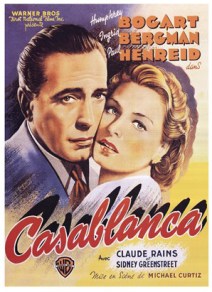 Casablanca (1942) — My number one favorite. Nothing else compares. I’m convinced the effective use of black and white requires more artistic skill than does a color palate. Starring Humphrey Bogart and Ingrid Bergman, set in World War II and released during the war, this one has more “quotable quotes” than any I know. So, “Play it once, Sam. For old times’ sake.” I will continue to play this one many times.
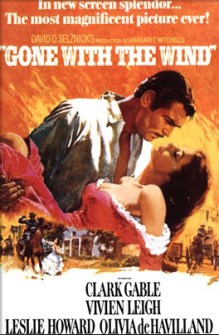 A 2014 Harris reader’s poll named , the novel the second most read book—just behind the Bible. To quote Scarlet, “After all, tomorrow is another day!” And, after all, I’ll watch this one again tomorrow and another day.
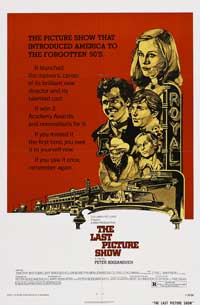 “Bein’ crazy about a woman like that is always the right thing to do,” according to Sam the Lion (Ben Johnson). For me, bein’ crazy about a movie like this one is the right thing to do.
 In 1995, the United States Library of Congress deemed the film “culturally, historically, or aesthetically significant” selecting it for preservation in the National Film Registry. “You can’t stay 17 forever,” to quote John Milner (Paul La Mat). I will, if I can watch this movie every year.
 The film is on the list of the “American Film Institute’s 100 Funniest American Movies.” “Seeing as how the VP is such a VIP, shouldn’t we keep the PC on the QT? ‘Cause if it leaks to the VC he could end up MIA, and then we’d all be put on KP.” — Adrian Cronauer (Robin Williams). I can’t even say that one time without stumbling, but I could easily watch this movie endless times.
