“Common sense is not so common. – Voltaire
What is there about graying hair that causes the days of our youth to beckon, makes us say things like, “Reminds me of that time when … ?”
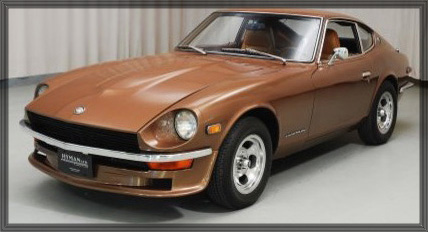
An ad offering an early 70s Datsun 240Z for sale last week reminded me of one that I owned just like it. It also reminded me of that time when late one night some years ago in the vast expanse of West Texas, “back before I had good sense,” that I thought I was driving the fastest thing on the road.
College was already in my rear view mirror, but not my love for fast cars. I wasn’t looking for a “Z-Car,” as they were called. But, the two-seater sports car that looked as good as it ran caught my eye sitting on a used car lot in Longview, Texas. My ’70 Volkswagen convertible was neither fast nor especially sporty looking, although it was more fun to drive than the law should allow. The Datsun appealed to me, was in my price range, and had air conditioning—something neither my VW, nor my motorcycle could boast. An hour after the test drive, it was mine.
My first road trip was out west to Abilene, Texas. As editor of a newspaper in central Louisiana, I made sure Friday’s paper was on the press by 10:00 p.m. on a Thursday night, then headed west out of the Pelican State. Crossing Toledo Bend Reservoir at Pendleton Bridge, I turned north traveling up through Center, Texas, and then westward, arriving in Fort Worth at about 1:00 a.m. After refueling both the 240-Z and my coffee cup, I pointed the long sleek nose of the Japanese sports car due west into a region of the Lone Star State one can only appreciate after having driven it. There is very little between Fort Worth and Abilene unless you pull off the interstate in places like Weatherford, Mineral Wells or Thurber. About the only change in elevation is Ranger Hill, a considerable grade challenging truck drivers in the middle of nowhere, other than being located close to Ranger, Texas. I sometimes believe that if it were not for Ranger Hill, on a clear night leaving Fort Worth you could almost see the lights of Abilene 149.7 miles due west.
The night air was euphoric, the sky was clear, and the Z-Car’s overhead cam multi-carburetor six-cylinder motor was orchestrating sweet music through its split manifold dual exhaust system. With very little traffic cluttering the desolate span of 1-20, I let the car stretch her legs up into the 85-90 region in hopes of an earlier arrival in Taylor County, Texas.
Had my mind not been sidetracked by the late hour and listening to the radio, I might have noticed the headlights behind me sooner. Sensing they were getting closer the second time I looked quickly got my attention. Headlights growing brighter behind you when you’re rolling at 90 or better will do that.
Fearing the worst, I eased off and watched the speedometer needle start a gradual descent, just in case the driver behind the headlights was uniformed. A lack of flashing lights eased my fears, but increasing size and brightness kept my attention glued to the rear view mirror. Then I saw it. Rubbing my eyes in disbelief, I looked again. Above the increasingly larger headlights, I saw no red and blue, but what I did see was a row of bright amber. Running lights, they were. I was being overtaken by a large truck.
Game on, I smiled, and mashed the accelerator smoothly until it stopped against the floor. The healthy Datsun motor responded in a heartbeat catapulting the speedometer needle back up and through the century mark. The looming luminance continued to narrow the distance between it and the Z’s tail lights through 110, then 120 and knocking on 130. We were still gaining speed when the headlights pulled over into the left lane to pass.
The car’s speedometer teased me with its 160 at the end of the arch, but a rare modicum of youthful common sense kicked in about then, and I lifted my foot off the accelerator. The apparition effortlessly passing me in the night as I split the wind at 130 miles per hour was in the form of a black conventional-cab Peterbilt diesel truck with chrome everything. It was pulling a flatbed trailer, empty except for a stack of neatly folded and securely tied tarps. Brilliant flames of orange and yellow, contrasting brightly against an ebony night sky, trailed off the tips of chrome stacks scant inches before bending sharply back into the wind and extending for what looked to be 10 feet or more over the trailer. As the rig sailed around me, the running lights blinked a couple of times, as if to say, “See ya’ round,” before flames and tail lights started to fade into the darkness ahead.
I would have told you back then that the popular old saying about “running flames” was just a truck driver’s coffee shop tale—that is until that night. But, I will tell you now with certainty that good sense, common or not, is something we don’t appreciate—that is until after we’ve gained it in exchange for the blessing of gray hair.
— Leon Aldridge
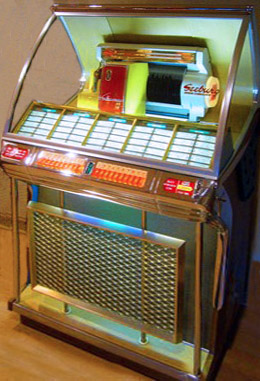
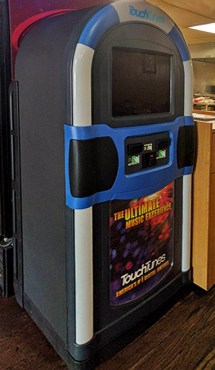 “No,” I responded. “What is it? Sort of reminds me of an old jukebox.”
 It started innocently enough with the “prefab” dinner in the oven. The offering of frozen gourmet meals at supermarkets today is nothing short of amazing, especially when compared to the TV dinners in aluminum trays that was half of my college cuisine. That and cheeseburgers.
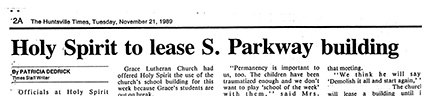 Like the East Texas newspaper headline on a story reporting that a Catholic School would be leasing a local building. Sure, the story explained it all, but after reading the headline, the reader’s mind has already gone down the road of thinking there’s a well-known and powerful new tenant in town.
 No explanation needed in the central Texas newspaper headline utilizing a similar sounding, but unfortunately, incorrect verb.
 Then there are those headlines that just should never have made it to press, like the coastal Texas newspaper headline that used an incorrect abbreviation. So many questions begging to be asked. I don’t know, maybe it resulted in a few more cookbook sales.
 Sometimes, a headline can be perfect, but placed on the page in such a manner as to suggest something entirely different than was intended. Like the photo in an East Texas weekly some years ago of four people standing waste deep in water, obviously prepared for a baptism service—which is what the headline and story below the picture reported. Unfortunately, the story and headline positioned right above the photo reported on an altogether different event that coincidentally, involved the same number of people pictured.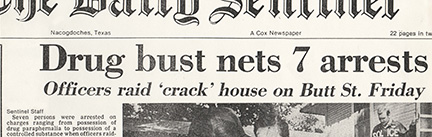
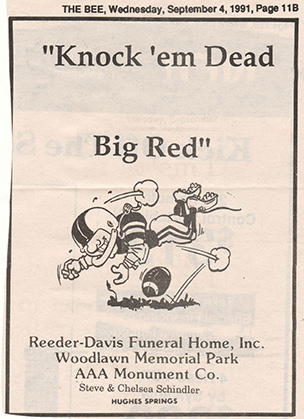 Having suffered the anguish of misprint maladies myself, I can testify that no writer is immune. Adding insult to injury, these few samples serve as evidence that once published, some typos will live in infamy for many years. Once the ink is on the newsprint, it’s there for published posterity.

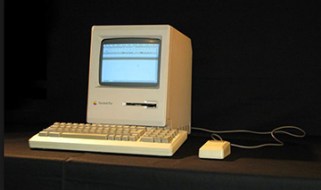
 Supplementing this collection of working wonders are three Mac desktops that preceded the current workhorse, a five-year old MacBook Pro. My Mac museum includes a PowerMac G5 currently living on a desk just in case it’s ever needed, in the same spot in which it’s collected dust since the MacBook Pro was first powered up. Stored in their original boxes are a PowerMac G4 and a first-generation iMac G3. It’s two-tone silver and gray. I just couldn’t take the plunge for one of the bright candy-colored configurations in which the revolutionary tear-drop shaped computers daringly debuted in the early 90s.
 So, what does a reformed “I’ll never need to know how to work a computer,” type do with all these devices? The easier answer is the same as it is for most of us today, “what would we do without them?”
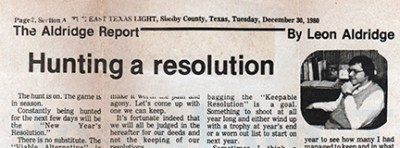


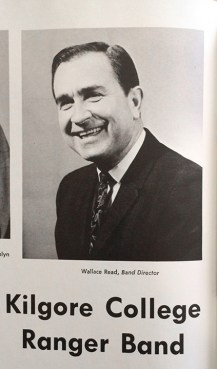
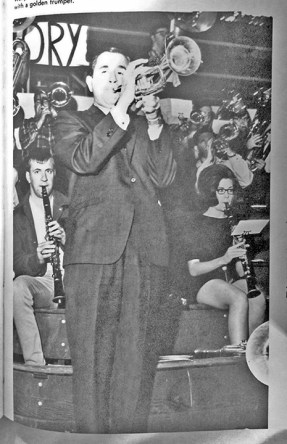
 “The crowning touch at KJC was the spring concert May 2, 1967. Read was friends with Tonight Show band leader ‘Doc’ Severinsen who started with NBC-TV’s Tonight Show in 1952 during Steve Allen’s tenure. Severinsen played trumpet in the band directed by Skitch Henderson, taking over as bandleader in 1967 for Johnny Carson, and continued until Carson and Severinsen’s band left the show in 1992. Under his direction, The Tonight Show NBC Orchestra became the most visible big band in America.”