Lighting up the night skies

“Shine bright like a firework in the darkest night.”
— “Firework” recorded by Katy Perry

– – – – – –

Holiday lights are the best. When colorful decorations delight, and fireworks illuminate the night. 

While I was fascinated by fireworks as a kid, I’m even more mesmerized these days by the growing phenomenon of drone light shows. Mindboggling artistic exhibitions in the nighttime skies using lighted drones driven with computer precision.

My son, Lee, became a skilled drone pilot a few years ago. Marveling at his breathtaking nighttime photos of lights on the horizon intrigued me to give it a try.

Snagging a simple example on sale, I headed for an empty field near my house. Loaded with instructions and optimism, .

“This lever is up; this one is down … I’ve got this.”

Enthusiasm turned to confusion on the first real test flight. “Was that the right stick forward or the left one back?” I watched as the just-out-of-the-box bird flew away, ignoring my futile attempts at any description of control. I was still watching when it disappeared into trees on the far side of the field.

A couple of hours of fighting briars and poison ivy, scanning treetops, and crawling through brush piles proved pointless. Dusk ended my doomed drone search.

Follow-up expeditions the next couple of days yielded not a peep from the locator beacon that the owner’s manual assured would sound if the drone were “accidentally” lost . “Guess I’ll leave the drones to Lee,” I conceded.

My son also loved fireworks as a youngster. With a passion. Every holiday, he stashed money away anticipating the opening of the first fireworks stand. The year of his most memorable fireworks show, he amassed an arsenal capable of defending our southern shores Lake Murvaul home against any invasion. Should one occur.

Dark descended as he opened the large plastic bucket full of “buy one get a dozen free” bargains.

Spectators unfolded lawn chairs and opened refreshment coolers. Lake Murvaul holiday fireworks shoreline displays border on legendary.

“Oohs” and “aahs” arose from the darkness as brilliant, colorful displays began lighting the night sky, painting the water with shimmering reflections.

Lee strated his contributions with small “twirly-thingys” whizzing upward. All was bliss until … until that one spent glowing winged ember thingy drifted downward. The one that descended into the arsenal bucket.

And that’s when the “really big show” began. Everyone broke into retreat mode toward land. But curiosity got the best of me. Looking back at the inferno, I saw several things.

I saw a fireworks display the likes of which I’m pretty sure had never before been seen on the lake, perhaps never since. Rockets shooting in one direction, buzz bombs going off in another. The light was blinding. The noise was deafening. Not since Wolf Blitzer’s CNN coverage of the invasion of Iraq had I witnessed such ferocious firepower.

I saw neighbors hunkering down, dodging bottle rockets as they folded lawn chairs and scrambled for safety.

Then I saw a broom in the boathouse. Wielding the makeshift shovel, I braved the rogue pyrotechnics show, pushing what was left off the pier and into the water.

Almost as fast as it had started, Lee’s fireworks show was over. With a muffled sizzle, the mass of embers, melted plastic, and detonating devices sank in a cloud of steam that lingered over the murky depths.

The silence was deafening. Not one frog or cricket was heard. Then someone applauded. Another. joined in. Clapping spread around the cove.

Lee was devastated. He had just watched weeks of allowance and pay for chores go up in a flash and die in a puff of smoke.

There was talk for days afterward. “Did you see that on the south shore the other night?” Everyone was pretty sure it was the most spectacular event since lightning hit the oil storage tanks over on FM 1970.

It was still being talked about years later, the day we moved from the lake.

Lee recovered, later earned a degree in computer networking and is tech savvy in ways I won’t pretend to understand. I haven’t asked him about fireworks lately. But who knows. He may consider tackling this amazing new field of drone powered nighttime light shows replacing fireworks.

Not me, though. I never did find my derelict drone.

—Leon Aldridge

– – – – – – –

Aldridge columns are featured in these publications: The Center Light and Champion, The Mount Pleasant Tribune, the Rosenberg Fort Bend Herald, the Taylor Press, the Alpine Avalanche,  the Fort Stockton Pioneer, the Elgin Courier, The Monitor in Naples, and Motor Sports Magazine.

© Leon Aldridge and A Story Worth Telling 2026. Excerpts and links may be used, provided full and clear credit is given to Leon Aldridge and ‘A Story Worth Telling’ with appropriate and specific directions to the original content.
Resolutions are so overrated

“Tonight’s December thirty-first,
Something is about to burst …
Hark, it’s midnight, children dear.
Duck! Here comes another year!”

Ogden Nash, (1902 – 1971) American poet declared by The New York Times as the country’s best-known producer of humorous poetry.

– – – – – –

“Well, I’ve completed my New Year’s resolutions,” a buddy bragged last week.

“Resolutions are so overrated,” I reacted. “They just go in one ‘year’ and out the other.”

I laughed. I thought it was funny. Popping off, however, compelled me to start thinking about some sort of, let’s say, focus, for the new year.

Resolving to make it through another year with a smile and being here this time next year for a progress report is a fantastic focus for any year. Iconic comedian Groucho Marx said it best when he was reportedly asked in an interview what he hoped people would say about him a hundred years from now.

He responded, “I hope they say, ‘Boy, doesn’t he look good for his age?’”

It was also Groucho who said in possibly one of the very few serious quotes he was credited with, “I, not events, have the power to make me happy or unhappy today. I can choose which it shall be. Yesterday is dead, tomorrow hasn’t arrived yet. I have just one day, today, and I’m going to be happy in it.”

Honestly, who does not want to live a long and happy life? Probably no one … except maybe for one of my relatives that comes to mind. Just ask him how he is doing, and he will likely growl, “Well, I was in a good mood this morning, but I am about to get over it.”

Some say he’s not grumpy, just being funny. Really? You should meet him.

A few years ago, I sent said relative a book I enjoyed. Written by UCLA postdoctoral researcher Alex Korb, “The Upward Spiral” validates my thoughts on the rewards of happiness. Korb says that listening to music from the happiest times of our past becomes our happiness in the present because we embrace music associated with intense emotional life experiences.

A happiness seeker as long as I can remember, my happiest memories have always been moments in music. Listening to it, studying it, making it, thinking about it. I can’t be involved with music and be unhappy.

My Uncle Bill, my mom’s baby brother, personified that musical theory long before Kolb’s book appeared in print. And, no, Uncle Bill is not the grumpy relative. He’s the life and humor of every family reunion. He’s also the one who taught me a fun music game many years ago.

Get a bunch of people together and start playing music from your younger years. Encourage every person to share the memories each song evokes. The city where they first heard the tune. The car they were driving at the time. The girl or guy they were dating. Smiles and laughter will be spontaneous.

Uncle Bill’s music game supports another of Korb’s happiness theories. Smile. Smile when you are happy. Smile when you’re not happy. Smile all the time.

“Why would I want to do that,” my aforementioned grumpy relative once asked.

Mom had the answer for that. “Smile! It makes everyone wonder what you’ve been up to.”

According to Korb,“ The brain isn’t always very smart.” The author contends that it responds to the world around us, sorting through random information and looking for clues on how to react. Therefore, when you smile, even when you aren’t happy, smiling fools the brain into thinking you must, in fact, be happy after all. Causing it to send happy signals, even though you really feel otherwise.

So, for 2026, I resolve to keep on enjoying my favorite music, beckoning to those intense emotional memories that keep me smiling, convincing my brain that I’m happy all the time, and keeping everyone wondering … “What is he up to.”

Then what remains, to quote Groucho one last time, “Getting older is no problem. You just have to live long enough.”

So, “Duck, here comes another year!” With it comes my wish for us all. For a happy, blessed, and prosperous year.

Especially for my aforementioned crabby relative.

—Leon Aldridge

– – – – – – –

Aldridge columns are featured in these publications: The Center Light and Champion, The Mount Pleasant Tribune, the Rosenberg Fort Bend Herald, the Taylor Press, the Alpine Avalanche,  the Fort Stockton Pioneer, the Elgin Courier, The Monitor in Naples, and Motor Sports Magazine.

© Leon Aldridge and A Story Worth Telling 2026. Excerpts and links may be used, provided full and clear credit is given to Leon Aldridge and ‘A Story Worth Telling’ with appropriate and specific directions to the original content.

Angels always close to us

“There is an angel close to you this day. Merry Christmas, and I wish you well.”
—Paul Crume (1912 –1975) Dallas Morning News columnist who wrote a front-page column every day for 24 years.

– – – – – –

As I sit crafting one more Christmas column, I do it relishing in the blessing of memories and personal traditions. Which means one more time, I’ll read my favorite Christmas columns from the work of long-time Dallas Morning News editor Paul Crume.

One, entitled “Christmas Fires,” I will still read this year, despite un-Christmas like 70-degree weather. The other, “To Touch an Angel,” was first published on Christmas Day of 1967 and is still published every Christmas in the Morning News as “Angels Among Us.”

I believe Angels are among us all the time. During this time of the year, reminders of them are seen everywhere on Christmas trees. The tree top angel at my house put in for vacation this year, so there’s a gnome filling in. But I know angels are still around.

Christmas has always been a magical season for me. Special times steeped in the comfort of family and loved ones gathering. Sharing a meal. Laughing. Being thankful to our Creator.  

Times like the Christmas living on the lake when Santa brought us all bicycles. My kids and I enjoyed Christmas morning peddling cheer along county roads around Lake Murvaul.

Then there’s the time we spent a snowy family Christmas in the mountains of Taos, New Mexico. Skiing days and enjoying a tiny tree with gifts, celebrating in our room at the lodge. Magically, Santa still found us.

And how many times have I smiled, recalling the Christmas when my incredibly artistic daughter, Robin, gathered up empty boxes and crumpled paper after gifts were opened, taking it all to her room. It was a while before I discovered she had left new toys under the Christmas tree while replicating Elvis’s Graceland home from the scavenged materials.

It was another 1980s Christmas Eve in Center when I used on my own children, an admonition that my grandmother once used on me. “You better go to sleep before Santa comes.”

Assuming my children were deep in dreams of the Jolly Old Elf, I tackled boxes bearing “Some Assembly Required.” Thinking, “This won’t take long.”

Pushing midnight, the Little Homemaker play kitchen was done, inserting the last tab A into slot 4 and securing with one #6 bolt and one #9 nut. Then came the tricycle, the doll stroller, and stocking stuffers. Just in time to experience the magic of an early Christmas morning sunrise.

Watching my children experience Christmas morning always reminded me of Christmas dawning in Mount Pleasant one 1960s Yule season when I heard a soft voice at my bedroom door. “You think he’s come?”

As the elder sibling realizing that Santa was more than mere magic, my trust became helping preserve the mystery for my younger sisters.

“I don’t know,” I told my youngest sister, Sylvia. “Let’s go see.” With middle sister Leslie also up and curious, we peeked into the living room. Changing colors projected Christmas magic onto the shiny aluminum tree. Under it, a collection of unwrapped gifts glittered in the early morning light.

“I think he’s been here,” I said.

And, about that Christmas Eve warning I borrowed from my grandmother. As a child, Christmas was a time of anticipation. The excruciating wait for Christmas to finally get here. Then waking up Christmas morning, excited to see what St. Nick had left.

We moved a lot back then. Perry Brothers five-and-dime store managers were relocated more often than Methodist ministers. Four times by the time I was in fifth grade. Traveling to East Texas for Christmas made updating forwarding addresses for Santa a full-time job.

There was magic in my grandmother’s bedtime stories on Christmas Eve with her frequent reminders that, “You better go to sleep before ‘ol Santy comes.”

If her stories didn’t put me to sleep fast enough, she typically turned off the bedside lamp, pretending to hear reindeer on the roof.  And I pretended to be asleep, still wishing it were Christmas morning.

My wish for each of you is the same as every year. That you are blessed with the wonderful magic of Christmas, both making memories and reminiscing about them.

In the company of angels close to us.

—Leon Aldridge

– – – – – – –

Aldridge columns are featured in these publications: The Center Light and Champion, The Mount Pleasant Tribune, the Rosenberg Fort Bend Herald, the Taylor Press, the Alpine Avalanche,  the Fort Stockton Pioneer, the Elgin Courier, The Monitor in Naples, and Motor Sports Magazine.

© Leon Aldridge and A Story Worth Telling 2025. Excerpts and links may be used, provided full and clear credit is given to Leon Aldridge and ‘A Story Worth Telling’ with appropriate and specific directions to the original content.

Let’s just call it thinning the herd

“A hobby a day keeps the doldrums away.”
— Phyllis McGinley (1905 – 1978) Pulitzer Prize winning American author of children’s books and poetry.

– – – – – –

Everyone needs a hobby. Crafting. Creating. Collecting. I started collecting model cars as a kid before moving on to real ones.

And everybody has their own take on hobbies. A good friend and business associate, whose “hobby” was collecting cows (he called it “ranching”), quizzed me late one evening decades ago. “Isn’t it expensive and lots of work taking care of those old cars?”

Pitching another log on the fire we started to keep warm while out checking on his small herd before an impending cold front, I casually smiled and offered, “You mean as compared to taking care of cows.”

He grinned and I waited before adding in friendly jest, “I don’t recollect ever feeding my old cars in the rain and cold. And if I get busy and ignore them for a while, they’re still in the garage when I come back.”

I’m still tending to my dwindling herd these days. But a survey of the stable last week left me wondering if maybe it’s time to let one of my steeds go to someone else’s love and care. Perhaps the ’57 Thunderbird or the ’55 Ford Crown Victoria. I’ve had my grandmother’s “bought new” ‘57 Ford for more than 40 years. That one is family and will go to family when I can no longer care for it.

In the garage, I ran my fingertips in the dust along the rear fender of the Thunderbird’s mid-century tailfin styling. Then stuck my head inside the Crown Vic to get a fix of the distinctive aroma of old car upholstery before glancing at Granny’s car. Where new brake parts lay, still in boxes on the floor nearby. Where I placed them, saying, “I’ll get back to this next week.”

Was that earlier this year … or was it last year.?

They get started occasionally and maybe even driven around the block because I subscribe to the same life motto for my cars that I do for myself. It’s better to wear out than to rust out.

Fun and fast cars have been a part of my life since the day I was old enough to read automotive magazines. The day I put the comic books back on the shelf and purchased a copy of Car Craft.

That was also around the time I recall attending a quarter mile drag-racing event at the legendary dragstrip at the old Caddo Mills, Texas airfield. With Mount Pleasant High School senior Larry Ward. He worked after school at Perry Brothers, where Dad was the manager. Larry was a car guy with a cool ’54 Plymouth sporting a fresh “Battleship Gray” paint job and checkerboard flipper hubcaps. It fell my good fortune that Larry noticed this car-crazy kid and invited me to tag along with him and his girlfriend, Barbara Riley. Who also worked at Perry’s. And later became Mrs. Larry Ward.

That was actually my second drag race. Credit for attending my first goes to my father when I was about 9 or 10. Which is something I’ve never figured out because Dad had no appreciation whatsoever for flash or fast in automobiles. His transportation philosophies focused on six-cylinders, standard shift, no power, no A/C, just low-price, barebones rides.

Yet I vividly remember the West Texas racetrack near Lake Kemp when we lived in Seymour. I also never forgot being astounded at watching an old, beat-up-looking jalopy dust off a brand-new white 1958 Ford Thunderbird like it was sitting still.

I was hooked.

Dad began shaking his head when I bought my first car at 15 and started spending Friday nights at Stracener Drag Strip in Bettie, Texas, and Saturday nights at Interstate Raceway near Tyler. “Son,” he lectured me, “cars are just transportation to get from point A to point B.”

“Sorry Dad,” I said. “It’s too late … and you kinda started it.”

So, after stamps, model cars, and hot rod magazines, I’ve spent my three score and ten collecting cars. Like the ones I grew up with. Like I used to have. Like I wanted back then but couldn’t afford.

And now? The last in a long line sit slumbering in the garage. Is it time maybe one of them grace someone else’s garage? Spend sunny afternoons at car shows again? Awaken memories for others as they have for me?

Now, don’t go calling the retirement home. I’m not swapping my mid-50s bench seats for a recliner. Let’s just call it thinning the herd.

I’m not ready for the doldrums.

And I still need to get those brakes fixed on Granny’s car.

—Leon Aldridge

– – – – – – –

Aldridge columns are featured in these publications: The Center Light and Champion, The Mount Pleasant Tribune, the Rosenberg Fort Bend Herald, the Taylor Press, the Alpine Avalanche,  the Fort Stockton Pioneer, the Elgin Courier, The Monitor in Naples, and Motor Sports Magazine.

© Leon Aldridge and A Story Worth Telling 2025. Excerpts and links may be used, provided full and clear credit is given to Leon Aldridge and ‘A Story Worth Telling’ with appropriate and specific directions to the original content.

Everything looks good … for your age

Count your blessings, name them one by one;
Count your many blessings, see what God hath done.

— Popular hymn written in 1897. Number 118 in the song book at church.

– – – – – –

I am blessed.

The Oxford dictionary defines blessings as “God’s favor and protection.” A good friend and mentor once defined blessings as family, friends, shelter, never going to bed hungry, health, and happiness. That same person, who knew wealth, said, “Money and material things are not blessings; they’re just yardsticks for those who foolishly think they are.”

My loving mother led me to learn about blessings. Attending services with her at Southside Church of Christ in Mount Pleasant where I was blessed to learn the heart and mind of being thankful to the Giver of all blessings. Exposed to God’s inspired word with Mom’s careful oversight.

Over the years I ‘ve come to believe, however, that I’m still comprehending more every day about how truly blessed we all are in one way or another. And how I need to be increasingly more grateful.

Concepts of blessings in my youth centered around simple things. Like leaving the classroom convinced I had just bombed a test, only to discover the next class period that I miraculously squeaked by, just above the bare minimum for passing. Or too many times when blessings overshadowed my bad decisions. Amazingly allowing me to dodge jail time and serious damage to my health record.

I have no doubt that I single handedly forced more than one guardian angel into therapy or early retirement.

Thankfully, however, not the one riding with me the long-ago night when a failed motorcycle tire at 70 m.p.h. caused my bike to abandon all natural forces and gravity. Catapulting me over the handlebars and through the cold night air. Slamming the right side of my head and shoulder down onto U.S. Highway 67. Sending me sliding on the pavement, grinding away the right side of a perfectly good safety certified helmet.

Blessings allowed me to get up and walk a quarter mile to find a ride to the hospital. Then allowed me to go home that night with only scratches, bruises, and a separated shoulder.

Some years after that, another poor guardian angel was assigned to bless my ride flying a Piper Cherokee 180 from Center to an Oklahoma destination I’ve since forgotten. My comfort in the reassuring sound of a Lycoming aircraft engine at full power boosting the aircraft upward through 6,000 feet at 725 to 750 feet per minute vanished when the motor faltered, missed, and began losing power.

Emergency procedure training kicked in and raced through my head. Along with an episode of Art Linkletter’s old TV show, “Kids Say the Darndest Things.” When Linkletter asked one youngster who wanted to be a pilot what he would tell his passengers if the engine quit, the little guy thought for a moment and replied seriously, “Now I lay me down to sleep …”

That’s when straight ahead, I saw the runway at Carthage, Texas. Altitude and airspeed were perfect for a straight-in semi-gliding approach. The airplane’s tires squeaked smoothly on the pavement just as good as any planned landing.

Blessings were abundant on Monday of last week in a big-city health care facility waiting room, filled to capacity. Where too many of the occupants required canes, walkers, and wheelchairs for mobility.

“I knew this day was coming … if was lucky,” I thought. “Sure seems like it got here in a hurry, though.”

“Always tried to take care of my health with exercise. Eating properly, sometimes.” I offered the cardiologist. “My doctor said I should come see you. Used that ‘at your age’ thing. The one that isn’t really funny any more.”

I was still counting blessings while walking on the treadmill. “Chest pains? Shortness of breath,” he asked? “Nope,” I responded. I counted more blessings as I watched my heartbeat on a monitor while skilled hands and eyes searched for the good, the bad, and the ugly.

“Everything looks good,” the doctor reported. “Great … for your age.”

Christmas is coming. Decorations are in place. I have family and friends who love and care for me, and whom I love and care for in return. My bed is warm at night. I have more food than I have any business eating. And maybe we’ll sing hymn number 118 Sunday at church.

I am truly blessed.

And I’m working harder every day, even at this age, to be more grateful for … “what God hath done.”

—Leon Aldridge

– – – – – – –

Aldridge columns are featured in these publications: The Center Light and Champion, The Mount Pleasant Tribune, the Rosenberg Fort Bend Herald, the Taylor Press, the Alpine Avalanche,  the Fort Stockton Pioneer, the Elgin Courier, The Monitor in Naples, and Motor Sports Magazine.

© Leon Aldridge and A Story Worth Telling 2025. Excerpts and links may be used, provided full and clear credit is given to Leon Aldridge and ‘A Story Worth Telling’ with appropriate and specific directions to the original content.

Christmas traditions, some old, some new

“O Christmas Tree, O Christmas tree,
Of all the trees most lovely.
Each year you bring to us delight.
With brightly shining Christmas light!”
— O Tannenbaum (Christmas tree) old German Christmas song from 1824 originally sung by Melchior Franck.

– – – – – –

Lights are brightly shining. Christmas decorating has started at my house. Emphasis on “started” because for me, decorating is a work in progress. It doesn’t happen overnight. Or even a week. Sometimes, it lasts until Christmas Eve.

Remembering.

That according to Mom, Christmas trees are put in place and decorated the Friday after Thanksgiving, not one day sooner. There was never a Christmas tree in her house on or before Thanksgiving. Ever.

My mother was a traditionalist in many ways. She also practiced “never wear white after Labor Day.” You could set your calendar by it when I was growing up. If the ladies at church were still wearing white, summer was not over. But when Mom put away her white hat, gloves, and shoes, we knew fall was just around the corner.

That “wearing white” thing fell out of tradition before the turn of the last century. But bless her heart, Mom was a diehard. She gave up wearing hats to church only after she and one other lady were the last of the faithful. Even then, she complained that she wasn’t properly dressed for church services.

“Never thought I’d live to see the day,” I remember her saying, “when a lady would go to church without a hat and gloves.”

“What is this country coming to?” is what Mom said after seeing for the first time, a brightly lit Christmas tree adorning the picture window a couple of houses down the street … a whole week before Thanksgiving.  

Historically, Americans found Christmas trees an oddity at any time before German settlers brought the tradition to America in the mid 1800s. Back then, plants and trees that remained naturally green year-round held special meaning in winter. Evergreen boughs over doors and windows were hung to celebrate the winter solstice while looking forward to cold weather giving way to spring’s return.

I appreciated cold weather at Christmas when I missed it while living in Boerne in the Texas Hill Country a few years ago. Where cold weather, as most recognize it, is rare. Short sleeves in December were the norm. I even recall wearing shorts on more than one Christmas day.

It was also a Hill Country Christmas the time the kids and I enjoyed seasonal decorations so much that we left the tree up a few days into the new year. Until Valentine’s Day. We boxed up the Christmas decorations and replaced them with hearts and Cupids. And we loved it! So much so that we rolled right into Easter with it, decorating appropriately, of course. Memorial Day. Followed by Independence Day. And so on.

But that violated one of Mom’s other traditions. “Got to get the tree down after Christmas day.” When the last dish from Christmas dinner was washed and dried, she was on it. “The New Year is coming. Bring me the boxes for those lights and ornaments.”

The first glass ornaments were seen in America in the late 1800s. Electric holiday lights were not common in U.S. homes until rural electrification became widespread in the late 1950s. That was about the same time Christmas decorating began to change.

Mom rocked it in the early 1960s when she bought an aluminum Christmas tree. Her first artificial tree. After first scoffing at artificial trees. We spent nights watching the color wheel change hues on the metallic “leaves” instead of our still somewhat new very first television set. After all, the TV was just black-and-white.

But even with the new tree, Mom never wavered on her traditions. It still went up on Friday after Thanksgiving and was gone soon after Christmas day.

Whether keeping traditions or making my own, I still decorate. Helpers are dwindling. Kids are grown and gone, living off in other cities busy with activities and traditions of their own.

But I still do it. With music and memories.

“Rockin’ around the Christmas tree
Have a happy holiday
Everyone dancin’ merrily
In the new old-fashioned way.”

— 1958, recorded by Brenda Lee.

Thanksgiving is behind us. Let the season begin. The Christmas tree is up with respect to my mother’s traditions. And recalling many gatherings of Christmases past with family and friends,

I hope Mom will forgive me, however. Once again, I may leave my decorations up for a while after Christmas.

Just for the memories.

—Leon Aldridge

– – – – – – –

Aldridge columns are featured in these publications: The Center Light and Champion, The Mount Pleasant Tribune, the Rosenberg Fort Bend Herald, the Taylor Press, the Alpine Avalanche,  the Fort Stockton Pioneer, the Elgin Courier, The Monitor in Naples, and Motor Sports Magazine.

© Leon Aldridge and A Story Worth Telling 2025. Excerpts and links may be used, provided full and clear credit is given to Leon Aldridge with appropriate and specific directions to the original content.

We should be grateful every day

“Seriously, you really don’t have to eat what I cook.
— Standing offer to my children at mealtime. Thanksgiving dinner or any meal..

– – – – – –

Thanksgiving Day really deserves more respect. Just saying.

One revered day of gratitude, thankful for things like family, friends, comfort, security, health, the freedom to express thanks. And food. Yes, those glorious 3,000-calorie Thanksgiving dinners.

Things for which we should be grateful every day.

Yet, that one day is sandwiched between Halloween and Christmas. Suffocating under discounted sale-priced Halloween masks and yuletide décor shamelessly shoved on store shelves before Labor Day.

The first Thanksgiving was much different. A 1621 religious celebration of prayer and fasting, not feasting. No turkey. No dressing. No pumpkin pie. No Alka Seltzer. No football. Just thanks for crops, weather, and simple blessings. Often celebrated with Native American tribes that helped them survive.

Sarah Josepha Hale, who authored “Mary Had a Little Lamb,” started a drive in 1846 for a national Thanksgiving holiday. Seventeen years later, President Abraham Lincoln proclaimed it a national holiday, hoping it would help heal a divided nation at war.

In 1941, Congress ended efforts by President Franklin D. Roosevelt to move the date to the third week of November, his plan to squeeze in another week of Christmas shopping to help an ailing economy. The move just created confusion, so the fourth Thursday of November was officially declared as the permanent date to reflect on things we picture as blessings.

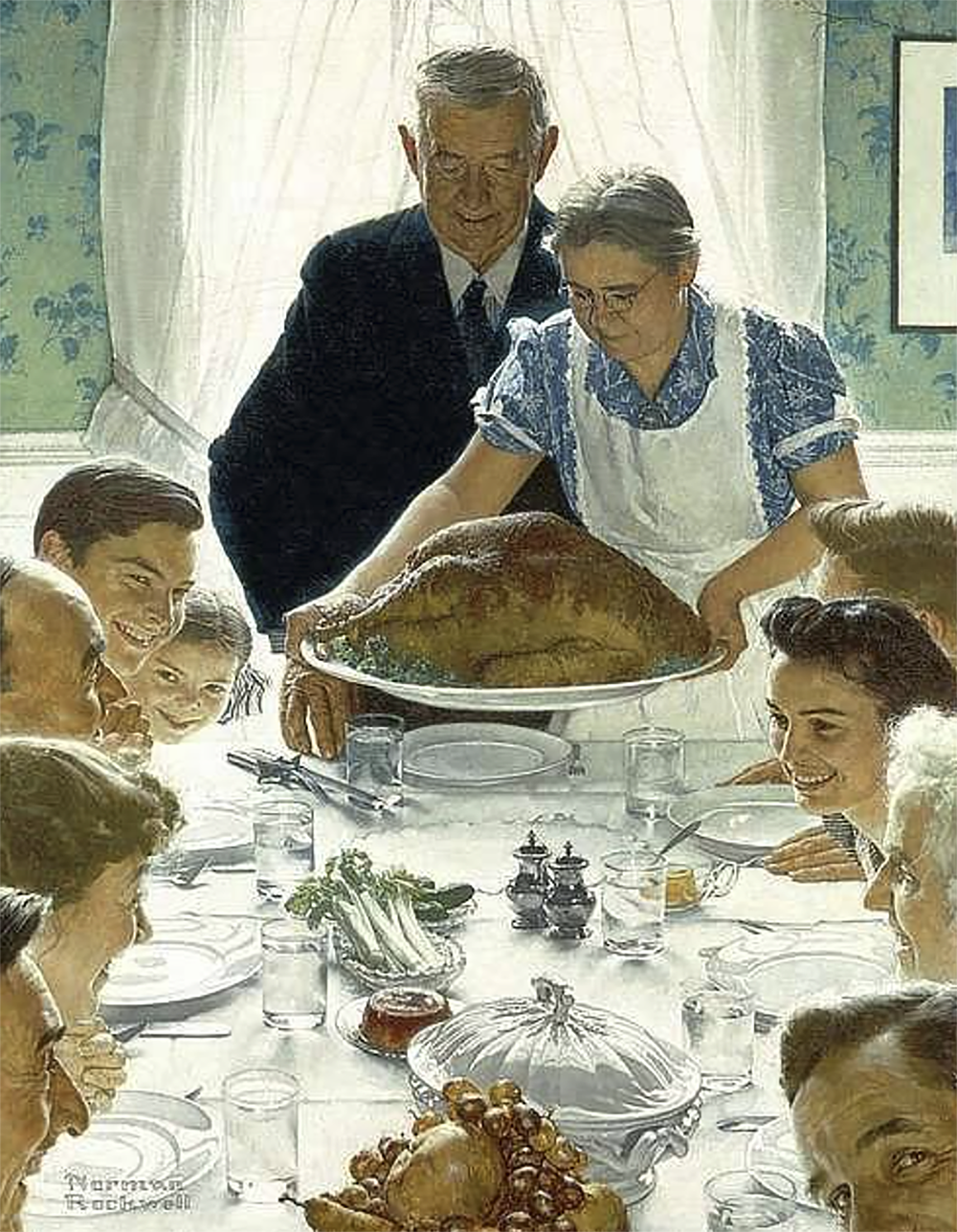
“Freedom From Want” painting by American artist Norman Rockwell.

An early 1940s picture painted by American artist Norman Rockwell, creator of more than 300 Saturday Evening Post covers and some 4,000 paintings during his lifetime, is the image most frequently associated with Thanksgiving. Titled “Freedom from Want,” the painting depicts a family gathering around a celebratory meal. It remains today as a favorite “picture of Thanksgiving.”

Rockwell once said that he painted life not as it was, but what he wished it could be. Maybe that’s what we’re all craving around the holidays, hope for what life should be.

Another American icon offering timeless pictures of America in childhood humor is Hank Ketcham’s cartoons, “Dennis the Menace.” One in particular mirrors Rockwell’s image, with Dennis and his parents sitting down for Thanksgiving dinner, heads bowed. In the caption, Dennis offers, “… and I’m thankful the pilgrims didn’t have liver an’ onions for their Thanksgiving meal.”

Let me say, I’m with Dennis. My father liked liver, so Mom cooked it. Too often. And like most kids of my generation, I dared not question any meal Mom prepared. My sisters and I respectfully ate what was set before us.

“When I left home,” I was telling a friend last week, “One of the things on my list vowing to never eat again was liver. A promise I have kept to this day.”

“You mean your mother didn’t cook a separate meal for you and your sisters,” the longtime acquaintance laughed.

Quick to affirm that we had obviously grown up in the same age, my response was, “Nope! If it was on your plate, you were going to eat it before leaving the table. And leaving a family meal was something you didn’t dare do without first asking, ‘May I please be excused?’”

My mother also played the “Mom card” to shame us for wasting food. “Eat it, don’t waste it. You know there are starving children all over the world.”

“Same with my parents,” reported my friend. “One day my sister and I suggested Mom box up her stewed tomatoes and send them to those starving children. We laughed and laughed. Until we noticed the deafening silence and parental glares of disapproval.”

“There were times when I felt like my parents didn’t have a sense of humor, either,” I sympathized.

Varying from my raising only slightly after I became a parent, I gave my kids a standing offer. I told them they didn’t have to eat what I cooked if they didn’t want to.

“Really,” daughter Robin asked the first time. Lee said nothing. He was always good at keeping his mouth shut a little longer than his older sister.

“Sure,” I said, reaching for her plate. “I’ll just put it in the refrigerator and save it for supper tomorrow night.”

My kids never questioned whether I had a sense of humor. Just how I sometimes applied it.

So, here’s my serious wish for a Happy Thanksgiving. May our hearts be filled with genuine gratitude for the things that make this country the best place on earth to live. Thanksgiving Day and every day.

With a small nod of agreement with Dennis The Menace. Thankful that if the Pilgrims menu did include liver or stewed tomatoes for Thanksgiving dinner, it never made it into the history books.

—Leon Aldridge

(Norman Rockwell’s “Freedom from Want” (above) appeared inside the March 6, 1943, edition of the Saturday Evening Post magazine. The painting was not intended as a Thanksgiving illustration, it was one of the “Four Freedoms” series by Rockwell symbolizing the aspirations of a world with security and well-being as articulated by President Franklin D. Roosevelt. However, it quickly became an iconic image associated with the Thanksgiving holiday )

– – – – – – –

Aldridge columns are featured in these publications: The Center Light and Champion, The Mount Pleasant Tribune, the Rosenberg Fort Bend Herald, the Taylor Press, the Alpine Avalanche,  the Fort Stockton Pioneer, the Elgin Courier, The Monitor in Naples, and Motor Sports Magazine.

© Leon Aldridge and A Story Worth Telling 2025. Excerpts and links may be used, provided full and clear credit is given to Leon Aldridge and ‘A Story Worth Telling’ with appropriate and specific directions to the original content.

Another bag of popcorn, please

For me, there is nothing more valuable about a movie than how people feel in a movie theater.
— Will Smith, American actor, entertainer, and film producer.

– – – – – –

Forget taking me out to the ol’ ballgame, I want to go out to the movies.

Nothing makes me feel finer than a good flick. However, movies worth a couple of hours of my life are films experienced the way they were intended to be enjoyed.

Sitting in a movie theater with people. On the third or fourth row. With a bag of popcorn.

Research reveals entertainment films debuted in 1894 in Berlin, and the first commercial, public screening took place in Paris in 1895. They were black and white, short (around a minute), and silent.

Which is sad because they lacked memorable movie quotes we enjoy repeating today. “Surprised, Eddie?… If I woke up tomorrow with my head sewn to the carpet, I wouldn’t be more surprised.”

Tell me you don’t know the name of the movie.

Movies gradually grew into an industry perfecting “new” techniques. Editing, lighting, and camera movement. Creating the captivating “credits,” which were until the mid-1950s, at the beginning of the movie. More on that in a moment.

“Talkies” entered the picture in 1927 when television was but a faint vision. In 1933, the comedy-mystery “The Crooked Circle” aired on the half-dozen or so homes with a TV set in the Los Angeles area at the time.

It would still be a while, however, before Hollywood successfully romanced TV. Not until 1956 when the 1939 movie “The Wizard of Oz” became the first network television feature film. Which left movies to be enjoyed, for a little longer, where they were intended to be viewed.

Sitting in a movie theater with people. On the third or fourth row. With a bag of popcorn.

Around 1956 or 1957, both my parents’ and my grandparent’s households were introduced to the phenomenon of black-and-white TV. Dad and his father watched Friday night boxing matches together. Grandmother watched Art Linkletter. My mother watched “Queen for a Day.” None of them were frequent movie goers, but I was becoming one.

Beginning during early grade school years at Crockett, when I walked from Perry Brothers, where Dad worked, to the Ritz Theater. Becoming mesmerized by 1950s B-movie sci-fi flicks on Saturday afternoons. The Blob, Them, and It Came from Outer Space.

After moving to Seymour, my film focus became the 50s epics. The Ten Commandments, The Seventh Voyage of Sinbad, and Ben-Hur. It didn’t hurt either, that the Texan theater was just across the street from Perry’s 5-and-dime store.

Once we arrived in Mount Pleasant, the Martin Theater on Third Street was great for Saturday bicycle trips to town. High school and my first car soon shifted my movie preference gears. 1960s film classics like The Pink Panther, Breakfast at Tiffany’s, Dr. Strangelove, and high-tech gadget spy films such as the James Bond films Dr. No, Goldfinger, and Thunderball.

Sitting with a date in a movie theater. In the back row of the balcony. With a bag of popcorn.

In 1963, Hollywood movies on television propelled cinema into regular weekly TV with NBC’s “Monday Night at the Movies.” Which became Wednesday Night at the Movies. Before it became Tuesday Night at the Movies. Another movie story for another time.

Today, movies experienced any night in a theater are still my favorite. The big screen visual. The bold theater sound. Laughing with friends one minute, crying the next.

Oh, and those credits? I am always the last to leave after the very last line. Watching the gazillion names and job titles. Marveling at how many people it takes to make a movie. Scanning the music score. Where was that movie filmed?.

Wondering … what in the world is a “best boy” or a “gaffer” anyway?

All of this, I can enjoy in Center, Texas. At The Rio Theatre. A genuine 1920s “walk-in” that’s within walking distance of my house. A movie theater that retains it’s work-of-art neon facade and marquee.

The Rio Theatre turns 100 next year. The local icon on the downtown square remains a movie theater where owners still sell tickets themselves, welcome moviegoers as they arrive and thank them for coming as they file out. Like Mike and Nita Adkison have been doing at the Rio for almost 50 years. 

It’s a place where anyone can experience every movie the way it was intended to be enjoyed.

Sitting in a movie theater. With a friend. On the third or fourth row. With a bag of popcorn.

—Leon Aldridge

– – – – – – –

Aldridge columns are featured in these publications: The Center Light and Champion, The Mount Pleasant Tribune, the Rosenberg Fort Bend Herald, the Taylor Press, the Alpine Avalanche,  the Fort Stockton Pioneer, the Elgin Courier, The Monitor in Naples, and Motor Sports Magazine.

© Leon Aldridge and A Story Worth Telling 2025. Excerpts and links may be used, provided full and clear credit is given to Leon Aldridge and ‘A Story Worth Telling’ with appropriate and specific directions to the original content.

A monument to the ‘taste of flight’

“Once you have tasted flight, you will forever walk the earth with your eyes turned skyward, for there you have been, and there you will always long to return.”
— Leonardo da Vinci (1452 –1519), Renaissance artist and inventor who documented theoretical flying experiments.

– – – – – –

As a licensed pilot, granted one who hasn’t taken the controls of an aircraft in many years, I can still feel da Vinci’s intoxicating longing for flight.

Even as a kid, my young eyes were turned skyward. Dreaming of a day that I might taste the feeling of flight.

That same longing obviously lingered in two little-known, long-ago aviators from Shelby County in East Texas. Their flying adventures were reportedly the subject of family reunion stories for many years—into the 1980s, for sure.

Standing for a long time as a “monument,” of sorts, to their tastes of flight was the abandoned frame of an old airplane in the Southern part of the county known as the Dreka community.

I first saw what was left of the rusty remains in Florence Duncan’s yard on a dirt road some 40 years ago. A stop at Mrs. Duncan’s house, while visiting family friends nearby, introduced me to her and to the fabled stories of the flying machine. Even then, it was already slowly succumbing to grass and weeds.

“It’s been there since ‘bout 1947,” she said of the old airplane’s skeletal parts. “I keep it there for sentimental value.”

“Two of the boys (family members Ernest Duncan and Duncan Rolland) bought the airplane and wanted to turn one of our fields in front of the house into a runway for it,” Mrs. Duncan reminisced. “My husband, Dean, and I told them ‘No.’ But you know what? They cut my persimmon tree and flew it there anyway.”

“It was an old airplane,” she continued. “Duncan said he gave $150 for it.

When they lit it out there that first time, they hit a terrace and broke one of the wheels.

“They fixed it with bailin’ wire before they decided to go to Center in it,” Mrs. Duncan continued. “They came back in a little while, but they didn’t set down on the field quite soon enough. The wheel they wired up didn’t hold, and the airplane crashed, almost flipped over.

“I was scared to death,” Mrs. Duncan recalled. “I went runnin’ out toward the field. The whole family was right behind me. When I got close enough, I heard Ernest say, ‘I told you we should have lit it down in Center.’ That’s when I knew they were all right. I couldn’t believe they crawled out of that airplane and walked away from it.

“After the crash,” she said, “Van Bertherd, a young man just down the road, thought he could do better. He worked on it and headed down to the corn patch with it. The corn was just coming up at the time, and the plane got stuck.

“We wound up havin’ to take the mule down to the field,” Mrs. Duncan continued, “then towed it to a level stretch on the road. Van got it off, just barely clearing the fence and the pine trees, but came right back. Said it needed lots more work.”

According to Mrs. Duncan, the wrecked aircraft was eventually dragged to a corner of the yard where children climbed and played on it. “Pretending to fly,” she said. “I went out there once and asked where they were flyin’. ‘Way up high over Dallas,’ they said.

“Duncan was shaken up for a long time by that wreck , but he admitted later to wishin’ the airplane had been salvaged,” Mrs. Duncan recalled. “Said it would be an antique now, worth a lot more than the $150 he paid for it.”

When I saw it in the 1980s, the wreckage of the Dreka flying machine had reportedly  spent years serving as a kid’s playground, target practice, and neglect. By then, little remained but the bare frame, which had once been covered in fabric that had long since rotted away. There were no wings or motor. By appearance, it was a small plane with a cockpit just large enough for a pilot and a passenger in tandem.

A visit to the area last week revealed no trace of the old airframe. I couldn’t even locate Mrs. Duncan’s residence in the heavily forested region. She reportedly passed away in the early 1990s.

I do remember her closing remarks during our visit back then, however.

“I’m glad Duncan and Ernest weren’t hurt in the crash,” she said. Then added, “About the only thing I’m still mad about is my persimmon tree.

“It never did come back.”

—Leon Aldridge

(PHOTO ABOVE — Mrs. Florence Duncan standing next to the Dreka airplane wreckage in her yard about 1981 or ’82. Photo taken by Patricia McCoy, a reporter for the East Texas Light during my first tenure at the newspaper as publisher.)

– – – – – – –

Aldridge columns are featured in these publications: The Center Light and Champion, The Mount Pleasant Tribune, the Rosenberg Fort Bend Herald, the Taylor Press, the Alpine Avalanche,  the Fort Stockton Pioneer, the Elgin Courier, The Monitor in Naples, and Motor Sports Magazine.

© Leon Aldridge and A Story Worth Telling 2025. Excerpts and links may be used, provided full and clear credit is given to Leon Aldridge and ‘A Story Worth Telling’ with appropriate and specific directions to the original content.

Those temporary losses of good judgement

“It seemed like a perfectly good idea at the time.”
— T-shirt the guy in the next cell was wearing.

– – – – – –

I got a ticket. A long time ago in a galaxy far, far away.

The aged and torn City of Los Angeles traffic citation dated August 17, 1967, was exhumed last week from its cardboard crypt of misfiled memories. A vivid reminder that havoc happens during those temporary losses of good judgement.

We all have them. Tell me you don’t!

Flashback to that year, a couple of weeks before the end of the spring semester at Kilgore College. I arrived home on a Friday afternoon. Mom was in the kitchen on the phone with her little brother in California. Everyone talked on the phone in the kitchen. Because that’s where the phone was, and the cord wasn’t long enough to go anywhere else.

“Tell Uncle Bill ‘Hello’,” I hollered.

Before I could drop my laundry bag by the washing machine, Mom called, “Come talk to Bill.”

“Do I want to come work for you in California this summer,” I responded to my uncle? “This a trick question, right?”

And just like that, I was Southern California dreamin’. Hot rod cruising nightly at Bob’s Big Boy drive-in. Beach Boys on the radio and the juke box. Dune buggies running the sand hills at Pismo. Surfboards and bikini watching Saturday afternoons at Malibu.

Reality, however, was centered on summer jobs to afford school. Not on a 19-year-old’s daydream coming true. This was a job offer. Uncle Bill was the body shop manager at a Volkswagen dealership in the Los Angeles suburb of Canoga Park.

Now, fast forward a few weeks. I’m balancing college money budget with that California dreamin’ thing when I spot a newspaper ad at my uncle’s house. “FOR SALE: 1929 Model A hot rod, 1946 Ford chassis, 1954 DeSoto “Firedome” Hemi V-8 motor. Needs finishing and paint.”

Visions of one cool car for cruising kept me working on it at nights.

Finally mechanically sound and finally prepped for paint, Ralph Kyger, the incredibly talented auto painter at the shop where I worked was called on to apply the bright red enamel.

Ralph painted VWs by day, and high-end, classics, and custom cars by night. He was my mentor for skills that I would use to finance the rest of my college career back home at Sandlin Chevrolet and Olds, and Surratt and Heimer body shops.

Granted, these are great memories. But here is where this one lapse of good judgement reared its ugly head. When I failed to transfer the old car’s registration at the courthouse.

Mount Pleasant friend and classmate, Ronnie Lilly, made the trip from Texas with me calling on his ’57 Chevy to make the journey. In a brief delusional lack of good sense, we decided that transferring the front plate off Ronnie’s car to the old Ford was a good idea to drive the 15 miles for painting. Done, I headed for the shop on back streets while Ronnie stopped to gas up his car.

That was well and good until the one turn required onto a busy street to reach my destination … just as a black and white Plymouth passed with LAPD on the door. I knew I was busted when the cruiser lit up doing a U-turn.

Standing streetside, the officer silently inspected the car and my driver’s license. “I can’t believe you drove this thing all the way from Texas,” he said suspiciously. Choosing my words carefully, I simply said, “I’ve done a lot of work on it. Taking it over to Thousand Oaks for a paint job tonight.”

Then just as I began to breathe again, Ronnie caught up. The Chevy’s brake lights came on, he pulled over and backed up to meet us. The officer’s eyes went to the Texas plate on the back of Ronnie’s car, then to the matching plate on the hot rod.

“Registration, please,” he said.

It was a different day and time back then, even in California. Issuing me citations for “no proper registration” and “no valid plates displayed,” all the officer said was, “Cool car. Go get it painted tonight, then get it registered tomorrow.”

In today’s California, or even in today’s small town anywhere, what seemed like a pretty good idea back then would likely mean jail time today.

Wearing that T-shirt.

—Leon Aldridge

– – – – – – –

Aldridge columns are featured in these publications: The Center Light and Champion, The Mount Pleasant Tribune, the Rosenberg Fort Bend Herald, the Taylor Press, the Alpine Avalanche,  the Fort Stockton Pioneer, the Elgin Courier, The Monitor in Naples, and Motor Sports Magazine.

© Leon Aldridge and A Story Worth Telling 2025. Excerpts and links may be used, provided full and clear credit is given to Leon Aldridge and ‘A Story Worth Telling’ with appropriate and specific directions to the original content.