No decline in reunions for this family

Reunion [ree-yoon-yuhn] Noun—A gathering of relatives, friends, or associates at regular intervals.Ale-8

The Johnson clan from Kentucky, to which I lay claim for half of my heritage, just completed another successful reunion in Texas, near Burleson.

The familial get togethers, held for at least as long as I can remember, were Kentucky events for many years. But, in the last decade or two, other locations convenient to surviving members and growing families have included Texas, Arkansas and other regions.

It’s been surprising to hear comments lately that family reunions in America are declining. If so, the Kentucky Johnsons haven’t been informed. In fact, one day just isn’t enough when they converge. Their gatherings have been known to last up to a week.

Arthur George Johnson, my mother’s father, is responsible for starting the events that have become family legend. He was born in 1894 and married Bernice Conlee before they settled in central Kentucky, started a family and spent the majority of their lives as educators.

My mother, Indianola Johnson, was the first child born to their union in 1923. Siblings following her included three sisters and two brothers who all grew up calling Winchester in Clark County, Kentucky, home.

Arthur Johnson did not live a long life by most standards. He died of cancer in 1951. He did accomplish a number of remarkable things, however, including instilling in his children an incredible sense of close family ties.

Among documents in my possession today is a letter he wrote to my mother on the occasion of her marriage. She was preparing to marry a young soldier by the name of Aldridge from Pittsburg, Texas, and this marriage would take her a long way off for 1944, away from the Blue Grass State and from her family. Likely adding gravity to the occurrence was the fact that she was the first child to leave home.

His letter covered all the admonitions of which one might assume a father would offer his daughter, things such as love, honor and devotion. It also strongly urged the importance of remaining in touch with family and conducting frequent get togethers—advice he offered all his children, and advice they obviously took to heart.

My earliest childhood memories are of Johnson family reunions in Kentucky for which every sibling was present. And this was no small feat. My mom moved to Texas where she was to live out her life. She was followed by two sisters who also called Texas home. The other sister settled in Ohio and the surviving brother in Southern California … before moving to Texas, to Phoenix and recently back to Texas.

Geography proved to be no obstacle, however. Reunions were planned a year in advance and no one missed the homecomings with some driving half way across the country and through the night to attend.

So how does a family spend a full week having a reunion? Not a problem for this bunch of Johnsons now numbering four generations deep. It takes at least two days of visiting to catch up with everyone else’s activities, events and stories. Throw in another day at the Kentucky reunions visiting with aunts, uncles, cousins and friends still residing in the area and the week’s half over. With many considering reunions as a vacation, there’s always a day or two to take in local attractions and landmarks.

Last but not least are the cemetery research expeditions, typically including one unique to this family. It’s called Johnson’s Mountain. It’s a day’s drive and hike in and out of a wooded Kentucky hilltop where remnants of ancestor’s log cabins remain and where graves of previous generations of Johnson settlers dating to the 1700s typically need cleaning. Every generation is required to make the pilgrimage at least once.

My mom was the oldest of her generation and I’m the oldest of my generation of cousins that has grown up more like brothers and sisters. Mom died in 2010, and declining health prevented her attending a number of the last several reunions while she was still living. The youngest Johnson sister died a few years before her, but the surviving three were in Burleson last weekend, plus representatives of every generation.

Stories about family members and events filled the late night hours supplemented with lots of snappy cheese dip and Ale-8-1 soft drinks—both Kentucky traditions rooted in the Winchester area.

Many of the stories, I have heard more times than I can count. But, I’ll listen to them as long as they are still being told because with each recitation, there are variations that only time and the love for recounting family history firsthand can enhance.

And that’s probably the best part of any family reunion, and the best reason I know of for continuing them—that, and the snappy cheese and Ale-8s.

Leon Aldridge — July 21, 2015

Lessons learned from loving an old dog

Robin & Maxey=B
Robin and Ol’ Maxey in Boerne, Texas – 1995

Spending time outdoors this past weekend was pure delight. Only a dog barking somewhere Saturday disturbed warming temperatures and gorgeous sunsets. Barking is what dogs do— at cars, at people, or for reasons known only to them. Something in the tone of this bark was troubling. Anyone who understands the unconditional love of man’s best friend could hear a plea in this bark.

Dogs were not a part of my youth. In fact, forty was behind me when daughter Robin first wanted a puppy. Hoping her requests would be short lived, creativity flourished as I offered reasons why having a dog wasn’t a good idea. But, I ran out of excuses when we adopted a terrier mix puppy she called, “Bug,” a happy white creature with a brown face that someone had literally thrown away. Together, they taught me lessons learned from loving a dog, and that anyone who says, “It’s just a dog,” is missing one of life’s greatest joys.

Watching the two of them love each other was rewarding, but the hound that touched my heart was an old gentleman of a basset named, “Max.”

“Dad,” Robin said shortly after we settled into our new home in the Texas Hill Country, “Bug needs a friend.”

“He’s got you,” I retorted.

“A dog friend, dad,” she replied curtly.

“Let me hear you bark,” I teased her.

Max lived with Bob Morgan near Lufkin. When Bob and his wife moved into town, their condo was perfect for them, but not big enough for Bob, his wife and “Ol’ Maxey.”

My mind was made up, however. One dog was sufficient. I stood my ground.

Headed back to South Texas the next day, Max appeared to enjoy the trip. The kids laughed and loved on the ol’ hound as we made our way out of the East Texas Pine Thicket.

Bob exercised great care to tell me all about Max. Gave me baby pictures and a letter of apology written to Max by one of Bob’s friends after she casually referred to Max as “just a dog.”

“He’s a fine dog,” Bob said with love. We usually go for a ride on Saturday morning. To the What-A-Burger drive through where Max gets his own, but you can cut the vegetables and mustard on his. Then we just ride around for a while and smoke a cigar.”

“Oh,” he added, “Ol’’ Maxy also likes tuna fish sandwiches and moon pies, but you can’t go riding with him after he eats them.”

In addition to his culinary and recreation history, Bob added on a more serious note, “If he ever barks at night, he’s either hungry, lonely or hurting.”

Back home in Bandera County later that night, we had made the old boy a nice comfy bed on the back porch. Left him water and a midnight snack. But, I had no more than turned out the lights when I heard it. “Oof.” First one, then two deep bass notes, “Oof—oof.”

As I stepped into the darkness on the porch, I heard the rhythmic “thump, thump, thump” of a large dog’s tail on the wooden surface.

After stroking his head, scratching his long floppy ears and assuring him he had been adopted into a good family, I bode him a good night again and headed back for my bed.

Moments later, there it was again. “Oof— oof!”

As this basset hound I had known less that 48 hours and I sat on the back porch, I stroked his head and said, “Max, we both need some sleep.”

Then, as the moon loomed larger over the mesquites down the hill toward the Medina River, we began to communicate. Him by resting his head on my leg and me by letting him know I was beginning to understand what Bob had said.

“I get it Max,” I said aloud. “You’ve lost your country estate followed by your cigar smoking, burger-eating best friend. And if that weren’t enough, now you’re 300 miles from East Texas and alone on a strange back porch somewhere in the Hill Country. Hang on—I’ll be right back.”

Once again, I pounded my pillow into just the right shape and made sure my feet were covered. “Got enough room there Max,” I asked.

The prince of an old dog that was to teach me many lessons about the love of a dog and I settled in together on the back porch watching a Bandera County moon and counting Hill Country stars as we both drifted off to sleep.

Years flashed by as Max and I traveled Texas, raised two kids, and shared a few burgers. I never really developed an appreciation for cigars though.

Kids grown and gone and me living in Center again, I was awakened again one night by another, “Oof!” I knew the tone of this one too well. Max was long in the tooth and enduring arthritis.

“How will I know when it’s time,” I had already asked Center vet, Dr. Robert Hughes.

“Oh, you’ll know,” he said. “You’ll know.”

I went to the living room that night and stretched out by the fireplace next to the old dog that had schooled me in devotion, love, friendship and loyalty. I stroked his head and rubbed his long floppy ears one more time. He sighed and drifted off to sleep long before I did. I’m pretty sure we both knew.

Fluffing and folding my pillow, I looked out the window at the East Texas moon rising over the pine trees, knowing the phone call I had to make in the morning, and knowing that the old dog and I were spending our last night together just as we had spent our first—sleeping on the floor.

Looking at nature’s spring flowering around me this past weekend, I thought about Ol’ Maxey. And I really hoped the dog speaking his heart somewhere in our neighborhood was barking at a cat, or a car. Or, for some reason known only to the dog.

Leon Aldridge – From archives

Originally published in the Boerne (Texas) Star – Oct. 1993

Edited and republished in the Center (Texas) Light and Champion – April 2014

The siren’s song just won’t be the same

Pale invaders and tanned crusaders
Are worshipping the sun
On the corner of “walk” and “don’t walk”
Somewhere on US 1.
I’m back to livin’ Florida’sBarney Gray Motel Postcard
Blue skies and ultra-violet rays
Lookin’ for better days.   

—Jimmy Buffett

Is it coincidence that often draws us back to the same place, or maybe habit? My observations run along the lines that accumulating years of memories help define the places we frequent.

Florida Gulf Coast cities have consistently called out in years past, but the beautiful song of the sirens in Panama City Beach in particular have been the most alluring.

A recent coincidental convergence spawned recollections of Florida and set the sirens to singing once more. One was old news in a Mount Pleasant (Texas) Daily Tribune clipping documenting my initial adventure to the Sunshine State. The other is current news that I’m headed back there soon.

During the last every five year “whether it needs it or not” reorganizing of my archives (a.k.a. “that unorganized bunch of junk I’ve saved”), I discovered a yellowed newspaper photo depicting a group of smiling motorcycle riders ready to depart Northeast Texas for Florida.

Blame it on reorganization, or on Murphy because it’s something I needed, but the clipping has since rejoined the ranks of temporarily unfindable items. However, memory tells me the photographer recorded the image in about ’73 or ’74 at the home of Larry and Dixie Spruill, organizers of the event and owners of a Mount Pleasant motorcycle shop.

The Spruill family was pictured, as was Oscar Elliott and yours truly. However, I’m crawling no farther out on a memory limb with names until I have evidence in hand again. I’m pretty sure statutes of limitation have expired for said adventure, but I’m taking no chances.

The anxious assemblage departed one afternoon after 5 p.m. hoping to get as far as possible before sleeping. Memories endure about our rolling into Vicksburg, Mississippi way after dark and seeking rooms.

Don’t know whether she volunteered or was appointed, but Dixie Spruill inquired about rooms at the motel office while the rest of us waited nearby out of sight. I’m assuming that was to forgo frightening the night clerk with a bunch of sapped cycle riders in the parking lot. Whatever the reason, it worked.

Next afternoon, we roared into Panama City Beach for a week’s stay at the Barney Gray Motel. “World’s Most Beautiful Bathing Beach” as a period chamber ad touted, or “Redneck Riviera” as others have called it, didn’t matter, we were there just for the fun.

Not long out of college and my first time to Florida, for me the trip was fun filled with educational experiences … of sorts. It’s where I learned about severe sunburn, the kind necessitating innovative ways of sleeping while standing, and about nights trying to forget about sunburn while cruising the Miracle Mile Beach Highway 98 amid hot cycles, cool cars and loud parties. It’s also where I learned about streakers. Hey, it was the 70s.

The bare facts of that story were that a group of us huddled around an arcade pinball machine watching the player on a streak piling up points. I never saw Ethel, but I did look when a couple of young women ran through the arcade toward us—au naturel. Couldn’t tell whether they were wearing nothing but a smile because they were wearing nothing but a paper bag on their head. At first unsure about whether to stare or share, I finally called out to alert the nearest bystanders, being ever careful to keep an eye on the birthday suit expo headed our direction. “Guys,” I stuttered, “Hey guys … over here … look!”

The streakers flashed by us, and out the door before someone finally turned and asked, “What?”

“Never mind,” I said, “Telling you about it—it just wouldn’t be the same.”

In years since, Panama City and I have streaked past each other at least a couple of other times. Once was in the mid 1980s returning from Daytona Beach driving a ’56 Ford Thunderbird when the little ‘Bird’s generator gave up the ghost in a restaurant parking lot. An hour’s worth of parking lot repairs followed by a meal in the Panama City restaurant and we were on the road again.

Then it was just a few years ago while there on a working expedition capturing product application photography for my employer that I noticed the Barney Gray Motel, along with most of the original Miracle Strip Beach magic, had succumbed to high-rise luxury hotels and lavish condos.

Thankfully, not long ago a friend sent me an old postcard depicting the motel in the 1950s. I was pretty sure the place looked the same in 60s as well, because it still looked like the postcard pic when we were there in the 70s.

Hopefully when I’m back on the Florida Gulf Coast next month, I’ll find time to visit Panama City Beach again. But, without the Barney Gray Motel and the arcade streaker, the siren’s song just won’t be the same.

Leon Aldridge — July 15, 2015

The night Elvis finally entered the building

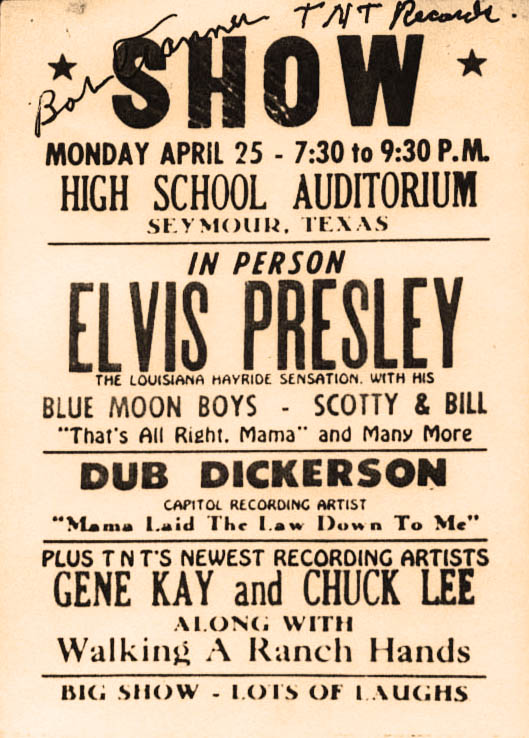
Elvis in Seymour posterDid I see Elvis? If I did, thankfully it wasn’t him and grandma welcoming me into the light.

Know me, and you know I thrive on old rock and roll music in general and anything about “The King of Rock and Roll” in particular. “Did you see him in person,” someone always asks. For many years, the short answer was, “No.” But, that’s where this story begins.

Before moving to Mount Pleasant during my grade school years, the last career stop for my dad was in the small West Texas community of Seymour—a dusty spot at that time where everything was within walking distance.

Walking to a country music show at the high school gym one night was exactly what the teenage daughter of a family friend had in mind. Only after agreeing to let a couple of younger kids tag along did her parents consent to allowing her and a girlfriend to attend. I suspect that was to dampen any plan for meeting boys, but it worked—and I was one of the tag along kids.

Childhood recollections of the night were pretty much limited to a late night, loud music, some guy in brightly colored clothes singing, and the weirdest thing—every girl in the crowd going insane. There were also doses of stern parental lectures afterward regarding trust, responsibility, not coming home on time, and other similar parental sermons many have heard … and given.

Fast forward to 2003 and on the phone is Ernst Jorgensen, a record executive whose life work has been documenting Elvis’s image by re-mastering songs and publishing books about “The King’s” career.

He was gathering information for a book chronicling early Elvis appearances from his Sun Records days driving across the South singing at small town store openings, community fairs, gyms and dance halls. Seeking confirmation of a 1955 appearance at the Mount Pleasant National Guard Armory, Jorgensen said Jordanaires’ lead singer Gordon Stoker suggested he call me. “Gordon says you’re from Mount Pleasant.”

“I am,” I said, “But we didn’t move there until 1959 … from Seymour.”

“I’ve already confirmed Elvis in Seymour,” Jorgensen said. “I’ll email you that clipping and a copy of the poster.”

“Cool!”

The story bylined Doug Dixon related how the local VFD had sponsored a country music show April 25, 1955, “… in the Seymour High School Auditorium … with special guest star, Elvis Presley.”

Dixon, who attended the show, reported a man at the entrance with a cigar box collected admission of one dollar “You just paid your dollar and walked in.”

Entertainers from the San Antonio record label TNT, “put on a pretty good opening show,” according to Dixon, “But of course, the crowd was impatient to see Elvis.” Dixon describes a long evening where, “Every singer sang twice, even the man who had taken our money at the door got up and sang. That was when the M.C. admitted Elvis wasn’t there yet, but he would be pretty soon.”

Dixon’s article accounted as how following intermission, the man with the cigar box went through the crowd refunding 50 cents to everyone, including some who had sneaked in without paying during the intermission. The second half continued much like the first and time grew late, wrote Dixon. “Eventually, most of the audience left, grumbling about being ‘took.’ Only hard core Elvis fans remained, still hoping for a miracle.”

“Suddenly a girl at the edge of the stage … screamed, ‘He’s here! He’s here!’” Dixon described guitar player Scotty Moore and other band members (drummer D.J. Fontana and bass player Bill Black) taking their places before Elvis walked on the stage.

“He was wearing a fire engine red sport coat, bow tie, white shirt and blue trousers, Dixon wrote. “Both coat and trousers were two sizes too large, so he could make his moves without ripping something. For a long moment, he stood there with half-closed eyelids, not saying a word. Scotty stepped up behind Elvis and pretended to wind him up as one winds a wind-up toy. With this done, Elvis suddenly grabbed his guitar and broke into ‘That’s All Right Mama’ … and the show was on.

“What a show it was!” Dixon wrote. “Elvis shook, danced and twisted, as he sang one song after another … Bill Black rode his bass like it was a horse, as he slapped out a rockabilly beat. Scotty Moore’s guitar lashed out adding to the frenzy of the crowd. Girls screamed, cried and several appeared to faint. The girl standing next to me moaned and slid to the floor and lay there jerking, as if she was having some kind of seizure.”

According to Dixon, after several songs Elvis explained their late arrival. “We were booked into Miller Brothers over at Wichita Falls for a dance,” he quoted Elvis as saying. “We didn’t know about this booking until we got a phone call earlier in the evening … some kind of mix up.”

Elvis reportedly asked for a long intermission in Wichita Falls allowing time for a quick appearance in Seymour. The problem was compounded, according to Elvis, when they ran out of gas just outside Seymour and had to hitchhike into town.

“Hectic man,” Dixon quoted Elvis as saying. “Real hectic.” Elvis reportedly also said he would appreciate someone taking them back to their car with some gas after the show, and “… almost every girl in the house volunteered.”

So the question remains. Did I see Elvis in person? There’s no way to know for sure, but the evidence is compelling that I was there the night in a dusty West Texas town when “Elvis finally entered the building.”

Leon Aldridge — July 7, 2015

(Originally published in the Center (Texas) Light and Champion, June 2, 2014)

The semi-famous Murvaul Fireworks Incident

IMG_0835Independence Day is the National Day of the United States. It’s the day we celebrate the adoption of the Declaration of Independence on July 4, 1776 declaring the American colonies as a new nation.

Americans mark the occasion with barbecues, parades, community celebrations, picnics, family reunions, and perhaps everyone’s favorite —fireworks.

July Fourth is also the day some of us celebrate the semi-famous “Lake Murvaul Fireworks Incident” of some year ago. In case you missed that one, it was the night my son, Lee, lit up the sky over the small East Texas lake.

Like many young boys, Lee loved fireworks with a passion to the extent that for years, I was pretty sure he was a pyromaniac. His artillery stash for this particular night rivaled a military weapons depot. Truly, he was equipped to defend the south shore of Lake Murvaul against any invasion, should one occur.

As dark descended on our Panola County lake house, Lee was ready. He had carefully stored every piece of his arsenal in a plastic container to keep them dry and safe from the firing line. Seemed like a smart move to me.

Families along the shore migrated to piers with lawn chairs and refreshments. Lake Murvaul was then, and is today, regarded as an excellent place to view fireworks displays staged by residents around the lake’s perimeter.

Shooting fireworks at the lake means launching them from piers. Not only is it safer, it’s also a Murvaul tradition to enjoy the numerous shows with family and friends.

“Oohs” and “aahs” rose from the darkness of nearby piers as brilliant, colorful displays began illuminating the night sky before falling into the placid water below. Certainly, no one was looking for anything spectacular when the small “twirly-thingy” whizzed upward, or even gave a second thought to the still glowing ember drifting downward. I’m pretty sure no one even noticed when the device, blown slightly off course by summer breezes, drifted toward Lee’s stash.

However, the instant it hit the bucket, we hit the road. When the “really big show” is about to begin at your feet, sitting at the end of a 30-foot pier becomes an obstacle leaving just two options for evacuation—go into the water or run.

Within milliseconds, four people broke into a sprint down the pier toward land. That would have been fine, except the pier was wide enough for only one person at a time.

Curiosity got the best of me. I stopped and looked back at the inferno. Funny, at that same instant, a Bible story crossed my mind—the one about Lot’s wife. As I looked through the boathouse door out onto the deck, I saw several things.

One, I saw a fireworks display the likes of which I’m pretty sure had never before been seen on Murvaul, perhaps never since. Rockets shooting one direction, bombs going off in another. Whizzers, climbers, flares and twisters. The light was blinding and the noise was deafening. Not since Wolf Blitzer’s CNN coverage of the invasion of Iraq, had I witnessed such firepower.

Next, I saw my pier beginning to burn. I knew it would eventually hit the water, but it also occurred to me that I was standing on it.

Last, I saw neighbors in both directions hunkering down, dodging bottle rockets while folding lawn chairs and scrambling to get off their own piers.

Then an idea hit me. Using a broom in the boathouse, I reached through the door and pushed what was left of the inferno off the pier and into the water. With a muffled sizzle, the mass of embers, melted plastic and still detonating devices sank in a cloud of steam that lingered over the murky depths. Almost as fast as it had started, the show was over.

The silence was deafening. Not one single flash of fireworks could be seen on the water. Not one frog or cricket was singing. Then it started. First with my neighbors, then spreading around the cove and across the lake, applause and cheering that lasted for several minutes.

My son was devastated. He had just watched weeks of allowance and pay for extra chores go up in a flash. He was out of fireworks and the evening was still young. Then in an act of sympathy and compassion, his sister, Robin, shared her fireworks with him. I was impressed, but had to wonder what this would cost Lee at some later date.

My son was famous. For weeks, people asked, “What was that over there on the south shore the other night?” Everyone was pretty sure it was the most spectacular event since lightening hit the oil storage tanks. The legend of the biggest fireworks display ever was still being talked about the day we moved away.

Enjoy the holiday weekend as we pause to celebrate this great country, say a prayer for the men and women in the armed services who will be working to protect our freedom—and remember the semi-famous “Lake Murvaul Fireworks Incident” if you’re celebrating with fireworks.

Leon Aldridge

July 3, 2015

Adapted from a column I wrote for the Boerne (Texas) Star, July 4, 1995

How one thing leads to another

One thing leads anotherIt’s funny how one thing often leads to another. Sometimes funny enough that it leaves us asking, “Who would have ever connected those events.”

Long-time Mount Pleasant friend, Susan Prewitt, sent a request last week searching for a column published recently in the Tribune. Seems she tossed the issue before husband Randy finished reading it.

After sending it and noting what I assumed was our common interest in that particular edition of my weekly missive, I had to smile when Susan responded with, “… unfortunately the mention of the cars is what attracted Randy’s attention. Some things never change.”

“And your point is …,” I pondered. When not sticking words together hoping for something meaningful, my other passion has always been bolting automotive iron together hoping for something fast, loud and cool looking.

One fast, loud and cool car that led from one thing to another years ago, and the common denominator in this narrative, was a high performance car built for drag racing. And race is exactly what I did with it at drag strips across Texas and Louisiana before eventually selling it to Randy Prewitt.

My sister Sylvia and Susan were buds at MPHS then, which led to Susan accepting my invitation to a race one summer night. I’d have to ask her, but that may have been the first time she went on a date and wound up working on a racecar. In any case, it certainly wasn’t the last. She later married Randy (and I guess the race car as well) and their passion ever since has been racing cars and motorcycles.

The Friday night Susan ventured off with me as a date more than a racing event, that for her turned into more of a racing event than a date, also led to her father teaching me something I’ve never forgotten.

Auto races were, and still are, unpredictable events that often become late night affairs, especially when you’re winning. This particular night in rural East Texas, we were almost an hour from home when the dust settled on the track as midnight approached.

Susan’s father, Carlton McAlister, was waiting when we pulled back into Mount Pleasant. And, Mr. McAlister was not a happy father. Our feet were hardly on the porch before he began strongly expressing his displeasure with this young man’s lack of responsibility for bringing his daughter home at that hour, and rightfully so.

The next morning, actually just a few hours later, Saturday dawned with me punching the time clock at Sandlin Chevrolet and Olds where I worked to support nagging habits like racing, college and dating. I was still trying to focus sleep-deprived eyes and sort out problems I had created for Susan when someone stepped up next to me. Sleep-deprived or not, my eyes quickly confirmed that I was face-to-face with Susan’s father—again.

I froze, my heart stopped and my first thought was, “Oh no, he forgot something last night. I’m about to hear ‘Angry Father Lecture—the sequel.’”

To my surprise, Mr. McAllister said, “I owe you an apology. Susan explained what happened.” He also added that it would be all right for me to ask her out again—something he told me in no uncertain terms just a few hours earlier that I needn’t bother attempting again.

Decades have failed to diminish the memory of that event, it’s still vivid and I can tell the story as good today as I did then, maybe better. More importantly, in later years I better understood Mr. McAlister and his actions. That clarity came once my own daughter reached the age that Susan was then.

As one thing leads to another, it was as a parent that I figured out his actions both that night and the next morning weren’t so much because he was mad at me, but more because he loved his daughter.

The old racecar is gone, although not forgotten by me or by Randy. Such is the legacy of fast, loud and cool cars among old guys who are still young at heart. But, as I told Susan recently, I’ve always fondly remembered her father and the valuable lesson I learned from him … because of a racecar, and how one thing often leads to another.

Leon Aldridge

July 1, 2015

Originally published 7-1-2015 in the Mount Pleasant (Texas) Daily Tribune

Something old, something new

Something old, something new

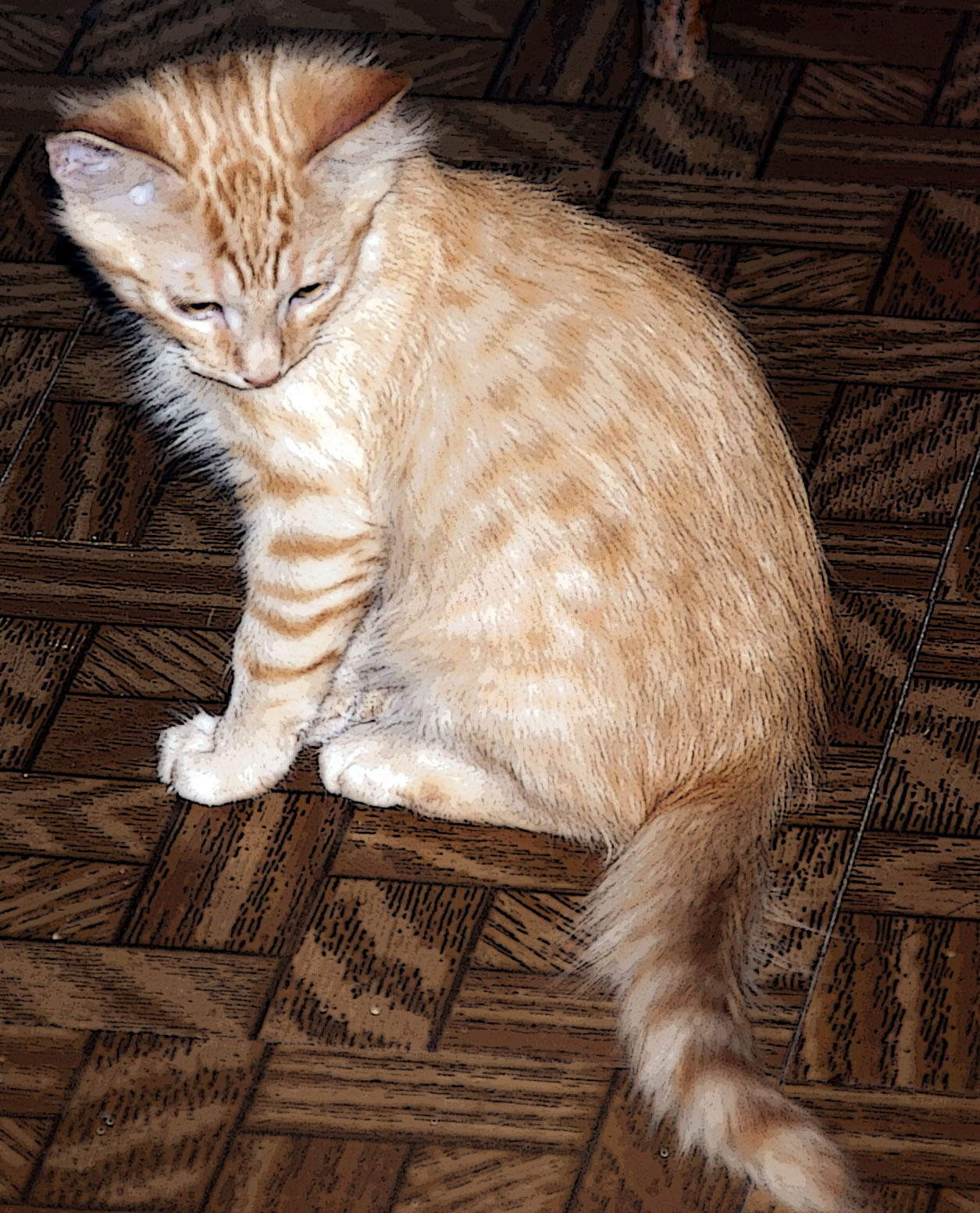
The kitten sits by our back door, gazing through the glass pane at the world on the other side. Her universe, since we found the scared infant feline on the back porch, has been limited to what she’s explored inside four walls.

She watches the older cats and dogs that allow us to live here as they parade in and out, but she seems content to sit and look, never venturing through the door. You have to wonder, isn’t she curious about what lies on the other side?

My curiosity was piqued the first time I peered through the back door of the old Mount Pleasant (Texas) Tribune office, and I’m talking about before the newspaper was a daily. Huge, noisy beasts, those machines were that once produced characters of type—one line at a time, and printed pages—one sheet at a time. In addition, the type setting machines that employed molten lead generated enough heat to make the entire office toasty during the winter and sweltering in the summer time.

Linotype machines, as they were called, assembled molds for the letter forms in lines of type called “matrices.” Each line was then cast from hot metal as a single piece producing what was called a “slug.” While tedious by today’s standards, the machines allowed for much faster typesetting and page composition than the previous method, by hand. Prior to linotype machines, typesetters built pages by placing one pre-cast metal letter, punctuation mark or space at a time.

With some 90 keys on two separate keyboards for caps and lower case letters, operating a linotype machine was a unique skill. As I recall, a Mr. King was the linotype operator at the Tribune that night.

Contrast that with the method for creating and delivering the communiqué you’re perusing right now. Took me about 20 minutes to compose it on a laptop computer that is small enough to tuck under your arm, quiet as a whisper and doesn’t heat up the room. Plus, no printing press was needed. All I did was hit “publish” and it was done, zapped away into cyber space, ready to read on any computer anywhere in the world. Hey, my computer will even send your computer an email to let you know I just “published” another volume of ramblings for your consideration.

With the launch of a blog for my columns, I’ve quit looking through the glass pane and I’ve stepped through the door. Certainly blogs are nothing new. They’ve been around a while, and they’re just a different means of doing the same job linotypes did until offset printing flourished in the 70s—delivering information such as someone’s weekly column. Using a blog to publish my columns is just a new world to me.

So, I’ll keep doing the same old thing I’ve been doing for decades, crafting a weekly dispatch, arranging words on a page while hoping to strike a note of harmony with your reading pleasure. The only new thing will be the method of delivery.

Look for a new column each week as well as an archive of some older pieces. Oh, and I’ll also let you know should the kitten ever make a bold new move into a different world.

Leon Aldridge

June 30, 2015