Beautiful music in anyone’s memories

Phone calls can often orchestrate unexpected news—news typically falling in the category of really good or really bad. One such call out of the blue a couple of weeks ago proved to be a little of both. While the news was a sad message, it stimulated many good memories.

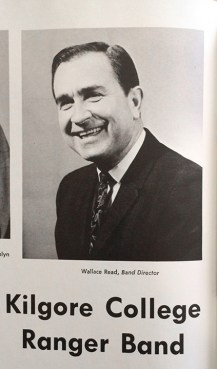
“This is Steve Hubbard in Fort Worth,” the caller began. “I know that doesn’t mean a thing to you,” he said with a smile in his voice. “I just read a column you wrote for a newspaper in Mount Pleasant…I think it was…maybe a year or two ago,” he articulated hesitatingly. “…and in it, you mentioned Wallace Read.” With the mention of Wallace Read’s name, I instantly had a great deal in common with someone I had never met before I answered the phone.

read-1-sm
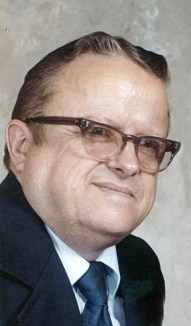
Wallace Read photo from the 1967 Kilgore College “Ranger” yearbook.

“Yes sir,” I told him. “If I recall correctly, I think that was a column about the importance of music in my life, and there’s no way I can talk about my love for music without remembering or mentioning Wallace Read.”

“I’ve been a long-time friend of Wallace’s,” Mr. Hubbard continued. “And, I hate to have to tell you that Wallace passed away this morning.”

“Oh,” I sighed. “I’m really sorry to hear that. I haven’t heard anything about him in years, but have thought of him often. He was my band director at Kilgore College in ’66 and ’67.”

“He was 93,” Mr. Hubbard replied. “But, was in good health and still performing and playing trumpet until about six months ago.”

News of the former Kilgore College band director’s death opened the floodgates for memories of my high school and college band years. Without a doubt, memories that are among the best of my educational experience.

Lufkin, Texas, native Wallace “Wally” Read was a trumpet player at Lufkin High School who followed a love for music through his military service in World War II playing in USOs, to becoming a band director after graduating from Stephen F. Austin State University in Nacogdoches, Texas. After high school jobs in East Texas at Beckville, Gaston, and White Oak, he went to Kilgore College to direct the Ranger Band where he remained until he retired. At Kilgore, he took the band program to a position of an award winning, internationally recognized band performing with the Rangerettes, earning invitations for events from the Cotton Bowl and Dallas Cowboy halftime shows to the Macy’s Thanksgiving Day Parade, plus appearances in a number of events in countries around the world.

After a little research, I located the column Mr. Hubbard had read. It was published in May of 2015 in both the Center (Texas) Light and Champion, and the Mount Pleasant (Texas) Daily Tribune.

The specific paragraphs about Mr. Read were: “Wherever my appreciation of band music originated, it was forever ingrained in me at Kilgore College as a member of the Ranger band under the direction of Lufkin native Wallace ‘Wally’ Read. Stage performances were more prevalent in college band, and it was not uncommon for Read to join in for a chorus, or a solo. I still remember his trumpet solo on Cherry Pink and Apple Blossom White.”

recordbg-out-sm2“The crowning touch at KJC was the spring concert May 2, 1967. Read was friends with Tonight Show band leader ‘Doc’ Severinsen who started with NBC-TV’s Tonight Show in 1952 during Steve Allen’s tenure. Severinsen played trumpet in the band directed by Skitch Henderson, taking over as bandleader in 1967 for Johnny Carson, and continued until Carson and Severinsen’s band left the show in 1992. Under his direction, The Tonight Show NBC Orchestra became the most visible big band in America.”
“However, the Ranger band’s performance that night in East Texas was second to no other when the well-known bandleader walked on the stage to join the Ranger band and cap the evening with a signature solo in Concert for Trumpets.”

“The entire performance was recorded and a copy of that record still on my shelf serves as proof positive should anyone challenge my lighthearted, boastful claim to have once played on the same stage with legendary musicians Wallace Read and Doc Severinsen.”

The day after our phone conversation, Mr. Hubbard sent an email detailing his relationship with Wallace Read and his family. The professional musician, trumpet player and trumpet builder wrote:

– – – – – – – – – – – – – – – –

I grew up in the small Texas town of Keene, home of Southwestern Adventist University. In the early 1960s, Professor (later, Doctor) John Read and his family moved to Keene, where Dr. Read became the director of choral studies at the college. One of my earliest memories is when Dr. Read invited the Kilgore College Band to perform at the college, directed by his brother, Wallace Read. 

As I grew older, and became more and more interested in music, I came to realize that Wallace Read was a legend among Texas college band directors. Although Kilgore College was a small two-year college, Wallace had developed a band program that was nationally famous. On several occasions, they were invited to perform in the Macy’s Thanksgiving Parade in New York, with all expenses paid. This honor was reserved for only the finest bands in the land.

After I began to learn the cornet and trumpet at age 10, I became aware that Wallace Read was also a world-class jazz and big-band trumpet player. He would come to Keene on occasion, to visit his family. Dr. Read saw to it that Wallace was available to coach me, as I worked to develop my abilities on the trumpet. Wallace took an interest in me, because of my association with the Read family, and went out of his way to mentor me. 

In the many years since, I have had numerous opportunities to visit with Wallace, and to play trumpet duets with him. We would improvise solos, trade choruses on Dixieland tunes, and discuss the various trumpet players who had been our heroes. Doc Severinsen, Harry James, Bunny Berigan, Rafael Mendez, and many others. Doc was a personal friend of Wallace, and sent his daughter to attend Kilgore college, just so she could be in Wallace’s band. Doc made multiple visits to Kilgore, and appeared as a soloist with the band. One of Wallace’s prize possessions was a Getzen Doc Severinsen Model trumpet, given to him personally by Doc. 

In 2012, I designed and built a custom sterling-silver trumpet, dedicated to Wallace, John, and Delbert “Sleepy” Read. John and Wallace were my musical mentors, and their older brother “Sleepy” gave me my first set of instrument repair tools. I had each of these brothers sign the bell of the trumpet with a felt marker. Then, I hand-engraved their signatures right into the sterling silver. I have a photograph of John, Wallace, and “Sleepy,” with Wallace holding the trumpet. John’s son, Clayton, now has that trumpet, and plays it on occasion. 

I am sorry that Wallace has passed away. His insights into jazz trumpet stylings, breathing, range studies, and overall musicianship, have been invaluable to me in my professional career. I seldom pick up a trumpet, without thinking about Wallace. I will always treasure his memory, and the time that I was privileged to spend with him.

 – – – – – – – – – – – – – – – –

read-2-sm
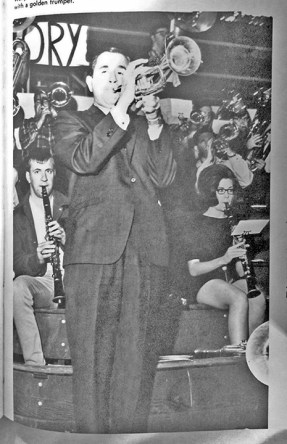
Wallace Read pictured with the Ranger Band performing at a pep rally. Photo from the 1967 Kilgore College “Ranger” annual. Caption in the annual reads: Wally Read, Ranger Band Director, is known throughout East Texas as the man with a golden trumpet.

I’ve always considered myself privileged to have played in a college band under Wallace Read’s direction. He made a lasting impression on me, and was an influence on my love for music. To be fair, so did both high school band directors at Mount Pleasant High School—Max Murphy and Blanton McDonald. All three were completely different personalities with different directing styles.

Mr. Read’s style was animated. He moved around the band hall “zooming in” to direct individual sections, often emphasizing the tempo or inflection of the music with body language. He was never without a signature smile, and was the upbeat persona in the rehearsal hall, on the football field or visiting one-on-one in his office.

He also cared about his students as individuals, although it would be nearly 40 years before I realized that. Bass horn players are essential to a band, but seldom garner lots of recognition or become a stand out in anyone’s band memories.

However, in about ‘04 or ’05 when the “Sounds of Swing” East Texas big band orchestra performed in Center, I recognized the lead trumpet player as Wallace Read, just a few bars into the group’s first song. Catching up with him during the intermission, I introduced myself and said, “Mr. Read, I was in your band at Kilgore in ‘66-‘67.” He paused a few seconds, smiled and said, “Yes…bass player from Mount Pleasant, right?”

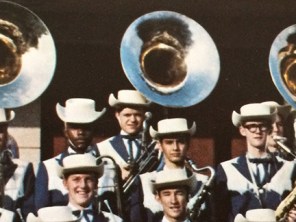
kjc-band-sm
Yep, that 1966-67 Kilgore Ranger Band bass horn player dead center of the photo is yours truly.

All very good memories. Wonderful memories recalled because someone I had never met read something I wrote about a man who obviously played an important role in both our lives, and contacted me not only to deliver a message, but also to share memories. That’s beautiful music in anyone’s memories.

—Leon Aldridge

More than likely, there are rules

“Enjoy the world outside.”

“Escape the routine life.”

Enticing slogans combined with pictures of happy campers, smiling faces and lovely families enjoying the great outdoors camping in travel trailers. Sales brochures like these reminded me of the pleasure my parents derived from years of camping experiences, and kept the thought of owning a travel trailer on my bucket list.

grannys-6-camper-b
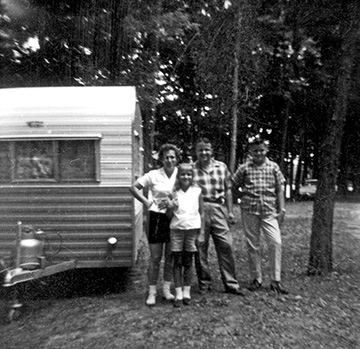
A rented trailer for a camping trip to Beaver’s Bend in Oklahoma, about 1961 or 1962. Back row left to right: Mom, dad, and yours truly. Standing between my parents, my sister Leslie. Missing, for reasons lost to time, is my youngest sister, Sylvia.

So, it seemed funny to me that none of those alluring thoughts came to mind recently after a half-dozen failed attempts at successfully backing my newly acquired 30-foot get away-on-wheels into my 31-foot driveway while concurrently attempting to negotiate a 90-degree turn. The huge white RV filling my rear-view mirrors at the moment really didn’t look all that big when it was just sitting there before I bought it—calling my name, whispering seductive things like, “Buy me, run away with me, fulfill your dreams spending quality time camping in the wilderness just like mom and dad used to do.”

In fact, trying to get my brain around the elusive relationship that turning the steering wheel one direction guaranteed said trailer out back would go where you think it should go was anything but seductive … actually closer to grounds for divorce. But, it was enough to make one think that surely, just as there are rules for successful relationships, there are more than likely rules one should first consider when contemplating fulfilment of any lifelong dream to develop a relationship with an RV. That was the exact moment I was also pretty sure I knew what the first rule should be.

Rule number one: Make sure you have a place to keep the thing. You can’t park an RV, especially a big one, just anywhere—more particularly if putting it somewhere requires rear view mirrors combined with a brain that “gets it” about the whole steering wheel, trailer direction backing up thing.

Recalling how mom and dad enjoyed their camping excursions really did have a large influence on crossing “buy a travel trailer” off my bucket list. They genuinely enjoyed camping, opting to vacation camp year after year, seldom traveling to any of the traditional destinations using motels or hotels. Enjoying the outdoors was never very far from where they lived in Mount Pleasant, Texas. Memories dated by my school years places them at setting up camp at Beaver’s Bend in Oklahoma until about my junior high era in the early 60s. My high school tenure in the mid-60s and into college years, they ventured over to Camp Albert’s Pike in Southwest Arkansas, eventually making that their go-to camp site for as long as they continued the life of happy camping. Both of these meccas in the natural wilderness were within a half-day’s drive of home. Their stays were typically a week.

Good memories are the recollection of times I would join them at Albert’s Pike for a weekend-long brief taste of the outdoors, complete with campfire smoke, long hikes, S’mores and cold Arkansas river water.

Their first choice of camping gear in the early 1950s was a trailer, home-crafted from the rear section of an old pickup truck and pulled by the family car, a 1950 Studebaker Starlight Coupe. My father fashioned a wooden A-frame roof structure on the pickup bed turned trailer and covered it with an Army surplus tarpaulin. It looked for all the world like a refugee from a WWII convoy, perhaps more than coincidence since dad was less than five years post discharge from the Army Corp of Engineers with service in that war. What it looked like notwithstanding, it served them well for a few years including one trip I remember as a pre-schooler when we traveled from East Texas to Colorado, camping within site of the Royal Gorge, sleeping in the homemade camper.

Sometime in the late 50s to early sixties, renting a small travel trailer for their annual summer treks replaced the old Army trailer clone. Trailer renting was replaced when they invested in a large tent. Over the years, they graduated from tents to a cab-over pickup camper before finishing their years of making camping memories with a travel trailer they purchased. A small one. A lot smaller than the 30-footer I was still trying to plant in my driveway. That’s when the next potential rule for buying an RV came into clear focus.

Rule number two: Start small and work your way up.

Neighbor’s some years ago in Center, Texas, Kenneth and Theron Sanders, were also campers for a time. Jumping right into it, they bought a nice, reasonably-sized (a.k.a. smaller than 30-f00t) travel trailer, loaded it up and headed south for Galveston and the Texas Gulf Coast beaches. “Keep an eye on the house while we’re gone,” Kenneth said. “I will,” I told him, smiling and waving while watching them roll out of the driveway.

Didn’t think much about it at first when our family feline, “Kitty,” (no sense in getting too creative with naming a cat—they’re genetically engineered not to respond to anything else any way) didn’t make role call the next morning for breakfast. She was a hunter, independent as cats tend to be, and not one to keep a schedule. But, a day or so later, when I had not seen hide nor fur of her, concern began to nest in my mind. Then after several days, I silently and sadly began to think that she must have, in some unfortunate way, used up all of her nine lives. I knew she didn’t have many left because five or six of them had already been spent living through my children’s toddler years.

After a week or so, the Sanders returned from their coastal excursion, smiling and happy as they arrived home. They looked good, tanned and relaxed, all three of them. Kenneth, Theron … and Kitty?

As Kitty hit the ground, appearing genuinely happy to be back on home turf, Theron related as how somewhere past the point of no return, they made their first fuel stop. “Imagine my surprise,” she said. “When I glanced at the trailer window and saw this wide-eyed cat staring back at me from inside.” While curiosity failed to kill the cat, it evidently played a pivotal part in enticing the critter to sneak inside the trailer’s open door as our neighbors busily prepared for the trip.

Deciding to make the best of entertaining the stow away, they bought a litter box, stocked up on Fancy Feast, and treated Kitty to a week’s all expense paid vacation on the coast. Which brought to mind another rule—or maybe we’ll call this one an option if you’re still struggling with numbers one and two.

Rule number three (optional): Consider skipping ownership entirely and just stow away in the neighbor’s RV. Don’t laugh, my cat made it work.

2006-jayco-29bh
Salient points not to be overlooked in the photo: The distance (or lack thereof) between the rear of the trailer and the eave of the house. Then, the distance (or again, the lack thereof) from the trailer hitch to the street running 90-degrees to the driveway.

No doubt, the list of rules for considering RV ownership are long, far exceeding the accepted length of this missive. Also no doubt, I will learn more of them as I go, accumulating my own list pretty much like everyone else has done, from experience.

That, of course, is necessarily preceded by ending the spectacle of this novice attempting to get his first trailer in the driveway with a minimum of dents and dings on it, structural damage to the house, decimated landscaping, or all of the above. Hopefully, we can do that soon so we can experience the most important rule for being a happy camper.

Most important rule: “Enjoy the world outside—escape the routine life.” Go camping.

— Leon Aldridge

Old Traditions for a New Year

Goodbye 2016, hello 2017! Strike up the band, it’s time for the perennial favorite, Auld Lang Syne. English translation of the 1700s Scots poem set to music and adopted as tradition to mark the end of something, be it an event, someone’s life, or simply another year, is “for (the sake of) old times.” Traditional use of the song in our culture has also developed an association with wishes for good luck and prosperity in the new year.

granny-3
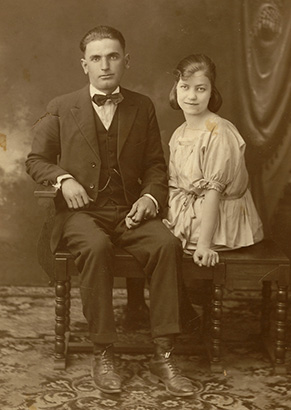
My grandfather, S.V. Aldridge, and my grandmother, Hattie Lois Farmer Aldridge—wise woman of philosophy and old sayings for the new year and all occasions—on the occasion of their marriage on New Year’s Day of 1920.

Prognostication and preparation for what sort of luck the new year might offer was an art form for my grandmother, something for which she relied on a tad of tradition, a smidge of superstition and likely a lot of old time wit and wisdom handed down to her. I’ve also wondered if it might have been in some way remotely related to the fact that she and my grandfather married on New Year’s Day in 1920.

My father’s mother, who was born in Aledo, Texas in 1905, married my grandfather when she was 15. My grandfather was born in Natchez, Mississippi in 1888, and was 31 when they married. He was already a veteran of 18 years of service with the Cotton Belt railroad having gone to work for them in 1901 when he was a mere 13 years old. Ten years later in 1930, when my father was seven years old, they moved to Pittsburg in Northeast Texas, where they lived in the same house for the rest of their lives. For him, that was 1967. For her, 1993.

Life was, to say at the very least, different a hundred years ago. My grandparent’s age difference when they married was not that far removed from the lives of many other members of the working class at the time. Many of my grandmother’s philosophies about explaining and coping with life were likely based in her parent’s and her husband’s thinking, all of whom were born in the 180os. While some of that philosophy was part superstition, the Lord certainly had a hand in her thinking as well. Granny was also a devout Christian and faithful member of the First Methodist Church in Pittsburg for more than 60 years.

As each year drew to a close, she wasted no time in sharing those personal philosophies—her old sayings, as she called them—to ensure that everyone in the family knew exactly what was in store for the new year. Those sayings included plenty of sage advice on how to predict and how to influence one’s life and luck as the calendar rolled over to January 1.

Perhaps the pivotal piece of providence was making sure you ate for prosperity. Dinner (the noon meal for her generation—a.k.a. contemporarily known as lunch) at her house on New Year’s Day held true to the common southern states tradition by including black-eyed peas and cabbage. Still widely practiced in Southern culture, popular belief is that dining on these delicacies will assure good luck and financial good fortune. Some hold to the premise that the key menu item is the peas, and that cabbage is simply a side dish for backup, or additional wealth. I’m a fan of peas and cabbage any day of the year as long as they come with cornbread and iced tea. And, while I’ve consumed more than my share over the years, I would truly be hard pressed to say how much worse off I might be had I opted for a peanut butter and jelly sandwich instead. Whatever the cuisine on January 1, I’ve always been blessed.

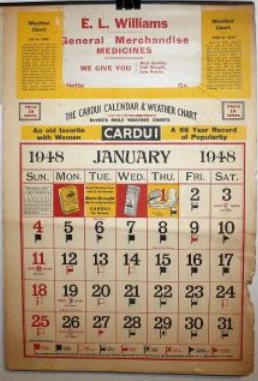
Her second favored New Year’s advice she proposed for approval regarded the weather. She noted on her Cardui calendar for every day of the first 12 days, exactly what the weather was on that day. These notes became her forecasting tool for each of the 12 months to follow. If New Year’s Day was stormy, cloudy or cold, then we were surely in store for bad weather during the first month of the New Year. Rain on the third meant March was going to be a wet month. I thought it was a really fascinating substitute for science until the year snow fell on the eighth. And, no‑it did not snow in August that year.

cardui-calendar
Cardui Calendars, along with a Farmer’s Almanac, were common in homes for 122 years before the calendar ceased publication in 2012. Looks as though New Year’s Day was on Thursday in 1948. Perhaps also noteworthy for this missive is that your author arrived just shy of three weeks later on Tuesday the 2oth that same year.

There was also something to do with the wind on New Year’s Day. I never could keep that one straight, something about if the wind was from the south, nice weather and good times were in store. Wind from the north was an omen of bad weather all year. Seems as wind from the east was a sign of bad things to come while westerly winds were hope for good things, or vice-versa. So what if it’s calm on New Year’s Day? A happy and prosperous year was in store for all, according to granny.

Other lesser pressed premises included gems such as the first person entering your home on January 1 would have a strong influence on your new year. She always advocated that it was especially good fortune if that first visitor to your house for the new year was bearing a gift or something good to eat. Truthfully, I’ve always thought any day someone came to my house with a gift or food was a good day.

For some odd reason, blondes and redheads arriving first were strong signs of bad luck according to my grandmother. And, another oddity offered as how the first one to your house should knock and be allowed in rather entering unannounced. But, it didn’t stop there. When leaving, that first visitor must be let out through another door other than through the door he or she entered. Last, but not least, no one in the house was supposed to leave before the first visitor arrived. The initial direction of travel through the door had to be in. It was bad luck should anyone dare go out of the house first.

Granny also did not wash any clothes on New Year’s Day. No how, no way. Dirty clothes would wait until January second. If you didn’t get your laundry done before January 1, you were on you own until January 2. That one, I recall, was not exclusive to New Year’s Day, however. She also held that it was bad luck to labor with laundry on any Monday. I wondered later in life if this had anything to do with the fact that my grandmother, who died in 1993 while still living in that same house she first occupied in 1930, never owned a washing machine. “Doing the laundry” for her meant a couple of number three wash tubs, a scrub board, and a clothes line. That, in my book, would constitute bad luck whatever day dirty clothes had to be dealt with.

Looking back, our good fortune is in many ways that life today is immensely better than it was then. Regardless of our perspective, it’s hard to deny these are the good old days.

Whatever your New Year’s traditions may be, my wish for you is a happy and prosperous 2017. Enjoy your black-eyed peas and cabbage, check the weather, may that first visitor bring you good cheer and a small gift, and leave your laundry basket full until Monday.

Oh, and “for (the sake of) old times,” I also wish for all of us that our good fortune in the new year lasts longer than our resolutions.

— Leon Aldridge

A Christmas Wish

Christmas comes in a variety of manifestations in America. To a child, it can be the anticipation of St. Nick delivering a shiny bicycle or a new doll on Christmas morning. To those of us who have seen a number of Christmas seasons come and go already, it can be the comfort of family and loved ones being blessed with one more Christmas together to share a meal, laugh and be thankful to our Creator. To many, it’s a season of thanksgiving and renewing of faith. To someone struggling to find the ends—let along make ends meet—it can be a meal and a warm place to sleep.tree-ball_7169

This morning, as I pondered a sampling of ideas for a column this Christmas weekend, I was at the point of feeling that if any one of those short-circuited brain wave thoughts came together in time to post a few words here, that I would truly be a believer in Santa Claus one more year.

Before I had very long to fret over writer’s block, however, Christmas Eve at the Aldridge household took a sharp, unexpected left turn Saturday morning. With plans for a family gathering at dinner tomorrow taking shape, illness struck the family event planner, chef, Christmas decorator, and household organizer—a.k.a. better half, Terry. What had been shrugged off as a nagging illness all week rose up and swiftly took her out of commission before morning coffee ever reached the second cup stage.

A doctor in Center, Texas on Saturday morning? On Christmas Eve? Not happening. So, before you could say, “On Donner and Blitzen,” we were on the way to urgent care in Nacogdoches. Short version of the rest of the story is that we were thankfully back home with a less than emergency status prognosis. Dinner plans for tomorrow were quickly rearranged with a quick handoff to other family members who pitched in to keep the turkey and dressing flowing, and Terry will be fine soon.

Needless to say, Christmas here for this year is one of thanksgiving—thankful that Terry’s medical diversion was not more serious than it was. Being sick is no fun for anyone at any time, but it’s a real bummer at Christmas.

Medical emergency scare? Taken care of and done. Christmas dinner plans? Rearranged and done. A Christmas story column for the blog? Oh yeah, I knew there was something else hanging. Turning back to face the Grinch of Christmas writer’s muse from earlier this morning, I placed fingers to keyboard, closed my eyes and prayed.

OK, I can’t explain it, but there is something in my twisted sense of perspective about panic attacks during medical emergencies that ratchets up my humor button. Probably some sort of psychological diversion, like Freud’s defense mechanisms, but I‘ve honestly caused emergency room medical staff to break out in laughter while turning an ER into a comedy improv at the slightest suggestion of pain or anguish.

So, it was that on the way home and thinking about the prospect of returning to a silent keyboard hoping to create a Christmas miracle tonight before Santa parked his sleigh back in the garage at the North Pole, an unexpected trip to urgent care was looming … well, humorous, when viewed in the right light, given that all was well in the end with the household event planner, chef, Christmas decorator, and household organizer. Really, it’s OK to laugh afterward, right?

Borrowing from a Christmas classic, and apologizing in advance to the memory of poet author Clement Clarke Moore, today’s trip to urgent care called to mind the time honored immortal poem entitled, “A Visit from St. Nicholas.” We’ll call ours, “A Visit to Urgent Care.”

A Christmas Visit to Urgent Care

‘Twas the day before Christmas, when all through the house
,
Not a creature was stirring, except maybe the mouse.
The stockings were hung, on the mantle up there,

Didn’t matter though, ‘cause we were at Urgent Care.


The dogs were nestled all snug in our beds,

While visions of chew bones danced in their heads.

Mamma watched TV, I was outside in the garage.
Polishing the old ’57 T-Bird, with loving massage.


When from the house, there arose such a clatter,
I tripped over the tool box, to see what was the matter.

Away to the back door, I flew like a turtle,

Hurrying at this age, is somewhat of a hurdle.


The 70-degree weather on the lawn’s dead grass,
Gave the luster of Texas, during winter’s last.
When, what to my blurry eyes should appear,

Mamma was telling me, “Hurry, I’m sick I fear.”


Like a little old driver, so lively and quick,
I knew in a moment we had to get there quick.
To the top of the hill! On past the next ridge!

Now dash away! Past Wal-Mart! After the bridge!

And then in a twinkling, we were finally there.
It all turned out OK said the doc, just a little scare.
I wrote them a nice check, and we turned around,

Out of town we rolled, back home with a bound
.

I sprang to the Tahoe, to it gave a whistle,

And away we flew like a guided missile.
I heard mamma exclaim, ‘ere we smoked tires out of sight,

”Merry Christmas to all, Lord get us home safely tonight!”

Whatever Christmas represents in your heart, I wish for you a modicum of fulfillment of your seasonal hopes, dreams and aspirations. I also wish for you, save travels, good health and happy memories to cherish a lifetime.

Merry Christmas, and best wishes for a glorious New Year!

— Leon Aldridge

Before station wagons were cool

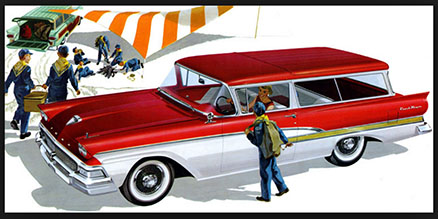
1958-ford-stattion-wagon-sm
1958 Ford station wagon sales brochure photo. Pretty in red and white, but ours in beige and white was cool, too.

“Station wagon—where did that come from,” a good friend laughed loudly after accidentally using the term to reference her Chevrolet Suburban.

Anyone born after 1970-75 or so will likely get that deer in the headlights look while asking questions like, “What kind of wagon did you say?” But, those of us driving the roads prior to the 1970s know exactly what a station wagon was. Still, however, it’s often an awakening to realize that what was once the standard mode of transportation for generations of American families quietly made the last exit off the freeway decades ago. Two things likely paved the road south for the icon of family motoring. One perhaps, the demise of the “full-sized” cruiser automobiles that were the platform for them. The other, likely the introduction of mini vans and the domestication of truck-based work vehicles, gussied up and relabeled as sport utility vehicles—or SUVS (aka soccer mom-mobiles).

Historical note to the previously mentioned younger crowd who never traveled to a ballgame, went on a family picnic or took a vacation riding in the back of a station wagon: The term was coined during the age of train travel, around the 1920s. Designed as utility vehicles and used at depots to transport people and freight lead to, “station wagon.” Primitive metal forming technology was expensive, therefore, the utility bodies were fashioned from hardwood incorporating metal front sections from regular cars and trucks of the period. This manufacturing method lasted through World War II and into the early 50s when advanced technology reduced the cost of an all-metal body. The popular style continued well into the 70s however, but the last of the “woody wagons” were all metal utilizing vinyl to obtain the faux wood look.

Today’s small SUVs and crossovers are occasionally referred to as station wagons. But, take my word for it if you’ve never ridden in a real station wagon, it’s just not the same experience.

Once the words were out of her mouth last week, the brake lights came on as my friend was driving right through her sentence doing about 65 to 70 words per minute and called her plush, modern SUV a “station wagon.” The silence before the laughter was deafening before she plowed into trying to analyze why “station wagon” so easily rolled off her lips.

While she thought about that, I shared with her as how it was actually odd that she used the term while talking to me. Old station wagons are cool today, and I’ve long harbored a secret lust for a ’55 Ford Country Squire wagon to compliment the trio of mid 50s Fords already in my stable. “Black,” I said. “Love the black with wood-grain trim on the side, and a red interior.”

“My father had a station wagon,” she said. “I backed it into a pole and bent the bumper when I started driving. I didn’t think he would notice right away,” she laughed. “I was wrong.”

“We also had one,” I echoed. “A 1958 Ford, beige and white, and huge. When I think about the car, I remember how my grandmother—my father’s mother—could so easily ruffle my mom’s feathers.”

My sisters and I were young, still grade school age, when dad traded the family’s blue ’56 Chevy sedan for the Ford wagon. Mom frequently made the short trip from Mount Pleasant to Pittsburg in Northeast Texas then, checking on dad’s parents, usually after school and always with three kids in tow. Soon after we acquired the big cruiser, mom and granny were engaged in another spirited conversation one afternoon, I’m guessing over one of my grandmother’s critiques on child rearing. Bless her heart, granny meant well, it was just in her personality to be everyone’s life coach.

Mom, in tears by then, loaded us up and gave ‘er the gas, headed south on Cypress Street toward highway 271 that would take us home. About the time the wagon’s motor revved up to shift gears, mom took the column-mounted shift lever and threw it up into second gear position, “three on the tree” style. That would have been just fine had she still been driving the Chevy. It was a standard shift. What mom had forgotten in her aggravated emotional state was that the wagon was not. It had an automatic. The first car with an automatic transmission dad bought.

Warning: Do not try this at home. What happens when you shift an automatic transmission equipped car from “D” to “P” as it’s passing through, oh, probably about 20-miles-per-hour, and still accelerating, is still a vivid memory. Loud and ugly grinding and grating noises emanating from under the car are accompanied by the rear tires violently bouncing up and down on the pavement from their abrupt termination of the ability to continue rolling smoothly. Signs inside the car that something is wrong include three wide-eyed children flying off the seats and into the floor (note: this was also the before seat belts era), the car screeching to a sudden and unexpected stop, and my poor stressed out mother uttering special words that she reserved just for such occasions. Words, that by the way, we were sternly forbidden to repeat.

Once the car came to a screeching stop, mom rested her head against her arms that were folded on top of the steering wheel for a moment, still in tears which soon became subtle, muffled laughter. Mom had that quality about her. She carefully moved the shift lever back into “D” and luckily, the big beige and white behemoth took us home without further incidents.

The wagon remained a part of our family for several years. I remember it being used to transport everything from groceries to bicycles to Christmas trees. I also remember one classic family vacation in the car during the summer of 1960 when we stayed at the Rose Motel located in, I believe it was Mena, Arkansas. We were still a year or two away from buying our first television at home, and I remember my fascination at watching the black and white set in the motel room, gazing at the news proclaiming that John F. Kennedy had been tagged by the Democratic Party to appear on the ballot in November against Republican nominee Richard Nixon.

Definitely before station wagons were cool—so, where did I see that ad for a ’55 Country Squire wagon? Maybe I’ll offer my friend a ride for old time’s sake, but I don’t think I’ll let her drive—not if backing up is required.

—Leon Aldridge

Shopping the ‘five and dime’ for Father’s Day

Does my heart good to hear someone say, “Five-and-dime store.” It’s something heard very little any more. The term is disappearing from American conversation just as the stores vanished from Main Street America some years ago.

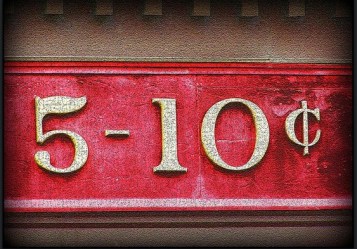
5-10 cent store
(Unattributed – Source Unknown)

Friend and fellow wordsmith Gary Borders mentioned Perry Brothers in one of his columns a few weeks ago, resurrecting memories of the long gone variety stores once found in every small community in Texas and adjoining states.

From the early to mid-20th century, the terms five-and-dime, five-and-ten-cent store, or dime store identified a retail establishment offering a wide variety of merchandise, inexpensive for the most part with many items priced at 5¢ or 10¢ — hence the name.

Dad 1975
My Dad – Leon Aldridge 1975

Perry Brothers, just one of the many dime-store chains that marked an era, was where my dad spent the majority of his retail business career. Others similar in size to Perry Brothers included Duke and Ayres and Ben Franklin. They were mainstays in the smaller communities and most were regional. In the bigger cities and at the national level, it was Woolworth’s, Kress Stores, or TG&Y. Five-and-dimes were typically located downtown, the place where everyone went to buy what they needed before urban sprawl gave birth to shopping centers and malls.

My memories of growing up during the era of five and dimes are triggered by smells. The aromatic experience started with the bulk candy case strategically placed just inside the front door. Long glass cases of popular confections like circus peanuts, orange slices, Boston baked beans, haystacks and candy corn—each with their own unique olfactory delight. And forget about prepackaged bags. These sugary delights were displayed in bulk, bought by the ounce, weighed on balance beam scales and served up in paper bags.

The variety store’s heyday was a time before air conditioning was standard fare. When the weather was warm, the front doors were open and ceiling fans were busy churning inviting smells out onto the sidewalk. Shoppers on the street really didn’t need signs. With a keen sense of smell, it was easy to identify a dime store, a clothing store, a bakery or a drug store along the sidewalk.

Once inside a variety store, the nose was still a satisfactory guide for directing a shopper past the candy to the unique smell of sizing in new fabric sold by the yard, to the fragrance counter identified by distinctive scents like “Blue Waltz” perfume, or to the machined metallic odor area of bicycles, tricycles and wagons in the toy department.

For this dime-store brat however, the strongest reinforcement scent was that of the oiled wood floors. Maintenance on the wood floors required a weekly oiling, an undertaking accomplished with a wide push mop. Sweeping floors and pushing the mop was just one of my jobs as the son of a Perry Brothers store manager. Others included assembling bicycles and wagons, taking out trash, washing windows or unpacking freight. All were good jobs for a youngster in junior high school.

The pay was 25¢ an hour. Doesn’t sound like much today, but in the late 1950s a quarter would snag a large bag of the aforementioned candy with change, at least a couple of comic books, or a ticket into the Saturday afternoon matinee at the Martin theater in Mount Pleasant, Texas.

Discount centers in the late 60s were the beginning of the end for variety stores. Perry Brothers, a Lufkin based chain lingered into the early 80s in a few places before closing or selling locations to other retailers or individuals. My dad saw the handwriting on the wall and migrated from Perry’s to Gibson’s Discount Centers before retiring.

When we moved to Mount Pleasant in 1959, Perry Brothers was on North Jefferson where Glynn’s Western Wear is located today. A newer store about 1964 was opened few blocks farther north on Jefferson near the city’s current water department. Gibson’s Discount Center came to Mount Pleasant in 1968, and not long afterward, Perry’s closed.

For one who remembers dime stores, it’s really pretty easy to look at the front of a building, squint just a bit and recognize an old Perry’s storefront. Many places, I’ve walked in the door and was pretty sure I could still smell the old diagonally cut oiled wood floors underneath another generation or two of floor covering. With a little imagination, the smell of candy near the front was not a far stretch, but that’s a sensory trip likely reserved for someone who grew up in an era when the five-and-dime store was the hub of downtown retail.

Happy Father’s Day dad, we miss you … and we miss the five and dime stores.

—Leon Aldridge, Jr.


Everything’s gonna be all right

Linda Ellis’s poem, The Dash, crossed my mind last week. Surely you’ve read it or heard it used in eulogies, the one about the dash that separates the dates of one’s birth and death on a tombstone, and ponders the question of what “that little line is worth.”

Oscar
Oscar Elliott – photo by Oscar Elliott from his Facebook page.

I was thinking about that during the occasion of celebrating the worth of that dash in the life of Oscar Elliott.

My family moved to Mount Pleasant in March of 1959 where I finished the last few weeks of fifth grade at South Ward Elementary School. It was during that time, while wrangling my bicycle from the rack in front of the school building one day at lunch, someone asked, “You new here?” I looked his way and said, “Yes,” guiding my bike toward the street. “Where you live,” he asked falling in beside me to ride along. “Redbud,” I said. “I live on Stella, I’ll ride as far as Redbud with you,” he replied.

Time has blurred anything else we may have talked about in that two-block trip, but the first date separated by the dash in my friendship with Oscar was that Spring day at lunch within days of exactly 57 years ago. I smiled last week after the second date was added, recalling that day as well as another one some years later when Oscar and I were again riding together. We were both employed at Sandlin Chevrolet and Olds in Mount Pleasant—me in the body shop earning money to stay in college and Oscar earning a paycheck to help support his mother and sisters. He had just reassembled a perfectly good, practically brand new car that we had disassembled in order to make it go faster. Making things run better and go faster was one of many things that seemed to come naturally for Oscar.

The car in this story was as fast as any he ever built for me. And it was fast before he took it apart and put it back together, but it was now ready to go faster. On that Sunday afternoon, it was also ready for a test drive. Sans exhaust and in full race trim with me behind the steering wheel and Oscar in the passenger seat, I guided the loud, rumbling car slowly out of Sandlin’s service department and onto highway 67 headed east. I shouted at Oscar above the sound of the car’s motor, “How far down the street you want me to go?” He leaned toward me and shouted back, “Just stab it and steer it, I’ll ride it 50 feet farther than you can drive it.”

Oscar was also good at responses deftly delivered with humor and wisdom rolled into one line. Last summer as I sat at home contemplating retirement, I snapped a photo of a new rescue cat at the Aldridge household, a yellow tom I called B.C. Knowing that Oscar was a cat person, I sent him the photo of B.C. sprawled across my laptop, demonstrating one of his best free style naps. Oscar’s reply was swift and was not disappointing. “It appears BC certainly knows how to relax. Your B.C. is a good looking guy. My complements to whoever does his hair. Just a little free advice from an old friend…NEVER, NEVER, NEVER let your cat balance your check book or do your taxes. –ome”

The ‘ome’ signature was only one of many names by which Oscar was well known. Born Oscar Milton Elliott III, ‘ome’ was what everyone at Sandlin’s called him because it was his standard signature on service tickets. He also answered to OME 3, as well as Moe.  His sisters called him Bubba and Bub was what most of his family knew him as. Family was a dedication with Oscar from the time we were both in high school when I spent time at his house where his mother made me feel like I was family, throughout his life with the family he and Jeanette shared when they married.

On yet another riding occasion, Oscar and I were going somewhere…I’m not sure where at the moment, but I do remember he was driving. What I also remember is that I was about to start teaching communication classes at Stephen F. Austin State University and Oscar was about 15 years into his career at Texas Utilities Mining Company. He said, “I want you to tell your communication students something. Tell them your good friend who never went to college a day in his life has a pretty good office job working for a big company in Dallas because of communication skills he was blessed with. Tell them your friend can walk into the biggest state of confusion imaginable, high-dollar machinery down and people standing around trying to figure out what to do next. Tell them that because your friend is a communicator, he can assess the situation, tell everyone from the suits to the mechanics what to do next, have everything back up and running in short order and file a report that every one of them can read and understand. You tell your students that communication skills are one of the most important skill sets they can learn.”

Oscar blended his ability to communicate with his ability to analyze and simplify the mysteries of life and made everything run better and go faster for all who knew him by giving back more than he received. I don’t know of anyone whose dash is worth more and was better spent than Oscar’s. I will miss him dearly although I’m sure he would tell me the same thing he’s told me many times before, “Everything’s gonna be all right. And even if it’s not, it’s still gonna be all right.”

—Leon Aldridge


Presidents and their planes; heady stuff at any age

President Dwight D. Eisenhower’s presidential aircraft, Columbine II, was going to land in Mount Pleasant, Texas? “Seriously! Can’t miss that,” I thought.

Columbine_4652SM
Lockheed Constellation ‘Columbine II’ served as the presidential aircraft for President Dwight D. Eisenhower from 1952 to 1954.

Several things make the Lockheed Constellation named Columbine II a significant piece of aviation history: Its service as the presidential aircraft for the 34th president; the only former presidential aircraft sold to a private owner; and most notably perhaps, it’s the first presidential aircraft to use the universally recognized call sign of Air Force One used whenever the president is on board any aircraft.

The historic “Connie,” as Constellations are known in aviation circles, was on its way to Bridgewater, Virginia to undergo a cosmetic restoration. Plans call for the plane to be configured just as it was when transporting the president and first lady in the early 1950s, then displayed at airshows.

Stopping in Mount Pleasant was not just a random navigation decision. Mount Pleasant native Scott Glover’s Mid-America Flight Museum in the Northeast Texas city played a key role in the mechanical restoration that brought the plane back to airworthy condition after many years of sitting at an Arizona airport. The Texas stop was convenient, in terms of breaking up the nine-hour trip from Arizona to Virginia, but it was also selected to note the museum’s efforts in getting the plane back in the air, and give the city’s residents a glimpse of surviving history.

Columbine_4675SMWhen I heard about the planned stopover up the road in Titus County, I knew I had to be there for a number of compelling reasons. First, as an old pilot and aviation buff, if there’s anything I get excited about as much as old cars, it’s old airplanes. Second, I vividly recall news stories as a youngster in the 1950s about President Eisenhower with pictures and mentions of Columbine. And, as a Mount Pleasant native, friend of the Glover family, and fan of the Mid-America Flight Museum, the opportunity was simply something I could not miss.

Numerous articles detailing the aircraft’s history can be found online, including the Mid-America Flight Museum’s Facebook page, or just pop “Columbine II” into Google for enough information to keep even a speed reader busy for a couple of days. But, a Reader’s Digest version for quick background here is that this Air Force Constellation tail number 8610 served as a presidential aircraft for a couple of years until Columbine III, another Constellation, went into service. During it’s tenure, confusion over the plane’s tail number coinciding with a commercial flight bearing the same number in 1953 led to a near miss prompting the creation of the Air Force One call sign. It was a backup for Columbine III for a short time before seeing service in other assignments and eventually being retired to Davis-Monthan Air Force Base in Arizona, the large outdoor military storage facility in the desert for retired and “mothballed” aircraft.

The Connie was sold by the government to a private owner as a part of a package deal of several Constellations in the late 60s and was almost cut up for scrap before the aircraft’s heritage was discovered. A second owner returned it to flying condition around 1990, but the plane was once again relegated to a long nap in the Arizona desert awaiting its next step in destiny. That happened about this time last year, and mechanical restoration to get the plane back in the air, with Mid-America Flight Museum personnel assisting, was competed just last week.

Columbine_4630SMThe Constellation is an icon from the era of propeller driven commercial airliners. It was one of the last of the breed and remained in service several years even after jets began replacing propellers. The sight of Columbine II completing its approach into Mount Pleasant last week personified the beauty of the plane’s porpoise shaped fuselage and distinctive triple rudder tail design. It was breathtakingly elegant as it floated toward the runway, touched down and rolled out on landing gear tall enough to elevate it well above other planes. The sound of the four 2,500 horsepower 18-cylinder radial engines as it taxied to the ramp gave rise to goose bumps on my arms. However, the symphony of that many cylinders rumbling in delightful cacophony is pure pleasure to any vintage airplane buff’s “music appreciation” senses.

My camera stayed busy for a couple of hours capturing images of the majestic airship, as well as the Mid-America Flight Museum’s stunning North American B-25 WWII bomber, God and Country, that had served as escort for the Arizona to Texas leg. Mellowing in the thought of Columbine being in Mount Pleasant called to mind another time that the Mount Pleasant airport was host to presidential history.

Columbine_4644SM
‘Columbine II’ on the apron at the Mount Pleasant Regional Airport with Mid-America Flight Museum’s B-25 ‘God and Country’ in the background

It was a night sometime about 1964, give or take a year. I have a clipping from the old Mount Pleasant Daily Times documenting the event. However, my somewhat-sorta filing system defied attempts to locate the article, so I’m flying solo from memory on this one.

A student at MPHS and a member of the local Explorer Scout Post, I was part of the crowd control program for the scheduled arrival of President Lyndon B. Johnson at the old airport on the other side of Highway 271 and closer toward town from the new airport where I stood last week photographing Columbine. The president was coming to town for a celebratory function honoring a local citizen and friend at the National Guard Armory on North Jefferson.

Darkness arrived prior to the president as onlookers crowded the airport, many in disbelief that the president was actually coming to the small East Texas community. Then, the presidential aircraft’s landing lights appeared. The plane touched down and taxied to an apron close to the terminal building and a car awaiting the chief executive. Explorer Scouts were posted along a designated walkway and instructed to assist in reminding the crowd to stay off the walkway.

President Johnson stepped out of the airplane, waving and smiling, and the night sky lit up with flash bulbs. The crowd cheered and clamored to get a glimpse, waving outstretched arms, each hoping the president would shake his or her hand. Young scouts stood with backs to the crowd and arms spread wide attempting to keep the walkway clear. I looked to my left as the president neared, surrounded by secret service personnel. He made his way along the narrow path, waving, tipping his hat and shaking hands before pausing in front of me. He smiled, grabbed my hand, shook it vigorously and said, “Nice uniform, son. Thanks.” Then quickly, he and his entourage moved on to the car and off to the event on the other side of town leaving me among the rapidly dispersing crowd. All I could think was, “You just shook hands with the president of the United States.”

The crowd was gone in short order and I went home to nearby Redbud Street where I charged in the house to tell my parents, “I shook the president’s hand tonight.” My dad smiled and exclaimed, “Well how about that.” My father pretty much voted Democratic in those days, and I’m reasonably sure that he cast his vote for “Landslide” Lyndon Johnson in his resounding victory over Republican Barry Goldwater.

Seeing and photographing the first Air Force One last week at Mount Pleasant was pretty heady stuff for an old pilot and airplane buff. Just about as heady as shaking the president’s hand at the Mount Pleasant airport was to a teenager in the 1960s.

—Leon Aldridge


Enjoying the 60s all over again

They were two different concerts with 50 years separating them, however at least two people were present at both concerts.

The second event was Saturday night, March 19 at the S.E. Belcher Jr. Chapel and Performance Center on the campus of LeTourneau University in Longview, Texas.

Hermans Hermimts 16
Photo from Peter Noone and Herman’s Hermits Longview, Texas performance — March 2016

The evening’s playbill in the East Texas city on a chilly night was Herman’s Hermits starring Peter Noone. If your birth certificate bears a date that is anywhere near mine, and you grew up listening to popular music of our youth, you’ll recognize the name. For generations younger or older than you and me, Herman’s Hermits was one of the more popular groups associated with the period in American pop music dubbed the British Invasion.

At a time when names like Elvis Presley, Ricky Nelson, Pat Boone, and Fats Domino dominated buttons on the juke box at the hamburger joints and malt shops, a group from England calling themselves the Beatles appeared on the Ed Sullivan Show. That national broadcast on a Sunday night in February of 1964 changed music forever. The Beatles opened musical gates between England and the U.S. shores, and British singing groups flooded America’s music listening youth who greeted them with open arms.

Herman's Hermits
Poster from Herman’s Hermits Dallas, Texas performance — July 1966

One of those bands was Herman’s Hermits whose lead singer was a 15-year-old by the name of Peter Noone. According to Noone’s website, Peter Blair Denis Bernard Noone was born in Manchester, England, studied voice and acting at St. Bede’s College and the Manchester School of Music and Drama. As a child, he played in the long-running British soap opera Coronation Street and other television series before becoming known as “Herman,” lead singer of the legendary 60s pop band Herman’s Hermits.

At the Longview, Texas show last Saturday, Noone and the Hermits performed most of their classic hits from the mid 60s including: “I’m Into Something Good,” “Mrs. Brown, You’ve Got A Lovely Daughter,” “I’m Henry VIII, I Am,” “Silhouettes,” “Can’t You Hear My Heartbeat,” “There’s A Kind of Hush,” “A Must To Avoid,” “Listen People,” “The End of the World,” and “Dandy.” Noone also demonstrated remarkable skill as an impersonator pulling off believable mimics of Johnny Cash, Mick Jagger and Tom Jones, much to the delight of the audience that was dominated by a gray haired, retirement age demographic.

Noone’s site also reports that Herman’s Hermits sold more than sixty million recordings producing fourteen singles and seven albums that reached Gold Record status. The Hermits were also twice named Cashbox magazine’s “Entertainer of the Year.”

The group was on the cover of Time Magazine, performed on top-rated television programs including appearances with Ed Sullivan, Jackie Gleason, Dean Martin and Danny Kaye. Noone starred in ABC’s musical version of The Canterville Ghost, Hallmark Hall of Fame’s presentation of the classic Pinocchio (in which he played the title role) and three feature films for M-G-M.

When music changed once again moving into the 70s and 80s, Noone’s success continued in other arenas. He performed, composed songs and produced recordings with artists such as David Bowie, Debby Boone and Graham Gouldman. His album with the Tremblers, Twice Nightly and his solo effort One of The Glory Boys were both critically and commercially successful. He had leading roles in numerous theatrical productions and in the 80s, starred on Broadway in the New York Shakespeare Festival’s production of The Pirates of Penzance. He also enjoyed an acting career with guest-starring roles in prime-time television shows such as: Married With Children, My Two Dads, Quantum Leap, Dave’s World, Easy Street, Too Close For Comfort and Laverne and Shirley.

Accompanied by his band, Herman’s Hermits, Noone still plays to venues the world over, and enjoys a faithful following of not only aging fans who enjoyed the music back in the day, but also newer generations of fans that has prompted VH-1 to select him as their viewer’s choice for the “Sexiest Artist of the Year.”

All this for a guy whose performance Saturday night looked and sounded like he was still a teenager as he joked about being 68, and thereby “enjoying the 60s all over again.”

Oh, the first concert? That was at the Dallas Memorial Auditorium in July of 1966 where the performers were also Herman’s Hermits and the Animals, another 60s Band from England. That group headed by Eric Burdon was known more for music with a little more bluesy and edgy sound than the polished and squeaky clean sound of Herman’s Hermits, but no less popular among young Americans filling the concert halls and buying the records.

Oh yes, I did say at least two people were at both concerts, didn’t I. Who were they? Well, one was Peter Noone, obviously. The other one was me. Enjoying the music and enjoying smiles from memories generated by Saturday’s performance in Longview was was a throwback to the summer following my high school graduation when I watched Noone and his band perform the same songs in Dallas. That was a time when Noone and I both were enjoying the 60s…the first time.

— Leon Aldridge

Think I’ll cruise tonight in my ’55 Ford

Read somewhere recently that many young adults today have no desire to own a car. Moreover, that many of them don’t even have a driver’s license.

55 Ford Crown Vic 2
The author’s 1955 Ford Crown Victoria

Before I had time scoff at the silliness of the idea that a generation of Americans lack the DNA necessary for the desire to drive a car by junior high, a columnist writing in one of the dozen or so automotive magazines on my subscription list offered a similar notion.

The earlier opinion was based on young urban dwellers with little or no need for their own mode of transportation. The latter was pegged on the view that nine of every ten automobiles seen on the road in the last 20 years more closely resemble each other than first cousins at a family reunion. That, combined with the thought that legislation based on politics more than real science leaves hot rodding, custom cars and auto racing with a dim future.

And restoration of antique automobiles? Even if there were any cars on the road today that held enough mystique for an auto historian down the road to appreciate, automotive offerings of the last few decades have been crafted from a myriad of disposable materials that offer little hope of leaving behind enough of a relic to restore or modify.

Either way you look at it, that’s somewhat disturbing for anyone who grew up in a time when most young males were reading hot rod magazines in history class by the seventh grade, drawing cool looking cars on book covers and building plastic model cars on weekends.

Every single car rolling out of Detroit then had its own personality. Not only could you tell a Chevrolet from a Ford or a Dodge at a quarter of a mile, but even the youngest novice had no problem distinguishing the various model lines within each manufacturer’s offerings. There was no mistaking a Bel-Air for an Impala, a Mainline for a Fairlane, or a Coronet for a Meadowbrook at a hundred yards.

Getting a driver’s license was once a right of passage, something that was nurtured by playing Auto Bingo in the back seat of the family sedan out to “See the USA in a Chevrolet” during summer vacation trips. Innovation and individuality were paramount during the years when Ford ads featured their newest in styling and performance innovations with the slogan, “Ford has a better idea.” Not to be outdone, Dodge touted the distinctiveness and flair of their designs with marketing that proclaimed, “One look and you’ve got Dodge Fever.”

Then there’s the makes that have faded into history in the last couple of decades. Names like Oldsmobile, Pontiac, Plymouth, Mercury and other marks that succumbed to the homogenized history that once took pride in their own individual looks, colors, and engines, even within the ranks of the big three.

So how did we get from a society built on the automobile to one that’s content with the city bus or Uber? From generations based on the legends and mystique of the new model unveiling every year to a generation that seemingly could care less?

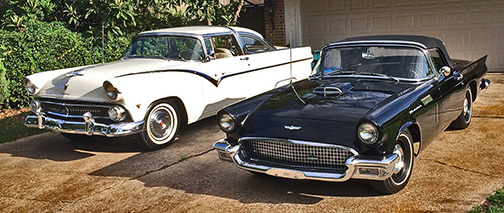
Don’t ask me. My small fleet is more mid-fifties than later current year makes. It includes a ’55 Ford Crown Victoria, a ’57 Ford Thunderbird and a ‘57 Ford purchased off the show room floor by my grandparents in North East Texas. It’s a survivor of America’s automotive hey day and the very car in which I learned to drive, and in which I dated my first girl friend. My second one too, now that I think about it, but that’s a different column.

It’s fair to say my personality would be much different had American automobiles and internal combustion engines not been an incentive to survive afternoon classes in high school just to watch the pilgrimage of rolling stock leaving the school parking lot carrying classmates to after school jobs, or to the local Dairy Queen.

The anticipation of cruising the Mount Pleasant city streets at night and blazing the asphalt at East Texas drag strips on the weekend made automobile ownership my top priority by age 12. My first year or so of driving was the family sedan until an after school job sweeping floors provided enough money for a set of wheels to call my own. But, when that first car deal was made, it had to be different. A young man’s car was an extension of his personality.

That’s a concept to which dad didn’t necessarily subscribe. “It’s just something to get from point A to point B,” I can still hear him saying. “True,” I admitted, but added that the trip had to be made in distinctive style making it possible for your friends to identify you simply by the car you drove. One trip by the local theater on a Friday night, and you knew exactly who was at the movies that night just by the cars parked around the square.

Even if dad was right, for me that trip from point A to B also had to be made in the shortest amount of time possible. Whatever I drove had to be fast which usually also meant that it was loud. Switching off the ignition and coasting the last block into the driveway at home was my only hope of preventing my parents from knowing exactly what time I got home.

That need for speed did two things. It kept me on a first name basis with most of the local police officers, and it spawned a brief career in drag racing during high school and college.

A love for American iron shod with four tires has been a part of our culture all my life. There’s never been a time when I didn’t own something interesting, different or unique to drive.  My motto is that life is too short to drive anything generic or slow.

Personally, I’m not writing off the car just yet. Once you get past the econo-sedans that the government has tried to make us love, the pickups and SUVs still outnumber the cars on lots. And once you peek beneath the look-alike skin of today’s cars, there’s comfort, economy and technology that wasn’t even dreamed of before the days of space exploration. In addition, the likes of Mustang, Camaro, Charger and Challenger, all throw backs to the 1960s, make up a large part of today’s car sales. And they produce horsepower that was unheard of even in the days of muscle cars. Unique and fast rides are far from extinct.

Maybe there is a generation lurking in the inner cities that doesn’t put as much emphasis on cars as those of previous years. Every generation is different and there’s a lot to be said for that as well.

But as for me, I think I’ll go cruising tonight in my ’55 Ford Crown Victoria.

— Leon Aldridge