Is Beach Blanket Bingo over yet

“Everything I learned, I learned from the movies.” — Audrey Hepburn

“What do you think someone’s tastes in movies says about their personality,” I asked a totally unsuspecting friend. We were swapping 60s movie trivia via text following said friend’s message letting me know that Beach Blanket Bingo, the 1965 beach party surfing genre movie, was on television—in case I wanted to watch it one more time.

The question was not random on my part having spent hours perusing my older columns and discovering one about popular movies of the time—the late 1980s. In the 30-year-old piece, I humorously scoffed at what I thought then, to be a lack of creativity and talent in movies. My first thought today was that some things never change. My second thought was the question I posed to my friend. There’s no wrong answer, varying tastes allow for choice, and that’s a good thing.

The movies that resonate with my tastes—the ones I really like a lot—I’ll watch them many times over. Like a good song, a book, or any work of art, the nuances that make movies memorable ensure that it will be just as good every time it’s watched.

Perhaps the most lasting impact great movies leave behind are the quotes. Ever noticed how movie quotes are employed for conversational spice long after we’ve forgotten the sizzle of the plot?

Whether it’s plots, acting, cinematography, quotes or just basic “feel good” appeal, here’s my top five favs, the one’s that are my “must watch every year or two” movie masterpieces.

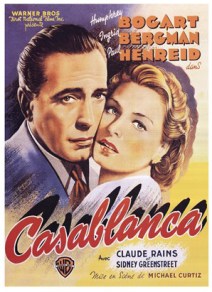
Movie-CasablanaCasablanca (1942) — My number one favorite. Nothing else compares. I’m convinced the effective use of black and white requires more artistic skill than does a color palate. Starring Humphrey Bogart and Ingrid Bergman, set in World War II and released during the war, this one has more “quotable quotes” than any I know. So, “Play it once, Sam. For old times’ sake.” I will continue to play this one many times.
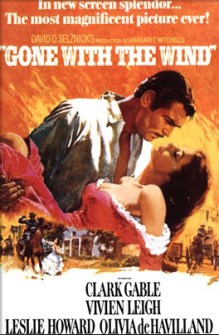
Gone with the Wind (1939) — Set in the South during Civil War and Reconstruction days, a young spoiled daughter of a well-to-do plantation owner struggles with life and love (Scarlet O’Hara played by Vivien Leigh). Based on the 1936 Pulitzer Prize winning novel by Margaret Mitchell, it won 10 Academy Awards from 12 nominations. Movie-GWTWA 2014 Harris reader’s poll named , the novel the second most read book—just behind the Bible. To quote Scarlet, “After all, tomorrow is another day!” And, after all, I’ll watch this one again tomorrow and another day.
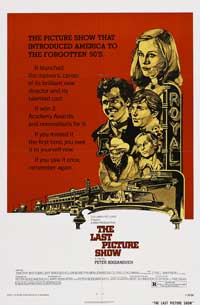
The Last Picture Show (1971) — Adapted from Larry McMurty’s semi-autobiographical 1966 novel and set in a small town in north Texas (filmed primarily in Archer City) during the early 1950s, the story is about one of the town’s young citizens and his friends. Another great black-and-white film nominated for eight Academy Awards and winner of two, it was deemed “culturally, historically, or aesthetically significant” in 1998 by the United States Library of Congress and selected for preservation in the National Film Registry. Movie-Last PS“Bein’ crazy about a woman like that is always the right thing to do,” according to Sam the Lion (Ben Johnson). For me, bein’ crazy about a movie like this one is the right thing to do.

American Graffiti (1973)— A coming-of-age comedy-drama starring a host of young actors who became the best of their Hollywood generation. Set in Southern California in 1962, it’s a classic study of the cruising and rock-and-roll culture of the “baby boomer” generation. George Lucas’ first hit film, rejected by several studios before being accepted by Universal Pictures, was nominated for Best Picture, and became one of the most profitable films of all time. Movie-American gIn 1995, the United States Library of Congress deemed the film “culturally, historically, or aesthetically significant” selecting it for preservation in the National Film Registry. “You can’t stay 17 forever,” to quote John Milner (Paul La Mat). I will, if I can watch this movie every year.

Good Morning Vietnam (1987) — A military comedy-drama set in Saigon in 1965 during the Vietnam War. One of Robin Williams’ best performances as a radio DJ on Armed Forces Radio who was popular with the troops, but infuriated military brass with what they called his “irreverent tendency.” Williams later confessed that his radio broadcasts in the film were, for the most part, improvised and off script. Williams won a Golden Globe Award and was nominated for an Academy Award for Best Actor. movie-GMVNThe film is on the list of the “American Film Institute’s 100 Funniest American Movies.” “Seeing as how the VP is such a VIP, shouldn’t we keep the PC on the QT? ‘Cause if it leaks to the VC he could end up MIA, and then we’d all be put on KP.” — Adrian Cronauer (Robin Williams). I can’t even say that one time without stumbling, but I could easily watch this movie endless times.
So, what does our taste in movies really say about us? Ezra Werb and Risa Williams assert in their book, Cinescopes: What Your Favorite Movies Reveal About You, that your ten favorite movies “show a lot about your personality.” They believe there’s a psychological link between our personalities and the movies that appeal to us, and we connect with the heroes and themes in the movies we’re drawn too.

Works for me. Guess I could ask my friend who started me down this picture show path, but I’m still waiting on a response. I guess Beach Blanket Bingo isn’t over yet.

Reminds me of that time when …

“Common sense is not so common. – Voltaire

What is there about graying hair that causes the days of our youth to beckon, makes us say things like, “Reminds me of that time when … ?”

240Z
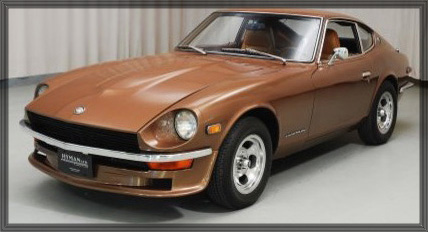
FOR SALE: Datsun 240Z. “Relive your youth,” the ad said to me. The spitting image of mine—same color, same wheels, identical to the one I was piloting the night a low-flying diesel rig taught me and the car a lesson in humility—and just maybe the bonus of a little common sense as well.

An ad offering an early 70s Datsun 240Z for sale last week reminded me of one that I owned just like it. It also reminded me of that time when late one night some years ago in the vast expanse of West Texas, “back before I had good sense,” that I thought I was driving the fastest thing on the road.

College was already in my rear view mirror, but not my love for fast cars. I wasn’t looking for a “Z-Car,” as they were called. But, the two-seater sports car that looked as good as it ran caught my eye sitting on a used car lot in Longview, Texas. My ’70 Volkswagen convertible was neither fast nor especially sporty looking, although it was more fun to drive than the law should allow. The Datsun appealed to me, was in my price range, and had air conditioning—something neither my VW, nor my motorcycle could boast. An hour after the test drive, it was mine.

My first road trip was out west to Abilene, Texas. As editor of a newspaper in central Louisiana, I made sure Friday’s paper was on the press by 10:00 p.m. on a Thursday night, then headed west out of the Pelican State. Crossing Toledo Bend Reservoir at Pendleton Bridge, I turned north traveling up through Center, Texas, and then westward, arriving in Fort Worth at about 1:00 a.m. After refueling both the 240-Z and my coffee cup, I pointed the long sleek nose of the Japanese sports car due west into a region of the Lone Star State one can only appreciate after having driven it. There is very little between Fort Worth and Abilene unless you pull off the interstate in places like Weatherford, Mineral Wells or Thurber. About the only change in elevation is Ranger Hill, a considerable grade challenging truck drivers in the middle of nowhere, other than being located close to Ranger, Texas. I sometimes believe that if it were not for Ranger Hill, on a clear night leaving Fort Worth you could almost see the lights of Abilene 149.7 miles due west.

The night air was euphoric, the sky was clear, and the Z-Car’s overhead cam multi-carburetor six-cylinder motor was orchestrating sweet music through its split manifold dual exhaust system. With very little traffic cluttering the desolate span of 1-20, I let the car stretch her legs up into the 85-90 region in hopes of an earlier arrival in Taylor County, Texas.

Had my mind not been sidetracked by the late hour and listening to the radio, I might have noticed the headlights behind me sooner. Sensing they were getting closer the second time I looked quickly got my attention. Headlights growing brighter behind you when you’re rolling at 90 or better will do that.

Fearing the worst, I eased off and watched the speedometer needle start a gradual descent, just in case the driver behind the headlights was uniformed. A lack of flashing lights eased my fears, but increasing size and brightness kept my attention glued to the rear view mirror. Then I saw it. Rubbing my eyes in disbelief, I looked again. Above the increasingly larger headlights, I saw no red and blue, but what I did see was a row of bright amber. Running lights, they were. I was being overtaken by a large truck.

Game on, I smiled, and mashed the accelerator smoothly until it stopped against the floor. The healthy Datsun motor responded in a heartbeat catapulting the speedometer needle back up and through the century mark. The looming luminance continued to narrow the distance between it and the Z’s tail lights through 110, then 120 and knocking on 130. We were still gaining speed when the headlights pulled over into the left lane to pass.

The car’s speedometer teased me with its 160 at the end of the arch, but a rare modicum of youthful common sense kicked in about then, and I lifted my foot off the accelerator. The apparition effortlessly passing me in the night as I split the wind at 130 miles per hour was in the form of a black conventional-cab Peterbilt diesel truck with chrome everything. It was pulling a flatbed trailer, empty except for a stack of neatly folded and securely tied tarps. Brilliant flames of orange and yellow, contrasting brightly against an ebony night sky, trailed off the tips of chrome stacks scant inches before bending sharply back into the wind and extending for what looked to be 10 feet or more over the trailer. As the rig sailed around me, the running lights blinked a couple of times, as if to say, “See ya’ round,” before flames and tail lights started to fade into the darkness ahead.

I would have told you back then that the popular old saying about “running flames” was just a truck driver’s coffee shop tale—that is until that night. But, I will tell you now with certainty that good sense, common or not, is something we don’t appreciate—that is until after we’ve gained it in exchange for the blessing of gray hair.

— Leon Aldridge

Five selections for a quarter

“In the corner of the bar there stands a jukebox,
With the best of country music, old and new.
You can hear your five selections for a quarter,
And somebody else’s songs when yours are through.”

“Please, Mr. Please” written by Bruce Welch and John Rostill.
Recorded in 1974 by Olivia Newton John.

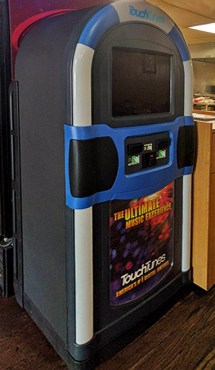
“Have you seen these,” daughter Robin’s text asked last week? The subject of her inquiry was a photo of a plain black box the size of a small refrigerator. It was adorned with silver and blue accents sitting in what appeared to be a restaurant. My first thoughts were along the lines of a Star Wars reincarnated 1940s jukebox.

JUkebox digitialNo,” I responded. “What is it? Sort of reminds me of an old jukebox.”
Recorded music players offering entertainment in public locations debuted in 1890, soon after the arrival of Thomas Edison’s phonograph. Edison is said to have thought his invention was best suited for office dictation, but America’s love for music quickly capitalized on the recording phenomenon. By the early 1930s, personal record machines at home were common, and large wooden boxes with glowing lights, mesmerizing mechanisms and hungry coin slots called jukeboxes were common forms of entertainment in public venues. As World War II was escalating toward Pearl Harbor, jukeboxes made by Wurlitzer, AMI, Rock-Ola and others were everywhere from malt shop hangouts to renowned restaurants, as well seedy joints and brawling barrooms.

“Juke” was derived from their popularity in “jook joints,” a term applied to establishments featuring music, dancing, gambling, and drinking which were typically, shall we say, low-class establishments—also known as “dives.” An association with the growing popularity of swing and rock and roll music with teenagers, not well regarded in society by some parents, didn’t help. Neither did the government’s exposure of Mafia control over the coin operated machine industry at the time.

Every negative factor aside, jukeboxes not only survived, they flourished. Artistic use of plastics, glass, chrome and wood combined with eye-popping designs made them instant classics then and sought after collectibles today. Since the advent of digital music, they have ebbed and flowed in popularity with some new iteration popping up every few years. My daughter’s discovery last week was the newest.

It’s a ‘new’ jukebox,” She replied, continuing our text conversation. “At my favorite real Mexican food place in Tyler! Takes credit and debit card payment!”

 Naturally,” I said with a smile. “Cash—it’s just so yesterday.” But, not so with America’s love for music. As one who has loved and appreciated music since childhood, my attraction to jukeboxes many years ago led me to acquire three working examples of 40s and 50s models. While I grew up with them in the 50s and 60s at places like the Dairy Queen, the bus stop cafe, and up the street at the Hillbilly Cafe in Mount Pleasant, Texas, my children grew up in the 80s with them in our home in Center, Texas.

1015 original-sm
Wurlitzer 1015 manufactured from 1946 to 1948. Yep, should have kept that one.

Robin’s favorite, and the pinnacle of my small collection, was a Wurlitzer 1015. Arguably one of the most beautiful jukeboxes to ever cast a soft, amber glow across a well-worn dance floor, the 1015’s arched top with cascades of bubbles down both sides, changing hues of softly illuminated plastic pillars emanating from a furniture-quality wooden box, and 78 r.p.m. records spinning behind a brightly illuminated glass window provided hypnotizing visual entertainment. Tunes like Glenn Miller’s “In the Mood,” Big Joe Turner’s “Shake, Rattle and Roll,” or Hank Williams’ “Your Cheatin’ Heart,” were almost secondary entertainment.

No stranger to a jukebox, one of Robin’s favorite childhood delights was dropping a nickel in the coin slot to watch the elaborate mechanism swing into action selecting the 1958 hit record, “Rockin’ Robin,” by singer Bobby Day,

Seeburg 100J
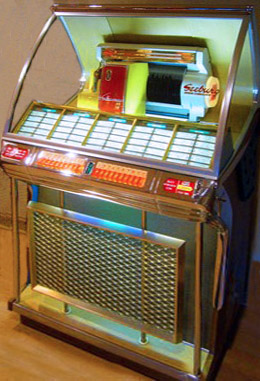
Seeburg Model 100-J manufactured in 1955. The one that didn’t get away.

Thirty years later, the sole survivor of that collection is a 1955 Seeburg offering a selection of 100 songs on 45 r.p.m. records resting in a horizontal tray. Although real wood boxes and bubbling tubes were gone by the mid 50s, the shiny chrome Seeburg box with faux-wood side panels and subdued lighting still spotlights a mechanized record changer to entertain in a fashion that no jukebox since has ever matched.

That’s interesting,” I told my daughter. “I’ll have to look for one.”

“My favorite Mexican food restaurant, or a digital jukebox,” she teased?

 Both, I guess,” was my reply.

“If you find yourself in Tyler, you better look for me,” she ordered. “I’ll take you to lunch and play the jukebox.”

“Wonderful,” I told her. “Guess there’s not much chance, though, that new one plays ‘Rockin’ Robin,’” I laughed. “Or that it will tap your plastic card just a quarter for five selections.”

—Leon Aldridge

The brain can do only one thing at a time

“Multitasking is over rated.” —Leon Aldridge

Recent discussion with a friend over the practice of doing multiple things simultaneously (a.k.a. multitasking) led me to research the topic, and as expected, expert opinions agree that multitasking is in reality, not possible. The brain can do only one thing efficiently at a time. I already knew that. I conducted my own personal research at home last week.

It was admittedly not scientific research, but none-the-less conclusive. Turn a frozen dinner (TV dinner to my generation) into a gourmet meal for one—“Easy Peasy.” Manage a “look what the cat drug up” escapade—a bit more daunting maybe, but not impossible. Carry on a phone conversation from an old friend—piece of cake. But, throw them all together into one evening, and then let me know how that multitasking stuff works for you.

cat art blogIt started innocently enough with the “prefab” dinner in the oven. The offering of frozen gourmet meals at supermarkets today is nothing short of amazing, especially when compared to the TV dinners in aluminum trays that was half of my college cuisine. That and cheeseburgers.
Things were well underway for dinner. The oven timer was set, a place at the table was prepared with condiments neatly arranged on the table.

This was about the time I was leisurely thumbing through the latest issue of Hot Rod Deluxe magazine while waiting for the oven timer to summon me back to the kitchen. It’s also when the cat appeared at the back door. Now, it’s possible I might have noticed she had something with her had I not been deeply engrossed in the magazine. As it was, she was already through the door bounding for the laundry room when I saw it. It was moving. And, worse—it was a snake.

This is about the best time to interject that I’m one who believes there is only one good kind of snake. Add to that I’ve also long subscribed to the theory that a live snake’s place is not in the house. A lunge toward the snake-toting cat was too little, too late. This was also about the time the phone rang. Should I answer it, or, should I pursue the cat with the snake? And, it seems like I was doing something else when all this started…what was it?

”Hello.”

“Yes, hey I’m fine, how are you?” Do you know how hard it is to concentrate on being cordial when you’re pretty sure there’s a reptile loose in the house. And, what else was it that I was doing?

This was about the time I saw the cat dart out the still open back door. “You better get out,” I hollered. “Oh, no, not you,” I told my friend on the phone. Did she take the snake with her, I wondered? Perhaps the only thing worse than knowing there’s a snake in the house is wondering if there’s a snake in the house.

“Yes,” I continued the conversation while looking all around my feet. It has been a long time, hasn’t it? “Uh-oh, dinner’s ready,” I said aloud. “No,” I told my friend, “We can talk. Hang on for a minute.” I removed dinner from the oven and placed it on the stove top before returning to our conversation. A short time later, we shared good-byes with a vow to not wait another 25 years before talking, ignoring the fact that the long shot at Saturday’s horse race has better odds than another 25 years for us at our age.

This was about the time I decided I should conclude whether or not I was sharing my living quarters with a snake. A search under the dryer and behind the water heater, in the clothes hamper and under the utility room sink cabinet utilizing a flashlight with dying batteries turned up no snake. I shifted my sleuthing efforts to the back porch from which the cat and snake had come, and to where the cat returned. Maybe, just maybe, she carried the thing back outside with her. The same failing flashlight uncovered only the furry feline curled up and sleeping soundly on the porch rocker. Returning to the house, I continued looking on my way to the bedroom, deciding there had been enough action for one night. Still no snake.

Morning came and the critter was still on my mind as l went about preparing for another day at the office. Heading for the kitchen in need of caffeine, I was tiptoeing through the house looking for a snake when I rounded the corner into the kitchen and was startled at the sight of a hot oven and last night’s mealtime offering still sitting on the stove top.

So much for multitasking. Hot dinner was a disaster, I never found the snake, and my phone visit was cut short by crazy events of the evening. This week, I’ve switched to cold sandwiches and the cat doesn’t come inside without a full TSA shake down.

Oh, and the online research? It also concluded that multitasking has been decisively proven to be an ineffective way to work citing repeated evidence that performance suffers when people multitask.

Again, who needs scientific research. It’s just as over rated as multitasking.

— Leon Aldridge

Proofreaders, untie against typos

“We made too many wrong mistakes.”—Yogi Berra

Writing can be an immensely rewarding endeavor one day and the most humbling of exercises the next—all but for one simple letter, or misused word.

Typo, the nemesis of every writer, can crush a masterpiece and render it a disaster quicker than you can say, “Proofreaders, untie against typos.”

There may be only 26 letters in the alphabet, but a mistake with just one within the 228,132 current words, obsolete words, and derivative words that the Second Edition of the 20-volume Oxford English Dictionary says we have at our literary disposal, will rain on even the best creative writer’s parade.

Whatever the odds, it has happened to every writer, and it happened to me last week in my day job as marketing director for Advanced Ecology. I was on a roll with our newly launched weekly e-card for sister company Bird & Crawford Forestry. Crowds were cheering, bands were playing, streamers were flying—it was deemed a success. Then in the flash of a keystroke, less than two minutes after the latest edition was released into cyberspace, someone pointed out a glaring typo. What should have read, “…long-range…” unfortunately read, “…long-ramge…”

While a typo is typically not a terminal illness, it can make any writer sick to his or her stomach. The frustration factor in this one ran higher than normal because the misspelled word was caught in the first draft and corrected, only to agonizingly reappear in a later revision.

The advent of spell check helped wordsmiths a great deal, but it’s not fool proof. Typos in any case are usually traced to lack of attention, rushing to finish, or both. I have to admit both played a role in mine.

If there can be a positive side to publishing a typo, mine was not the kind that can make a writer want to wear a disguise before going out in public—the kind that used to serve as fodder for Jay Leno’s feature, “Headlines,” on the Tonight Show. About the time Leno was born, The (Naples, Texas) Monitor publisher Lee Narramore was already collecting them. His tradition has been continued by Monitor publisher since 1968, Morris Craig, and supplemented with a few of mine in the last 30 years or so.

The following samples date back a couple of decades and more. We’ve applied some computer magic to protect the innocent and the guilty as the statute of limitations (or laughs) may not have expired. Under admissions and disclaimers, some of these were published in newspapers on my watch, and none were borrowed from social media. They were collected “pre-social media,” and I have the clippings.

Headlines can be the worst. In 30-point type, it’s like saying, “Let’s not just make a mistake, let’s shout it out in huge type.”

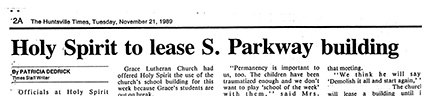
Typos Holy Spirit-smLike the East Texas newspaper headline on a story reporting that a Catholic School would be leasing a local building. Sure, the story explained it all, but after reading the headline, the reader’s mind has already gone down the road of thinking there’s a well-known and powerful new tenant in town.

Typos Parishes-smNo explanation needed in the central Texas newspaper headline utilizing a similar sounding, but unfortunately, incorrect verb.

Typos Heart Assoc-smThen there are those headlines that just should never have made it to press, like the coastal Texas newspaper headline that used an incorrect abbreviation. So many questions begging to be asked. I don’t know, maybe it resulted in a few more cookbook sales.

Typos-Disorderly Conduct-smSometimes, a headline can be perfect, but placed on the page in such a manner as to suggest something entirely different than was intended. Like the photo in an East Texas weekly some years ago of four people standing waste deep in water, obviously prepared for a baptism service—which is what the headline and story below the picture reported. Unfortunately, the story and headline positioned right above the photo reported on an altogether different event that coincidentally, involved the same number of people pictured.
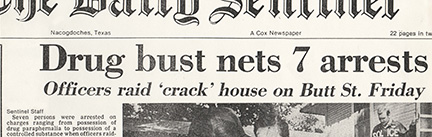
Other times, just the combination of words in a perfectly good headline that is well written and factually accurate  can still cause the reader to  think, “I’m not sure I would have stated it exactly like that.”

It’s a fact that there is a Butt Street in the East Texas city where the newspaper was published. And it’s a fact that police officers raided a crack house on that street. But, I just don’t think I would have pieced all of that together in the same headline … at the top of the front page.

Typos Crack House-sm

Typos and other things that make you wonder “why” can also sneak into an ad.

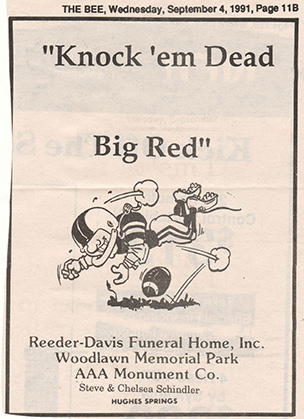
Technically, there is nothing wrong with advocating, “Knock ‘em Dead Big Red,” on any given Friday night somewhere in Texas. It’s perfectly acceptable football jargon when the gridiron competition warms up on a cool fall night. But, there are just some businesses, for which it might not be totally appropriate ad copy.

Typos Knock 'Em Dead-smHaving suffered the anguish of misprint maladies myself, I can testify that no writer is immune. Adding insult to injury, these few samples serve as evidence that once published, some typos will live in infamy for many years. Once the ink is on the newsprint, it’s there for published posterity.

The 60-plus year collection, long years ago dubbed “The Proofreader’s Bible” by Narramore, or Craig, or maybe both, contains more examples than space allows here. Plus, a number of them venture into the realms of political incorrectness and content deserving of a restricted movie rating.

While the dreaded typo can range from mildly humorous to downright hilarious for readers, the typo will forever cause writers to cringe. Therefore, should you find one in this column, laugh all you like, just don’t tell me.

Lessons learned pushing a lawnmower

“I find that the harder I work, the more luck I have.” —Thomas Jefferson

“Know where I can buy a used lawn mower,” someone asked a few days ago? “Afraid not,” I said, explaining how I was a couple of years removed from owning or operating a lawn mower. Finally gave up mowing in favor of hiring it done.

There was a time when I enjoyed the pride of a well groomed yard resulting from my hard work. That time was when it didn’t take as long to recover from the aches and pains such physical labor induces. However, recalling lessons learned while walking behind a lawn mower creates a crop of good memories.

Mowing the family lawn while growing up on Redbud Street in Mount Pleasant, Texas, was part of earning an allowance—a necessity. On occasion, I also mowed my grandparent’s yard just down the road in Pittsburg, Texas. Now, that was fun. Funny how grandparents somehow make the worst tasks seem like fun.

Lawnmower ad
A 1950s Saturday Evening Post ad depicting a lawn mower similar to the one my grandfather owned, and one of first behind which I learned some basic lessons in life.

My grandfather’s lawn mower was an old Sears and Roebuck reel-type, self-propelled, power mower, the only one of its kind I recall seeing. The old green mower with big yellow wheels and a wooden roller device trailing them personified my grandfather. Both were outdated—even then, but both were hard working and both were reliable to a fault. One pull of the starter rope and it was running and ready. Flipping a handle mounted lever released the machine to roll slowly around the yard, doing the job it was designed to do. The only work required was walking along behind the mower and keeping it on course.

Mowing the grass at home for an allowance was a chore, one of many on the list. Completion of those chores that earned my mother’s approval also earned me 25 cents a week. Not much money by today’s standards, but not bad for the late 1950s. In reality, both were chores, but somehow having to mow for my allowance was anything but my idea of fun until I figured out that walking behind the lawn mower for mom meant money in my pocket.

Soon after making that connection between working and wages, I determined that the shortest route to a raise from my quarter a week income was a summer job. So, where did I go to increase my standard of living over the two-bit allowance? Mowing yards. For at least a couple of summers after that, keeping lawns around south-side Mount Pleasant neighborhoods neatly manicured—converting green grass to green in my pockets, also converted my pocket money from the rattling kind to the folding kind.

Thinking about mowers also caused me to contemplate how many of the devices I’ve owned over the years. Although, I failed to arrive at an exact number, two recollections stuck with me.

One: in my fifty-something years of mower ownership, I owned only two riding mowers and didn’t keep either one very long. Walking behind a lawn mower was, in some unexplained way, a great time to solve the world’s problems.

Two: buying my first lawn mower. Not quite up there with my first car or my first date, but a vivid memory no less, coinciding with the purchase of my first house. It was bright yellow and performed a splendid job grooming the thick carpet of San Augustine grass surrounding my first home on Dogwood Street in Mount Pleasant. That experience miraculously turned what had been a chore into a genuine source of pride. As I admired the sight and the enjoyed the smell of newly mowed grass, I knew then what my mom was striving for when she chided me to keep the yard looking nice. It wasn’t punishment, it was pride.

I also understand the lawn mowing lesson my dad tried to instill in me long before I had mowed enough lawns to understand. “Dad,” I once asked him, “Why do parents punish their kids by making them mow the grass all the time?”

“It’s not punishment, son,” he told me. “It’s to teach the value of working to earn money. It’s about taking pride in what you do, being proud of how nice the yard looks.”

“I’d be more proud if you mowed it,” I suggested.

“You’ll understand some day,” he said. “In the meantime, let me see if I can make this lesson a little easier to understand for today. Remember that working hard to make the yard look nice will result in your mother proudly paying your allowance.”

Best neighbor I ever had

“Being a good neighbor is an art which makes life richer.”—Gladys Taber

The tall, gray-haired fellow walked slowly toward me from the small house next door. There only for a phone number on the “For Sale” sign nailed to a pine tree at Lake Murvaul in East Texas, I had no idea I was about to meet the best neighbor I would ever have.

dawn at murvaul framed
“You could set your watch by the sound of Bill’s boat heading out full-throttle as the sun came up on the cove …”

It’s my opinion that the art of neighboring is dying, the victim of instant, easy and impersonal communication. I was again reminded of that recently while being updated on Center, Texas, news—incredibly, via text from a good friend and former Center resident now living on the other side of the state. “Haven’t heard that,” I told him. ”You’d think news in a small town would travel faster.”

“It did before the internet,” was my friend’s profound comeback. He was right. The result of more and more email, texts, tweets, etc., is less and less visiting across the fence, across the street and across the coffee shop table.

“Looking to buy a place on the lake,” the old fellow quizzed me that afternoon. “Good fishin’ here. You’ll like it,” he continued. His thinning gray hair, weathered face and slow walk revealed his age in years. His smile, twinkling eyes, and friendly curiosity uncovered a much younger heart. “I love this lake, wouldn’t live anywhere else. Retired and moved here from Dallas 17 years ago.”

In the weeks that followed, Mr. Bill made working on our newly acquired lake property tolerable. “How ’bout a glass of tea,” I heard him call out, then looked over the edge of the roof where I was working in mid-July to see him holding two glasses of iced tea. “Come on down,” he laughed. “I got a new joke for you.” He always had a new joke, and no one laughed louder or longer at them than he did.

“Come over for supper later,” he offered as he headed back across the easement that separated us. “Katherine’s fixin’ pork chops. I might save you one,” he chuckled.

Mr. Bill and Miss Katherine quickly “adopted” my children. He timed his afternoon picnic table coffee break to coincide with the arrival of the Gary, Texas, ISD school bus. “Y’all better get over here,” he’d announce as they stepped off the bus. “Katherine just made cookies.”

Buggy-Final copy
A search through photo files failed to produce a picture of the best neighbor I ever had. It did, however, render a picture of Mr. Bill’s friends, the dog with two names and my daughter, Robin.

“Bug,” was the name my daughter selected for the scruffy Terrier mutt she adopted, but Bill called the puppy, “Bitsey.” Robin constantly corrected him, but to no avail. I soon learned this was just Bill’s teasing way of keeping Robin’s attention. The dog with two names soon became Bill’s “bus alert.” Long before Bill’s failing ears heard the school bus coming, the dog’s head would pop up as she looked toward the curve signaling him that it was near.

Good hearing was not a requirement for his fishing, however. You could set your watch by the sound of Bill’s boat heading out full-throttle as the sun came up on the cove, and again just before the sun dropped behind the pine trees on the other side. “Catch anything?” I’d call out when I saw him coming back. “Naw,” he’d laugh. “One tried to jump on my hook, but I talked him out of it.”

Every back porch around the cove was within “hollering” distance, a perfectly acceptable form of communication. Every porch was also within sight, meaning that meandering toward your pier with a cup of coffee hoping to catch fish hitting the top of the water guaranteed someone would soon join you—coffee cup in hand.

Pier sitting wasn’t a requirement with Bill, though. “Got any more of that coffee,” he’d often ask, sticking his head in the back door on Saturday morning. “Katherine won’t let me have any more. Says I don’t need it. If she calls, don’t tell her I’m over here,” he’d laugh, pouring himself a cup of coffee.

Miss Katherine was a determined woman, and she determined one day that it was time to sell their lake property and move closer to kids and grand kids in Ft. Worth. “Crazy woman,” Bill said, shaking his head one evening as we sat on the back porch. “I came to this lake to stay.” He protested to everyone, except Miss Katherine of course, and the “For Sale” sign went up on the hilltop place they had called home for 20 years.

‘Where ya’ going,” I asked one afternoon as I saw him heaving suitcases in the car. “Goin’ to Ft. Worth to see the kids,” he replied. Looking around to make sure Miss Katherine wasn’t within earshot, he smiled and said, “If anyone stops to look at the house, tell ’em it’s eaten up with termites, the roof leaks and the plumbing’s shot.”

“Got ‘cha,” I laughed. “Have a good trip.” The little place next door eventually sold, Bill and Katherine moved to Fort Worth and closer to family, all about the same time opportunity called me to Boerne in the Texas Hill Country. But to this day, every time someone talks about good neighbors, I still see the best neighbor I ever had coming across the easement laughing and saying, “I got a new joke for you…”

— Leon Aldridge

 Aldridge columns are also published in the Center, Texas, Light and Champion (http://www.lightandchampion.com) and the Mount Pleasant, Texas, Tribune newspapers (http://www.tribnow.com).

I’m still getting error messages

“Never say ‘never’… karma has a wicked sense of humor.” —Experience

My first close encounter with a computer just months into the 80s occurred when we took delivery of our first one at the East Texas Light in Center, Texas, where it was set up in the bookkeeper’s office.

Computers of a sort were already used for typesetting, although primitive by today’s standards. Imagine tall boxy devices the size of a refrigerator beeping and humming at the command of multiple yards of perforated paper tapes generated by reporters on typewriter-style machines in the news room—a far cry from the new one in bookkeeping around which everyone huddled that day. Typically found in banks and big businesses, the newspaper now had a modern computer—one with a glowing black-and-green TV tube monitor, noisily generating reams of green-and-white paper.

Mac Plus
Apple’s first Macintosh computer like the one that introduced me to computers.

Whereas children born today come with a plethora of knowledge pre-installed for intuitively knowing how to operate complex computing devices, I couldn’t spell ‘computer’ until my junior year of college. Remembering my only course in ‘computer science’ at East Texas State University in Commerce, Texas, involved thick stacks of punch cards created during many late nights in the computer center used to produce reams of that same green-and-white paper (most of mine with error messages attached), my reaction to the new computer was quick. “I’ll never need to know how to work a computer, just bring me the print outs.”

Karma was swift and sure. The first computer in my house came no more than a year later—an Apple IIe in about 1983. It was soon replaced with a first-generation McIntosh introduced the next year that came with two floppies required to operate it. One, a system disk and the other a data disk—cutting edge technology at 128k from a device that weighed 12-15 pounds.

So, here I was last week, some 35 years following my profound proclamation, attempting rationalization to a somewhat understanding friend how (and why) I possess six functioning devices, any one of which has mega times the capacity and power of the first one I owned. Never mind that the one called iPhone is small enough to fit in a pocket, or become easily lost under or behind something when the ringer is turned off.

Error message 1Supplementing this collection of working wonders are three Mac desktops that preceded the current workhorse, a five-year old MacBook Pro. My Mac museum includes a PowerMac G5 currently living on a desk just in case it’s ever needed, in the same spot in which it’s collected dust since the MacBook Pro was first powered up. Stored in their original boxes are a PowerMac G4 and a first-generation iMac G3. It’s two-tone silver and gray. I just couldn’t take the plunge for one of the bright candy-colored configurations in which the revolutionary tear-drop shaped computers daringly debuted in the early 90s.

Rounding out the current collection of computing devices are:

  • A first-generation iPad that still performs perfectly, at the ready for me to read Kindle books, or to provide chords and lyrics for my embattled endeavors to master the guitar.
  • Two iPad minis. Why two? That’s an interesting story for another time.
  • An Asus Android 7″ tablet that I own only because it was part of a promotion with my last phone contract renewal. Used to be my Kindle reader before I discovered the app existed for the iPad.
  • Two iPhones. One for me which will have to be surgically removed when it dies so that a new one can be installed, and one that my wife uses for phone calls, taking photos of cats and grandchildren, and marveling at her newly discovered ability to send and receive text messages…that is when she remembers to take it with her.

A fitting footnote might be the prodigy of that first computer, the Apple IIe. No, I don’t still have that one. It wasn’t functioning properly and was handed off to my son after the first Macintosh was dedicated to duty. Lee was young, yet to enter school, but he somehow managed to make it work and was playing games on it the same day. How did he do that? He told me at the time, but I didn’t understand it, even then. Today, he has a degree in computer networking and maintains IT networks and automation equipment for a manufacturing company in Mount Pleasant, Texas, with locations in four, or is it five, states…and he still plays computer games.

Error message 3So, what does a reformed “I’ll never need to know how to work a computer,” type do with all these devices? The easier answer is the same as it is for most of us today, “what would we do without them?”

Some things have not changed, however, since the days of that iconic green-and-white paper. I’m still getting error messages.

— Leon Aldridge

 Aldridge columns are published in the Center, Texas, Light and Champion (http://www.lightandchampion.com) and the Mount Pleasant, Texas, Tribune newspapers (http://www.tribnow.com).


Everyone has a story

“Column writing is storytelling in written form. Those who understand the magic in words make the best writers and the best story tellers. Therefore, I believe there is only a thin line that separates the two crafts.”—Leon Aldridge

That thought came to me a couple of weeks ago while on a mission to name the newest series of Aldridge columns scheduled for publication in the Center, Texas, Light and Champion and the Mount Pleasant, Texas, Tribune.

header-trib-id
The Mount Pleasant (Texas) Tribune—2017

Columns published in newspapers have traditionally been identified by names. Sometimes, the name will include the author’s name in a catchy manner, such as “Borderline” written by friend and former colleague Gary Borders. Other times, it might refer to the publication itself, as in the column called “Monitoring Main Street,” written by Morris Craig and several publishers and staffers at The Monitor in Naples, Texas for more than at least 60 years that I know of.

Whatever the name, column writing has provided me with more fun and reward than almost any other aspect of the newspaper business. I was hooked on columns in high school reading Paul Crume’s, “Big D,” in the Dallas Morning News.

Crume’s first column was published in 1952 and was on the front page every Sunday through Friday edition for 24 years. He reportedly never missed a deadline, but also never made one with more than seconds to spare. And supposedly, never read his column in the paper the next day.

His last column appeared November 13, 1975, just three days before he died. No one took his place, and unfortunately, in my opinion, the tradition of front page columns also died—with one exception we’ll touch on shortly.

Header-ETL
Center (Texas) East Texas Light—1980

My first regular column ran in the Center East Texas Light (now the Light and Champion) in April of 1980, dubbed, “The Aldridge Report.” That was, however, not the first column bearing my byline. As editor for the Sabine News in Many, Louisiana in the late 70s, I penned sporadic contributions for the struggling weekly where time to write regular columns was a luxury—likely why it never garnered a name.

Header-Boerne
The Boerne (Texas) Star—1993

After Center, and after teaching journalism at Stephen F. Austin State University in Nacogdoches, Texas, my next publishing gig was at The Boerne Star in the Texas Hill Country. We called that column “This Week,” a name I also used at the Marlin Democrat, a brief stop on my way back to East Texas to publish the Naples Monitor.

Header-Marlin
The Marlin (Texas) Democrat—1998

Keeping with the aforementioned Naples Monitor tradition dating back many decades, my column ran on the front page as, “Monitoring Main Street.” Morris Craig still continues that tradition, as he did before me and after me, with the only front-page newspaper column of which I’m aware.

Header-Monitor
The Naples (Texas) Monitor—1999

Returning to the Light and Champion briefly in 2014-2015, my column ran under the name, “It’s All in How You Look At It.”

All of that leads to naming this most recent Aldridge column, a process that started right before the first offering went to press recently when a message from Center publisher Steve Fountain asked about  a name. I honestly had no idea, so the brainstorming commenced. Now, if you think the catchy titles on newspaper columns are just whimsical taglines requiring little thought or creativity, read on.

I hastily jotted names on sticky notes and threw them up on the wall to stare at them for a while. As midnight struck, the list included:

  • Life is a journey
  • It’s gonna be all right
  • The story goes on forever
  • Everyone has a story
  • I swear It’s the truth
  • That’s how I remember it
  • Still playing with words
  • Miscellaneous Musings
  • Random Ruminations

Employing the latest in scientific methods such as throwing darts at the notes while chanting the proposed names aloud, I began to think about how general interest column writing is little more than telling a story. People love a good story, and it doesn’t even have to be 100-percent true—minor embellishment can be a virtue, like careful use of spices when cooking, only to enhance what’s already there.

Other names fell out of contention as I recalled sage advice from columnist and local new writer Mattie Dellinger years ago in Center who always reminded, “Don’t use 50-cent words when nickel words will do.” Just before 12:30 a.m., the list read:

  • It’s Gonna Be All Right
  • The Story Goes On Forever
  • Everyone Has a Story
  • I Swear It’s the Truth
  • That’s How I Remember It

I borrowed “It’s Gonna Be All Right” from my life-long friend Oscar Elliott in Mount Pleasant, one of the wittiest guys I ever knew. Also liked, “That’s How I Remember It.” It had merit for storytelling. Both of them needed additional words to complete, and column names should be brief. Approaching 1:00 a.m., the survivors were:

  • The Story Goes On Forever
  • Everyone Has a Story
  • That’s How I Remember It

Delaying a final decision until morning, I turned off the computer in favor of sleeping. As darkness replaced lamp light at 12:58 a.m., I had an epiphany. Knowing it would be gone by morning, I wrote this on a note, “It’s a Story Worth Telling.”

header-LC-id
The Center (Texas) Light and Champion—2017

Morning and 5:50 came quickly. I let the dogs out and glanced at the words hastily scribbled scant hours before. Reading the survivors aloud for the last time, I fired off an email to Center and to Mount Pleasant … “It’s a Story Worth Telling.”

After seeing it in print, I felt good about it. Truly, we all have a story or two worth telling, and we should be sharing them.

—Leon Aldridge

 Aldridge columns are now published in the Center, Texas, Light and Champion (http://www.lightandchampion.com) and the Mount Pleasant, Texas, Tribune newspapers (http://www.tribnow.com).

Before I quit playing

 “We do not quit playing because we grow old — we grow old because we quit playing.”  — Oliver Wendell Holmes, Sr.

Traveling the path of what was once U.S Route 66 from one end to the other while driving one of Detroit’s finest from the era is but one of many items remaining on my bucket list. Time, or money, or both will determine what’s left on the list at the end of my road. For now, it’s one of the dreams, and I know of no better motivator for growing older than dreams.

66_2642
Authentic Route 66 sign from the decommissioned Historic highway’s stretch through the Texas Panhandle.

Read a news article about Route 66 last week, one of the original super highways within the 1920s U.S. Highway System. The legendary 2,448-mile thoroughfare was designated in November of 1926 and signs went up. It ran from Chicago, Illinois to the Los Angeles suburb of Santa Monica, California through Missouri, Kansas, Oklahoma, Texas, New Mexico, and Arizona opening new destinations to a generation of American travelers while inspiring a number of movies, a 1960s television series, and one of the great songs of our time.

During its heyday, the highway was filled with dazzling neon-adorned buildings that housed one-of-a-kind eateries, motels and tourist attractions bringing new-found prosperity in small towns along the way. It also served as a major path for those who migrated west, especially during the Dust Bowl of the 1930s, supporting the economies of the communities through which it passed. Many of the original buildings and even stretches of the highway itself have been restored and are still in use, but according to last week’s article, a 10-year-old federal program to help fund small town promotional endeavors along the historic highway may be ending soon.

Route 66, and other well-known American thoroughfares like the transcontinental Lincoln Highway, and even the Bankhead Highway through my hometown of Mount Pleasant, Texas, saw the beginning of the end with President Dwight Eisenhower’s interstate system in the 1950s. As interstates began crisscrossing the country, Route 66 became less and less traveled. It was officially decommissioned as a US Highway in 1985.

So, it was in that year while opening mail as publisher of the Light and Champion newspaper in Center, Texas, I found myself reading a press release from the Texas Highway Department announcing the highway’s official closure. As a part of marking the end of US 66 through Texas, the state conducted a sealed bid auction for the road signs that were taken down and stored in Austin that year. The soon to be historical pieces were offered in two groups—steel signs and aluminum signs.

“Got to have one,” I told myself. I wish I could tell you the strategy I employed, but details are lost to time…and to all the other tidbits of data my mind has heaped on top of 1985 since then. I remember it had something to do with bidding in several price ranges on both types, so that if they went higher, I would hopefully snag at least one or two. And, if they sold at a lesser price, I might wind up with several. Notification came soon that I was a successful bidder and proud owner of two genuine Route 66 highway signs—one aluminum and one steel.

T-Bird and Crown Victoria
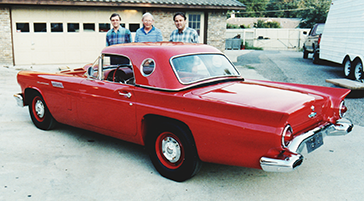
The author’s white 1955 Ford Crown Victoria and black 1957 Ford Thunderbird ready for a road trip along the Mother Road. In the garage is a 1957 Ford Custom 300. Maybe someday.

I still have one of the signs. It hangs on my garage wall amid a lifetime collection of other memorabilia from the golden age of American automobiles surrounding my stable of three mid-50s Fords—any one of them a candidate for completing the aforementioned, highly anticipated bucket list trip.

Traveling Route 66 from one end to the other is a common aspiration of auto enthusiasts like me who enjoy playing with old cars. During the 80s, I managed to set foot on both ends of the “Mother Road,” as it’s been called, on unrelated trips at different times. Also, a portion of it is the route Ronnie Lilly and I took driving from Mount Pleasant to Los Angeles in 1967 in Ronnie’s 1957 Chevrolet. If we knew that we were traveling Route 66 then, I could not say today. But, looking back now, we picked up the iconic highway near Albuquerque where we spent a night and left it around Flagstaff headed to Las Vegas.

Thus, the itch yet to be scratched for traveling Route 66 from one end to the other in one memorable and fun road trip remains. Something I must do before I quit playing.

Won’t you get hip to this timely tip,
When you make that California trip,
Get your kicks on route sixty-six.

—“Route 66” lyrics 1946 by American songwriter Bobby Troup

— Leon Aldridge