Phoning home; 15 years and 35 miles later

“We can only blame ourselves for all the crime and violence today. We removed all the phone booths and now Superman has no place to change.” — Author unknown.

– – – – – –

Comfortably seated at a Nacogdoches restaurant a few years ago, my eyes absorbed the antiques and vintage signs adorning the old warehouse-turned-eatery with historical charm and famous for good food.

I had dined there many times earlier, before a brief detour in the Texas Hill Country. That night, however, my casual scan locked onto one conspicuously familiar piece against a far wall.

“What are the odds?” I murmured.

Fast forward to last week. A KLTV Channel 7 news report on an icon of times gone by reminded me of that night at Clear Springs restaurant. According to the story, bewildered crowds up in Gilmer, Texas were attracted to the strange sighting that prompted calls from curious residents—many of whom confessed they had never seen anything like it.

The tall glass and aluminum enclosure was said to look just big enough for a single person to stand inside; like a huge mannequin in a display case. Inside hung a crude, hard-wired telephone. Passing youngsters called it a donation box or a primitive ATM, before an older gentleman, according to the news report, recognized it and identified it immediately.

“Pay phone,” he stated bluntly. “That was once the only way to make a call away from home.”

Public payphone booths shaped American communication and culture for more than a century. At their peak, they were everywhere. Some crafted from rich mahogany or oak, standing tall like elegant grandfather clocks serving as sentinels of American transit at airports, bus stops, and train stations.

By the late 1950s, wood gave way to sleek glass-and-aluminum structures. In both forms, they were also once the lifeblood of journalism. Hollywood loved the trope of the frantic reporter rushing into a phone booth to dictate a scoop before the printing presses rolled.
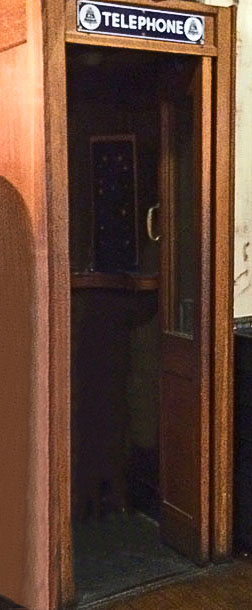
The phone booth that was in the game room at my Center home in the late 1980s as it appeared when I saw it in Clear Springs restaurant in Nacogdoches about 2005.

The last time I personally played that live-action role was in 1997 in Washington, D.C. I was at the Supreme Court building, covering the high court’s hearing of “The City of Boerne v. Flores”—a legal battle over a church building permit and historic preservation about which I had written stories.

Once the courtroom arguments concluded, reporters flocked around attorneys for both sides like swarms of paparazzi on the steps of the majestic building. I snapped a few photos, then sprinted toward the nearest payphone where I dictated the story to Travis, our editor back in Boerne, before overnighting my film.

Thus thanks to an humble payphone, our hometown weekly in Texas broke the news the same day as every major daily.

That was also about the time that the U.S. peaked at more than 2.6 million pay phones. Just before the ruthless communication revolution: cell phones that put a phone booth in everyone’s pocket. The death blow came with the 1996 Telecommunications Act removing subsidies, effectively “hanging up” on phone booths for good.

Today, it’s estimated that fewer than 100,000 examples remain nationwide, like ghostly reminders of an analog world.

Reminded last week of that night in Nacogdoches, I recalled turning to my dining companion and saying, “See that old wooden phone booth over there? I had one exactly like it in the game room of a house I sold in Center back in 1990. Mine was a ‘stand-up’ model from 1937 with phone numbers scratched into the metal near the door.”

Jotting on a napkin, remnants of those numbers as best as I could recall, I then walked across the room with nostalgic anticipation. Reaching the folding glass door, I stepped inside. It was a stand-up model. I recognized the familiar, bare, unshielded fan and light fixture.

I folded the door shut, sealing myself into the quiet chamber. Looking above the door casing, there it was. Stamped clearly in the data plate: 1937. Beneath it, still perfectly legible, were the phone numbers I had just recorded portions of at the table.

Like it was yesterday, I remembered putting my finger in the rotary dial and giving it a spin. Then waiting for the “tick, tick, tick” as it mechanically contacted each digit. The old phone booth I once enjoyed at my house and I were briefly united at a restaurant some 15 years and 35 miles down the road from where I last saw it.

It was like phoning home.

—Leon Aldridge

– – – – – – –

Leon Aldridge is a veteran editor, publisher, and communications professional, currently enjoying semi-retirement while awaiting his next challenge. His columns appear in: The Center Light and Champion, The Mount Pleasant Tribune, the Rosenberg Fort Bend Herald, the Taylor Press, the Alpine Avalanche, the Fort Stockton Pioneer, the Elgin Courier, The Monitor in Naples, and Motor Sports Magazine.

© Leon Aldridge and A Story Worth Telling 2026. Feel free to use excerpts with full and clear credit given to Leon Aldridge and ‘A Story Worth Telling.’

Still wishing for that slower time

“It is strange that the years teach us patience; that the shorter our time, the greater our capacity for waiting.”
— Actress Elizabeth Taylor (1932 – 2011)

– – – – – – –

“I’m going up to W.R. DeWoody’s Western Auto,” I remember my grandfather announcing one summer day in the early 1960s.

Summertime was fun time for a kid at my father’s parent’s house in Pittsburg. Sleeping late. Home-cooked breakfast. Playing in the tree-filled yard. Afternoons sailing homemade boats in the city park pond.

“What for,” Grandmother quizzed, pouring another cup of coffee.

“See if they have a mower part,” was his short response.

“Why don’t you call,” she retorted. “We got a telephone now.” The recently acquired black dial-operated device connected to the wall by a cord sat mostly ignored. Sometimes, even when it rang and my grandparents argued over who was going to get up and answer it.

“I’m not going to answer that thing,” I heard Granddaddy say often. “I can’t think of anybody I want to talk to right now.”

The number was University 8-3721. I think. All that was required for a local call, however, were the last four digits. The University 8 was used only to give the operator when dialing “0” to place a long-distance call. Which my grandparents rarely did because it cost an extra 20 cents. If you kept your conversation under three minutes.

“I’d rather see who I’m talking to,” my grandfather said, responding to the “why don’t you call” question. “Looking at who I’m talking to cuts down on confusion, builds relationships, and teaches patience. Ain’t got time to talk to nobody I can’t look in the eyes.”

Granddaddy was on to something more than lawnmower parts.

The rush between Thanksgiving and Christmas makes me yearn for that slower time. When people had patience. Except for kids looking forward to Christmas.

From an adult’s perspective, time speeds up every year. But a child is born into the world counting the days until Christmas.

Once counted as a virtue, patience appears to be diminishing as the number of loose nuts behind steering wheels keep increasing. Like the story I heard last week about a driver being tailgated by a stressed-out woman on a busy street. When the traffic light ahead turned yellow, the driver in front of her stopped as the light turned red. As he should have.

The tailgater was enraged. Horn honking and hollering at the driver ahead. She was still in mid-rant when a police officer walked up and asked her to get out of the car and put her hands behind her head. She was taken to the station and held for questioning before the police officer told her she was free to go.

“We’re very sorry for the mistake,” he said.  “I saw you honking your horn, gesturing at the driver ahead, and cussing a blue streak. Then I saw the ‘What would Jesus Do’ license frame, the ‘Follow me to Sunday School’ bumper sticker, and the chrome Christian fish symbol and naturally assumed you had stolen the car.   

I laughed, but that recalled an incident my mother encountered years ago. Back when I was a kid counting the days until Christmas. South Jefferson Street in my hometown of Mount Pleasant differed from the busy, booming street it is now. There was no bypass loop then. No shopping Center with a parking lot full of cars. Just three businesses facing the street. The Dairy Bar, a tractor dealership, and Larry Talley’s small neighborhood grocery … without gas pumps. Because there was no such thing then as self-service gasoline.

Mom drove her green-and-white ’54 Chevy under the railroad overpass and slowed at the corner at Boatner’s Furniture. The light was turning yellow as she approached, and being the careful driver my mother was, she stopped just as the light changed to red.

Everything was fine until a honking horn blared behind her. A lady emerged from the car and walked to Mom’s car window while hollering about a carton of broken eggs. A conversation ensued between them about whether yellow means slow down and stop or “floor it and run the red light.”

The discussion was short-lived. The light turned green, and other horn honkers egged them both to get on down the road.

I’m a few years down the road myself since that incident. Christmas is coming again, and I’m, once more, wishing for that slower time. When people had more patience. Took time to relax. Weren’t joined at the hip to a telephone.

My capacity for waiting is better, but I still ask God to grant me patience.

I just ask Him to grant it now … please.

—Leon Aldridge

– – – – – – –

Aldridge columns are featured in these publications: The Mount Pleasant Tribune, the Rosenberg Fort Bend Herald, the Taylor Press, the Alpine Avalanche,  the Fort Stockton Pioneer, the Elgin Courier, The Monitor in Naples, and Motor Sports Magazine.

© Leon Aldridge and A Story Worth Telling 2024. Excerpts and links may be used, provided full and clear credit is given to Leon Aldridge and ‘A Story Worth Telling’ with appropriate and specific directions to the original content.