Nostalgia fires a powerful fuel

“It’s a small world and the older I get, the smaller it gets.”
— Still my favorite saying.

– – – – – –

“Hmmm,” I thought, feeling my Cajun curiosity kick in. “Lacie needs my number?” Lacie and husband, Josh, are friends, therefore I responded quickly.

For the record, wondering about everything is just a part of some Cajun heritage on my dad’s side. As Southern Louisiana humorist Justin Wilson always said, “Us Cajuns… we got a big curious.”

My curiosity was satisfied when I got a phone call. “Leon, you don’t know me …” the missed-message recording began. “Tommy Cheatwood is my friend. He’s got a red ’68 GTO. Me and Tommy have been drag racing for years.”

I did not know the caller, Randy Frazier. But I knew Tommy, Lacie’s father. Either way,, I was all in at “drag racing.” Two cars racing from a standing start, side by side in a straight-line quarter mile to cross the finish line first. Typically enjoyed with loud powerful motors, smoking tires, and breathtaking speeds. Often considered an incurable addiction detected at early ages in kids (and some professed adults) racing between stop lights.

Among drag racers, nostalgia fires a powerful fuel capable of igniting friendships between aging gearheads regardless of the geographical and time distance between them. Bound by memories an era of cheap factory horsepower muscle cars, intoxicating aromas of burning rubber, and unbelievable adrenaline rushes.

This unforeseen twist of fate last week proved just how enduring those memories can be for two guys who were total strangers right up to “Hello…”

In this case, the (former) stranger to me, Randy, is Lacie’s father’s friend, Tommy, who I first met at a car show in Center a few years ago. Lacie’s husband Josh is the son of my also friend and neighbor, Billie Sue Payne. Fun thing about small towns. There are very few true strangers.

As it turned out, Randy was calling me after Tommy said something to him about me and my drag racing days with an Oldsmobile muscle car. Wondering if we might have coincidentally been at the same tracks back then.

Once Randy and I connected, we wasted no time reminiscing in the universal language of fast cars and habit-forming horsepower. And the more we rambled about ol’ racing days, the closer we got to confirming Randy’s speculation. That we probably did, in fact, wrench on fast cars and chase elapsed-time records at some of the same drag strips now lost to history.
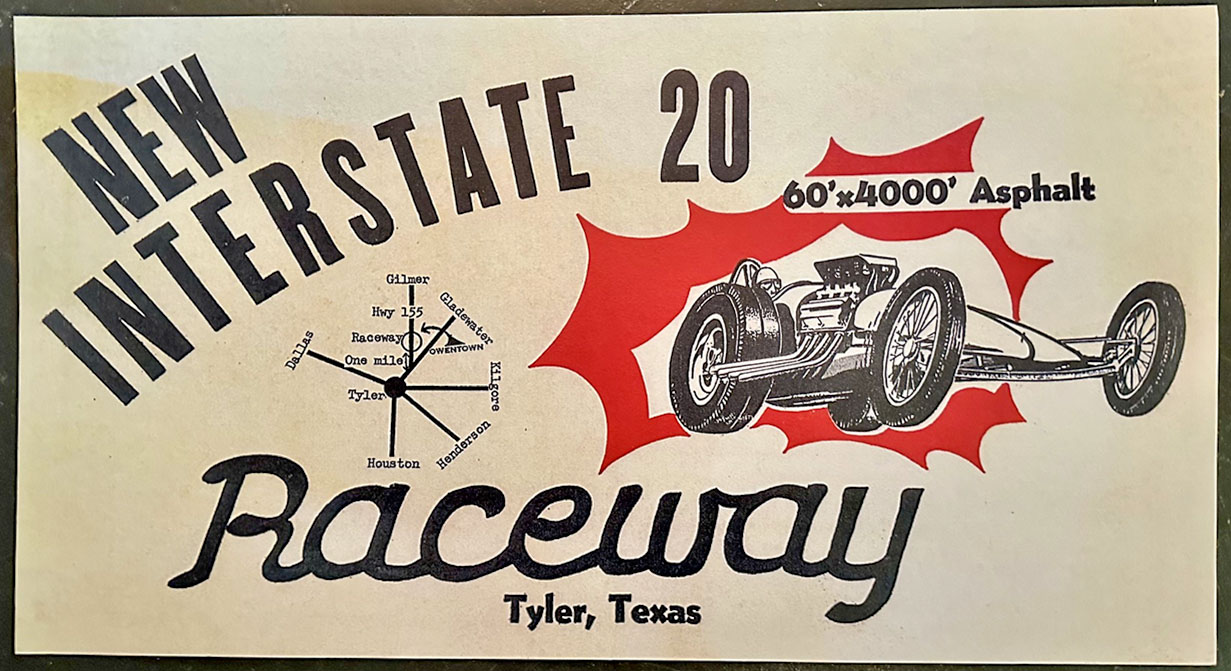
Places like Interstate 20 Raceway on US 155 northeast of Tyler. Where I stopped to pay homage a few years ago to the site that once welcomed big name racers and small-town hopefuls every Saturday night. Gone were any obvious clues of the once well-known drag strip that opened in 1961, but knowing eyes recognized a faint path of asphalt remnants where a well-traveled quarter mile once ruled.

No such luck, however, for the short-lived world-class Dallas International Motor Speedway that opened in 1969 on I-35 near Lake Lewisville. Retail expansion and Dallas urban sprawl long ago obliterated any sign of the track that once hosted nationally known competitors lining up in front of the iconic tower. Back when that area was all open fields and farmland.

Shortly after we finished bouncing names of old cars and drivers back and forth, Randy sent me digital video he captured on 8mm home movies made at Interstate 20 Raceway in August of 1969.
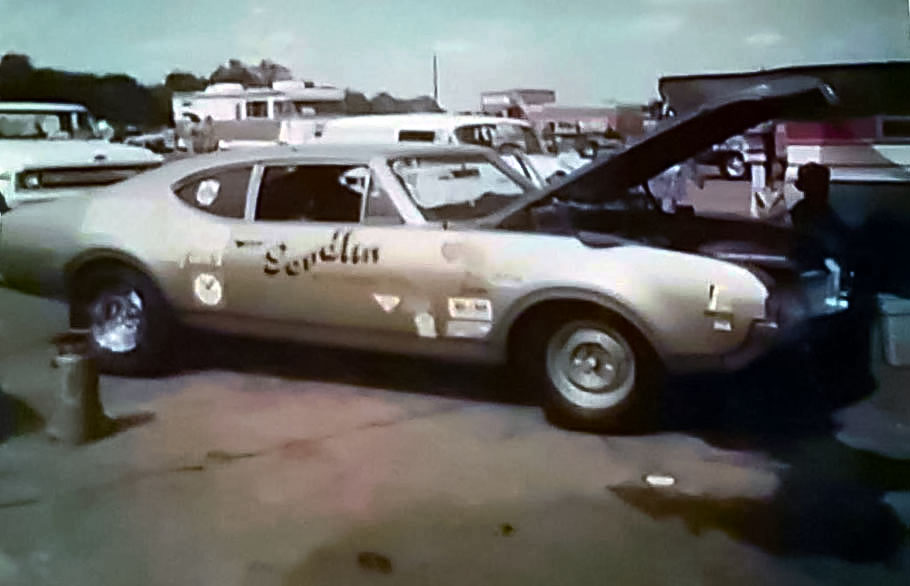
“See if you recognize your car,” he wrote. It didn’t take long. Just eighteen seconds into the flickering footage, there I was. Faded images of my storied old race car in our glory days. Then another glimpse a minute later in the staging lanes and one more leaving the starting line. “Precious memories” immortalized in home movies by someone I could have shaken hands with that night but would not meet for decades to come.

More than just a blast from the past; this was a vivid reminder of days spent squeezing every bit of power from race-prepped motors; winning and losing races by hundredths of a second. Reliving the craving for power and speed that defined me before I was old enough to drive.

Forging friendships back then that have remained, and still creating new friendships from old film clips.

Mesmerizing movie moments last week, melting away decades to discover small world moments. Triggering more of my Cajun curiosity questions, wondering …

“I ran the NHRA Spring Nationals at Dallas in ‘71. Were you there? Do you remember …?”

—Leon Aldridge

– – – – – – –

PHOTO – Top: August 1969 image captured from Randy Frazier’s home movies. First outings at Interstate 20 Raceway for me and my 1969 Olds W-31 destined to become a race car. Randy was there. We could have shaken hands that night, had we known.

PHOTO – Middle: Vintage poster advertising the “all new” Interstate 20 Raceway” near Tyler, Texas that opened in 1961.

PHOTO – Bottom: Me and my 1969 Olds W-31 again, this time in 1971 at the NHRA Spring Nationals at Dallas International Motor Speedway in June of that year. Randy was there, also. Little did we know.

Leon Aldridge is a veteran editor, publisher, and communications professional, currently enjoying semi-retirement while awaiting his next challenge. His columns appear in: The Center Light and Champion, The Mount Pleasant Tribune, the Rosenberg Fort Bend Herald, the Taylor Press, the Alpine Avalanche, the Fort Stockton Pioneer, the Elgin Courier, The Monitor in Naples, and Motor Sports Magazine.

© Leon Aldridge and A Story Worth Telling 2026. Feel free to use excerpts with full and clear credit given to Leon Aldridge and ‘A Story Worth Telling.’

It’s a small town, after all

“It’s a small town, son. And the news travels quicker than wheels.
—”Talking at the Texaco” song lyrics by James McMurtry.

– – – – – –

Driving west for an Abilene wedding 20 years ago, I did something that still brings me joy: taking impromptu detours off the designated route. Sometimes to satisfy curiosity. Other times, just to say, “I’ve been there.”

Searching last week for a source to get my hands on a copy of Tracy Daugherty’s new biography, “Western Star: The Life and Legends of Larry McMurtry,” reminded me of that road trip detour to Archer City, Texas. Hometown of the Pulitzer Prize-winning author.

Archer City is a small town—1,600 people small, give or take a few—where I’m sure news does travel faster than wheels as suggested by McMurtry’s singer-songwriter son, Larry McMurtry. It’s not on the road to anywhere, unless you’re traveling State Highway 25 between Wichita Falls and Olney. Then you’ll find Archer City, where 25 intersects State Highway 79. Close to Seymour, one of many small towns my family called home before settling in Mount Pleasant.

I wanted to see Archer City for two reasons. One: McMurtry’s bookstore. Once one of the largest bookshops in the country, “Booked Up” filled four downtown buildings, reportedly housing close to half a million books.

Another was the Royal Theater featured in the movie based on my favorite McMurtry novel, “The Last Picture Show.” It was filmed in and around Archer City, where my walking around that day was like stepping onto a film set. Where vivid visions of the gas station, the pool hall, the theater, and the novel’s characters surrounded me.

“Booked Up” buildings lined the streetscape. Assuming the largest was the main collection, I wandered inside. The door had barely closed behind me before the building whispered, “old car dealership.” Loving old cars almost as much as old books, floor-to-ceiling showroom windows and the obligatory parts department counter on the back wall were obvious giveaways for me.

Sitting at the one-time parts window was a young lady. She smiled. We made eye contact and exchanged soft-spoken “hellos” before I noticed bookstore “dos and don’ts” posted on a nearby wall. One with large black type caught my eye. In essence, it declared that after many years in the spotlight, Mr. McMurtry wished not to be disturbed, and that he no longer accepted requests for photos or autographs. The explicit notice concluded, “So, please do not ask.”

Seeing no one else or nothing more there, I followed a directional sign to what was unmistakably once the service department. High ceilings. Concrete floors. Roll-up doors at both ends. Now filled with endless rows of bookshelves higher than I could reach, divided by narrow aisles. A veritable book heaven.

Browsing the stacks in awe left me intoxicated by the aroma of old paper and mesmerized by countless volumes of history, romance, drama, history and goodness knows what else. Remembering however, that I had a wedding to attend, I made my way back to the “showroom” where an older man was now sitting alone, reading and taking notes. Looking through the large widows at the street outside for a moment, I turned back for a better view of the gentleman who never looked up.

“No,” I thought. “Can’t be.” Trying not to stare, I looked at “parts department lady.” She grinned, nodding yes, as if in answer to my unspoken question. But there was that sign again. “… so, please do not ask.” Looking her direction again, I saw her still smiling. This time, a sad smile while pointing to the sign.

With respect, I gave her a sigh and a silent “thumbs-up thank you.” Then I looked one more time before leaving, at one of the great authors of my time, in the same room with me, seemingly oblivious to the world around him.

McMurtry died in 2021. Most of the inventory of books were sold. One bookstore building remains as the McMurtry Legacy Center. And still standing is the restored Royal Theater.

I found Archer City to be more than McMurtry’s legacy, however. More than an inspiration for his works. It’s a small town, after all. The kind I enjoy detouring just to visit. Where, as the characters in McMurtry’s novels reflect, the more life changes, the more it stays the same.

And a place about which I can say, “I’ve been there.”

“Hey, what’re you up to? I already know.
I heard the boys talking at the Texaco.
It’s a small town, son.”

– – – – – – –

— Leon Aldridge

Photo above: Downtown Archer City, Texas, and the Royal Theater used in the movie “The Last Picture Show” from Larry McMurtry’s book by the same name.
Credit: Creative Commons / Photo by Rene Gomez
At: commons.wikimedia.org/wiki/File:ArcherCity5_(1_of_1).jpg#filelinks
Original color photo unedited but converted to black and white.

Leon Aldridge is a veteran editor, publisher, and communications professional, currently enjoying semi-retirement while awaiting his next challenge. His columns appear in: The Center Light and Champion, The Mount Pleasant Tribune, the Rosenberg Fort Bend Herald, the Taylor Press, the Alpine Avalanche, the Fort Stockton Pioneer, the Elgin Courier, The Monitor in Naples, and Motor Sports Magazine.

© Leon Aldridge and A Story Worth Telling 2026. Feel free to use excerpts with full and clear credit given to Leon Aldridge and ‘A Story Worth Telling.’

Some things never change

“The good physician treats the disease; the great physician treats the patient who has the disease.”
— William Osler (1849 -1919), one of the founding Johns Hopkins Hospital professors and creator of residency programs.

– – – – – – –

“Come in Dr. Reitz.” With those words, my grandmother welcomed the Pittsburg, Texas, family physician of many years into her home. “Thank you for coming. S.V. isn’t feeling well; he’s coughing and feverish.”

Sylvester Aldridge was my grandfather’s full legal name. No middle initial. Why she called him S.V. was a question I never thought to ask.

The good doctor pulled a chair next to the bed, opened his small black bag, and took out a tongue depressor and a thermometer. “I expect your fruit trees will be blooming before long,” he small talked with my grandfather.

Standing silently at the edge of the room, I was just tall enough to peek over the windowsill. The physician’s shiny new 1951 Chevy sitting in the driveway caught my eye. When I looked back at him, we made eye contact. I can still hear his deep voice say, “My, you’re getting to be a big boy.”

Dr. P.A. Reitz had delivered me into the world a little more than three years before that day. On a cold January 20, 1948, evening at the M&S Hospital he founded in Pittsburg. I don’t remember much about that day, but I was told light snow was falling outside.

I do remember house calls, once a common convenience by small-town physicians that slowly slipped into the past in the years that followed. A time when doctors wore suits and ties in the clinic and for house calls. And nurses wore white uniforms and caps. When “scrubs” were seen only in operating rooms.

Much of my childhood healthcare fell to Dr. Reitz. Dad’s years with Perry Brother’s five-and-dime stores moved us from one small Texas town to another before Mount Pleasant became the last stop. Many of my summer days, however, were still spent at my grandparents’ house.

“He’s going to need some stitches, Mrs. Aldridge.”

The wound for which I still display a scar on my head was inflicted during an afternoon of friendly playtime. Granny was enjoying afternoon coffee inside with her friend, Mrs. Martin. Outside, Mrs. Martin’s grandson and I whiled away the time with comic book fantasies. I don’t remember if I was the good guy or the bad guy, but I became the wounded guy when the other youngster got the drop on me with a piece of pipe. From atop a car in the driveway.

“Get a good grip on him,” Dr. Reitz cautioned my grandmother. His recall of my extreme dislike for doctors wielding needles was impeccable.

Those aged memories offer a different perspective on healthcare of today. Opinions abound, but popular views rival genealogical histories of Biblical proportions.

“Therefore, in all the days of medicine, throughout the land, specialization begat doctors passing small towns for big cities; and that begat the decline of rural hospitals; which begat small towns with clinics staffed by P.A.s and nurse N.P.s who take care of routine exams and illnesses begatting acute cases to emergency rooms or specialists.”

In bigger cities.

– – – – – – –

Dr. P.A. Reitz, one of Pittsburg’s best known, most respected and beloved citizens, died at M&S Hospital early Monday morning after suffering a massive heart attack,” the 1978 newspaper article in my archives read.

The yellowed paper news story bore no attribution. I suspect from the heartfelt and personal tone used by the writer, it might have been published by Pittsburg’s long-time local newspaper, the Gazette.

Dr. Reitz was born April 18, 1904, in Kansas. He moved to Pittsburg in 1935. He was a graduate of the University of Nebraska Medical School and completed his internship at Parkland Hospital in Dallas. He served in the U.S. Army in Europe during World War II.

“He was a family doctor for 43 years …” the story shared. According to the newspaper tribute, Dr. Reitz gave M&S Hospital to the citizens of Pittsburg in 1968.

“The business community closed Thursday afternoon for his funeral at the First Methodist Church,” the clipping concluded. “Interment was at Rose Hill Cemetery.”

I still visit Dr. Reitz … in a manner of speaking. My father and mother, Leon and Indianola Aldridge, are buried at Rose Hill Cemetery. Right next to Dad’s parents, Sylvester and Hattie Lois Aldridge.

Just across the narrow lane at the Pittsburg cemetery, maybe 50 feet away, are the graves of Percy. A. and Hazel Reitz.  

I miss small-town hospitals with doctors’ offices in or near the facility. Doctors who made house calls and knew their patients like family. That said, I get it that change and adaptation are inevitable aspects of life.

Some things never change, though. Like needles. I still don’t like needles.

And I still don’t know why Granny called my grandfather S.V.

—Leon Aldridge

– – – – – – –

Aldridge columns are featured in these publications: The Center Light and Champion, The Mount Pleasant Tribune, the Rosenberg Fort Bend Herald, the Taylor Press, the Alpine Avalanche,  the Fort Stockton Pioneer, the Elgin Courier, The Monitor in Naples, and Motor Sports Magazine.

© Leon Aldridge and A Story Worth Telling 2025. Excerpts and links may be used, provided full and clear credit is given to Leon Aldridge and ‘A Story Worth Telling’ with appropriate and specific directions to the original content.