Angels always close to us

“There is an angel close to you this day. Merry Christmas, and I wish you well.”
—Paul Crume (1912 –1975) Dallas Morning News columnist who wrote a front-page column every day for 24 years.

– – – – – –

As I sit crafting one more Christmas column, I do it relishing in the blessing of memories and personal traditions. Which means one more time, I’ll read my favorite Christmas columns from the work of long-time Dallas Morning News editor Paul Crume.

One, entitled “Christmas Fires,” I will still read this year, despite un-Christmas like 70-degree weather. The other, “To Touch an Angel,” was first published on Christmas Day of 1967 and is still published every Christmas in the Morning News as “Angels Among Us.”

I believe Angels are among us all the time. During this time of the year, reminders of them are seen everywhere on Christmas trees. The tree top angel at my house put in for vacation this year, so there’s a gnome filling in. But I know angels are still around.

Christmas has always been a magical season for me. Special times steeped in the comfort of family and loved ones gathering. Sharing a meal. Laughing. Being thankful to our Creator.  

Times like the Christmas living on the lake when Santa brought us all bicycles. My kids and I enjoyed Christmas morning peddling cheer along county roads around Lake Murvaul.

Then there’s the time we spent a snowy family Christmas in the mountains of Taos, New Mexico. Skiing days and enjoying a tiny tree with gifts, celebrating in our room at the lodge. Magically, Santa still found us.

And how many times have I smiled, recalling the Christmas when my incredibly artistic daughter, Robin, gathered up empty boxes and crumpled paper after gifts were opened, taking it all to her room. It was a while before I discovered she had left new toys under the Christmas tree while replicating Elvis’s Graceland home from the scavenged materials.

It was another 1980s Christmas Eve in Center when I used on my own children, an admonition that my grandmother once used on me. “You better go to sleep before Santa comes.”

Assuming my children were deep in dreams of the Jolly Old Elf, I tackled boxes bearing “Some Assembly Required.” Thinking, “This won’t take long.”

Pushing midnight, the Little Homemaker play kitchen was done, inserting the last tab A into slot 4 and securing with one #6 bolt and one #9 nut. Then came the tricycle, the doll stroller, and stocking stuffers. Just in time to experience the magic of an early Christmas morning sunrise.

Watching my children experience Christmas morning always reminded me of Christmas dawning in Mount Pleasant one 1960s Yule season when I heard a soft voice at my bedroom door. “You think he’s come?”

As the elder sibling realizing that Santa was more than mere magic, my trust became helping preserve the mystery for my younger sisters.

“I don’t know,” I told my youngest sister, Sylvia. “Let’s go see.” With middle sister Leslie also up and curious, we peeked into the living room. Changing colors projected Christmas magic onto the shiny aluminum tree. Under it, a collection of unwrapped gifts glittered in the early morning light.

“I think he’s been here,” I said.

And, about that Christmas Eve warning I borrowed from my grandmother. As a child, Christmas was a time of anticipation. The excruciating wait for Christmas to finally get here. Then waking up Christmas morning, excited to see what St. Nick had left.

We moved a lot back then. Perry Brothers five-and-dime store managers were relocated more often than Methodist ministers. Four times by the time I was in fifth grade. Traveling to East Texas for Christmas made updating forwarding addresses for Santa a full-time job.

There was magic in my grandmother’s bedtime stories on Christmas Eve with her frequent reminders that, “You better go to sleep before ‘ol Santy comes.”

If her stories didn’t put me to sleep fast enough, she typically turned off the bedside lamp, pretending to hear reindeer on the roof.  And I pretended to be asleep, still wishing it were Christmas morning.

My wish for each of you is the same as every year. That you are blessed with the wonderful magic of Christmas, both making memories and reminiscing about them.

In the company of angels close to us.

—Leon Aldridge

– – – – – – –

Aldridge columns are featured in these publications: The Center Light and Champion, The Mount Pleasant Tribune, the Rosenberg Fort Bend Herald, the Taylor Press, the Alpine Avalanche,  the Fort Stockton Pioneer, the Elgin Courier, The Monitor in Naples, and Motor Sports Magazine.

© Leon Aldridge and A Story Worth Telling 2025. Excerpts and links may be used, provided full and clear credit is given to Leon Aldridge and ‘A Story Worth Telling’ with appropriate and specific directions to the original content.
My hometown

“Home is not a place … it’s a feeling.”
—Uncredited bit of wisdom I picked up years ago.

– – – – – – –

“So, where’s home,” asked the man whose hand I was still shaking. A mutual friend had just introduced us as we all met for lunch at a local restaurant.

“East Texas,” I replied with a smile. “I live in Center, but I grew up in Mount Pleasant. I claim them both as my hometown.”

Even as I said it for the umpteenth time, that statement still sounded somewhat unusual. Odd that I’ve had a Center mailing address through a dozen presidential terms, and while my home in Mount Pleasant years ago was a fourth of that, I still call it my hometown. And what about the various Texas communities where we lived before settling in Mount Pleasant to stay when I was eleven?

Someday, I’ll examine the paper trail in a cardboard box full of evidence of my parents’ pilgrimage from the time before my own memories began. A collection of letters, receipts, car registrations, repair bills, church bulletins, report cards, and black-and-white school pictures.

It wasn’t until after my mother’s death that I realized she had amassed this veritable family history in her cedar chest. I guess I owe her thanks, or maybe the blame, for my own tendency to hang on to similar seemingly worthless pieces of paper.

My family’s last move to Mount Pleasant was just in time for me to finish fifth grade at South Ward Elementary. But evidence in Mom’s hoarded documents hints at previous addresses in Ballinger, Muleshoe, and Midland. Plus, Pampa up in the Panhandle.

My first and oldest cognitive connections from around the age of three or four are of Pampa. I also remember Crockett where we lived next and where I entered first grade. A move to Seymour, Texas, followed where I completed third and fourth grade, and all of fifth grade except those last few weeks spent in Mr. Mattingly’s home room in Mount Pleasant.

So, I contemplated, what really qualifies one place over another as “my hometown?”

To me, it’s where our heart was first grounded. Places we associate with the “firsts” in life, such as our first friends. Friends remembered from fifth grade in Seymour are tall, skinny Joe, with whom I played basketball at recess. Mike, a neighbor I rode bicycles with to the park. And Carolyn, the first girl I exchanged valentines with in fifth grade.

Many firsts became memories in Mount Pleasant. Some with those end-of-the-year fifth graders from South Ward when we graduated from high school together seven years later. And some of those graduates who became college roommates and long-time friends beyond high school.

First dates, first jobs, my first car, and house—those memories all began in Mount Pleasant.

“Home is sometimes a place you grow up wanting to leave and grow old wanting to return to,” I added to the lunch conversation. I thought about Mount Pleasant, and how after college, I tried to plant roots there twice. But that path just wasn’t in the cards.

I took the path more traveled, rooting in Center many years ago. Enough years to see my children begin school and make their first memories. Enough years to amass many friends and loved ones, and to lose some of both. Enough years to have tasted happiness and to endure heartache.

And even enough years to see good eating establishments come and go. Which is where this missive started. Over lunch.

“So, while my home has been in Center for most of my life, I also consider Mount Pleasant my hometown,” I concluded, thinking about some of my “trips home.”

I return occasionally. Navigating new highways and bypasses makes driving more stressful than it was when I learned to drive there. And, though the old streets are familiar, the places and the faces have constantly changed over time. while the memories of “firsts” linger there like it was yesterday.

“I never thought about having two hometowns,” my new acquaintance offered as we worked on chips, salsa, and sweet tea.

“Yeah,” I drawled. “I think home is anywhere we leave a piece our heart.

“Because hometown is not really a place … it’s a feeling in the heart.”

—Leon Aldridge

(Photo info: My youngest sister, Sylvia, on the front porch at 206 Redbud Lane in Mount Pleasant, Texas, “home and hometown” to me and my sisters Leslie and Sylvia. There is no date on the photo, but I’m guessing about 1962 or ’63. I have no clue what she was modeling on her head. It may or may not have had anything to do with what appears to be Easter baskets behind her. The house that was our home is still there today, but it’s been extensively remodeled and doesn’t look the same as I remember it. Sylvia moved to her eternal hometown December 14, 2023. )

– – – – – – –

Aldridge columns are featured in these publications: The Center Light and Champion, The Mount Pleasant Tribune, the Rosenberg Fort Bend Herald, the Taylor Press, the Alpine Avalanche,  the Fort Stockton Pioneer, the Elgin Courier, The Monitor in Naples, and Motor Sports Magazine.

© Leon Aldridge and A Story Worth Telling 2025. Excerpts and links may be used, provided full and clear credit is given to Leon Aldridge and ‘A Story Worth Telling’ with appropriate and specific directions to the original content.

Write so that memories live on

“Tell me facts, and I’ll learn. Tell me truth, and I’ll believe you. But tell me a story and it will live in my heart forever”
— Native American Proverb”

– – – – – – –

We became gas pump neighbors one afternoon a few days ago.

You know, people we meet while watching numbers on the gas pump climb higher than an August afternoon heat index. Exchanging smiles with strangers at the pump while we’re trying to remember where we needed to be ten minutes ago … before remembering that we forgot to gas up last night.

That’s what we do because we were raised to be kind; to be friendly. “Don’t be stuck up,” Mom instructed. Friendliness mission accomplished, I returned to watching pump numbers escalate.

That’s when my new gas pump neighbor engaged me. “I enjoy your stories in the paper.” I did the next thing we were raised to do. Be polite … and don’t let on like you don’t know who they are. “Hey,” I said, buying time. “How’s it going. And thank you, I appreciate you reading my weekly ramblings.”

You have more stories than a book has pages,” he laughed. “I love ‘em. Are those all of those stories real?”

“Sure,” I scoffed. “You can’t make up stuff like that. “Mostly memories,” I added. “Things that happened growing up. Something I remember from a few years ago; a few days ago.”

“Well, I enjoy reading them,” he smiled. “Keep it up.”  

“Thank you,” I said again. “We all share many of the same basic memories. Only the people and the places change. All stories just waiting to be told. I’ll bet you have a story.”

He laughed, and we parted ways going in different directions. The exchange was another reminder of the importance of memories and the value of capturing them. Documenting them. Sharing them as often as possible. Something that didn’t dawn on me until a long time after I had been getting paid to write them.

I probably owe the credit for that to one of my journalism students at Stephen F. Austin State University, a generation of young writers ago.

Charged with imparting writing skills, tools and techniques to aspiring journalists, I enjoyed challenging young minds to find and write their first story. “Everybody has a story,” I offered one day to end a lecture period. “They may not know they do, but that is your first challenge. Strike up a conversation and just listen.”

“That’s easy for you to do,” countered one student. “You have age and experience, and you know a lot of people. It’s not that easy for someone our age.”

“Listening and understanding have no age requirements,” I replied. “Ask questions about what they remember from growing up. About their proudest moments. What they hope to achieve in the years to come. Talk about dreams. Then, be quiet and listen with appreciation. You’ll hear more stories than you can write.”

Long time newspaper mentor and friend Jim Chionsini executed the storytelling technique to a fine art. For instance, when asked for suggestions on the best way to tackle a tough situation at work, he often replied with a story rather than an explanation. “Well, let me tell you how Les Daughtry down at the Galveston News handled issues like that.”

It was also Jim who distinguished between memories that made good stories for publication from the few that are often better left unpublished. “Just because something we did was a bad idea doesn’t mean it isn’t a good memory,” he would laugh. “Just keep those kind among friends.”

Our stories, whether published or simply shared with friends and family, need to be told. And that’s where the value of memories takes root. We all should be writing. Preserving snapshots of our past, moments in our minds, tidbits of history that go untold and lost to time unless we write about them.

That, in my estimation, is the most significant challenge that has no limitations in terms of experience or age for writers. Everyone has a story. Most of us have many. I write as many as I can for weekly columns. And I write some of those just for my personal files, too. But I write so that memories will live on. For family and friends after I’m no longer able to write them.

We all have stories. Even my new gas pump neighbor had one. I’ll be writing his, too.

—Leon Aldridge

– – – – – – –

Aldridge columns are featured in these publications: The Center Light and Champion, The Mount Pleasant Tribune, the Rosenberg Fort Bend Herald, the Taylor Press, the Alpine Avalanche,  the Fort Stockton Pioneer, the Elgin Courier, The Monitor in Naples, and Motor Sports Magazine.

© Leon Aldridge and A Story Worth Telling 2025. Excerpts and links may be used, provided full and clear credit is given to Leon Aldridge and ‘A Story Worth Telling’ with appropriate and specific directions to the original content.

I still remember both

You’ll never relive the moment you got your first car. That’s it, that’s the highest peak… it has a lot of meaning to me” —George Lucas, American filmmaker best known for Star Wars and Indiana Jones.

– – – – – – –

Cooler evenings a couple of days last week were a nice break from summer’s sweltering heat. But don’t be fooled. Mother Nature plays tricks in East Texas, teasing that there will actually be a real fall.

Cool breezes were just enough, however, to entice me into the garage where my ’50s vintage first-love cars spent the hot summer. The garage where I connect to motoring memories dating back some 60-plus years ago when I bought my first car.

Memories of first cars and first dates have been an American phenomenon for generations. Typically beginning with captivating garage aromas—gasoline, motor oil, chrome polish, and unique interior fabric scents lingering longer than the finest French perfume. Or at least until the fragrance worn by your first date in your first car.

Memories of my first car are somewhat more vivid than those of my first date. But that’s no reflection on the attractive young lady who first caught my eye at Mount Pleasant High School. After all, she was the first to take my mind off cars long enough for me to make a stammering attempt to ask her out for a date.

Still, I must admit that my first date memory moments pale ever so slightly in comparison to the time I laid eyes on the first automobile I envisioned as mine. That dark blue 1951 Chevrolet Styleline DeLuxe. Sitting at Rex Kidwell’s Fina Station on South Jefferson Street in Mount Pleasant, Texas.

Everybody knew Rex. The friendly service station proprietor with autographed black-and-white photos of country music stars on the walls. Most of them signed, “To Rex …”

Where customers were always greeted with a smile, gas was pumped while they sat in the car, the oil checked, the windshield washed, and the floor mats hand swept with a whisk broom, one just like every service station attendant used to keep in his back pocket.

And all that for about 30¢ a gallon.

That service was standard for everyone. Not just customers filling up with ethyl gas and getting change from a five. The “Gim’me a dollar’s worth of regular ‘til payday, please,” drivers received the same treatment.

I was no stranger to driving when the car at Rex’s turned my head. My father and grandfather had groomed me in driving skills since I was 12 years old. I made it legal at 14 by taking driver’s ed, the minimum age for becoming a licensed driver in Texas in 1963.

Stopping at Rex’s station on the way home to gas up Dad’s car that night, I saw the old Chevy. It was love at first sight, gleaming in the spotlight beside the building.

Rex was known for acquiring pristine used cars meeting his standards of ‘nice,’ and parking them at his station with a ‘for sale’ sign.

With some meager money pocketed from my after-school job at Beall’s department store and an interest-free loan from my grandmother repaid at five dollars a week, I was back the next day with the $250 asking price in hand.

If I live to be 100, I will never relive that moment of driving home in my first car during my sophomore year at MPHS.

As time and money permitted, personal touches were added. A split manifold with dual exhaust and glass-pack mufflers from Redfearn’s Automotive. Baby moon hubcaps from the J.C. Whitney catalog.

My first car got me to school, to work, to Saturday night drag races, and to church on Sundays. It was a participant in many nights of cruising fun between the Dairy Queen and “Bobby Joe’s,” aka the Dairy Mart, located at opposite ends of town.

Last but not least, it was a trustworthy mode of transportation for a Saturday night at the Martin Theater to see “Goldfinger,” the third film in the James Bond series. With my first date.

Visiting in Mount Pleasant a few years ago, I happened to see her coming out of a store where I was going in. We spoke briefly, and I wondered if she remembered that she was my first date all those years ago. Or if she remembered my first car.

I still remember both.

—Leon Aldridge

– – – – – – –

Aldridge columns are featured in these publications: The Center Light and Champion, The Mount Pleasant Tribune, the Rosenberg Fort Bend Herald, the Taylor Press, the Alpine Avalanche,  the Fort Stockton Pioneer, the Elgin Courier, The Monitor in Naples, and Motor Sports Magazine.

© Leon Aldridge and A Story Worth Telling 2025. Excerpts and links may be used, provided full and clear credit is given to Leon Aldridge and ‘A Story Worth Telling’ with appropriate and specific directions to the original content.

The picture looks great in her house

“City people make most of the fuss about the charms of country life.”  
— Mason Cooley, American writer and educator 1927-2002

– – – – – – –

“Which one do you like?”

The request for consultation from a friend trying to decide between two pieces of artwork was noted. One, a small country farmhouse with a red barn. The second, a white frame country church building.

“I like them both — either will complement the art in your house,” I offered, trying to be helpful but not persuasive. “Visualize each one in your house for a moment; the better choice will come to you.”

Art, like beauty, is the eyes of the beholder. My art collection, I like to call “an eclectic extravaganza.” Some pieces by recognized artists. Some by obscure unknowns. A few, my own personal work from another lifetime spent earning a degree in art.

Likewise, appreciation for where we choose to live is defined by personal tastes and experience. “I like the country farmhouse picture,” my friend smiled. “I wonder sometimes what it would be like to live on a real farm.”

Country life, from a city perspective, often seems charming. Farming, however, is dedication and hard work. I learned this as a city kid in the early 1950s, spending time at my country friend’s house.

His family lived on a muddy county road in deep East Texas near Crockett. Where a dirt driveway circled a huge oak tree. A gate on the left led to the simple four-room farmhouse, and another on the right connected to a cow pasture and hay meadow. Beyond the tree was a shed sheltering a well-worn Ford 8N tractor and an equally used GMC one-ton flat-bed truck, both of late 1940s vintage.

The truck was the only vehicle the tenant farming family owned, serving double duty as a work vehicle and the only means of transportation to town for Saturday provisions or to church on Sunday.

The old frame house sat up off the ground with nothing to keep a cold North wind from blowing under it. Except a couple of hound dogs calling under the house their home that delighted in barking at anything that moved … and some things that didn’t.

A well-worn path from the back door forked about halfway across the yard. One way led to the smokehouse where pork was cured. The other, more heavily traveled trail passed the firewood stack on the way to the outhouse. Also known as the privy. The “John.” Predecessors to indoor porcelain bathrooms with running water.

In fact, the only indoor plumbing was a hand-operated well pump at the kitchen sink. Electricity was limited to four bare bulb lights, one hanging from the ceiling in each room. Heat was supplied by a wood-burning stove in the kitchen and a small fireplace in the living room.  

A telephone was still on the “maybe someday” list. A television was just a dream.

Air conditioning? A rare commodity anywhere in the early 1950s. The few businesses that had it boasted of the luxury, enticing customers with “refrigerated air” signs in their windows. However, it was enjoyed in very few homes then, especially rural farmhouses.

My initial experiences of country life, all those years ago, included many memorable firsts. Things like riding on a horse. On a tractor. And on the back of a flatbed farm truck.

It was also the only time I took a Saturday night bath in a number three washtub in the middle of the kitchen floor. And my first time sitting in a hot outhouse on a summer afternoon listening to dirt dabbers buzzing.

It was also where I saw family love and friendship. Dedication and hard work. Where I enjoyed home-cooked meals in the most literal sense of the word. Vegetables from the garden, milk from the cows, meat from the smokehouse. Where raising crops, cattle, and farm products was not only their livelihood, but also their means of providing food for the table.

Granted, farming and farm living have changed immensely since my so-called city boy childhood experiences eons ago. For the better, thankfully. But many good memories of those brief farm living experiences remain.

Except for outhouses. Those are probably best left to humorous stories and a sense of gratitude that they are gone.

My friend made her artwork selections last week, and we were off to dinner. I had silently picked my favorite; had I been buying one — the church picture. Because without country churches, family farms would be vastly different, yesterday and today.

By the way, the canvas of the country church looks great in her house.

—Leon Aldridge

– – – – – – –

Aldridge columns are featured in these publications: The Center Light and Champion, The Mount Pleasant Tribune, the Rosenberg Fort Bend Herald, the Taylor Press, the Alpine Avalanche,  the Fort Stockton Pioneer, the Elgin Courier, The Monitor in Naples, and Motor Sports Magazine.

© Leon Aldridge and A Story Worth Telling 2025. Excerpts and links may be used, provided full and clear credit is given to Leon Aldridge and ‘A Story Worth Telling’ with appropriate and specific directions to the original content.

Should I update my picture?

“Things that make you go ‘hmmm.’”
— Arsenio Hall, actor, comedian, and talk show host

– – – – – –

Interesting and surprising turns of events. Seemingly unrelated occurrences connecting in unexpected ways. Things that make you go, “hmmm!”

“You don’t know me,” said the man approaching the table where I was sitting. “But I recognize you. You look just like your picture.”

“Oh man,” I thought to myself. “Didn’t post offices stop displaying wanted posters a long time ago?”

We were both guests at a 50th wedding anniversary celebration in my hometown of Mount Pleasant a couple of weeks ago. He was family. I was longtime friends of the celebrating couple.

“My name is Gerald Hampton,” he said. “I read your column. You look just like your photo.”

“Nice to meet you,” I said, standing to shake his hand. “I know another Gerald Hampton. From Naples.”

“I’ve heard of him,” the Gerald Hampton standing in front of me said. “But I’ve never met him.”

“Really nice guy,” I replied.

“You know, it’s funny,” I said. “That you recognized me from my picture. Met a nice lady a few minutes ago who said she heard someone mention my name and wanted to tell me she reads my column. Then added, ‘But you don’t look like your picture.’”

“Gerald Hampton in Naples is a really nice guy,” I said again as we chuckled about the photo story. “I met him many years ago, working my first newspaper job as a photographer and reporter at The Monitor newspaper in Naples.

“Gerald’s day job was fireman at a plant near Texarkana,” I said, sorting through old memories. “It might have been the Lone Star Army Ammunition Plant. That one shut down some years ago.

“Gerald also had a sideline business as the local printer. He had a small shop just off Main Street. Back when almost every small town had someone that printed things like letterheads, business cards, and invitations.

“He was a longtime good friend of Monitor publisher Morris Craig,” I continued, “and was in the newspaper office on a regular basis. I want to think he and Craig may have also worked together at The Monitor. When it was owned by Lee Narramore.

“I do know he was also a co-founder of The Printing Factory in Naples,” I said as my memories trailed off for a moment.

“I never met him,” the Titus County Hampton said. “But I’ve heard good things about him. And I do have a story about him. My wife asked me about a bill from Sears one evening some years ago. I told her I hadn’t bought anything from Sears recently, and she said, ‘Well, we got a bill from them for two bicycles.’”

Hampton said when he checked with Sears, he learned it was the Naples Gerald Hampton who made the purchase that was mistakenly billed to their account.

Following that visit a couple of weeks ago, other memories about Gerald Hampton in Naples came to mind. Things like walks down Naples’ Main Street. Going to the post office to get the mail… sometimes glancing at the wanted posters. Or to Rodney Cook’s Piggly Wiggly for a snack. Stopping at Gerald’s print shop, for business sometimes, but more often just to visit. Because I knew what would greet me when I opened the door. The rhythmic clacking of the small job presses, a friendly greeting from Gerald, and a good story.

The last time I saw Gerald, 20 years or more ago, he talked about how he and his wife were enjoying retirement, managing camp sites and entertaining campers with their bluegrass music performances.

My short visit with Titus County Gerald Hampton recently taught me that he was a lifelong educator. It didn’t take long to also learn about his congenial nature and his ease in getting to know people. Very much like the personality of the Morris County Gerald Hampton.

Shortly after that visit, however, I learned that the Gerald Hampton I called a friend from Naples had passed away. Mere days before I met the Mount Pleasant Gerald Hampton. I wondered how two Gerald Hamptons with similar personalities lived less than 20 miles apart and never met.

I also wondered about two people seeing the same picture and disagreeing on whether it resembled the person they to whom they were talking. I wondered why wanted posters are no longer displayed in the local post office. And now I’m wondering … should I update my picture?

You know. Just things that make you go, “Hmmm!”

—Leon Aldridge

(Photo Credit: Mom’s photo album. Yours truly about age 3 or 4 in Pampa, Texas. Mom made notes on some photos, but not all of them. )

– – – – – – –

Aldridge columns are featured in these publications: The Center Light and Champion, The Mount Pleasant Tribune, the Rosenberg Fort Bend Herald, the Taylor Press, the Alpine Avalanche,  the Fort Stockton Pioneer, the Elgin Courier, The Monitor in Naples, and Motor Sports Magazine.

© Leon Aldridge and A Story Worth Telling 2025. Excerpts and links may be used, provided full and clear credit is given to Leon Aldridge and ‘A Story Worth Telling’ with appropriate and specific directions to the original content.

Friendships that foster fond memories

My old friend, I apologize
For the years that have passed
Since the last time you and I
Dusted off those memories
The running and the races
The people and the places
There was always somewhere else I had to be.”
Song lyrics by Tim McGraw 2004

– – – – – –

We never forget friends. It’s easy when we see or talk with them frequently. But it’s the friends we lose contact with that linger in memory. Friendships that fostered fond memories.

I met Minnesota native Tom Lund while living in Boerne. He played guitar and sang at local restaurants and entertainment spots. His wife, Tenlee, had an advertising agency that conducted business with the newspaper I published there during the 1990s, The Boerne Star.

Tom was fun. Always upbeat and positive with a great sense of humor. He graduated from Minnesota State University in 1968, served with the U.S. Air Force including time in Vietnam. Returning to civilian life in sales and sales management with U.S. Surgical Corporation found him starting in Milwaukee, followed by moves to Dallas and San Antonio before settling in Boerne.

Tom was always involved in music. Classic and “Outlaw” country songs by others. But he was also a songwriter, singing songs that, although he never said so, hinted at biographical bits put to music. Lyrics from life. Something typical of good songwriters.

Like the young blues musician who was consulting one of the older seasoned artists for advice. Sizing up the young man before responding, the old musician told him, “You won’t never be no blues singer driving a Cadillac with hun’ert dollar bills in your pocket. You gots to live heartbreak and sorrow before you can sing the blues.”

I got that feeling from Tom’s repertoire. Songs like “I Can’t Think About You Now” and “My Losin’ Was Really My Gain.” Even some of his others with whimsical titles. “You’re Just a Pimple on the Backside of My Life” and “Honey Won’t You Please Be My Ex-Wife.” Lyrics with brief myopic views of lost love and old friendships. Some with hints of haunting memories from Vietnam.

Above the depths of his music, Lund’s life was a fascinating success story. Two successes. I invited him to a Boerne civic club meeting to recount the details of his career utilizing his gifted storytelling, song writing style.

It was a story revolving around Laparoscopic surgery, a procedure used as early as 1901 that didn’t flourish until some 75 years later following advancements in technologies aiding medical care.

Enter Tom Lund. The tall, outgoing guy who dominated not only in stature but in smiles, personality, and a Midwestern accent deep in the heart of Texas. Never met a stranger. Always made people feel like a friend from the first handshake. Traits that, no doubt, contributed to his becoming one of the leading sales reps for surgical tools when laparoscopic surgery surged in the early 1980s.

The “new” medical procedure ultimately opened doors for the other side of medicine: malpractice suits. Enter Tom Lund for the second time. As the country’s leading sales rep for surgical instruments a decade earlier, his phone now rang off the hook with legal counsel seeking expert witnesses.

“Twice,” Lund said, “laparoscopic surgery provided a successful career for me. Something I never, ever dreamed of.”

That good fortune allowed Tom time in the Texas Hill Country to pursue his love for music becoming acquainted with other singer/songwriters. Lund performed at times solo, and others under the name of “Back Roads” with a young Boerne vet tech, Steve Ammann, who Tom credited with helping improve his “three oord country song” guitar playing.  

Lund was a lover of all kinds of music. So much so that he organized a music festival at the Kendall County Fairgrounds in 1995. Called it the “Texas Music Jamboree” featuring a varied lineup. Joining Back Roads was Conjunto flavored music from Conjunto Los Aguilas, the duet ballads of Brian and Bonnie, old time country from Tom and Classic Country, and some Cajun sounds of Swamp Angel. The festival kicked off right after lunch and ran into the evening hours with other performers. Too many for me to remember.

I left Boerne in 1998. Tom and Tenlee moved “home” to Brainard, Minnesota, a couple of years later. We lost contact.  

Time gets away from us much too quickly. We turn around twice, and our children are grown with families of their own. Lives go in different, often unexpected, directions. Friends we once laughed with, cried with, and made memories with start new chapters of life in other places. And for many, earthly time expires too soon.

When I began looking for Tom not long ago, that’s what I found. An obituary. Tom’s time ran out in 2022.

So, tonight, I’ll strum a few guitar chords and sing Tom’s song about “best friends” one more time. I might even take a stab at McGraw’s song. Vowing to get better at dusting off memories made with old friends.

While I still can.

—Leon Aldridge

(Photo above: Tom Lund (on the right) with his Backroads duet partner, Steve Ammann. Photo from the Wednesday, October 4, 1995 edition of The Boerne Star highlighting the first Texas Music Jamboree organized and produced by Tom, set for the following Saturday.)

– – – – – – –

Aldridge columns are featured in these publications: The Center Light and Champion, The Mount Pleasant Tribune, the Rosenberg Fort Bend Herald, the Taylor Press, the Alpine Avalanche,  the Fort Stockton Pioneer, the Elgin Courier, The Monitor in Naples, and Motor Sports Magazine.

© Leon Aldridge and A Story Worth Telling 2025. Excerpts and links may be used, provided full and clear credit is given to Leon Aldridge and ‘A Story Worth Telling’ with appropriate and specific directions to the original content.

History not found in books

“Count your age by friends, not years. Count your life by smiles, not tears.”
— John Lennon

– – – – – – –

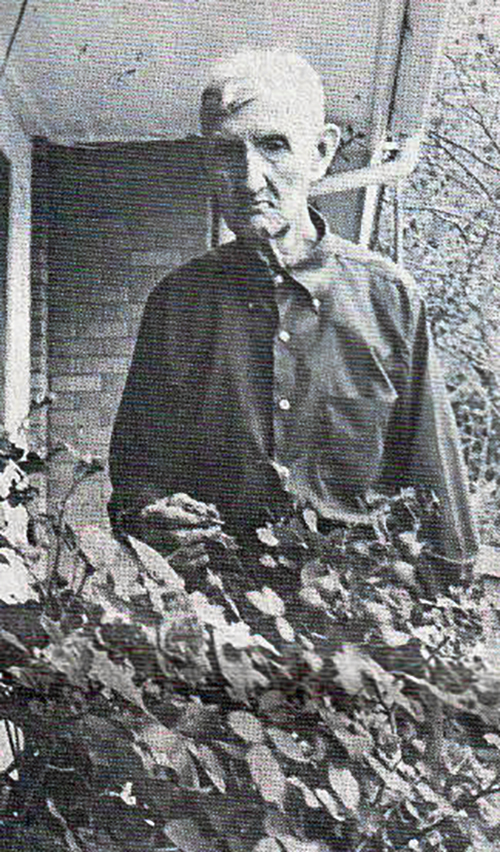
Nothing defines the perspective of time for a writer better than aging manuscripts in a life’s collection of work. Less than subtle reminders of lives chronicled half a century or more ago; people who were witness to history not available in books.

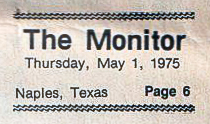
May 1 will mark 50 years since I penned a piece printed in the Naples Monitor on Thursday, May 1, 1975. An interview with a gentleman born when Ulysses S. Grant, commanding general of the Union Army in the Civil War, was serving as the 18th president of a United States with only 38 states.

Burgess Peter Jacobs, aka “Papa Jake,” had just celebrated his 99th birthday when we talked. “Came here the 15th day of January 1907,” he said with a big smile. “I stepped off the train at the Naples depot with a wife and five kids. Came from North Carolina where I worked in a sawmill and raised a little patch of cotton.

“There were no brick buildings,” he reminisced, recalling dirt streets and wood sidewalks as if it were only yesterday. “Charlie Pope built the first one in 1908 or ’09. You know where the Lee Davis’ store is? He put his name in the brick on that building. Course, when Lee moved in, he covered up Charlie’s name.”

“We call these “Mama’s blooms.”

His crystal-clear mind revealed knowledge like someone reading from a history book. “The big business here was the sawmill, but it shut down a few years after.”

When questioned about occupations through the years, he called on quick wit and humor. “Like everyone else — as little as I could. Two years in Bowie County and a year in West Texas before settling down near Naples.

“I farmed mostly. Until about 17 or 18 years ago,” Jacobs continued. “My house was in Morris County, but I farmed in Cass County. About as far as from here to the street,” he said, looking out the window.

“Tax collector came one day. Spent the whole day measuring,’ lookin’ and askin.’ When he discovered I lived in Morris County, he tore up the papers and Ieft. I could have told him if he had asked,” he chuckled.

Laughter and a zest for life filled his stories. “This fellow was runnin’ for sheriff in Cass County once and came by to ask me to vote for him. I told him that no one was coming that far to get me, and no one there was going to bother me. So I didn’t need a sheriff.”

Shifting to birthday cards, he showed me one from President Gerald Ford. “Seen a lot of presidents come and go,” Jacobs said, proudly displaying the greeting. “But sure was surprised to get a letter from one.”

According to Jacobs, family has commemorated his birthday since the early 1920s by staging the family reunion on the Sunday falling nearest his birthday. And family came large for Papa Jake.

Looking fondly at a picture of him and his wife, Quincey Adalee, he added, “I was married to her for 69 years, five months and a few days. I liked a little being 20; she was a little over 16 when we married.” After a noticeable hesitation, he said softly, “She’s been gone about ten years now.”

The couple had nine children and 42 grandchildren. Asked about great and great-great-grandchildren, Jacobs shook his head and laughed. “I don’t know. I can’t count ’em all. I just call ’em my dirty dozen.”

Papa Jake reported his daily activities included “watching a right smart of television. Like to watch the wrestling. Listen to the news on radio. I walk to the mailbox every day. Used to get the mail for the ladies around here ’till I got to where I couldn’t see too well.”

Jacobs expressed pride in seeing roses growing around his house. Especially the white roses. “We call them “Mama’s blooms,” he said, holding his wife’s picture.

I attended his birthday party Saturday night at the Naples Community Center and the family reunion Sunday. “He did not miss a minute of the activity while spreading  humor and warm smiles,” I wrote. “Posing for pictures with family that came from as far as California to attend.”

You can read history books all day long. But none will touch your soul the same as talking to someone who has lived it.

Papa Jake was a living example of the old saying that you are only as old as you feel. Smiles on a weathered face and laughter in an aged voice recalling family, friends, and a century of living left me thinking I was the old timer in that conversation.

Fifty years ago, come May 1.

—Leon Aldridge

– – – – – – –

Aldridge columns are featured in these publications: The Center Light and Champion, The Mount Pleasant Tribune, the Rosenberg Fort Bend Herald, the Taylor Press, the Alpine Avalanche,  the Fort Stockton Pioneer, the Elgin Courier, The Monitor in Naples, and Motor Sports Magazine.

© Leon Aldridge and A Story Worth Telling 2025. Excerpts and links may be used, provided full and clear credit is given to Leon Aldridge and ‘A Story Worth Telling.’

Still trying to remember where …

Take care of all of your memories, For you cannot relive them.”
— Song lyrics by Bob Dylan and The Band

– – – – – – – –

Memories. I write about them often. Because at this age, I have a lot of memories to keep up with. And possibly because that’s all I can remember.

Most amazing are moments remembered when I forget everything else. My phone. My keys. My checkbook. It will come to me in a minute, but while we’re waiting, let me share a conversation with a good friend not long ago. We talked about what we remembered as new South Ward Elementary students in Mount Pleasant. Back when Fred Flintstone was still in Bedrock kindergarten .

By chance or destiny, we arrived in northeast Texas just a few years apart; coming from opposite directions. The reminiscing was fun. But what we agreed was really the amazing part was how much we remembered about grade school.

My first-grade year was 1954 at Crockett, Texas. The small white frame structure my parents rented sat in the middle of an empty field next to the only nearby residence. Two houses not far from downtown with a long, shared dirt driveway, surrounded by woods on three sides.

We didn’t have a television, or a telephone. What we did have was the sound of rain falling on a tin roof, the smell of Mom’s morning glories covering the trellis on the front porch, and late-night crackers and milk with Dad. It was his favorite bedtime snack.

A green Studebaker was transportation for our one-car family until the fateful Sunday afternoon when Dad and the neighbor, Mr. Hooks, went fishing. Old timbers on a country bridge failed, sending them off into a dry creek bed below.

The crumpled car and my father in bandages are scary memories. He and Mr. Hooks were banged up and bruised, but otherwise, all right.

My youngest sister, Sylvia, was born in Crockett. I remember Dad showing off our newborn sibling at the hospital’s back door, where middle sister Leslie and I waited in the car. Mom in a bathrobe, ws standing behind Dad. Both beaming with smiles.

My father worked for the long gone five-and-ten-cent store chain, Perry Brothers. Small wooden crates in which china dishes were received at the store served many uses, from garage storage to creative kid’s activities. One pinnacle of playtime was the day I launched one in the creek behind our house to see if it would float.

It did.

Basking in that delightful discovery, I then talked Leslie into boarding it to see if it would still float.

It didn’t.

Thank goodness the creek was shallow.

The bungled boating caper, plus the time I talked Leslie into jumping off the roof, certain that a bed sheet was a good parachute, probably accounts for less-than-good memories of parental punishment. Mom seldom administered any, deferring that chore to Dad. But her warnings were stern enough. “You just wait until your father gets home!”

Dad was good to take me to town following his lunch break on summertime Saturdays. Clutching a quarter and a dime, I walked to the nearby theater where the two coins were ample funding for a double-feature matinee plus popcorn and a Coke.

The last of 1954 summer movies was the beginning of first grade in the basement of an old brick school building.

The quintessential teacher, whose name I don’t remember, wore gray hair up in a bun and lace-up, high-heeled shoes. We wrote 1+1=2 on black chalkboards over which hung examples of cursive writing and the obligatory portrait of George Washington. The unfinished one that renders the appearance of clouds at the bottom.

First grade was my first and last playground fight. It went down near the front steps of the old schoolhouse. I don’t remember what it was about or who won it.

I do remember thinking that I didn’t particularly enjoy it and made a mental note to never get into another exchange of fisticuffs if I could help it.

First-grade classes moved into new classrooms after the Christmas break, from the basement into the modern mid-1950s structure with lots of glass and open spaces. That’s where we stood in line for the Salk polio vaccine. It’s also where a spring tornado turned the sky black, dark as night, as we huddled behind the new green chalkboards.

We left Crockett with our memories in 1955, arriving in Seymour where we lived until 1959 when we moved to Mount Pleasant where we stated long enough to call it home. It was the last relocation my parents would make.

I could tell you about our arrival in Seymour. It was about the same time that a young entertainer named Elvis performed at the Seymour High School gymnasium.

But that’s a different memory for a different day.

Right now, I’m still trying to remember where I laid my keys five minutes ago.

—Leon Aldridge

– – – – – – –

Aldridge columns are featured in these publications: The Center Light and Champion, , The Mount Pleasant Tribune, the Rosenberg Fort Bend Herald, the Taylor Press, the Alpine Avalanche,  the Fort Stockton Pioneer, the Elgin Courier, The Monitor in Naples, and Motor Sports Magazine.

© Leon Aldridge and A Story Worth Telling 2025. Excerpts and links may be used, provided full and clear credit is given to Leon Aldridge and ‘A Story Worth Telling’ with appropriate and specific directions to the original content.

The soundtrack of our lives

“Music is probably the one real magic I have encountered in my life. It’s pure and it’s real. It moves, it heals, it communicates and does all these incredible things.”
— Tom Petty (1950 – 2017) American singer, songwriter, and guitarist. 

– – – – – – –

Leadville, Colorado, came to mind. 1976. Or was it ’77? Me, Oscar Elliott, and others from Mount Pleasant. We were in the middle of a motorcycle sabbatical through the Rockies.

The same trip where we topped Monarch Pass and crossed the Continental Divide. Elevation 11,312 feet. Which was the first time I rode a motorcycle over the Continental Divide. And the first time I rode one on snow-covered roads. With snow still steadily falling.  

The song playing on my Pandora today brought back those memories. The same tune was playing on the jukebox in the bar at the back of that restaurant where we we ate supper that night in Leadville. The one next to the motel where we were staying the morning we woke up to find the city and our bikes covered in snow. The song was “The Y’all Comeback Saloon” by the Oak Ridge Boys.

Funny how music works that way.

As a kid, it amazed and amused me when my Uncle Bill, mom’s little brother, told stories about how he and his Navy buddies spent time listening to music. “When a song came on the radio,” he told me with a smile, “the objective was to describe the car we owned at the time, the exact place where we were when we heard the song, and the name of the girl we were with when we heard it. Any additional information was optional at the storyteller’s discretion.”

As a writer and journalist introduced to the news business through the art of photography, the adage, “a picture is worth a thousand words,” makes a great deal of sense to me. But it’s also apparent that any wordsmith worth the paper their thesaurus is printed on can likewise argue for a thousand words expressing as much as one photo.

As a lifelong music lover, however, I will concede the power of both words and images to the magic of music when it comes to shaking memories loose in the lost caverns of our past.

My mother introduced me to that musical enchantment with a collection of 78 r.p.m. records from her Kentucky high school days. I remember Saturdays, her playing records and singing along with them as she completed weekly house cleaning rituals. Glenn Miller, Tommy Dorsey, Tennessee Ernie Ford, Patty Page, Eddie Arnold, and Hank Williams, Sr.

As a grade-schooler in the 1950s, that genetic appreciation for music led me to saving my weekly 25¢ allowance to spend on records at Richardson’s White’s Auto Store in Mount Pleasant. Elvis Presley, Ricky Nelson, Fats Domino.

High school and college band memories from the 60s are infused with John Phillip Sousa marches. “King Cotton ” and “The Washington Post” performed at goodness knows how many football games.

At the same time, my car radio was always tuned to KLIF in Dallas during the day. Making radio music memories at night cruising the streets or watching the moon rise over the city lake required tuning to WNOE in New Orleans.

Viet Nam era music by The Box Tops, Creedence Clearwater Revival, or Country Joe and the Fish still remind of the PA systems at drag strips filling pauses in racing action. Music for changing spark plugs at Interstate 20 Raceway in Tyler on Saturday night one weekend, and the next, listening for the next round of class call to the Dallas International Motor Speedway staging lanes.

Even work memories are bookmarked by music. Let me hear “Crazy” by Patsy Cline, and I’ll tell you about the night Johnny Garner and I sprayed a late-night paint job on a big truck at Sandlin’s Body Shop in Mount Pleasant with the radio keeping us awake.

And should I hear George Strait’s “Does Fort Worth Cross Your Mind,” you might have to endure my memories of good times with a dear friend 30-plus years ago at Joe T. Garcia’s Mexican Restaurant.

Long-time American Bandstand host Dick Clark, whose name is synonymous with music, is credited with saying, “Music is the soundtrack of our lives.”

Maybe that’s why mom always appeared as though she was in a different world, lost in time while vacuuming or folding laundry.

It might also be why you can catch me at home on any given evening after work. Sitting and strumming a few chords on a guitar. Singing. Smiling. Remembering that time that me and …

—Leon Aldridge

– – – – – – –

© Leon Aldridge and A Story Worth Telling 2025. Excerpts and links may be used, provided full and clear credit is given to Leon Aldridge and ‘A Story Worth Telling’ with appropriate and specific directions to the original content.

Aldridge columns are featured in these publications: The Mount Pleasant Tribune, the Rosenberg Fort Bend Herald, the Taylor Press, the Alpine Avalanche,  the Fort Stockton Pioneer, the Elgin Courier, The Monitor in Naples, and Motor Sports Magazine.