Practical application of a good education

“Education is what remains after one has forgotten what one has learned in school.”
— Albert Einstein

– – – – – – –

Mom talked fondly about her father. I remember some things about Arthur G. Johnson, my maternal grandfather. He died February 15, 1951. That I can remember him at all seems incredible when I think about it. Considering that I celebrated my third birthday a month before his death.

The most vivid memory is waiting at the bottom of the stairs leading to his second-floor bedroom at 382 South Main in Winchester, Kentucky. Waiting to hear him call my name when he awoke from his nap. That was my signal to sneak up the stairs and hide under a bedroom dresser while he continued calling my name, pretending he couldn’t see me.

Called Pop or sometimes Poppa by Mom and her four siblings, Arthur Johnson was an educated man. Photos picture him as stoic in stature, exhibiting a state of calm and composure—someone that most might expect to face life with education, practicality, and wisdom.

He came from a long line of Kentucky stock documented back into the 1700s. A schoolteacher and a principal in both Kentucky and Tennessee, he also served as an educational director for the Civilian Conservation Corps, commonly referred to as the CCC. Before the U.S. entered World War II in 1941, the CCC constructed public buildings, fences, and state park facilities still in use today; often recognized by their stone construction.

In addition to his educational and professional presence, however, I learned last week that Arthur Johnson also had a penchant for practical applications of learning.

“Let me tell you one story,” my Uncle Bill said last week at the annual reunion of the descendants of Arthur G. and Bernice Conlee Johnson held near Winchester, Kentucky. Uncle Bill is my mother’s last surviving sibling. He celebrated his 90th birthday in May and has always been a great storyteller.

“Pop had a degree in psychology,” Mom’s little brother began. “He was educated and intelligent, but he applied his education with practicality.

“There was a little boy in the neighborhood, also named Billy. And he was … well, he was bad. I mean, he was a really bad seed. His mother couldn’t control him. He got into more kinds of trouble, but she always defended him. He never did anything wrong; you know. It was always the other person.

“At one point, I had a little dog,” Bill continued. “It got caught up in a wire fence around the back yard and couldn’t get out. But this kid killed my dog rather than help it get loose. That’s the kind of evil bad he was.

“One day, his mother comes down the road,” Bill’s story continued. “I’d had a bunch of run-ins with her son. So, when she came flying down the road and turned in at our house, I thought, ‘Oh, my gosh, what have I done now?’ That woman was as bad as her son was.”

“’Is Mr. Johnson here,’ she asked me? People in the community often sought Pop’s advice since he was a respected teacher. I told her I’d check; that I didn’t know. So, I went up to his room that was his own world in that house. I told him, ‘Billy’s mom is down there and wants to talk to you.’ He sighed and said, ‘OK, let her in.'”

“She went in, but the door stayed open just a little,” Uncle Bill continued. ” I just stood there, you know, and listened. She started telling Pop about Billy. ‘I just can’t control him anymore,’ she said. ‘He’s mean, he’s out of control, and I don’t know what to do with him.’”

“Pop was quiet for a minute,” Uncle Bill related. “Then he gave Billy’s Mom some advice. ‘I’ll tell you what to do. You go down here to the local library, and you check out a book called Elements of Psychology. Remember that title. It’s a big book. It’s a good book. Check it out and take it home. Then when you get home, you take that book, and you beat his butt with it. Two or three doses of some applied psychology will help straighten him out.”

I laughed. I had always heard that the grandfather I barely got to know was a wise man. One who valued education and the value of a good book.

But I never knew just how well he understood the practical application of them.

—Leon Aldridge

– – – – – – –

Aldridge columns are featured in these publications: The Center Light and Champion, The Mount Pleasant Tribune, the Rosenberg Fort Bend Herald, the Taylor Press, the Alpine Avalanche,  the Fort Stockton Pioneer, the Elgin Courier, The Monitor in Naples, and Motor Sports Magazine.

© Leon Aldridge and A Story Worth Telling 2025. Excerpts and links may be used, provided full and clear credit is given to Leon Aldridge and ‘A Story Worth Telling’ with appropriate and specific directions to the original content.
I still hear those words

“Art washes away from the soul, the dust of everyday life.”
— Pablo Picasso (1881 – 1973) Spanish artist

– – – – – – –

While hanging the painting of a sad, wet dog on the wall in my newly refurbished “music room slash library” last week, words from some 30 years ago came back to me.

“You collect some heavy stuff, man.”

They were the words of Judy Snouffer. About July 1993. The day I accepted a generous offer from her and her husband Chuck to help unload truckloads of household belongings at my newly acquired Hill Country home near Pipe Creek, Texas.

As the newest editor and publisher at the Boerne Star, my charge included producing the Boerne newspaper and looking after Granite Publications properties in Bandera, Gonzales, and Fort Stockton.

Judy (better known to friends and co-workers as “Jet”) was composing supervisor and graphic artist at The Star. Chuck worked for the City of Boerne. What I didn’t know was Judy’s artistic skills reached far beyond that of just newspapers.

What Chuck and Judy didn’t know was that I collected unique but heavy stuff. Books, artwork, phonograph records, juke boxes, neon signs, gas pumps …and cars.

I knew Chuck and Judy owned a car. I don’t remember ever seeing it, but I did hear them talk about one. Their daily transportation was matching motorcycles. Not just any motorcycle, but Moto-Guzzis. Manufactured in Italy. Also, the oldest European manufacturer in continuous production.

Jet parked her bike by the newspaper office back door every morning. Far outclassing my Honda Shadow, whenever I rode it.

She was different. A cool kind of different. Like a refugee hippie from the 1960s. An artistic soul who worked and thought outside the dust of everyday life. She wore black fingernail polish before it was a thing. She personalized her work area with stars, moons, and crystals. Motivation for her creative vibe.

And creative she was. Jet surprised me one day with the painting I still have of a sad, forlorn looking dog in the rain. The dog closely resembled Max, the adopted basset hound who made the move to the Hill Country with me. He hung out at the office on Fridays, quickly becoming known to the staff as “Office Max.” Jet was moved by my story one day about Max getting rained on and wet in the back yard before I got a doghouse built. That’s when she gifted me with her painting titled, “Dog Day Blues.” Noted on the back as “No. 507” dated January 22, 1994.

It blew me away. “This is beautiful,” I said. “I knew you were an artist, but I didn’t know you painted.” Jet was humble, shyly showing me photos of her other work plus a feature story from the San Antonio Express News about her artistic awards.

Jet wasn’t the only one who contributed to my lifetime of acquired pieces still hoarding memories today in my music room slash library. “How would you like a Boerne fire hydrant for your quirky collection,” Chuck asked one evening?

“You’re speaking my language,” I quickly responded.

“The city’s replacing old ones. A pile at the yard is headed for scrapping,” he said. Go with me after work tomorrow and we’ll get you one.”

I was thrilled. Until I grabbed one end of it. “You didn’t tell me a fire hydrant weighed as much a Buick Roadmaster station wagon,” I laughed.

‘Bout like your Seeburg jukebox or that Mobil gas pump we unloaded,” he quipped.

I left the Hill Country in 1998. It was a few short years later the day the message arrived from a mutual friend in Boerne. An obituary.

Judy “Jet” Atkins Snouffer died tragically March 18, 2004. The way she would’ve wanted to go – on her motorcycle. She “died with her boots on.”

“Jet” was survived by her loving husband, Chuck Snouffer of Boerne, the obit continued. Judy grew up between Texas and Germany. She worked at the Boerne Star and STPS. Judy was a very free spirit, living life to the fullest. Aside from being a very eclectic personality, Jet was a very creative and talented person; a “’ane of all trades.’ She was a recognized artist having won several awards.”

The obit concluded with, “Ride on Jet!”

I think of Chuck and Jet when I glance at the painting.

And I still hear, “You collect some heavy stuff, man.” 

—Leon Aldridge

– – – – – – –

Aldridge columns are featured in these publications: The Center Light and Champion, The Mount Pleasant Tribune, the Rosenberg Fort Bend Herald, the Taylor Press, the Alpine Avalanche,  the Fort Stockton Pioneer, the Elgin Courier, The Monitor in Naples, and Motor Sports Magazine.

© Leon Aldridge and A Story Worth Telling 2025. Excerpts and links may be used, provided full and clear credit is given to Leon Aldridge and ‘A Story Worth Telling’ with appropriate and specific directions to the original content.

Why careful career planning is crucial

“What you get by achieving your goals is not as important as what you become by achieving your goals.”

— Zig Ziglar (1926 – 2012) world-renowned motivational author and speaker

– – – – – – – –

“So,” friends ask, “How is retirement going?”

“Great,” is my go-to answer. “I get just enough of it … between calls from people who need my expertise for a while.”

I’ve always advocated that careful planning of one’s career, even through retirement, is a crucial step in life. Having survived my attempts to chart a course from a very early age, I offer my thoughts on successes and failures while adding the best advice all. Advice is worth what you pay for it..

Before entering junior high, scrutinizing Popular Mechanics magazine classified pages at the barber shop was my source for career possibilities. Rare opportunities for unique businesses. Things like making authentic Bowie knives to marketing assembly plans for constructing scale models of the U.S.S. Constitution. In a bottle.

One I liked a lot seemed like a lucrative field. Army surplus dealers. “Return the postage free card for details,” the ad beckoned. “High demand, big profits.”

Exploring these and other rare opportunities kept both me and the Mount Pleasant, Texas, postmaster busy. My requests for information in outgoing mail and loads of informational literature coming in.

My concern was about which one of these money makers would be the best choice. The postmaster’s concern was which one of them I might be harboring plans to enter.

“You’re not thinking about anything like mail-order pot­bellied stove kits are you,” he quizzed me one day as I handed him another stack of postcards.

My search was going well when one Saturday afternoon while pondering empty pockets in front of the old Martin Theater in downtown Mount Pleasant, Texas, I heard voices. Mystic musings offering new concepts on career choice. “You see, son,” Dad said as he put his arm around me. “Think about this. No work … no money.”

I think he sensed I was broke and had missed the sci-fi flick matinee “I Married a Man From Outer Space.”

From that day forward, my life became a testbed for various after-school careers. I.E. Paying jobs. Sweeping floors at Perry Brothers five-and-dime store after school. Working Saturdays in the men’s department at Beall’s. Pumping gas and washing driveways at the Fina Station at night.

Efforts that dropped postage-free postcards going out in exchange for spending money coming in. Plus, providing valuable experience. Experience that led to seeking college advice on careers that didn’t involve manual labor. ” Well, Leon, looking at your grades,” I remember MPHS counselor Mrs. Sanders telling me, “It’s tough to tell … um, exactly what your field of expertise might be.”

“I’ve been thinking,” I replied. “I was trying to decide between truck driving and funeral director. But I really enjoyed Mr. Murray’s mechanical drawing class, so i’m leaning now toward being an architect.”

So, with a high school diploma plus extracurricular credits in fast cars, loud music, and late-nights, I was off to college to study building design. It was the beginning of five years spent trying to circumvent the evil conspiracy among college professors to prevent me from passing math courses and working when not in classes. To stay in school. Auto body shops, wrecker driving, and oil roustabout to name a few.

Then one day to everyone’s surprise, when the registrar’s office wasn’t looking, I slipped out the back door of East Texas State University with a degree in psychology and art.

“Tell me,” my understanding father asked after graduation, “what is it you plan to do with this varied preparation for your future.”

“It’s really very simple, Dad,” I assured him with my best college graduate look. “Unless I change my mind before Monday, I think I’ll teach school.”

Not long after that, by pure luck, I was afforded the opportunity to get the best career advice ever from motivational speaker and author Zig Ziglar. All right, so we just happen to get on the same hotel elevator together. I was still the only one in the room with him. For 12 whole floors.

“If you can’t control the events that happen to you, you can control the way you choose to respond to them,” he offered with a smile and a handshake.

All that said, I’m hoping to finish my long-awaited book by the end of the year. And I will include in the forward how all of this careful planning was crucial in leading me to a successful career … in communication and journalism.

I still get Army surplus brochures, though. And I’ve got a couple of canteens and a folding field shovel.

If anyone’s searching for a career path.

– – – – – – –

Aldridge columns are featured in these publications: The Center Light and Champion, The Mount Pleasant Tribune, the Rosenberg Fort Bend Herald, the Taylor Press, the Alpine Avalanche,  the Fort Stockton Pioneer, the Elgin Courier, The Monitor in Naples, and Motor Sports Magazine.

© Leon Aldridge and A Story Worth Telling 2025. Excerpts and links may be used, provided full and clear credit is given to Leon Aldridge and ‘A Story Worth Telling’ with appropriate and specific directions to the original content.

Some things never change

“The good physician treats the disease; the great physician treats the patient who has the disease.”
— William Osler (1849 -1919), one of the founding Johns Hopkins Hospital professors and creator of residency programs.

– – – – – – –

“Come in Dr. Reitz.” With those words, my grandmother welcomed the Pittsburg, Texas, family physician of many years into her home. “Thank you for coming. S.V. isn’t feeling well; he’s coughing and feverish.”

Sylvester Aldridge was my grandfather’s full legal name. No middle initial. Why she called him S.V. was a question I never thought to ask.

The good doctor pulled a chair next to the bed, opened his small black bag, and took out a tongue depressor and a thermometer. “I expect your fruit trees will be blooming before long,” he small talked with my grandfather.

Standing silently at the edge of the room, I was just tall enough to peek over the windowsill. The physician’s shiny new 1951 Chevy sitting in the driveway caught my eye. When I looked back at him, we made eye contact. I can still hear his deep voice say, “My, you’re getting to be a big boy.”

Dr. P.A. Reitz had delivered me into the world a little more than three years before that day. On a cold January 20, 1948, evening at the M&S Hospital he founded in Pittsburg. I don’t remember much about that day, but I was told light snow was falling outside.

I do remember house calls, once a common convenience by small-town physicians that slowly slipped into the past in the years that followed. A time when doctors wore suits and ties in the clinic and for house calls. And nurses wore white uniforms and caps. When “scrubs” were seen only in operating rooms.

Much of my childhood healthcare fell to Dr. Reitz. Dad’s years with Perry Brother’s five-and-dime stores moved us from one small Texas town to another before Mount Pleasant became the last stop. Many of my summer days, however, were still spent at my grandparents’ house.

“He’s going to need some stitches, Mrs. Aldridge.”

The wound for which I still display a scar on my head was inflicted during an afternoon of friendly playtime. Granny was enjoying afternoon coffee inside with her friend, Mrs. Martin. Outside, Mrs. Martin’s grandson and I whiled away the time with comic book fantasies. I don’t remember if I was the good guy or the bad guy, but I became the wounded guy when the other youngster got the drop on me with a piece of pipe. From atop a car in the driveway.

“Get a good grip on him,” Dr. Reitz cautioned my grandmother. His recall of my extreme dislike for doctors wielding needles was impeccable.

Those aged memories offer a different perspective on healthcare of today. Opinions abound, but popular views rival genealogical histories of Biblical proportions.

“Therefore, in all the days of medicine, throughout the land, specialization begat doctors passing small towns for big cities; and that begat the decline of rural hospitals; which begat small towns with clinics staffed by P.A.s and nurse N.P.s who take care of routine exams and illnesses begatting acute cases to emergency rooms or specialists.”

In bigger cities.

– – – – – – –

Dr. P.A. Reitz, one of Pittsburg’s best known, most respected and beloved citizens, died at M&S Hospital early Monday morning after suffering a massive heart attack,” the 1978 newspaper article in my archives read.

The yellowed paper news story bore no attribution. I suspect from the heartfelt and personal tone used by the writer, it might have been published by Pittsburg’s long-time local newspaper, the Gazette.

Dr. Reitz was born April 18, 1904, in Kansas. He moved to Pittsburg in 1935. He was a graduate of the University of Nebraska Medical School and completed his internship at Parkland Hospital in Dallas. He served in the U.S. Army in Europe during World War II.

“He was a family doctor for 43 years …” the story shared. According to the newspaper tribute, Dr. Reitz gave M&S Hospital to the citizens of Pittsburg in 1968.

“The business community closed Thursday afternoon for his funeral at the First Methodist Church,” the clipping concluded. “Interment was at Rose Hill Cemetery.”

I still visit Dr. Reitz … in a manner of speaking. My father and mother, Leon and Indianola Aldridge, are buried at Rose Hill Cemetery. Right next to Dad’s parents, Sylvester and Hattie Lois Aldridge.

Just across the narrow lane at the Pittsburg cemetery, maybe 50 feet away, are the graves of Percy. A. and Hazel Reitz.  

I miss small-town hospitals with doctors’ offices in or near the facility. Doctors who made house calls and knew their patients like family. That said, I get it that change and adaptation are inevitable aspects of life.

Some things never change, though. Like needles. I still don’t like needles.

And I still don’t know why Granny called my grandfather S.V.

—Leon Aldridge

– – – – – – –

Aldridge columns are featured in these publications: The Center Light and Champion, The Mount Pleasant Tribune, the Rosenberg Fort Bend Herald, the Taylor Press, the Alpine Avalanche,  the Fort Stockton Pioneer, the Elgin Courier, The Monitor in Naples, and Motor Sports Magazine.

© Leon Aldridge and A Story Worth Telling 2025. Excerpts and links may be used, provided full and clear credit is given to Leon Aldridge and ‘A Story Worth Telling’ with appropriate and specific directions to the original content.

The cost of conversation is going up

“If it’s a penny for your thoughts and you give your two cents worth, where did the other penny go?”
— Comedian George Carlin

– – – – – –

“Are they really going to going to stop making pennies.”

“Must be true, I read they will stop production in 2026,” I said. The lowly penny surfaced as a topic of conversation at dinner with friends last week. Sadly, it appears that a penny saved is no longer a penny earned, as Ben Franklin once noted. As a matter of economic fact, they’ve been a monetary loss for most of 20 years.”

According to the U.S. Mint, the production cost of a penny was 3.69-cents in 2024. About 3 cents for manufacturing and the rest for administrative costs and distribution.

“Rising costs aren’t the real reason pennies are going away,” someone added. “No one spends them anymore. Most pennies put into circulation are given as change in cash transactions, then never reused. There were about 240 billion in circulation last year. That’s 700 pennies per person; most in jars or dresser drawers.”

“I have my share,” I laughed. “At least that many on my dresser, more in my car’s console, and not telling how many under the front seat.”

“I save pennies I find on the ground,” said another. “Haven’t you heard the poem? ‘So don’t pass by that penny when you’re feeling blue. It may be a penny from heaven, that an angel’s passed to you.” Finding a penny is a reminder that someone in heaven is thinking about you.”

Adding to the poetic perspective, I contributed, “‘Find a penny, pick it up. All day long you’ll have good luck.’ I’m guilty of picking up a heads-up penny for luck. But if I spot one that’s tail’s up, I turn it over and leave it for someone else to find good fortune.”

While financial fortune might be hard to measure in pennies today, the copper coins represent more than mere monetary value to many. The humble penny represents priceless value in conversational expressions that have coined philosophies of American life for generations.

My grandmother’s favorite was, “Take care of the pennies, and the dollars will take care of themselves.” Survivors of the Great Depression, like my grandparents, characterized the less fortunate by saying, “They’re so poor, they don’t have two cents to rub together.”

“A penny for your thoughts” attributes value in wisdom to the meager one-cent piece. However, I am also quick to remind that “advice is worth what you pay for it.”

Today, “rattling money,” as one longtime friend always described pocket change, can be little more than a nuisance amid plastic money or folding money … or in my case, no money. However, it was historical appreciation for a penny that caused me to pause long enough to peruse a wheat penny in my pocket pile a couple of years ago.

Some my age will remember that the first version of the still-current penny, portraying a likeness of “Honest Abe” on one side, was first issued with two grains of wheat and the words “one cent” on the other. “Wheat pennies,” as they are called by coin collectors,” were minted from 1909 to 1958 when the reverse side was replaced with a likeness of the Lincoln Memorial in 1959.

Finding a wheat penny in pocket change, or anywhere today except in a coin collection, is rare enough. But the odds of someone giving me one in change at a Center, Texas, business that day might have been good enough to win the lottery. It bore the date 1919, minted when plenty of Indian Head pennies produced from 1859 to 1909 were still familiar in pockets and cash registers.

The coin had been in circulation for nearly 100 years the day it ended up in my pocket.

It was crazy to think that World War I had just ended when someone first pocketed the penny. The same year that Congress approved the Grand Canyon as a national park. The year a flight from New York to Atlantic City established the first commercial airline service. When Woodrow Wilson was president. The 19th Amendment to the Constitution, giving women the right to vote, was newly ratified.

And the year before my father’s parents became newlyweds in 1920.

So, what’s a 1919 “wheat” penny worth? Besides lots of memories and some sage sayings about life and luck? Around a dollar, maybe two, according to numismatic value guides.

“What will we ever do without pennies,” one of my friends lamented.

“One thing for sure,” I concluded, “The cost of conversation will go up.”

“From now on, it’s going to be ‘a nickel for your thoughts’ to start discussions like this.”

—Leon Aldridge

– – – – – – –

Aldridge columns are featured in these publications: The Center Light and Champion, The Mount Pleasant Tribune, the Rosenberg Fort Bend Herald, the Taylor Press, the Alpine Avalanche,  the Fort Stockton Pioneer, the Elgin Courier, The Monitor in Naples, and Motor Sports Magazine.

© Leon Aldridge and A Story Worth Telling 2025. Excerpts and links may be used, provided full and clear credit is given to Leon Aldridge and ‘A Story Worth Telling’ with appropriate and specific directions to the original content.

Learning to cope with emerging technology

“Our mission is to connect every person in the world.”
– Mark Zuckerberg

– – – – – – –

Technological advancement, properly applied, should bring improved quality of life with rewards in time savings and productivity. Don’t you agree?

But with every application of cutting edge techie tools comes more knowledge not enjoyed by those with a learning curve geared to outsmarting a computer. Or worse, nefarious characters with devious ideas for using it never intended by the developer. The internet, cell phones, mind boggling apps. A plethora of digital diversions that delight one day and dishearten the next.

Even with the newest … AI. Don’t we have enough artificial intelligence already serving as elected officials, television news analysts, and customer service reps?

Tech tools and toys were just emerging when fax machines were hailed as futuristic. We marveled at the one installed at the newspaper office in Center back then. “It’s going to save so much time,” we cheered, gazing at documents magically transferred through telephone lines. With every screeching sound of the machine’s “handshake” tone, everyone gathered to “ooh” and “ah” at letters from the other side of the country arriving in mere minutes.

In no time at all, we were sharing jokes and cartoons with friends and business associates. It was the best source for laughter around. Until Facebook came along.

In the real world, technology can make the impossible happen with ease and in record time. But just like a questionable joke inadvertently faxed to the wrong number, tech can create a desire to disappear into the unknown. Or render us ready to take the device and “throw it in the horse lot” as my grandmother used to say, when it doesn’t work as we think it should,

The late Lewis Grizzard, Southern humorist and author, put it succinctly in his book entitled, “Elvis Is Dead, and I Don’t Feel So Good Myself.” With his insightful humor, Grizzard poked fun at baby boomers trying to cope with emerging technology when he said, “The world around me is a tuxedo, and I’m a pair of brown shoes.”

That very thought came to me a while back. When my home security system designed to provide the secure feeling of a bad dog backing up a Smith and Wesson failed to function properly.

It’s a great piece of technology. Monitors doors and windows, the thermostat and selected appliances, the lights, reports the weather, and more that I have yet to master. It records videos of anyone approaching the doors and allows me to answer the doorbell from across town or across the country via my cell phone that has features I have yet to comprehend. Things that work great, provided the system installer and said smartphone user are both smarter than the technology.

It started the day a young technician came to my house and upgraded the control panel. Is it my imagination, or do all technical service reps look like they are a couple of years shy of being old enough to get a driver’s license? After he explained the changes to me in a language that might as well have been Swahili, he assured me it was the best on the market and was gone in short order. “Thank you,” I smiled.

At bedtime that night, cats were put out, dogs let in, doors locked, and pillows fluffed. As the last measure before drifting into blissful slumber, I armed the alarm confident in the sophisticated system with my “three dog night” backup.

For the record, my money’s on the dogs for reliability. They do one thing the alarm doesn’t—wake me without fail at 5:30 a.m., reminding me of their urgent need to go out and visit nature.

5:32 a.m. The doggie alarms goes off. With blurry vision, I poke the control panel app with my code. Nothing, followed by the words “Incorrect Code.” A second attempt with glasses was equally unsuccessful. By the third try, the dogs were poised and pointing at the back door with tears in their eyes.

“What next?” I could simply open the door. Within seconds, I would be on the phone with someone from the security company checking on me. “Wait,” I thought. I could also be talking to uniformed police officers. With guns.

I dialed the number for the alarm company and was pleasantly greeted. “XYZ Security, how may I help you?”

“My dogs and I are being held hostage in my house,” I joked about the non-functioning panel. I’ve always considered humor as an ice breaker for pleasant conversation. Please note, however, that humor is not the appropriate response when talking to a home security agent. At 5:30 a.m.

Once we reached an understanding of what constitutes funny and what does not, tests were performed to arrive at a conclusion. The servicing technician had failed to program the new panel with my security code.  

“No problem, I can walk you through it,” the understanding agent said. Her discovery that she was dealing with someone who could not program their VCR, combined with realizing she was talking with someone who still uses a VCR, appeared to dash all hopes of a speedy solution.

We stumbled through it, though. Much to the delight of the agent and me. And three agonizing dogs who burst out the back door when it was finally opened.

Crisis over, my thoughts turned to caffeine. And to Zuckerberg’s philosophy and Grizzard’s humor. With the last sip, I wasn’t convinced that chatting with security system people at 5:30 a.m. was Zuckerberg’s vision of “connecting to every person in the world.”

Especially when I’m wearing brown shoes in a tuxedo world.

—Leon Aldridge

– – – – – – –

Aldridge columns are featured in these publications: The Center Light and Champion, The Mount Pleasant Tribune, the Rosenberg Fort Bend Herald, the Taylor Press, the Alpine Avalanche,  the Fort Stockton Pioneer, the Elgin Courier, The Monitor in Naples, and Motor Sports Magazine.

© Leon Aldridge and A Story Worth Telling 2025. Excerpts and links may be used, provided full and clear credit is given to Leon Aldridge and ‘A Story Worth Telling’ with appropriate and specific directions to the original content.

History not found in books

“Count your age by friends, not years. Count your life by smiles, not tears.”
— John Lennon

– – – – – – –

Nothing defines the perspective of time for a writer better than aging manuscripts in a life’s collection of work. Less than subtle reminders of lives chronicled half a century or more ago; people who were witness to history not available in books.

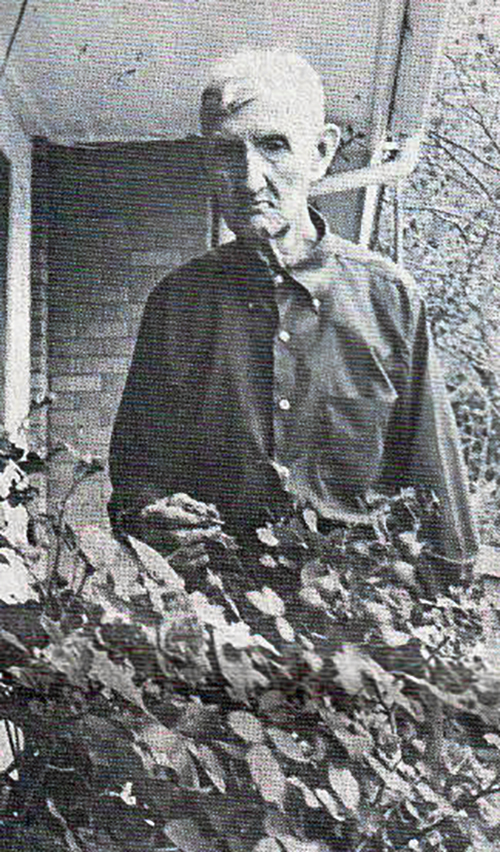
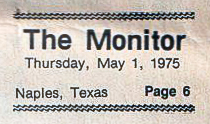
May 1 will mark 50 years since I penned a piece printed in the Naples Monitor on Thursday, May 1, 1975. An interview with a gentleman born when Ulysses S. Grant, commanding general of the Union Army in the Civil War, was serving as the 18th president of a United States with only 38 states.

Burgess Peter Jacobs, aka “Papa Jake,” had just celebrated his 99th birthday when we talked. “Came here the 15th day of January 1907,” he said with a big smile. “I stepped off the train at the Naples depot with a wife and five kids. Came from North Carolina where I worked in a sawmill and raised a little patch of cotton.

“There were no brick buildings,” he reminisced, recalling dirt streets and wood sidewalks as if it were only yesterday. “Charlie Pope built the first one in 1908 or ’09. You know where the Lee Davis’ store is? He put his name in the brick on that building. Course, when Lee moved in, he covered up Charlie’s name.”

“We call these “Mama’s blooms.”

His crystal-clear mind revealed knowledge like someone reading from a history book. “The big business here was the sawmill, but it shut down a few years after.”

When questioned about occupations through the years, he called on quick wit and humor. “Like everyone else — as little as I could. Two years in Bowie County and a year in West Texas before settling down near Naples.

“I farmed mostly. Until about 17 or 18 years ago,” Jacobs continued. “My house was in Morris County, but I farmed in Cass County. About as far as from here to the street,” he said, looking out the window.

“Tax collector came one day. Spent the whole day measuring,’ lookin’ and askin.’ When he discovered I lived in Morris County, he tore up the papers and Ieft. I could have told him if he had asked,” he chuckled.

Laughter and a zest for life filled his stories. “This fellow was runnin’ for sheriff in Cass County once and came by to ask me to vote for him. I told him that no one was coming that far to get me, and no one there was going to bother me. So I didn’t need a sheriff.”

Shifting to birthday cards, he showed me one from President Gerald Ford. “Seen a lot of presidents come and go,” Jacobs said, proudly displaying the greeting. “But sure was surprised to get a letter from one.”

According to Jacobs, family has commemorated his birthday since the early 1920s by staging the family reunion on the Sunday falling nearest his birthday. And family came large for Papa Jake.

Looking fondly at a picture of him and his wife, Quincey Adalee, he added, “I was married to her for 69 years, five months and a few days. I liked a little being 20; she was a little over 16 when we married.” After a noticeable hesitation, he said softly, “She’s been gone about ten years now.”

The couple had nine children and 42 grandchildren. Asked about great and great-great-grandchildren, Jacobs shook his head and laughed. “I don’t know. I can’t count ’em all. I just call ’em my dirty dozen.”

Papa Jake reported his daily activities included “watching a right smart of television. Like to watch the wrestling. Listen to the news on radio. I walk to the mailbox every day. Used to get the mail for the ladies around here ’till I got to where I couldn’t see too well.”

Jacobs expressed pride in seeing roses growing around his house. Especially the white roses. “We call them “Mama’s blooms,” he said, holding his wife’s picture.

I attended his birthday party Saturday night at the Naples Community Center and the family reunion Sunday. “He did not miss a minute of the activity while spreading  humor and warm smiles,” I wrote. “Posing for pictures with family that came from as far as California to attend.”

You can read history books all day long. But none will touch your soul the same as talking to someone who has lived it.

Papa Jake was a living example of the old saying that you are only as old as you feel. Smiles on a weathered face and laughter in an aged voice recalling family, friends, and a century of living left me thinking I was the old timer in that conversation.

Fifty years ago, come May 1.

—Leon Aldridge

– – – – – – –

Aldridge columns are featured in these publications: The Center Light and Champion, The Mount Pleasant Tribune, the Rosenberg Fort Bend Herald, the Taylor Press, the Alpine Avalanche,  the Fort Stockton Pioneer, the Elgin Courier, The Monitor in Naples, and Motor Sports Magazine.

© Leon Aldridge and A Story Worth Telling 2025. Excerpts and links may be used, provided full and clear credit is given to Leon Aldridge and ‘A Story Worth Telling.’

Adventures meant to be

“Blessed are the curious, for they shall have adventures.”
— Lovelle Drachman, author

– – – – – – –

Adventure was not on my mind after another day at the newspaper office almost 40 years ago. I was simply cruising the day’s mail that included the newest issue of Hemmings Motor News (aka “the car nut’s bible). And the best place to satisfy anyone’s curiosity about any car for sale.

I braked to a stop in the Chevrolet ads when I saw, “For sale by original owner, 1965 Malibu SS, factory L-79 engine. Stored in Iowa.”

Cars collectors are known for many strange behaviors. Including, but not limited to, buying long lost siblings to something they had back in the day and “shoulda kept it.” Or wanted to have but couldn’t afford it then. And just about anything hidden away in storage for some time. Better known today as a “barn find.”

My story is no different. While still a student at East Texas State University, I became the third owner of a 1965 Chevy Malibu SS factory born with that same L-79 high horsepower motor as the car in the ad. I parted with the vehicle too soon, vowing quickly to replace it … if I ever found another one.

It was way after dark the night I saw the ad some 15 years after taking that vow. But I dialed the number anyway, apologizing profusely for the late hour when a lady’s voice said, “Hello.” My inquiry was met with, “My husband is working the night shift, all I can do is read the window sticker for you.”

That’s when I sensed my first adventure that was meant to be.

Combing the huge auto Pate Swap Meet near Fort Worth the next day, the car in the ad still weighed heavily on my mind. Near dawn the next morning, DFW airport was fading from view at my American Airlines window seat. Before lunch, I was shaking hands with the man who had special ordered the car as a high school student. Drooling over all the paperwork he had on the car and loving his stories.

“Because I wasn’t 18 yet,” he laughed. “The dealership required my mother to sign for the car because of the high-horsepower engine. And the car took five months to get, not because of the motor, but because I ordered a vinyl top. Figure that one out!”

Just days before my arrival, He had brought the car to his home in the northern Chicago suburb of Northbrook, Illinois, from his father’s home in Iowa, where it was stored. “They don’t salt the roads in the winter like they do here,” the car’s owner said, “Salted roads are the best way I know of to get the rust worm in your car.”

Technically speaking, a barn is not required for an old car to gain the status of barn find. When the rescue story is told, any neglected shelter leaving a coat of dust on a desirable relic will elevate that hidden ride to “barn find” status at the next storytelling night.

“Barn finds” are on the opposite end of the spectrum from beautifully restored cars bought at televised auctions for stratospheric prices. Often a little more revered in some circles. And almost always, the beginning of an automotive adventure.

The first decision with a barn find is whether to drive it home or trailer it. The owner had already changed the oil, filled the tank with fresh fuel, and washed away the “barn” dust. I checked fluids, tires, hoses, belts, and electrical.

My curiosity satisfied after a short test drive, I opted for the adventure … “Let’s drive ‘er home.” By 5 a.m. the next day, I was beating rush hour traffic out of the city. On board were some basic tools, an extra fan belt, a fire extinguisher, and a spare quart of oil. All acquired from an auto parts store the previous evening.

And a hand full of fast food joint coupons pulled from the newspaper.

Now, if you’re considering something similar at home, let me be transparent on this one point. Taking time to thoroughly assess a stored vehicle before driving it any distance is critical. Looking back, I could have been — should have been — much more thorough in this, my first rodeo, before putting Chicago in my rear-view mirror and a smile on my face.

Another point of perspective is that was back when gas station road maps were the only form of navigation, interstate highways were not as connected as they are today, and the only decent coffee was at truck stops.

GPS says in 2025 the nearly 1,000-mile trip will require 13 hours of driving time with good traffic. I made the same trip non-stop again in 2016, attending the Muscle Car and Corvette Nationals, using only Waze and hot, black coffee. Took me fourteen hours in a rental car.

The mid-1980s adventure in an aged muscle car that hadn’t seen daylight in a long time consumed 21 hours. On tires that “looked pretty good” but were manufactured before date coding where the rubber meets the road was a thing. I was easy on her, too. Monitoring gauges, listening for noises, and stopping regularly for visual inspections.

Granny always joked that “God takes care of old folks and fools.” Whatever the case, He was with me on that trip right up the time I turned into my driveway at 1 a.m. Without incident. Four tanks of gas, one quart of oil, and a myriad of tasteless fast food later.

Other trips would follow. The value of the treasure rescued aside; the adventure has always been the best part. Because even when the journey is without incident, there is always an interesting story to tell.

Like this one. One I’ve shared countless times in almost 40 years.

Every time with a smile.

—Leon Aldridge

– – – – – – –

Aldridge columns are featured in these publications: The Center Light and Champion, The Mount Pleasant Tribune, the Rosenberg Fort Bend Herald, the Taylor Press, the Alpine Avalanche,  the Fort Stockton Pioneer, the Elgin Courier, The Monitor in Naples, and Motor Sports Magazine.

© Leon Aldridge and A Story Worth Telling 2025. Excerpts and links may be used, provided full and clear credit is given to Leon Aldridge and “A Story Worth Telling.”

How do they possibly know

Sometimes I think we are alone in the universe, and sometimes I think we’re not. In either case the idea is quite staggering.
— Arthur C. Clark, (1917 – 2008) English science fiction writer.

– – – – – –

Mount Pleasant friend and MPHS classmate Dick Zachary noted on social media a couple of weeks ago, his struggle to comprehend how much “six trillion times several billion” might be.

I agree with him. We had great teachers. I mastered the slide rule that I never used outside of class and was able figure out the cost of a Frito pie and a Dr. Pepper at the Tiger Den across the street from the campus. But even Mount Pleasant High never equipped us with calculation capabilities involving billions and trillions.

Dick’s mathematics mystification was triggered by a newspaper article he shared with his post. I didn’t see a source on it, but a portion of what looked to be an Associated Press byline was visible. The headline read, “Sneaking a peek at distant galaxies — Data trove from European telescope previews areas of new six-year study.”

The text reported, “A European space telescope launched to explore the dark universe has released a trove of new data on distant galaxies.

“The images and other data released Wednesday by the European Space Agency’s Euclid observatory includes a preview of three cosmic areas that the mission will study in finer detail mapping the shapes and locations of galaxies billions of light years away. A light-year is nearly six trillion miles.”

And this is where Dick asked his first question, “How do they possibly know? It blows my mind. At the speed of light, it would take around 20 years just for a light beam to reach a billion miles.”

I bring up my friend’s curiosity not to imply that I have an answer. Oh no, far from it. I still get cross-eyed trying to figure out how the GPS app on my phone knows where I am, where I am going and that I missed the last three turns. And that’s just traveling a few miles in East Texas. Heaven forbid I should attempt six trillion miles into deep space.

Dick’s doubts about grasping distance in space, however, does remind me of my daughter Robin. And a conversation we shared on the back porch one night at our home in the Texas Hill Country near the Medina River. A long time ago, in a galaxy far, far away … about three decades ago.

My beautiful daughter inherited my gift of gab and thirst for questions that make one think, which led to some wonderful and often spirited conversations. That heritage, and the fact that she excelled in high school debate — a skill she practiced on me every day when she was a teenager — made for moments I remember as if they had happened just yesterday.

“Do you ever wonder how far the sky goes,” she quizzed me one night as we gazed at stars in the Hill Country sky and discussed her report card.

“That’s easy,” I replied. “The sky never ends. The heavens go on forever.”

Silence.

“W-w-what do you mean … it never ends,” she responded slowly.

“It never ends,” I repeated. “Some things are infinite, and space is one of them. It has no end.”

More silence. Silence indicated differing processes with my children. It made my son, Lee, smile. He was the quiet type who was always thinking about something. With Robin, the more you offered, the more freely she vocalized her thoughts while processing them.

“No wait,” she recovered sitting up on the edge of her chair. “That’s not possible. It has to end somewhere. Everything has to have a beginning and an end.”

“Not necessarily,” I said. “Space is one thing that has no beginning and no end.”

More silence.

‘Dad, there has to be an end. Nothing can go on forever without end.”

“OK,” I proposed. “Let’s say that you are right, that trillions and trillions of miles and light years out there is a stop sign that says, ‘The end. Space ends here. Please take an alternate route to wherever you were going or go back from where you came.’ Something has to be on the other side of that sign. A brick wall. A different kind of space. Something. With space and the universe, there cannot be just nothing.”

Longer silence.

Before she could arrive at a response, I added, “Let me give you something else to think about. Just as the heavens have no end, time also has no end.”

“Daaaddd!” Her falling tone of voice was filled with frustration. “I’m still working on this space thing.”

“Work on this while you are at it,” I added. “God has always existed. There never was a time when there was not God. He has always been and always will be. And He created ‘the heaven and the earth.’ It’s all in the Bible.” Just start at Genesis one and one.”

The silence by this time was deafening.

“Do you want to know something else,” I asked?

“No,” she replied sharply. “We’ve covered enough space and time for one night.” She got up, turned toward the door, and paused. “Good night, Dad. All of this makes my brain hurt. I’m going to bed.” Then added with a smile, “This conversation has an end … for tonight.”

So, how do modern space researchers really know? Maybe I can get my daughter and my friend together to figure this out. Then they can let me know. I’ll even loan them my slide rule.

Goodness knows I can’t help them, though. I can’t even follow a GPS out of the county without missing a turn.

—Leon Aldridge

– – – – – – –

Aldridge columns are featured in these publications: The Center Light and Champion, The Mount Pleasant Tribune, the Rosenberg Fort Bend Herald, the Taylor Press, the Alpine Avalanche,  the Fort Stockton Pioneer, the Elgin Courier, The Monitor in Naples, and Motor Sports Magazine.

© Leon Aldridge and A Story Worth Telling 2025. Excerpts and links may be used, provided full and clear credit is given to Leon Aldridge and ‘A Story Worth Telling’ with appropriate and specific directions to the original content.

Will the circle be unbroken

 “… Havin’ fun sittin’ shotgun ‘cause I’ve come full circle.”
— song lyrics by Ben Kweller

– – – – – – –

“I didn’t know you rode motorcycles,” the voice behind me said.

Sunday morning Bible class had just ended. I was marking my place on the front pew as song leader by stacking my songbook, Bible, and other assorted paraphernalia.

It’s just a habit. Goodness knows I’m not competing with anyone for Sunday morning front-row seating.

The voice behind me belonged to one of the sweet ladies at church. Before turning around, I thought for a fleeting second about her perception of me after learning I used to ride motorcycles. Then laughed at myself for thinking that sweet little church ladies might have questionable connotations about cycle riders.

Riding was something I did for almost 50 years before contrasting my aging reflexes and vision with the noticeably increasing number of drivers who have no concept of what they are doing at 75 miles per hour other than texting or talking on a cell phone.  

“Yes,” I said as I turned her direction. “Steve Windham asked me back around Thanksgiving last year what I was doing. I told him, ‘Just sitting home bored, trying to dispel the ugly rumor that I retired.’ He said he needed help in parts and service at his motorcycle dealership, so there I am.”

Her questioning statement was understandable. It’s been long enough since I sold my last bike that someone who knew me only by my mild-mannered news reporter image could easily be surprised.

Truth is, though, I wanted a motor scooter way back in the sixth grade after my friend Gary Cornett did something that kindled one of my life’s more serious love affairs. Just as I threw a leg over my bicycle to go home for lunch, Gary rolled up on his Cushman. “Nice scooter,” I said.

Before I could start peddling, he hit me with, “Wanna ride it to your house for lunch?”

Some questions have only one logical answer at age 12. I thanked Gary, jumped once on the kick-starter and was gone. Arriving at home two blocks away, Mom met me with, “I don’t like those things. You could get killed. Eat your lunch and get it back to school. And I never want to hear of you getting on one again. Do you understand me, young man?”

“Yes ma’am,” I said. Another easy answer for a 12-year-old. Or at any age for a son responding to his mother.

Scant weeks later, my grandfather in Pittsburg invited me to go to W.R. DeWoody’s Western Auto with him. Yet another question with only one answer because I knew what he was thinking. A stop at the Piggly Wiggly parking lot where he would let me drive his ’57 Ford the remaining few blocks to town.

“And, don’t tell your grandmother I let you drive,” he always added.

Once inside, he sought help for his needs, and I went straight to the new Cushman scooters lined against the wall to fantasize. I was still dreaming when my grandfather found me, took the price tag in his hand, looked at it and said, “Two hundred and nineteen dollars!” Then whistled loudly, registering his opinion of the cost.

“Reckon you could ride that if I bought it,” he asked?

“I rode my friend’s,” I said as my heart raced. Then, just as fast, it flatlined. “I better not. If I bought that for you, your mother would have my hide.”

“We can keep it at your house,” I pleaded.

“Then your grandmother would have my hide,” he chuckled.

Mom still objected years later when I bought my first motorcycle at age 20. She continued to do so for the rest of her life every time I shared with her accounts of my trips traveling the U.S. Riding to Florida, crossing Colorado Rocky Mountain passes, or cycling through the Smokies. “I don’t like those things. You could get killed.”

“So, you see,” I told the sweet lady at church. “Me working for a motorcycle dealership is nothing new. It’s actually like coming full circle.”  

Going in circles has been a positive and rewarding way of life for me. I started my publishing career at the newspaper in Center, returned for a short stint about ten years ago, and came full circle to presumably finish it there last year.

Full circles cross my mind every day at the motorcycle dealership. I look longingly at the variety of two-wheeled rides on the showroom floor and think, “Maybe just one more time—one more circle.”

I could even ride it to church.

—Leon Aldridge

– – – – – – –

Aldridge columns are featured in these publications: The Center Light and Champion, The Mount Pleasant Tribune, the Rosenberg Fort Bend Herald, the Taylor Press, the Alpine Avalanche,  the Fort Stockton Pioneer, the Elgin Courier, The Monitor in Naples, and Motor Sports Magazine.

© Leon Aldridge and A Story Worth Telling 2025. Excerpts and links may be used, provided full and clear credit is given to Leon Aldridge and ‘A Story Worth Telling’ with appropriate and specific directions to the original content.