Christmas traditions, some old, some new

“O Christmas Tree, O Christmas tree,
Of all the trees most lovely.
Each year you bring to us delight.
With brightly shining Christmas light!”
— O Tannenbaum (Christmas tree) old German Christmas song from 1824 originally sung by Melchior Franck.

– – – – – –

Lights are brightly shining. Christmas decorating has started at my house. Emphasis on “started” because for me, decorating is a work in progress. It doesn’t happen overnight. Or even a week. Sometimes, it lasts until Christmas Eve.

Remembering.

That according to Mom, Christmas trees are put in place and decorated the Friday after Thanksgiving, not one day sooner. There was never a Christmas tree in her house on or before Thanksgiving. Ever.

My mother was a traditionalist in many ways. She also practiced “never wear white after Labor Day.” You could set your calendar by it when I was growing up. If the ladies at church were still wearing white, summer was not over. But when Mom put away her white hat, gloves, and shoes, we knew fall was just around the corner.

That “wearing white” thing fell out of tradition before the turn of the last century. But bless her heart, Mom was a diehard. She gave up wearing hats to church only after she and one other lady were the last of the faithful. Even then, she complained that she wasn’t properly dressed for church services.

“Never thought I’d live to see the day,” I remember her saying, “when a lady would go to church without a hat and gloves.”

“What is this country coming to?” is what Mom said after seeing for the first time, a brightly lit Christmas tree adorning the picture window a couple of houses down the street … a whole week before Thanksgiving.  

Historically, Americans found Christmas trees an oddity at any time before German settlers brought the tradition to America in the mid 1800s. Back then, plants and trees that remained naturally green year-round held special meaning in winter. Evergreen boughs over doors and windows were hung to celebrate the winter solstice while looking forward to cold weather giving way to spring’s return.

I appreciated cold weather at Christmas when I missed it while living in Boerne in the Texas Hill Country a few years ago. Where cold weather, as most recognize it, is rare. Short sleeves in December were the norm. I even recall wearing shorts on more than one Christmas day.

It was also a Hill Country Christmas the time the kids and I enjoyed seasonal decorations so much that we left the tree up a few days into the new year. Until Valentine’s Day. We boxed up the Christmas decorations and replaced them with hearts and Cupids. And we loved it! So much so that we rolled right into Easter with it, decorating appropriately, of course. Memorial Day. Followed by Independence Day. And so on.

But that violated one of Mom’s other traditions. “Got to get the tree down after Christmas day.” When the last dish from Christmas dinner was washed and dried, she was on it. “The New Year is coming. Bring me the boxes for those lights and ornaments.”

The first glass ornaments were seen in America in the late 1800s. Electric holiday lights were not common in U.S. homes until rural electrification became widespread in the late 1950s. That was about the same time Christmas decorating began to change.

Mom rocked it in the early 1960s when she bought an aluminum Christmas tree. Her first artificial tree. After first scoffing at artificial trees. We spent nights watching the color wheel change hues on the metallic “leaves” instead of our still somewhat new very first television set. After all, the TV was just black-and-white.

But even with the new tree, Mom never wavered on her traditions. It still went up on Friday after Thanksgiving and was gone soon after Christmas day.

Whether keeping traditions or making my own, I still decorate. Helpers are dwindling. Kids are grown and gone, living off in other cities busy with activities and traditions of their own.

But I still do it. With music and memories.

“Rockin’ around the Christmas tree
Have a happy holiday
Everyone dancin’ merrily
In the new old-fashioned way.”

— 1958, recorded by Brenda Lee.

Thanksgiving is behind us. Let the season begin. The Christmas tree is up with respect to my mother’s traditions. And recalling many gatherings of Christmases past with family and friends,

I hope Mom will forgive me, however. Once again, I may leave my decorations up for a while after Christmas.

Just for the memories.

—Leon Aldridge

– – – – – – –

Aldridge columns are featured in these publications: The Center Light and Champion, The Mount Pleasant Tribune, the Rosenberg Fort Bend Herald, the Taylor Press, the Alpine Avalanche,  the Fort Stockton Pioneer, the Elgin Courier, The Monitor in Naples, and Motor Sports Magazine.

© Leon Aldridge and A Story Worth Telling 2025. Excerpts and links may be used, provided full and clear credit is given to Leon Aldridge with appropriate and specific directions to the original content.

We should be grateful every day

“Seriously, you really don’t have to eat what I cook.
— Standing offer to my children at mealtime. Thanksgiving dinner or any meal..

– – – – – –

Thanksgiving Day really deserves more respect. Just saying.

One revered day of gratitude, thankful for things like family, friends, comfort, security, health, the freedom to express thanks. And food. Yes, those glorious 3,000-calorie Thanksgiving dinners.

Things for which we should be grateful every day.

Yet, that one day is sandwiched between Halloween and Christmas. Suffocating under discounted sale-priced Halloween masks and yuletide décor shamelessly shoved on store shelves before Labor Day.

The first Thanksgiving was much different. A 1621 religious celebration of prayer and fasting, not feasting. No turkey. No dressing. No pumpkin pie. No Alka Seltzer. No football. Just thanks for crops, weather, and simple blessings. Often celebrated with Native American tribes that helped them survive.

Sarah Josepha Hale, who authored “Mary Had a Little Lamb,” started a drive in 1846 for a national Thanksgiving holiday. Seventeen years later, President Abraham Lincoln proclaimed it a national holiday, hoping it would help heal a divided nation at war.

In 1941, Congress ended efforts by President Franklin D. Roosevelt to move the date to the third week of November, his plan to squeeze in another week of Christmas shopping to help an ailing economy. The move just created confusion, so the fourth Thursday of November was officially declared as the permanent date to reflect on things we picture as blessings.

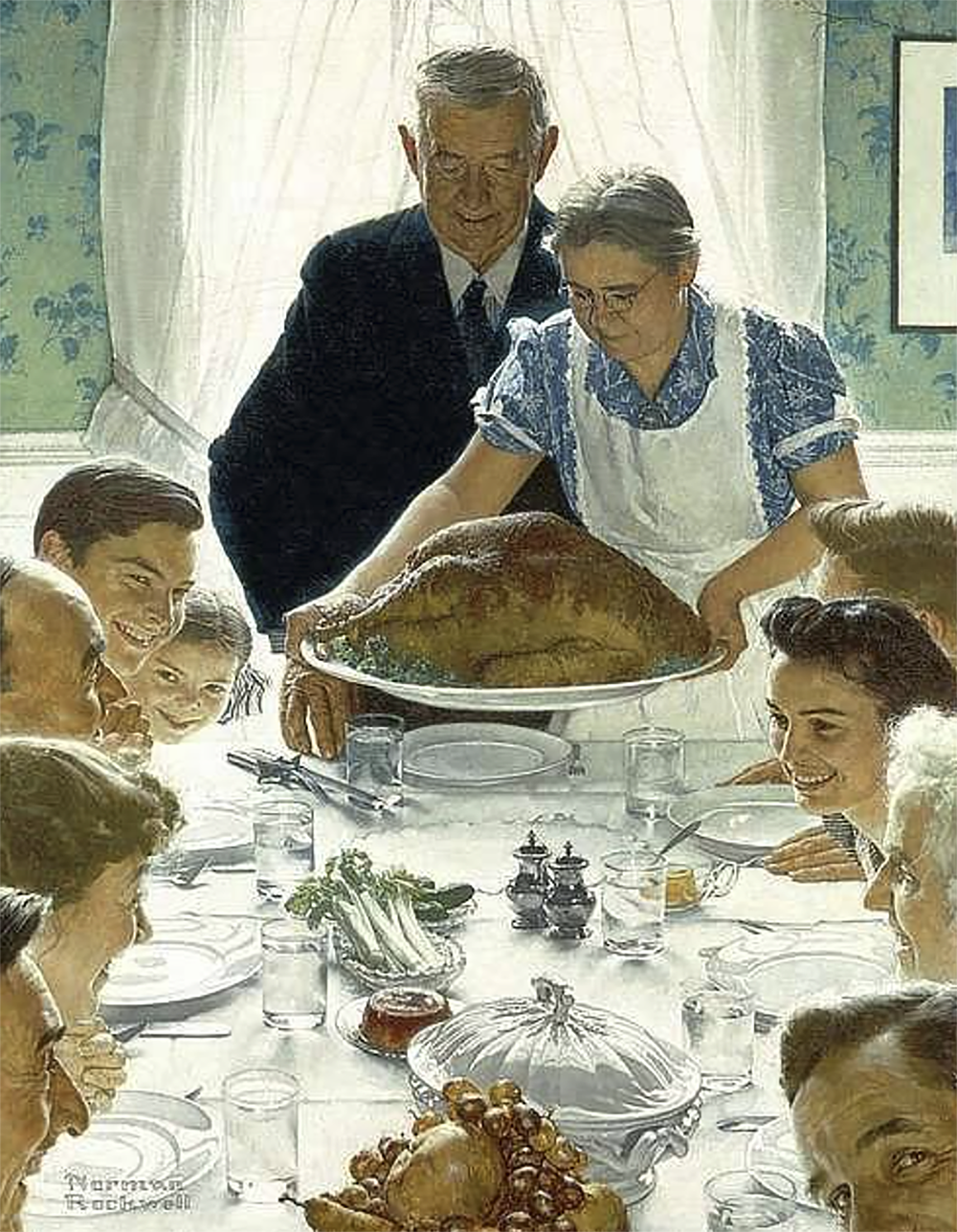
“Freedom From Want” painting by American artist Norman Rockwell.

An early 1940s picture painted by American artist Norman Rockwell, creator of more than 300 Saturday Evening Post covers and some 4,000 paintings during his lifetime, is the image most frequently associated with Thanksgiving. Titled “Freedom from Want,” the painting depicts a family gathering around a celebratory meal. It remains today as a favorite “picture of Thanksgiving.”

Rockwell once said that he painted life not as it was, but what he wished it could be. Maybe that’s what we’re all craving around the holidays, hope for what life should be.

Another American icon offering timeless pictures of America in childhood humor is Hank Ketcham’s cartoons, “Dennis the Menace.” One in particular mirrors Rockwell’s image, with Dennis and his parents sitting down for Thanksgiving dinner, heads bowed. In the caption, Dennis offers, “… and I’m thankful the pilgrims didn’t have liver an’ onions for their Thanksgiving meal.”

Let me say, I’m with Dennis. My father liked liver, so Mom cooked it. Too often. And like most kids of my generation, I dared not question any meal Mom prepared. My sisters and I respectfully ate what was set before us.

“When I left home,” I was telling a friend last week, “One of the things on my list vowing to never eat again was liver. A promise I have kept to this day.”

“You mean your mother didn’t cook a separate meal for you and your sisters,” the longtime acquaintance laughed.

Quick to affirm that we had obviously grown up in the same age, my response was, “Nope! If it was on your plate, you were going to eat it before leaving the table. And leaving a family meal was something you didn’t dare do without first asking, ‘May I please be excused?’”

My mother also played the “Mom card” to shame us for wasting food. “Eat it, don’t waste it. You know there are starving children all over the world.”

“Same with my parents,” reported my friend. “One day my sister and I suggested Mom box up her stewed tomatoes and send them to those starving children. We laughed and laughed. Until we noticed the deafening silence and parental glares of disapproval.”

“There were times when I felt like my parents didn’t have a sense of humor, either,” I sympathized.

Varying from my raising only slightly after I became a parent, I gave my kids a standing offer. I told them they didn’t have to eat what I cooked if they didn’t want to.

“Really,” daughter Robin asked the first time. Lee said nothing. He was always good at keeping his mouth shut a little longer than his older sister.

“Sure,” I said, reaching for her plate. “I’ll just put it in the refrigerator and save it for supper tomorrow night.”

My kids never questioned whether I had a sense of humor. Just how I sometimes applied it.

So, here’s my serious wish for a Happy Thanksgiving. May our hearts be filled with genuine gratitude for the things that make this country the best place on earth to live. Thanksgiving Day and every day.

With a small nod of agreement with Dennis The Menace. Thankful that if the Pilgrims menu did include liver or stewed tomatoes for Thanksgiving dinner, it never made it into the history books.

—Leon Aldridge

(Norman Rockwell’s “Freedom from Want” (above) appeared inside the March 6, 1943, edition of the Saturday Evening Post magazine. The painting was not intended as a Thanksgiving illustration, it was one of the “Four Freedoms” series by Rockwell symbolizing the aspirations of a world with security and well-being as articulated by President Franklin D. Roosevelt. However, it quickly became an iconic image associated with the Thanksgiving holiday )

– – – – – – –

Aldridge columns are featured in these publications: The Center Light and Champion, The Mount Pleasant Tribune, the Rosenberg Fort Bend Herald, the Taylor Press, the Alpine Avalanche,  the Fort Stockton Pioneer, the Elgin Courier, The Monitor in Naples, and Motor Sports Magazine.

© Leon Aldridge and A Story Worth Telling 2025. Excerpts and links may be used, provided full and clear credit is given to Leon Aldridge and ‘A Story Worth Telling’ with appropriate and specific directions to the original content.
May good fortune outlast our resolutions

 “We’ll take a cup o’ kindness yet, for auld lang syne.”
— Robert Burns, “Auld Lang Syne”

– – – – – –

That 1700s Scots poem set to familiar music is often used to mark the end of something. In our culture, usually another year “for (the sake of) old times.”

“Auld Lang Syne” became a U.S. tradition after Canadian bandleader Guy Lombardo and his Royal Canadians orchestra played it on New Year’s Eve in 1929 during a radio broadcast at the Roosevelt Hotel in New York City.

But a few years before that, on New Year’s Day in 1920, my father’s parents began what would become 47 years of marriage. S.V. Aldridge took as his bride, Hattie Lois Farmer. She became the family wise woman of philosophy and old sayings, for the new year, and all occasions. Prognostication regarding luck and life was almost an art form for my grandmother. Something for which I suspect she relied on a tad of tradition, a smidge of superstition, and a lot on the Lord. She was a devout member of the First Methodist Church in Pittsburg for more than 60 years.

She was born in Aledo, Texas in 1905 and was 15 when she married. He was born in Natchez, Mississippi in 1888 and was 31 when he said, “I do.” By then, he had worked for the railroad since the age of 13 and recently served with the U.S. Army in France during WW I.

Ten years later, my father was seven years old when they moved to Pittsburg in Northeast Texas, where my grandparents lived in the same house for the rest of their lives. For him, that was until 1967. For her, 1993.

Life was different a hundred years ago. Their age difference was not that uncommon then. And their education, for the most part, came more from experience than from schoolbooks.

As each year drew to a close, she shared her philosophies to inform everyone in the family about what was in store for the new year, according to Hattie Aldridge.

Her pivotal piece of providence was eating for prosperity. New Year’s dinner included black-eyed peas, cabbage, and delicacies dedicated to ensuring good luck and financial fortune. Truthfully, I was a fan of peas and cabbage any day at her house if they came with cornbread and iced tea.

Weather forecasts were also part of her New Year’s admonitions. On her Cardui calendar, she noted the weather every day for the first 12 days. These notes became her forecasting tool for each of the next 12 months. If New Year’s Day was stormy, cloudy, or cold, then bad weather was in store for the first month of the New Year. Rain on the third meant March would be wet. It seemed a really fascinating substitute for science until the year snow fell on the eighth. And, no — it did not snow in August that year.

She also swore that the first person entering your home on January 1 would strongly influence your life in the new year. And it was especially good fortune if that first visitor was bearing a gift or something good to eat. Well, yes! I’ve always thought that any day someone came to my house with gifts or food, or both, was a good day.

Another piece of advice was never do laundry on New Year’s Day. No how, no way. She said I it was bad luck. Dirty clothes would wait until January 2. But she also held that it was bad luck to labor with laundry on any Monday. She died having never owned a washing machine. “Doing the laundry” for her meant a couple of number three wash tubs, a scrub board, and a clothesline.

In my book, that would constitute lousy luck for any day I dealt with dirty clothes.

Looking back, our good fortune today is that, in many ways, life is immensely better than it was then. Or, as my good friend Oscar Elliott used to say, “These are the good old days.”

With your New Year’s traditions, I wish you a happy and prosperous 2025. Enjoy your black-eyed peas and cabbage, check the weather, and may that first visitor bring you good cheer and a small gift … and do your laundry.

And “for (the sake of) old times,” I also wish for all of us that our good fortune in the new year lasts longer than our resolutions.

—Leon Aldridge

– – – – – – –

Aldridge columns are featured in The Mount Pleasant Tribune, the Rosenberg Fort Bend Herald, the Alpine Avalanche,  the Fort Stockton Pioneer, and Granite Media Partners publications including the Taylor Press, the Elgin Courier and others. Also in The Monitor in Naples, and Motor Sports Magazine.

© Leon Aldridge and A Story Worth Telling 2024. Excerpts and links may be used, provided full and clear credit is given to Leon Aldridge and ‘A Story Worth Telling’ with appropriate and specific directions to the original content.

Wherever you are, Merry Christmas

“Just remember, the true spirit of Christmas lies in your heart.”
— Santa Claus, “The Polar Express” 2004 movie

– – – – – – –

A five-year-old was feeling Christmas magic at his grandparent’s house in Northeast Texas some years ago.

Home for his family back then was somewhere in West Texas. Maybe it was Ballinger, or Muleshoe. Might have been Pampa. One of those places where he made childhood memories before his father decided the family would stop moving after settling in Mount Pleasant.

Visions of St. Nick swirled in his mind as he snuggled close to his grandmother while she read a bedtime story that early 1950s Christmas Eve. “You better go to sleep before ‘ol Santy comes,” she said. “If he sees you’re awake, he’ll just keep on going.”

Suddenly, he heard something. Was that the “ding-ding” of a bicycle bell coming from the vicinity of the living room? “Oh no,” he thought, “Santa can’t see me awake.”

“He’s here,” Granny said. In a flash, she turned off the bedside lamp. The child clinched his eyes tightly shut hoping that if Santa did peep into the bedroom, he would surely appear to be fast asleep.

A few years later in Mount Pleasant, the youngster had learned the secret of how Santa managed to know where to deliver Christmas gifts. And always to the right house. But as the oldest sibling, his duty was to help preserve the legend of Santa for his younger sisters.

Christmas 1945 “V-Mail” telegram my father sent to my mother in Pittsburg, Texas while he was spending Christmas in Europe with the U.S. Army 276th Combat Engineers.

The night sky was fading to gray with the Christmas dawn, No one was stirring when he was awakened by a small voice at his bedroom door. “You think Santa has come yet,” his baby sister whispered?

“I don’t know,” he said. “Let’s go sneak a peek and see.”

All three siblings looked as he quietly opened the living room door just enough for a glimpse of Christmas splendor. His sisters oohed and awed at colors sparkling like shiny magic on the aluminum tree around which were neatly placed gifts from Santa.

He smiled. It was Christmas magic in the early morning dawn.

“I think he has been here,” he whispered to his sisters. “We better get back in bed until Mom and Dad wake up.”

Another twenty years later on a Christmas Eve in Center, he sat in front of the fireplace waiting to make sure both of his children were sound asleep. He had tucked them in bed earlier, using the same line on them that his grandmother had used on him when he was their age.

“You better go to sleep so Santa will come.”

Hoping they had asked for their last drink of water and quizzed him for the last time about mailing their letters to the North Pole, he pulled Santa’s gifts from their hiding place in the closet. Hot chocolate in one hand and tools in the other, he was ready for “Some Assembly Required” duty.

“Just 9:00 o’clock,” he noted with a smile. “This won’t take long.”

About midnight, the Little Suzy Homemaker play kitchen lacked only one “insert tab A into slot 4 and secure with one #6 bolt and one #9 nut.”

“That wasn’t bad, “ he thought. “Only had to take it apart and start over twice.”

All that remained was a tricycle, a doll stroller, and half a dozen small items to wrap. “Just enough time to make a pot of coffee,” he thought. Before experiencing the magic of another early Christmas morning in a child’s eye.

In the decades of Christmas Eves following that all-nighter, he saw a variety of Christmas magic. Like the snowy Yule spent with his family in the mountains of Taos, New Mexico. And the Christmas morning he and his teenage kids rode new bicycles around county roads on Lake Murvaul.

This Christmas, even as he commits words to digital bits and bytes, he’s not sure where he’ll be Christmas Day. So many friends and family from his Christmas past are gone now. And his children live away with families of their own. But one thing’s for sure. Wherever he is and whatever he is doing, the seasonal magic from decades of Christmas joy will fill his heart every Christmas present.

So, I wish … I mean, he wishes for you as well, that the magical blessings of Christmas fill your heart. Not just at Christmas, but throughout the year.

Wherever you are. Merry Christmas.

—Leon Aldridge

– – – – – – –

Aldridge columns are featured in these publications: The Mount Pleasant Tribune, the Rosenberg Fort Bend Herald, the Taylor Press, the Alpine Avalanche,  the Fort Stockton Pioneer, the Elgin Courier, The Monitor in Naples, and Motor Sports Magazine.

© Leon Aldridge and A Story Worth Telling 2024. Excerpts and links may be used, provided full and clear credit is given to Leon Aldridge and ‘A Story Worth Telling’ with appropriate and specific directions to the original content.