Good teachers are the ones who can challenge young minds without losing their own.
-Author unknown but approved by every good teacher I know.
– – – – – –
Grade school, 1959, in Mount Pleasant, Texas, included reading, writing, arithmetic, recess, and repeats of last week’s cafeteria fare. “Meatloaf? Must be Tuesday.”
Education set among pine trees, stifling humidity, and a rigid educational hierarchy.
N.A. Mattingly at South Ward Elementary challenged young minds with math and history classes while prepping the Bulldogs for crosstown elementary school football showdowns against West Ward and Annie Sims.
His weathered face reflected life on the farm. As did his green 1950s GMC pickup always parked at the curb near the bicycle rack. His ever-present smile and patient personality revealed his love for challenging young minds.
School dress codes then favored mainstream conservative looks in clothing, haircuts, and politeness. “Yes, Ma’am” and “Yes Sir” were the only responses to a teacher standing between you and a lecture on manners.
Frequently repeated recess stories among young minds were mixtures of mischief and Mr. Mattingly’s paddle, should we get caught, rumored to reside in his bottom desk drawer.
That was the same year my fifth-grade world started shrinking with a simple purchase at Raney’s top of the hill neighborhood grocery store on South Jefferson. A revolutionary device reflecting 1950s space-age fascination, the small red-and-white rocket ship looked like a toy. It was, however, much more. It was a radio.
Music in most homes then came from boxy radios like the one Mom used to tune in Miss Lee’s hometown news on KIMP. Or our first television, a large, cabinet-style, black-and-white affair. Both were operated exclusively via parental guidance. With the TV, that was Dad utilizing his remote control. The one where he sat comfortably in his chair and said, “Son, get up and turn that big knob on the right to channel three.”
So, this pocket-sized rocket radio was my first taste of selecting entertainment. In the backyard, in my bedroom, or better yet … in the classroom.
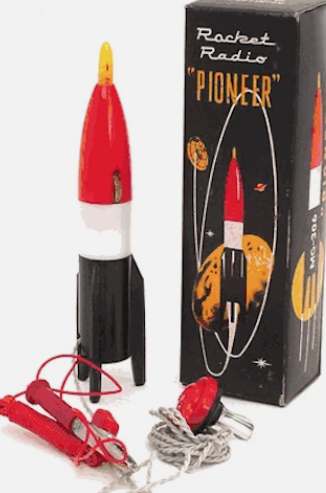
Unlike most transistor radios of the era, this one was a “crystal radio,” meaning it required no batteries. Don’t ask me how that worked. I didn’t know then, and I’m still clueless. All I knew were three things. Connecting the alligator clip wire to something large and metallic brought it to life. An earplug provided private listening. And stations were selected by sliding the tuner in the rocket’s nose.
The next morning at recess, I clipped it to the barbed-wire fence separating the back side of the South Ward playground from a cow pasture, the spot where we gathered to chew on “sour doc” weed stalks. I slipped the earplug firmly in place and slowly moved the tuner until static faded into music. I was listening to my own private radio. At school.
Back in class with the rocket radio in my pocket, I discreetly attached the clip to the metal window frame next to my desk, and channeled music right into the middle of math class. The local AM station was loud and clear, but with a little searching, I found KLIF, the Dallas rock-and-roll station.
Resting my head in my hand hid the earplug while I pretended to be deep in multiplication tables. Secretly multiplying my listening pleasure with Elvis Presley, Ricky Nelson, and Buddy Holly.
Clever, yes, but it soon proved to be an imperfect setup. Signals wandered, and intermittent bursts of static interrupted the music until one loud, ear-piercing pop caused me jump. Right in the middle of Mr. Mattingly’s, “… seven times nine is … how much?”
An experienced teacher adept in classroom auditory awareness, Mr. Mattingly stopped mid-stream of memorization techniques to ask, “Everything OK, Leon?”
“Yes, sir,” I humbly offered. “I heard something …. outside the window … I think.”
The bell rang, and I headed for the door. But not before Mr. Mattingly motioned me to his desk.
“Yes, sir,” I questioned politely.
“I’m glad you’re OK,” he smiled. Then, nonchalantly resting a hand near the dreaded desk drawer rumored to hold the storied instrument of punishment, he added. “Tomorrow, how ‘bout you leave that radio at home?”
My enthusiastic response was the only acceptable answer – back then and now.
“Yes, sir.”
—Leon Aldridge
(Photos — Top of the page — Mr. Mattingly’s fifth grade class at South Ward Elementary School in Mount Pleasant, Texas, circa 1959. Your author is sitting directly in front of Mr. Mattingly, the kid wearing the striped shirt and dark sweater. Lower photo — My 1950s vintage “rocket radio” was sadly lost to history decades ago. This one pictured is very similar to the one I purchased at Raney’s neighborhood grocery in 1959 for about $2.98, if memory serves me correctly. You can purchase this one on eBay today for $323.00.)
– – – – – – –
Aldridge columns are featured in these publications: The Center Light and Champion, The Mount Pleasant Tribune, the Rosenberg Fort Bend Herald, the Taylor Press, the Alpine Avalanche, the Fort Stockton Pioneer, the Elgin Courier, The Monitor in Naples, and Motor Sports Magazine.
© Leon Aldridge and A Story Worth Telling 2026. Excerpts and links may be used, provided full and clear credit is given to Leon Aldridge and ‘A Story Worth Telling’ with appropriate and specific directions to the original content.
 A Story Worth Telling