Nobody left the table hungry

“A grandmother’s kitchen — where memories are seasoned with love.”
– Author unknown but most likely well nourished.

– – – – – –

Just like Sunday dinner at Granny’s house.

That was my first thought last week at Lions Club, where fried chicken, mashed potatoes and gravy, corn, and hot rolls were served up for the civic club luncheon.

Any meal my father’s mother cooked on any day of the week was the equivalent of an East Texas Thanksgiving and Christmas dinner combined. I cherish the festive childhood memories of meals at her house that sadly ceased after my grandfather died. And feasts like last week’s Lion’s lunch still remind me of those family gatherings like they were just yesterday.

A yesterday when most meals were enjoyed at home. Meals that weren’t “hit and run” on the way to somewhere else. When family’s sat down together to eat. No phones. No TV. No rush. Fast food was yet to replace home cooking, TV dinners were still trendy and eating out somewhere other than the bus stop cafe downtown or the truck stop out on the highway was a rare treat.

It was a yesterday when Mom’s meals on the table coincided with Dad’s arriving home from work. You could set your watch by it. Back when we wore watches. That needed to be set.

A yesterday when being in your place at the dinner table was a request not open to debate. And failure to comply meant you’d better be so badly incapacitated that walking to the table was not physically possible.

Also not debatable was deciding whether Mom’s meal suited your taste buds. You ate what was on the table without question or comment. Unless you were saying how good everything tasted … including that nasty liver.

Although it was the age of “eat what your momma put on the table,” there was no way even the pickiest eater was going to leave the table hungry. And that went double for Sunday dinner at Granny’s.

The table that occupied my grandmother’s dining room, which now resides in mine, was the center of many meals. Common fare was fried chicken or ham, often both. Baked chicken and dressing were usually holiday delights. Mashed potatoes covered with cream gravy, steaming corn on the cob, and hot homemade biscuits begging for butter. Plates were piled high, but not so high that the aroma of fresh-baked pie coming from the kitchen failed to remind that you’d better save room for dessert.

For most grandmothers, including mine, cooking was a labor of love. Meals prepared without a single recipe. Ingredients blended with just a dash of this, a pinch of that, and a lot of love. Everything coming together at the same time, which was no small feat considering Granny could have a meal on the table and not miss a Sunday service sitting in her pew at the Pittsburg Methodist Church.

As a child, I never knew she accomplished her miracles having dinner ready like that by spending hours in the kitchen Saturday night and Sunday morning before church. I thought the plate I sat down to was just another measure of “grandmother’s meal magic.”

Watching her prepare a meal (only if we promised not to get in the way) was more than magic. It was controlled, coordinated chaos. Prepping chicken for the oven, mixing the dressing, peeling potatoes, and pulling husks off ears of corn. Hands moving with the precision of a symphony orchestra conductor.

To this day, I don’t know how she did it. But when we heard, “Y’all come on, it’s ready,” the chicken was moist and perfect. The potatoes were fresh and creamy, waiting for gravy. And the corn? Dripping with butter, ready to savor every bite, row by row.

And then the most amazing thing happened. Once the blessing was offered and bowls started around the table, Granny wiped her hands on her apron, sat down with a cup of coffee, and ate nothing. Just visited and waited on everyone else while we ate.

Honestly, I know meals today are still out-of-this-world good. We still dine to a supreme sufficiency, as my good friend Joe Fomby used to say. So why do we long for those Sunday dinners at Granny’s house? Some insist the food really was that much better. Others argue it was the family-gathering tradition, seemingly not as common today as it once was.

I’m saying it’s a little of both — seasoned with a lot of love.

But while we’re debating this issue, could you pass me another piece of chicken and a roll … please.

—Leon Aldridge

– – – – – – –

Aldridge columns are featured in these publications: The Center Light and Champion, The Mount Pleasant Tribune, the Rosenberg Fort Bend Herald, the Taylor Press, the Alpine Avalanche,  the Fort Stockton Pioneer, the Elgin Courier, The Monitor in Naples, and Motor Sports Magazine.

© Leon Aldridge and A Story Worth Telling 2026. Excerpts and links may be used, provided full and clear credit is given to Leon Aldridge and ‘A Story Worth Telling’ with appropriate and specific directions to the original content.
We should be grateful every day

“Seriously, you really don’t have to eat what I cook.
— Standing offer to my children at mealtime. Thanksgiving dinner or any meal..

– – – – – –

Thanksgiving Day really deserves more respect. Just saying.

One revered day of gratitude, thankful for things like family, friends, comfort, security, health, the freedom to express thanks. And food. Yes, those glorious 3,000-calorie Thanksgiving dinners.

Things for which we should be grateful every day.

Yet, that one day is sandwiched between Halloween and Christmas. Suffocating under discounted sale-priced Halloween masks and yuletide décor shamelessly shoved on store shelves before Labor Day.

The first Thanksgiving was much different. A 1621 religious celebration of prayer and fasting, not feasting. No turkey. No dressing. No pumpkin pie. No Alka Seltzer. No football. Just thanks for crops, weather, and simple blessings. Often celebrated with Native American tribes that helped them survive.

Sarah Josepha Hale, who authored “Mary Had a Little Lamb,” started a drive in 1846 for a national Thanksgiving holiday. Seventeen years later, President Abraham Lincoln proclaimed it a national holiday, hoping it would help heal a divided nation at war.

In 1941, Congress ended efforts by President Franklin D. Roosevelt to move the date to the third week of November, his plan to squeeze in another week of Christmas shopping to help an ailing economy. The move just created confusion, so the fourth Thursday of November was officially declared as the permanent date to reflect on things we picture as blessings.

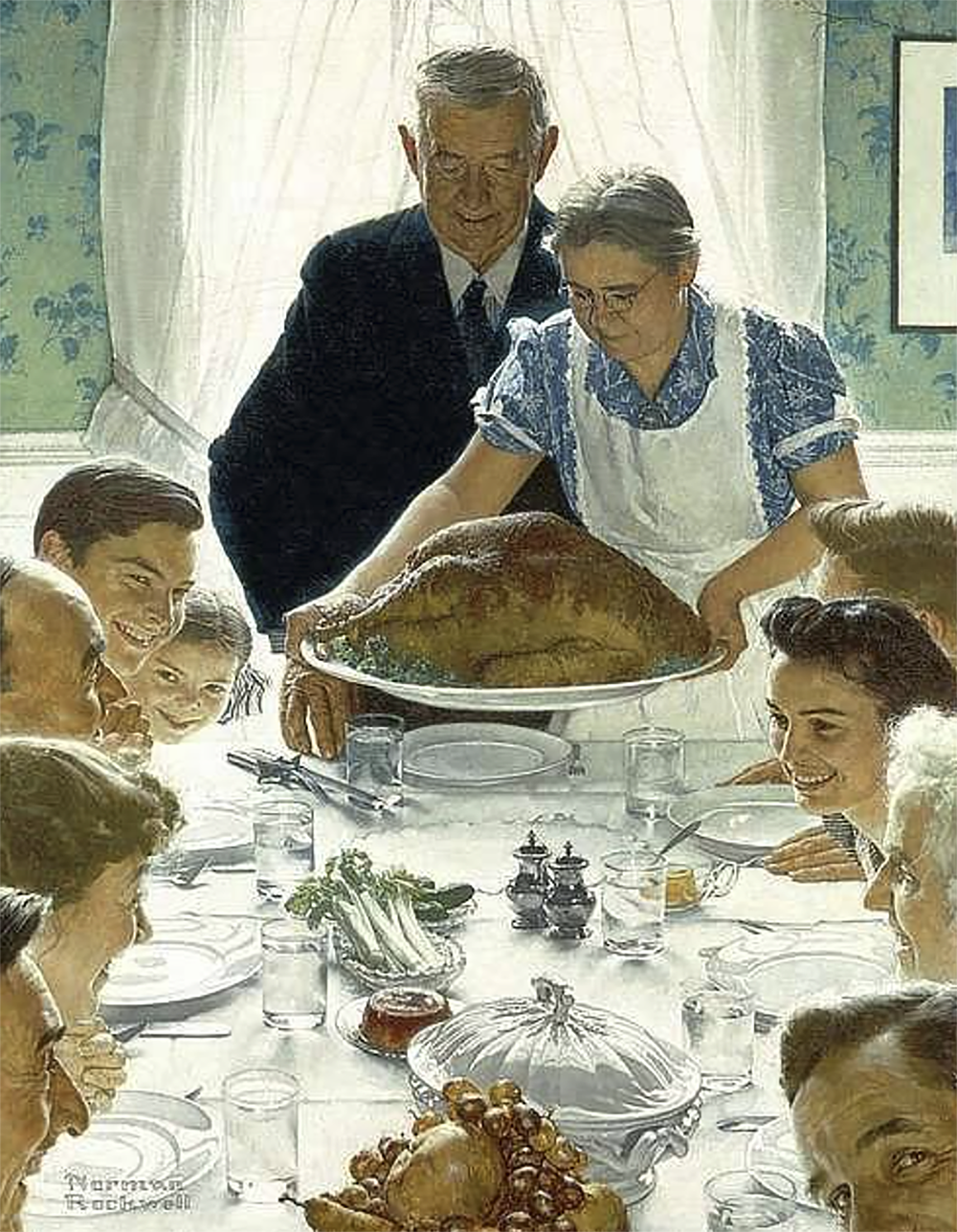
“Freedom From Want” painting by American artist Norman Rockwell.

An early 1940s picture painted by American artist Norman Rockwell, creator of more than 300 Saturday Evening Post covers and some 4,000 paintings during his lifetime, is the image most frequently associated with Thanksgiving. Titled “Freedom from Want,” the painting depicts a family gathering around a celebratory meal. It remains today as a favorite “picture of Thanksgiving.”

Rockwell once said that he painted life not as it was, but what he wished it could be. Maybe that’s what we’re all craving around the holidays, hope for what life should be.

Another American icon offering timeless pictures of America in childhood humor is Hank Ketcham’s cartoons, “Dennis the Menace.” One in particular mirrors Rockwell’s image, with Dennis and his parents sitting down for Thanksgiving dinner, heads bowed. In the caption, Dennis offers, “… and I’m thankful the pilgrims didn’t have liver an’ onions for their Thanksgiving meal.”

Let me say, I’m with Dennis. My father liked liver, so Mom cooked it. Too often. And like most kids of my generation, I dared not question any meal Mom prepared. My sisters and I respectfully ate what was set before us.

“When I left home,” I was telling a friend last week, “One of the things on my list vowing to never eat again was liver. A promise I have kept to this day.”

“You mean your mother didn’t cook a separate meal for you and your sisters,” the longtime acquaintance laughed.

Quick to affirm that we had obviously grown up in the same age, my response was, “Nope! If it was on your plate, you were going to eat it before leaving the table. And leaving a family meal was something you didn’t dare do without first asking, ‘May I please be excused?’”

My mother also played the “Mom card” to shame us for wasting food. “Eat it, don’t waste it. You know there are starving children all over the world.”

“Same with my parents,” reported my friend. “One day my sister and I suggested Mom box up her stewed tomatoes and send them to those starving children. We laughed and laughed. Until we noticed the deafening silence and parental glares of disapproval.”

“There were times when I felt like my parents didn’t have a sense of humor, either,” I sympathized.

Varying from my raising only slightly after I became a parent, I gave my kids a standing offer. I told them they didn’t have to eat what I cooked if they didn’t want to.

“Really,” daughter Robin asked the first time. Lee said nothing. He was always good at keeping his mouth shut a little longer than his older sister.

“Sure,” I said, reaching for her plate. “I’ll just put it in the refrigerator and save it for supper tomorrow night.”

My kids never questioned whether I had a sense of humor. Just how I sometimes applied it.

So, here’s my serious wish for a Happy Thanksgiving. May our hearts be filled with genuine gratitude for the things that make this country the best place on earth to live. Thanksgiving Day and every day.

With a small nod of agreement with Dennis The Menace. Thankful that if the Pilgrims menu did include liver or stewed tomatoes for Thanksgiving dinner, it never made it into the history books.

—Leon Aldridge

(Norman Rockwell’s “Freedom from Want” (above) appeared inside the March 6, 1943, edition of the Saturday Evening Post magazine. The painting was not intended as a Thanksgiving illustration, it was one of the “Four Freedoms” series by Rockwell symbolizing the aspirations of a world with security and well-being as articulated by President Franklin D. Roosevelt. However, it quickly became an iconic image associated with the Thanksgiving holiday )

– – – – – – –

Aldridge columns are featured in these publications: The Center Light and Champion, The Mount Pleasant Tribune, the Rosenberg Fort Bend Herald, the Taylor Press, the Alpine Avalanche,  the Fort Stockton Pioneer, the Elgin Courier, The Monitor in Naples, and Motor Sports Magazine.

© Leon Aldridge and A Story Worth Telling 2025. Excerpts and links may be used, provided full and clear credit is given to Leon Aldridge and ‘A Story Worth Telling’ with appropriate and specific directions to the original content.