Practical application of a good education

“Education is what remains after one has forgotten what one has learned in school.”
— Albert Einstein

– – – – – – –

Mom talked fondly about her father. I remember some things about Arthur G. Johnson, my maternal grandfather. He died February 15, 1951. That I can remember him at all seems incredible when I think about it. Considering that I celebrated my third birthday a month before his death.

The most vivid memory is waiting at the bottom of the stairs leading to his second-floor bedroom at 382 South Main in Winchester, Kentucky. Waiting to hear him call my name when he awoke from his nap. That was my signal to sneak up the stairs and hide under a bedroom dresser while he continued calling my name, pretending he couldn’t see me.

Called Pop or sometimes Poppa by Mom and her four siblings, Arthur Johnson was an educated man. Photos picture him as stoic in stature, exhibiting a state of calm and composure—someone that most might expect to face life with education, practicality, and wisdom.

He came from a long line of Kentucky stock documented back into the 1700s. A schoolteacher and a principal in both Kentucky and Tennessee, he also served as an educational director for the Civilian Conservation Corps, commonly referred to as the CCC. Before the U.S. entered World War II in 1941, the CCC constructed public buildings, fences, and state park facilities still in use today; often recognized by their stone construction.

In addition to his educational and professional presence, however, I learned last week that Arthur Johnson also had a penchant for practical applications of learning.

“Let me tell you one story,” my Uncle Bill said last week at the annual reunion of the descendants of Arthur G. and Bernice Conlee Johnson held near Winchester, Kentucky. Uncle Bill is my mother’s last surviving sibling. He celebrated his 90th birthday in May and has always been a great storyteller.

“Pop had a degree in psychology,” Mom’s little brother began. “He was educated and intelligent, but he applied his education with practicality.

“There was a little boy in the neighborhood, also named Billy. And he was … well, he was bad. I mean, he was a really bad seed. His mother couldn’t control him. He got into more kinds of trouble, but she always defended him. He never did anything wrong; you know. It was always the other person.

“At one point, I had a little dog,” Bill continued. “It got caught up in a wire fence around the back yard and couldn’t get out. But this kid killed my dog rather than help it get loose. That’s the kind of evil bad he was.

“One day, his mother comes down the road,” Bill’s story continued. “I’d had a bunch of run-ins with her son. So, when she came flying down the road and turned in at our house, I thought, ‘Oh, my gosh, what have I done now?’ That woman was as bad as her son was.”

“’Is Mr. Johnson here,’ she asked me? People in the community often sought Pop’s advice since he was a respected teacher. I told her I’d check; that I didn’t know. So, I went up to his room that was his own world in that house. I told him, ‘Billy’s mom is down there and wants to talk to you.’ He sighed and said, ‘OK, let her in.'”

“She went in, but the door stayed open just a little,” Uncle Bill continued. ” I just stood there, you know, and listened. She started telling Pop about Billy. ‘I just can’t control him anymore,’ she said. ‘He’s mean, he’s out of control, and I don’t know what to do with him.’”

“Pop was quiet for a minute,” Uncle Bill related. “Then he gave Billy’s Mom some advice. ‘I’ll tell you what to do. You go down here to the local library, and you check out a book called Elements of Psychology. Remember that title. It’s a big book. It’s a good book. Check it out and take it home. Then when you get home, you take that book, and you beat his butt with it. Two or three doses of some applied psychology will help straighten him out.”

I laughed. I had always heard that the grandfather I barely got to know was a wise man. One who valued education and the value of a good book.

But I never knew just how well he understood the practical application of them.

—Leon Aldridge

– – – – – – –

Aldridge columns are featured in these publications: The Center Light and Champion, The Mount Pleasant Tribune, the Rosenberg Fort Bend Herald, the Taylor Press, the Alpine Avalanche,  the Fort Stockton Pioneer, the Elgin Courier, The Monitor in Naples, and Motor Sports Magazine.

© Leon Aldridge and A Story Worth Telling 2025. Excerpts and links may be used, provided full and clear credit is given to Leon Aldridge and ‘A Story Worth Telling’ with appropriate and specific directions to the original content.
I still hear those words

“Art washes away from the soul, the dust of everyday life.”
— Pablo Picasso (1881 – 1973) Spanish artist

– – – – – – –

While hanging the painting of a sad, wet dog on the wall in my newly refurbished “music room slash library” last week, words from some 30 years ago came back to me.

“You collect some heavy stuff, man.”

They were the words of Judy Snouffer. About July 1993. The day I accepted a generous offer from her and her husband Chuck to help unload truckloads of household belongings at my newly acquired Hill Country home near Pipe Creek, Texas.

As the newest editor and publisher at the Boerne Star, my charge included producing the Boerne newspaper and looking after Granite Publications properties in Bandera, Gonzales, and Fort Stockton.

Judy (better known to friends and co-workers as “Jet”) was composing supervisor and graphic artist at The Star. Chuck worked for the City of Boerne. What I didn’t know was Judy’s artistic skills reached far beyond that of just newspapers.

What Chuck and Judy didn’t know was that I collected unique but heavy stuff. Books, artwork, phonograph records, juke boxes, neon signs, gas pumps …and cars.

I knew Chuck and Judy owned a car. I don’t remember ever seeing it, but I did hear them talk about one. Their daily transportation was matching motorcycles. Not just any motorcycle, but Moto-Guzzis. Manufactured in Italy. Also, the oldest European manufacturer in continuous production.

Jet parked her bike by the newspaper office back door every morning. Far outclassing my Honda Shadow, whenever I rode it.

She was different. A cool kind of different. Like a refugee hippie from the 1960s. An artistic soul who worked and thought outside the dust of everyday life. She wore black fingernail polish before it was a thing. She personalized her work area with stars, moons, and crystals. Motivation for her creative vibe.

And creative she was. Jet surprised me one day with the painting I still have of a sad, forlorn looking dog in the rain. The dog closely resembled Max, the adopted basset hound who made the move to the Hill Country with me. He hung out at the office on Fridays, quickly becoming known to the staff as “Office Max.” Jet was moved by my story one day about Max getting rained on and wet in the back yard before I got a doghouse built. That’s when she gifted me with her painting titled, “Dog Day Blues.” Noted on the back as “No. 507” dated January 22, 1994.

It blew me away. “This is beautiful,” I said. “I knew you were an artist, but I didn’t know you painted.” Jet was humble, shyly showing me photos of her other work plus a feature story from the San Antonio Express News about her artistic awards.

Jet wasn’t the only one who contributed to my lifetime of acquired pieces still hoarding memories today in my music room slash library. “How would you like a Boerne fire hydrant for your quirky collection,” Chuck asked one evening?

“You’re speaking my language,” I quickly responded.

“The city’s replacing old ones. A pile at the yard is headed for scrapping,” he said. Go with me after work tomorrow and we’ll get you one.”

I was thrilled. Until I grabbed one end of it. “You didn’t tell me a fire hydrant weighed as much a Buick Roadmaster station wagon,” I laughed.

‘Bout like your Seeburg jukebox or that Mobil gas pump we unloaded,” he quipped.

I left the Hill Country in 1998. It was a few short years later the day the message arrived from a mutual friend in Boerne. An obituary.

Judy “Jet” Atkins Snouffer died tragically March 18, 2004. The way she would’ve wanted to go – on her motorcycle. She “died with her boots on.”

“Jet” was survived by her loving husband, Chuck Snouffer of Boerne, the obit continued. Judy grew up between Texas and Germany. She worked at the Boerne Star and STPS. Judy was a very free spirit, living life to the fullest. Aside from being a very eclectic personality, Jet was a very creative and talented person; a “’ane of all trades.’ She was a recognized artist having won several awards.”

The obit concluded with, “Ride on Jet!”

I think of Chuck and Jet when I glance at the painting.

And I still hear, “You collect some heavy stuff, man.” 

—Leon Aldridge

– – – – – – –

Aldridge columns are featured in these publications: The Center Light and Champion, The Mount Pleasant Tribune, the Rosenberg Fort Bend Herald, the Taylor Press, the Alpine Avalanche,  the Fort Stockton Pioneer, the Elgin Courier, The Monitor in Naples, and Motor Sports Magazine.

© Leon Aldridge and A Story Worth Telling 2025. Excerpts and links may be used, provided full and clear credit is given to Leon Aldridge and ‘A Story Worth Telling’ with appropriate and specific directions to the original content.

My friend, the belated birthday card

“Since I’m late sending you this birthday card, let’s make sure that doesn’t happen again. Please consider this your first happy birthday wish for the year.”
—  My standard birthday card greeting.

– – – – – – – –

“The difference in Father’s Day and Mother’s day,” Center Church of Christ minister Tim Perkins began last Sunday’s sermon. “… is that some people feel like you don’t have to spend as much on Father’s Day presents as you do on Mother’s Day.”

I laughed. But Tim’s signature humor reminded me of my long-established habits regarding those special days. Father’s Day, Mother’s Day, Christmas, Valentine’s Day. And the big one, birthdays. Each one, a special occasion for remembering those we love and cherish.

“Caring enough to send the very best,” as Hallmark once promoted, I still do. And I still prefer the lost art of sending a real card that can be held, saved, and cherished.

My only problem is I’m always late. Believe me when I say the “belated” birthday card was invented just for me.

Striving to improve over the years, I had one great idea about 40 years ago. And it was genius, if I do say so. Came up with it all by myself.

Instead of sending belated birthday cards all year long, just send everyone a card at the first of the year. Sign them, “Let me be the first one to wish you happy birthday this year.”

The plan was to mail them all between Christmas and New Year’s. However, since February events typically cross my mind at the Fourth of July picnic, it was around St. Patrick’s Day before this stroke of genius came to me. Therefore, the ship had already sailed for January and February birthdays.

“Oh well,” I thought. “They’ll get the belated version one more year. Which is what would have happened anyway.”

“This is going to be a great idea,” I giggled with glee.

My sister Leslie’s birthday is in February. One more belated card for her would be no problem at all. Unless I forgot to mail it.

And the timing was perfect for my grandmother’s birthday on March 6. There was some concern, however. Granny was dealing with some minor heart issues at that time. Would getting a birthday card from me on time be too much of a surprise for her heart?

Next on the list was my baby sister, Sylvia. May 21. A card from me a couple of months early might make her wonder, “What can this be. Leap year? National Pickle Week? Jewish New Year?”

She had never received a birthday card from me on time. So, I knew she would have laughed. She would also have been the first one to say, “Now that is really dumb … even for Leon.”

Next on the list was my mother’s birthday in June. But getting a card in March, she would have still just quietly opened it, smiled, and said, “How nice. Leon remembered.”

Then, she would have put it aside to go into her cedar chest later, with every other card she had ever received, before returning to lunch or the latest episode of All My Children.”

Mark my word, however, sometime between 3:30 p.m. and next Tuesday, the light would have come on, and she would have said out loud, “My birthday is not until June!”

Dad would have opened his card, laughed softly, and shook his head because his birthday was in August. And because for as long as I could remember, he was the only one who knew exactly what I did, why l did it, and most of the time, before I did it.

Dad would have also been the one to explain it all to Mom. Sylvia would be calling Leslie to figure out what marble I’ve lost now. Leslie would then have been trying to understand why she got a belated card when everyone else got a regular card.

It’s an idea that still might work. At the time, I decided it was just too risky. More than everyone could figure out, and too much confusion to explain. Even for me.

But feel free to give it a try. I still think it’s the best idea since the “Vegematic” was promoted on late-night TV.

In any case, remember this. If someone forgets your birthday, take it as a compliment. It could mean you don’t look like you’ve aged enough to have another birthday yet.

—Leon Aldridge

– – – – – – –

Aldridge columns are featured in these publications: The Center Light and Champion, The Mount Pleasant Tribune, the Rosenberg Fort Bend Herald, the Taylor Press, the Alpine Avalanche,  the Fort Stockton Pioneer, the Elgin Courier, The Monitor in Naples, and Motor Sports Magazine.

© Leon Aldridge and A Story Worth Telling 2025. Excerpts and links may be used, provided full and clear credit is given to Leon Aldridge and ‘A Story Worth Telling’ with appropriate and specific directions to the original content.

Some things never change

“The good physician treats the disease; the great physician treats the patient who has the disease.”
— William Osler (1849 -1919), one of the founding Johns Hopkins Hospital professors and creator of residency programs.

– – – – – – –

“Come in Dr. Reitz.” With those words, my grandmother welcomed the Pittsburg, Texas, family physician of many years into her home. “Thank you for coming. S.V. isn’t feeling well; he’s coughing and feverish.”

Sylvester Aldridge was my grandfather’s full legal name. No middle initial. Why she called him S.V. was a question I never thought to ask.

The good doctor pulled a chair next to the bed, opened his small black bag, and took out a tongue depressor and a thermometer. “I expect your fruit trees will be blooming before long,” he small talked with my grandfather.

Standing silently at the edge of the room, I was just tall enough to peek over the windowsill. The physician’s shiny new 1951 Chevy sitting in the driveway caught my eye. When I looked back at him, we made eye contact. I can still hear his deep voice say, “My, you’re getting to be a big boy.”

Dr. P.A. Reitz had delivered me into the world a little more than three years before that day. On a cold January 20, 1948, evening at the M&S Hospital he founded in Pittsburg. I don’t remember much about that day, but I was told light snow was falling outside.

I do remember house calls, once a common convenience by small-town physicians that slowly slipped into the past in the years that followed. A time when doctors wore suits and ties in the clinic and for house calls. And nurses wore white uniforms and caps. When “scrubs” were seen only in operating rooms.

Much of my childhood healthcare fell to Dr. Reitz. Dad’s years with Perry Brother’s five-and-dime stores moved us from one small Texas town to another before Mount Pleasant became the last stop. Many of my summer days, however, were still spent at my grandparents’ house.

“He’s going to need some stitches, Mrs. Aldridge.”

The wound for which I still display a scar on my head was inflicted during an afternoon of friendly playtime. Granny was enjoying afternoon coffee inside with her friend, Mrs. Martin. Outside, Mrs. Martin’s grandson and I whiled away the time with comic book fantasies. I don’t remember if I was the good guy or the bad guy, but I became the wounded guy when the other youngster got the drop on me with a piece of pipe. From atop a car in the driveway.

“Get a good grip on him,” Dr. Reitz cautioned my grandmother. His recall of my extreme dislike for doctors wielding needles was impeccable.

Those aged memories offer a different perspective on healthcare of today. Opinions abound, but popular views rival genealogical histories of Biblical proportions.

“Therefore, in all the days of medicine, throughout the land, specialization begat doctors passing small towns for big cities; and that begat the decline of rural hospitals; which begat small towns with clinics staffed by P.A.s and nurse N.P.s who take care of routine exams and illnesses begatting acute cases to emergency rooms or specialists.”

In bigger cities.

– – – – – – –

Dr. P.A. Reitz, one of Pittsburg’s best known, most respected and beloved citizens, died at M&S Hospital early Monday morning after suffering a massive heart attack,” the 1978 newspaper article in my archives read.

The yellowed paper news story bore no attribution. I suspect from the heartfelt and personal tone used by the writer, it might have been published by Pittsburg’s long-time local newspaper, the Gazette.

Dr. Reitz was born April 18, 1904, in Kansas. He moved to Pittsburg in 1935. He was a graduate of the University of Nebraska Medical School and completed his internship at Parkland Hospital in Dallas. He served in the U.S. Army in Europe during World War II.

“He was a family doctor for 43 years …” the story shared. According to the newspaper tribute, Dr. Reitz gave M&S Hospital to the citizens of Pittsburg in 1968.

“The business community closed Thursday afternoon for his funeral at the First Methodist Church,” the clipping concluded. “Interment was at Rose Hill Cemetery.”

I still visit Dr. Reitz … in a manner of speaking. My father and mother, Leon and Indianola Aldridge, are buried at Rose Hill Cemetery. Right next to Dad’s parents, Sylvester and Hattie Lois Aldridge.

Just across the narrow lane at the Pittsburg cemetery, maybe 50 feet away, are the graves of Percy. A. and Hazel Reitz.  

I miss small-town hospitals with doctors’ offices in or near the facility. Doctors who made house calls and knew their patients like family. That said, I get it that change and adaptation are inevitable aspects of life.

Some things never change, though. Like needles. I still don’t like needles.

And I still don’t know why Granny called my grandfather S.V.

—Leon Aldridge

– – – – – – –

Aldridge columns are featured in these publications: The Center Light and Champion, The Mount Pleasant Tribune, the Rosenberg Fort Bend Herald, the Taylor Press, the Alpine Avalanche,  the Fort Stockton Pioneer, the Elgin Courier, The Monitor in Naples, and Motor Sports Magazine.

© Leon Aldridge and A Story Worth Telling 2025. Excerpts and links may be used, provided full and clear credit is given to Leon Aldridge and ‘A Story Worth Telling’ with appropriate and specific directions to the original content.

Learning to cope with emerging technology

“Our mission is to connect every person in the world.”
– Mark Zuckerberg

– – – – – – –

Technological advancement, properly applied, should bring improved quality of life with rewards in time savings and productivity. Don’t you agree?

But with every application of cutting edge techie tools comes more knowledge not enjoyed by those with a learning curve geared to outsmarting a computer. Or worse, nefarious characters with devious ideas for using it never intended by the developer. The internet, cell phones, mind boggling apps. A plethora of digital diversions that delight one day and dishearten the next.

Even with the newest … AI. Don’t we have enough artificial intelligence already serving as elected officials, television news analysts, and customer service reps?

Tech tools and toys were just emerging when fax machines were hailed as futuristic. We marveled at the one installed at the newspaper office in Center back then. “It’s going to save so much time,” we cheered, gazing at documents magically transferred through telephone lines. With every screeching sound of the machine’s “handshake” tone, everyone gathered to “ooh” and “ah” at letters from the other side of the country arriving in mere minutes.

In no time at all, we were sharing jokes and cartoons with friends and business associates. It was the best source for laughter around. Until Facebook came along.

In the real world, technology can make the impossible happen with ease and in record time. But just like a questionable joke inadvertently faxed to the wrong number, tech can create a desire to disappear into the unknown. Or render us ready to take the device and “throw it in the horse lot” as my grandmother used to say, when it doesn’t work as we think it should,

The late Lewis Grizzard, Southern humorist and author, put it succinctly in his book entitled, “Elvis Is Dead, and I Don’t Feel So Good Myself.” With his insightful humor, Grizzard poked fun at baby boomers trying to cope with emerging technology when he said, “The world around me is a tuxedo, and I’m a pair of brown shoes.”

That very thought came to me a while back. When my home security system designed to provide the secure feeling of a bad dog backing up a Smith and Wesson failed to function properly.

It’s a great piece of technology. Monitors doors and windows, the thermostat and selected appliances, the lights, reports the weather, and more that I have yet to master. It records videos of anyone approaching the doors and allows me to answer the doorbell from across town or across the country via my cell phone that has features I have yet to comprehend. Things that work great, provided the system installer and said smartphone user are both smarter than the technology.

It started the day a young technician came to my house and upgraded the control panel. Is it my imagination, or do all technical service reps look like they are a couple of years shy of being old enough to get a driver’s license? After he explained the changes to me in a language that might as well have been Swahili, he assured me it was the best on the market and was gone in short order. “Thank you,” I smiled.

At bedtime that night, cats were put out, dogs let in, doors locked, and pillows fluffed. As the last measure before drifting into blissful slumber, I armed the alarm confident in the sophisticated system with my “three dog night” backup.

For the record, my money’s on the dogs for reliability. They do one thing the alarm doesn’t—wake me without fail at 5:30 a.m., reminding me of their urgent need to go out and visit nature.

5:32 a.m. The doggie alarms goes off. With blurry vision, I poke the control panel app with my code. Nothing, followed by the words “Incorrect Code.” A second attempt with glasses was equally unsuccessful. By the third try, the dogs were poised and pointing at the back door with tears in their eyes.

“What next?” I could simply open the door. Within seconds, I would be on the phone with someone from the security company checking on me. “Wait,” I thought. I could also be talking to uniformed police officers. With guns.

I dialed the number for the alarm company and was pleasantly greeted. “XYZ Security, how may I help you?”

“My dogs and I are being held hostage in my house,” I joked about the non-functioning panel. I’ve always considered humor as an ice breaker for pleasant conversation. Please note, however, that humor is not the appropriate response when talking to a home security agent. At 5:30 a.m.

Once we reached an understanding of what constitutes funny and what does not, tests were performed to arrive at a conclusion. The servicing technician had failed to program the new panel with my security code.  

“No problem, I can walk you through it,” the understanding agent said. Her discovery that she was dealing with someone who could not program their VCR, combined with realizing she was talking with someone who still uses a VCR, appeared to dash all hopes of a speedy solution.

We stumbled through it, though. Much to the delight of the agent and me. And three agonizing dogs who burst out the back door when it was finally opened.

Crisis over, my thoughts turned to caffeine. And to Zuckerberg’s philosophy and Grizzard’s humor. With the last sip, I wasn’t convinced that chatting with security system people at 5:30 a.m. was Zuckerberg’s vision of “connecting to every person in the world.”

Especially when I’m wearing brown shoes in a tuxedo world.

—Leon Aldridge

– – – – – – –

Aldridge columns are featured in these publications: The Center Light and Champion, The Mount Pleasant Tribune, the Rosenberg Fort Bend Herald, the Taylor Press, the Alpine Avalanche,  the Fort Stockton Pioneer, the Elgin Courier, The Monitor in Naples, and Motor Sports Magazine.

© Leon Aldridge and A Story Worth Telling 2025. Excerpts and links may be used, provided full and clear credit is given to Leon Aldridge and ‘A Story Worth Telling’ with appropriate and specific directions to the original content.

We thought it was funny — everyone laughed

A well-meaning friend gifted me a coffee mug on my 40th birthday … a few years ago.

Black in color, it reflected the American mindset of 40 as the midnight hour of aging when birthday celebrations turn into pumpkins. I still have the mug. Every so often, I glance at it once more, and the message that foreshadowed coming years.

“After 40, it’s patch, patch, patch.”

How funny, we all laughed at the party. These “Golden Years” were still a distant vision when we celebrated as I announced my intentions to remain “thirty-nine and holding.” A motto, which I also used to think was funny when my optimistic Uncle Freddie joked about it years ago.

While sitting in the waiting room of the hospital imaging area last week, leisurely looking at dog-eared magazines dating back to just after Y2K, the mug’s message returned to me in a vision. One with memories of household items routinely patched when I was a kid. Things that no one patches anymore. At least, not that I know of.

Things like blue jeans. With cuffs turned up a couple of rolls. Extra leg length allowing for growing boys because buying new jeans didn’t happen frequently. Usually once a year. At back to school time. And when they were finally tossed, the dark color was long gone, the cuffs completely unrolled, and the knees patched. Sometimes more than once.

Iron-on blue jean patches were a staple of every mother’s mending basket back then. New patches stood out like a bandaged sore thumb on worn out jeans. Something that no doubt promoted the popularity of decorative patches.

I remember going to school sporting a likeness of Davy Crockett on my knees. “King of the Wild Frontier.” Other times, with Roy Rogers riding on Trigger, hat waving high above his head.

Patching clothes was not limited to blue jeans, though. Mom darned my socks. Who today even remembers the word “darning?” Or knows what it means. The domestic art of stitching up small holes in clothing by weaving thread to cleverly hide the repair was also used on my sisters’ sweaters. Extracting extra miles from everything we wore.

Even down to our shoes. Making them good for more miles. When every small town had a “shoe shop” where the rich smell of leather greeted customers at the door. Glynn’s Shoe Shop on the south side of the square in Mount Pleasant extended the life of footwear with new soles and heels and a complimentary shine, all at a fraction of the cost of new shoes.

New heels and soles were still available at Center’s shoe shop when I located here during Gerald Ford’s presidency. It was just off the square on Logansport Street .

Another shoe shop service was cutting a couple of inches off the ends of leather belts and punching extra holes to extend their life of keeping pants up on young boys as they sprouted into lanky teenagers.

Washing machines, refrigerators, and other appliances were once repaired when they stopped working. Now, we go shopping for a new one when the old one hiccups. A popular advertising slogan touting quality back in the day proclaimed the Maytag repairman to be “the loneliest man in town.” Today, simply finding a service technician to repair any brand in some communities is a lonely search.

Patching practices included the family car. Repaired tire tubes for flat tires on Dad’s Studebaker Starlight Coupe. A box of Camel brand inner tube patches was ever-present in his toolbox. Like most men then, he did minor repairs on the family’s only car. When automobile maintenance required little more than common sense and logic.

Today’s riding lawnmower is a more complex machine than a 1950 Studebaker.  And cost as much as three or four new Studebaker cars did then.

Household repairs were creative by today’s standards. My grandfather patched Granny’s pots and pans utilizing a nut and bolt with flat washers on both sides of the hole. And I own a rocking chair on which he repaired a broken leg. I remember him repairing and patching his favorite rocker when the US flag had 48 stars.

Previous generations were adept at patching and repairing to make household items and money last longer. One repair shop I remember displayed a sign claiming, “We can repair anything but a broken heart.”

“Mr. Aldridge,” a voice interrupted my daydreaming. It was an invitation to join the technician for an MRI party in my honor down the hall. A party where there will be less laughing than was heard at my 40th birthday.

By the time you’re reading this, I likely know the test results. I should also know the options for dealing with that aching, aging shoulder. The one that’s endured everything from a 1970s motorcycle wreck to a hillside hiking spill just a couple of years ago. But it’s amazing what modern medicine can patch now.

If I’m lucky, maybe one of those Camel tube patches might even work.

—Leon Aldridge

– – – – – – –

Aldridge columns are featured in these publications: The Center Light and Champion, The Mount Pleasant Tribune, the Rosenberg Fort Bend Herald, the Taylor Press, the Alpine Avalanche,  the Fort Stockton Pioneer, the Elgin Courier, The Monitor in Naples, and Motor Sports Magazine.

© Leon Aldridge and A Story Worth Telling 2025. Excerpts and links may be used, provided full and clear credit is given to Leon Aldridge and ‘A Story Worth Telling’ with appropriate and specific directions to the original content.

It’s just the way my daddy trained me

“Things Money Can’t Buy: Time. Happiness. Integrity. Love. Manners. Respect. Trust. Class. Common sense. Dignity.” ― Roy T. Bennett, inspirational author

– – – – – – –

“You don’t have to get up,” someone told me during an introduction and handshake meeting last week.

“Are you kidding,” I laughed as I rose to my feet. “That’s the way my daddy trained me. I don’t know any other way.”

Good manners will never be down and out in a civilized society, we agreed at the boomers coffee klatch last week. But random acts of kindness and courtesy once commonly taught in every home are gowing scare in public places.

“It’s not as much of a thing as it used to be,” one personality-less employee in a local business told me last week. Guess they didn’t like my facetious “thank you” for noticing their overwhelming lack of customer service and manners.

All debates aside, the boomers coffee klatch also agreed on one thing. Courtesy and manners still matter. We all get one chance to make a first impression. Often, before we ever speak the first word.

“You always dress that way for work,” I recall a member of management asking one of the new guys on a job many years ago.

“Yeah,” the newbie stuttered,

“And you always address your supervisors and elders with, “Yeah? Where’s your manners?” Before the young man could dig himself any deeper, the manager offered advice I’ve never forgotten.

“If you want customers and colleagues to perceive you as a professional, you have to dress and act like a professional. No one gives you respect for free, you earn it by the way you present yourself and the way you treat others.”

Manners were important to my parents and grandparents. Something for which I have always been deeply grateful. Learning manners requires no textbook and very little intelligence. Just treat others like you would like to be treated.

“Manners make the man,” Mom used to say. “Real men are considerate of others, especially ladies.” My father made sure I understood that one well one day at the Perry’s 5¢ and 10¢ store in downtown Mount Pleasant where he was the manager. Quickly stepping up to hold the door for a lady behind us, he smiled and said, “Please pardon my rude son. I’ve tried to teach him some manners, but he seems to have forgotten that today.”

A big one with my grandmother was hats. “A gentleman always removes his hat indoors,” she reminded me often. “Take that cap off,” she informed me the first time. “It’s rude to wear a hat inside. And don’t ever sit down to eat with a cap or hat on your head.”

The second time, she wasn’t as subtle. She snatched the cap off my head, handed it to me, and asked, “What did I tell you about a gentleman and a hat indoors? People will think you were raised in a barn.”

My grandmother also clearly illustrated “Please” and “Thank you.” She bought a strawberry ice cream cone one afternoon at Lockett’s Drug Store soda fountain in downtown Pittsburg, Texas and handed it to me. Just as I was about to enjoy the first bite, she abruptly took it back.

“Thank you,” she said to the young man who had just scooped the delectable delight. She then took a bite of it and said, “You must not have appreciated it, I didn’t hear you thank anyone.”

After a most humble “thank you” to both her and the soda fountain attendant, she returned the ice cream cone to me … minus one bite. The price for missing my manners.

“What do you say when speaking to someone?” I remember Mom asking.

“Yes,” I responded.

“Yes … what?”

I soon learned that “Yes, ma’am” and “Yes, sir” were the only acceptable words for a mannerly answer. As were “No, ma’am” and “No, sir.”

“Manners are not important just because I say so,” Dad told me many times. “They are a measure of how you respect people. If you show others respect, they will respect you.”

Someone asked me about a fellow employee in a workplace not long ago, “Why doesn’t she respect me when I ask her for something?”

Recalling the words of the supervisor I always remembered and my father’s words, I said, “Could be the way you ask. No one gives you respect for free, you earn it only by giving it.”

True enough, money doesn’t buy respect or manners. But if it did, a lot of people these days are apparently broke.

—Leon Aldridge

– – – – – – –

Aldridge columns are featured in these publications: The Center Light and Champion, The Mount Pleasant Tribune, the Rosenberg Fort Bend Herald, the Taylor Press, the Alpine Avalanche,  the Fort Stockton Pioneer, the Elgin Courier, The Monitor in Naples, and Motor Sports Magazine.

© Leon Aldridge and A Story Worth Telling 2025. Excerpts and links may be used, provided full and clear credit is given to Leon Aldridge and ‘A Story Worth Telling’ with appropriate and specific directions to the original content.

History not found in books

“Count your age by friends, not years. Count your life by smiles, not tears.”
— John Lennon

– – – – – – –

Nothing defines the perspective of time for a writer better than aging manuscripts in a life’s collection of work. Less than subtle reminders of lives chronicled half a century or more ago; people who were witness to history not available in books.

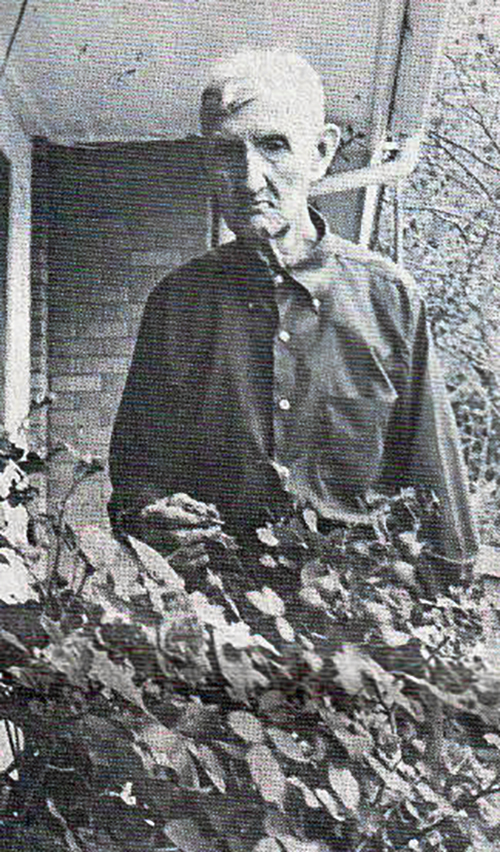
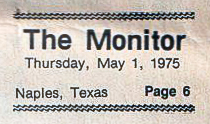
May 1 will mark 50 years since I penned a piece printed in the Naples Monitor on Thursday, May 1, 1975. An interview with a gentleman born when Ulysses S. Grant, commanding general of the Union Army in the Civil War, was serving as the 18th president of a United States with only 38 states.

Burgess Peter Jacobs, aka “Papa Jake,” had just celebrated his 99th birthday when we talked. “Came here the 15th day of January 1907,” he said with a big smile. “I stepped off the train at the Naples depot with a wife and five kids. Came from North Carolina where I worked in a sawmill and raised a little patch of cotton.

“There were no brick buildings,” he reminisced, recalling dirt streets and wood sidewalks as if it were only yesterday. “Charlie Pope built the first one in 1908 or ’09. You know where the Lee Davis’ store is? He put his name in the brick on that building. Course, when Lee moved in, he covered up Charlie’s name.”

“We call these “Mama’s blooms.”

His crystal-clear mind revealed knowledge like someone reading from a history book. “The big business here was the sawmill, but it shut down a few years after.”

When questioned about occupations through the years, he called on quick wit and humor. “Like everyone else — as little as I could. Two years in Bowie County and a year in West Texas before settling down near Naples.

“I farmed mostly. Until about 17 or 18 years ago,” Jacobs continued. “My house was in Morris County, but I farmed in Cass County. About as far as from here to the street,” he said, looking out the window.

“Tax collector came one day. Spent the whole day measuring,’ lookin’ and askin.’ When he discovered I lived in Morris County, he tore up the papers and Ieft. I could have told him if he had asked,” he chuckled.

Laughter and a zest for life filled his stories. “This fellow was runnin’ for sheriff in Cass County once and came by to ask me to vote for him. I told him that no one was coming that far to get me, and no one there was going to bother me. So I didn’t need a sheriff.”

Shifting to birthday cards, he showed me one from President Gerald Ford. “Seen a lot of presidents come and go,” Jacobs said, proudly displaying the greeting. “But sure was surprised to get a letter from one.”

According to Jacobs, family has commemorated his birthday since the early 1920s by staging the family reunion on the Sunday falling nearest his birthday. And family came large for Papa Jake.

Looking fondly at a picture of him and his wife, Quincey Adalee, he added, “I was married to her for 69 years, five months and a few days. I liked a little being 20; she was a little over 16 when we married.” After a noticeable hesitation, he said softly, “She’s been gone about ten years now.”

The couple had nine children and 42 grandchildren. Asked about great and great-great-grandchildren, Jacobs shook his head and laughed. “I don’t know. I can’t count ’em all. I just call ’em my dirty dozen.”

Papa Jake reported his daily activities included “watching a right smart of television. Like to watch the wrestling. Listen to the news on radio. I walk to the mailbox every day. Used to get the mail for the ladies around here ’till I got to where I couldn’t see too well.”

Jacobs expressed pride in seeing roses growing around his house. Especially the white roses. “We call them “Mama’s blooms,” he said, holding his wife’s picture.

I attended his birthday party Saturday night at the Naples Community Center and the family reunion Sunday. “He did not miss a minute of the activity while spreading  humor and warm smiles,” I wrote. “Posing for pictures with family that came from as far as California to attend.”

You can read history books all day long. But none will touch your soul the same as talking to someone who has lived it.

Papa Jake was a living example of the old saying that you are only as old as you feel. Smiles on a weathered face and laughter in an aged voice recalling family, friends, and a century of living left me thinking I was the old timer in that conversation.

Fifty years ago, come May 1.

—Leon Aldridge

– – – – – – –

Aldridge columns are featured in these publications: The Center Light and Champion, The Mount Pleasant Tribune, the Rosenberg Fort Bend Herald, the Taylor Press, the Alpine Avalanche,  the Fort Stockton Pioneer, the Elgin Courier, The Monitor in Naples, and Motor Sports Magazine.

© Leon Aldridge and A Story Worth Telling 2025. Excerpts and links may be used, provided full and clear credit is given to Leon Aldridge and ‘A Story Worth Telling.’

Fondness for a family motoring icon

Let’s leave town on a permanent vacation,
Lock up the house, pack up the station wagon.
— “Outta Here” song lyrics by Kenny Chesney

– – – – – – –

“Station wagon—where did that come from,” a friend laughed loudly, talking about her new sport utility vehicle approaching the size of a World War II Sherman Tank.

Station wagons disappeared from dealership model lineups in the mid-1990s. But, for those of us whose first driver’s license predated man’s landing on the moon, there’s usually a lingering fondness for the one-time icon of family motoring.

Two things likely paved the road south for true station wagons. One is the demise of “full-sized” cruiser automobiles that served as the station wagon’s platform. Caprices. Roadmasters. Galaxies. The other was the introduction of minivans and the gussied-up domestication of truck-based work vehicles.

The term “station wagon” originated in the early 1920s during the age of train travel. A wooden wagon body mated to an automobile chassis served to transport people and freight to and from train stations. Hence, “station wagon.” The wood look remained in fashion through the last true station wagons of the 90s, long after metal was the better suited method of manufacturing. The last of the “woody wagons” utilized decorative vinyl to obtain the popular faux wood look.

Old station wagons are cool today. I’ve long harbored a secret lust for a ’55 Ford Country Squire wagon. Black with a red interior.

“My father had a station wagon,” my friend said, recalling where her words came from. “I backed it into a pole and bent the bumper when I started driving. Didn’t think he would notice right away,” she laughed. “I was wrong.”

“We also had one,” I replied. “A 1958 Ford Country Country Sedan. Beige and white. And huge. Dad traded in a ’56 Chevy sedan when he brought the Ford wagon home in about 1960. Mom made frequent after-school trips in those days from Mount Pleasant to Granny’s house in Pittsburg, checking on Dad’s parents.

One memorable day, Mom and Granny were engaged in one of their spirited conversations, I’m guessing over one of my grandmother’s critiques on child-rearing. My grandmother, bless her heart, could ruffle Mom’s feathers in a heartbeat. She really meant well, it was just in her personality to be everyone’s life coach.

Nearing tears over their discussion and deciding it was time to go home, Mom loaded us in the wagon and gave ‘er the gas heading south on Cypress Street. As the motor revved up and the car gained speed, Mom took the column-mounted shift lever and threw it up into the “second gear position.”

Now, that would have have been just fine had she still been driving the recently traded-off Chevy. It was a standard shift. What Mom forgot in her aggravated emotional state was that the wagon was the first car Dad bought with an automatic transmission.

For anyone never having experienced this automotive faux pas, it’s something you long remember. Shifting an automatic transmission car from “D” to “P” at about 20-25 miles per hour and still accelerating produces a conglomeration of noises. The loud and ugly grinding kind coming from under the car. Almost always accompanied by violent lunges when the rear tires start bouncing up and down on the pavement.

Inside the big station wagon, three wide-eyed children flew off the seats and onto the floor. The seat belt craze was still a relatively new fad as a seldom purchased extra cost option. In brief silence after the car screeched to an abrupt and unexpected stop, my mother uttered one of her rarely used vocabulary words usually called on in extreme frustration. Words we kids were sternly forbidden to repeat.

In that moment of silence in the middle of the street, Mom folded her arms on the steering wheel and the tears came. Soft sobs soon became subtle, muffled laughter. Mom had that quality about her.

She carefully moved the shift lever back into “D.” Luckily, the big behemoth continued under its own power. We arrived home without further incidents or subsequent strange noises.

For the next couple of years, the reliable wagon transported everything from camping gear to groceries and Christmas trees to Cub Scouts. It also took us on memorable family vacations including one in the summer of 1960 when we lodged at the Rose Motel in Mena, Arkansas.

Still a year or two away from buying our first television, I was enamored watching the black-and-white set in the motel room. Gazing at the news of John F. Kennedy being tagged by the Democratic Party to appear on the ballot in November against Republican nominee Richard Nixon.

My fondness for old station wagons remains to this day. Maybe one day I’ll find that ’55 Ford Country Squire wagon I’ve been longing for. Perhaps I’ll even offer my friend a ride for old time’s sake.

But I don’t think I’ll let her drive—not if backing up is required.

—Leon Aldridge

(Image above — 1958 Ford Ford Motor Company original advertising piece that today, not only boldly portrays an iconic American automotive vehicle, but also subtly reminds of a long lost lifestyle in the U.S.)

– – – – – – –

Aldridge columns are featured in these publications: The Center Light and Champion, The Mount Pleasant Tribune, the Rosenberg Fort Bend Herald, the Taylor Press, the Alpine Avalanche,  the Fort Stockton Pioneer, the Elgin Courier, The Monitor in Naples, and Motor Sports Magazine.

© Leon Aldridge and A Story Worth Telling 2025. Excerpts and links may be used, provided full and clear credit is given to Leon Aldridge and ‘A Story Worth Telling’ with appropriate and specific directions to the original content.

Still trying to remember where …

Take care of all of your memories, For you cannot relive them.”
— Song lyrics by Bob Dylan and The Band

– – – – – – – –

Memories. I write about them often. Because at this age, I have a lot of memories to keep up with. And possibly because that’s all I can remember.

Most amazing are moments remembered when I forget everything else. My phone. My keys. My checkbook. It will come to me in a minute, but while we’re waiting, let me share a conversation with a good friend not long ago. We talked about what we remembered as new South Ward Elementary students in Mount Pleasant. Back when Fred Flintstone was still in Bedrock kindergarten .

By chance or destiny, we arrived in northeast Texas just a few years apart; coming from opposite directions. The reminiscing was fun. But what we agreed was really the amazing part was how much we remembered about grade school.

My first-grade year was 1954 at Crockett, Texas. The small white frame structure my parents rented sat in the middle of an empty field next to the only nearby residence. Two houses not far from downtown with a long, shared dirt driveway, surrounded by woods on three sides.

We didn’t have a television, or a telephone. What we did have was the sound of rain falling on a tin roof, the smell of Mom’s morning glories covering the trellis on the front porch, and late-night crackers and milk with Dad. It was his favorite bedtime snack.

A green Studebaker was transportation for our one-car family until the fateful Sunday afternoon when Dad and the neighbor, Mr. Hooks, went fishing. Old timbers on a country bridge failed, sending them off into a dry creek bed below.

The crumpled car and my father in bandages are scary memories. He and Mr. Hooks were banged up and bruised, but otherwise, all right.

My youngest sister, Sylvia, was born in Crockett. I remember Dad showing off our newborn sibling at the hospital’s back door, where middle sister Leslie and I waited in the car. Mom in a bathrobe, ws standing behind Dad. Both beaming with smiles.

My father worked for the long gone five-and-ten-cent store chain, Perry Brothers. Small wooden crates in which china dishes were received at the store served many uses, from garage storage to creative kid’s activities. One pinnacle of playtime was the day I launched one in the creek behind our house to see if it would float.

It did.

Basking in that delightful discovery, I then talked Leslie into boarding it to see if it would still float.

It didn’t.

Thank goodness the creek was shallow.

The bungled boating caper, plus the time I talked Leslie into jumping off the roof, certain that a bed sheet was a good parachute, probably accounts for less-than-good memories of parental punishment. Mom seldom administered any, deferring that chore to Dad. But her warnings were stern enough. “You just wait until your father gets home!”

Dad was good to take me to town following his lunch break on summertime Saturdays. Clutching a quarter and a dime, I walked to the nearby theater where the two coins were ample funding for a double-feature matinee plus popcorn and a Coke.

The last of 1954 summer movies was the beginning of first grade in the basement of an old brick school building.

The quintessential teacher, whose name I don’t remember, wore gray hair up in a bun and lace-up, high-heeled shoes. We wrote 1+1=2 on black chalkboards over which hung examples of cursive writing and the obligatory portrait of George Washington. The unfinished one that renders the appearance of clouds at the bottom.

First grade was my first and last playground fight. It went down near the front steps of the old schoolhouse. I don’t remember what it was about or who won it.

I do remember thinking that I didn’t particularly enjoy it and made a mental note to never get into another exchange of fisticuffs if I could help it.

First-grade classes moved into new classrooms after the Christmas break, from the basement into the modern mid-1950s structure with lots of glass and open spaces. That’s where we stood in line for the Salk polio vaccine. It’s also where a spring tornado turned the sky black, dark as night, as we huddled behind the new green chalkboards.

We left Crockett with our memories in 1955, arriving in Seymour where we lived until 1959 when we moved to Mount Pleasant where we stated long enough to call it home. It was the last relocation my parents would make.

I could tell you about our arrival in Seymour. It was about the same time that a young entertainer named Elvis performed at the Seymour High School gymnasium.

But that’s a different memory for a different day.

Right now, I’m still trying to remember where I laid my keys five minutes ago.

—Leon Aldridge

– – – – – – –

Aldridge columns are featured in these publications: The Center Light and Champion, , The Mount Pleasant Tribune, the Rosenberg Fort Bend Herald, the Taylor Press, the Alpine Avalanche,  the Fort Stockton Pioneer, the Elgin Courier, The Monitor in Naples, and Motor Sports Magazine.

© Leon Aldridge and A Story Worth Telling 2025. Excerpts and links may be used, provided full and clear credit is given to Leon Aldridge and ‘A Story Worth Telling’ with appropriate and specific directions to the original content.