Christmas traditions, some old, some new

“O Christmas Tree, O Christmas tree,
Of all the trees most lovely.
Each year you bring to us delight.
With brightly shining Christmas light!”
— O Tannenbaum (Christmas tree) old German Christmas song from 1824 originally sung by Melchior Franck.

– – – – – –

Lights are brightly shining. Christmas decorating has started at my house. Emphasis on “started” because for me, decorating is a work in progress. It doesn’t happen overnight. Or even a week. Sometimes, it lasts until Christmas Eve.

Remembering.

That according to Mom, Christmas trees are put in place and decorated the Friday after Thanksgiving, not one day sooner. There was never a Christmas tree in her house on or before Thanksgiving. Ever.

My mother was a traditionalist in many ways. She also practiced “never wear white after Labor Day.” You could set your calendar by it when I was growing up. If the ladies at church were still wearing white, summer was not over. But when Mom put away her white hat, gloves, and shoes, we knew fall was just around the corner.

That “wearing white” thing fell out of tradition before the turn of the last century. But bless her heart, Mom was a diehard. She gave up wearing hats to church only after she and one other lady were the last of the faithful. Even then, she complained that she wasn’t properly dressed for church services.

“Never thought I’d live to see the day,” I remember her saying, “when a lady would go to church without a hat and gloves.”

“What is this country coming to?” is what Mom said after seeing for the first time, a brightly lit Christmas tree adorning the picture window a couple of houses down the street … a whole week before Thanksgiving.  

Historically, Americans found Christmas trees an oddity at any time before German settlers brought the tradition to America in the mid 1800s. Back then, plants and trees that remained naturally green year-round held special meaning in winter. Evergreen boughs over doors and windows were hung to celebrate the winter solstice while looking forward to cold weather giving way to spring’s return.

I appreciated cold weather at Christmas when I missed it while living in Boerne in the Texas Hill Country a few years ago. Where cold weather, as most recognize it, is rare. Short sleeves in December were the norm. I even recall wearing shorts on more than one Christmas day.

It was also a Hill Country Christmas the time the kids and I enjoyed seasonal decorations so much that we left the tree up a few days into the new year. Until Valentine’s Day. We boxed up the Christmas decorations and replaced them with hearts and Cupids. And we loved it! So much so that we rolled right into Easter with it, decorating appropriately, of course. Memorial Day. Followed by Independence Day. And so on.

But that violated one of Mom’s other traditions. “Got to get the tree down after Christmas day.” When the last dish from Christmas dinner was washed and dried, she was on it. “The New Year is coming. Bring me the boxes for those lights and ornaments.”

The first glass ornaments were seen in America in the late 1800s. Electric holiday lights were not common in U.S. homes until rural electrification became widespread in the late 1950s. That was about the same time Christmas decorating began to change.

Mom rocked it in the early 1960s when she bought an aluminum Christmas tree. Her first artificial tree. After first scoffing at artificial trees. We spent nights watching the color wheel change hues on the metallic “leaves” instead of our still somewhat new very first television set. After all, the TV was just black-and-white.

But even with the new tree, Mom never wavered on her traditions. It still went up on Friday after Thanksgiving and was gone soon after Christmas day.

Whether keeping traditions or making my own, I still decorate. Helpers are dwindling. Kids are grown and gone, living off in other cities busy with activities and traditions of their own.

But I still do it. With music and memories.

“Rockin’ around the Christmas tree
Have a happy holiday
Everyone dancin’ merrily
In the new old-fashioned way.”

— 1958, recorded by Brenda Lee.

Thanksgiving is behind us. Let the season begin. The Christmas tree is up with respect to my mother’s traditions. And recalling many gatherings of Christmases past with family and friends,

I hope Mom will forgive me, however. Once again, I may leave my decorations up for a while after Christmas.

Just for the memories.

—Leon Aldridge

– – – – – – –

Aldridge columns are featured in these publications: The Center Light and Champion, The Mount Pleasant Tribune, the Rosenberg Fort Bend Herald, the Taylor Press, the Alpine Avalanche,  the Fort Stockton Pioneer, the Elgin Courier, The Monitor in Naples, and Motor Sports Magazine.

© Leon Aldridge and A Story Worth Telling 2025. Excerpts and links may be used, provided full and clear credit is given to Leon Aldridge with appropriate and specific directions to the original content.

We should be grateful every day

“Seriously, you really don’t have to eat what I cook.
— Standing offer to my children at mealtime. Thanksgiving dinner or any meal..

– – – – – –

Thanksgiving Day really deserves more respect. Just saying.

One revered day of gratitude, thankful for things like family, friends, comfort, security, health, the freedom to express thanks. And food. Yes, those glorious 3,000-calorie Thanksgiving dinners.

Things for which we should be grateful every day.

Yet, that one day is sandwiched between Halloween and Christmas. Suffocating under discounted sale-priced Halloween masks and yuletide décor shamelessly shoved on store shelves before Labor Day.

The first Thanksgiving was much different. A 1621 religious celebration of prayer and fasting, not feasting. No turkey. No dressing. No pumpkin pie. No Alka Seltzer. No football. Just thanks for crops, weather, and simple blessings. Often celebrated with Native American tribes that helped them survive.

Sarah Josepha Hale, who authored “Mary Had a Little Lamb,” started a drive in 1846 for a national Thanksgiving holiday. Seventeen years later, President Abraham Lincoln proclaimed it a national holiday, hoping it would help heal a divided nation at war.

In 1941, Congress ended efforts by President Franklin D. Roosevelt to move the date to the third week of November, his plan to squeeze in another week of Christmas shopping to help an ailing economy. The move just created confusion, so the fourth Thursday of November was officially declared as the permanent date to reflect on things we picture as blessings.

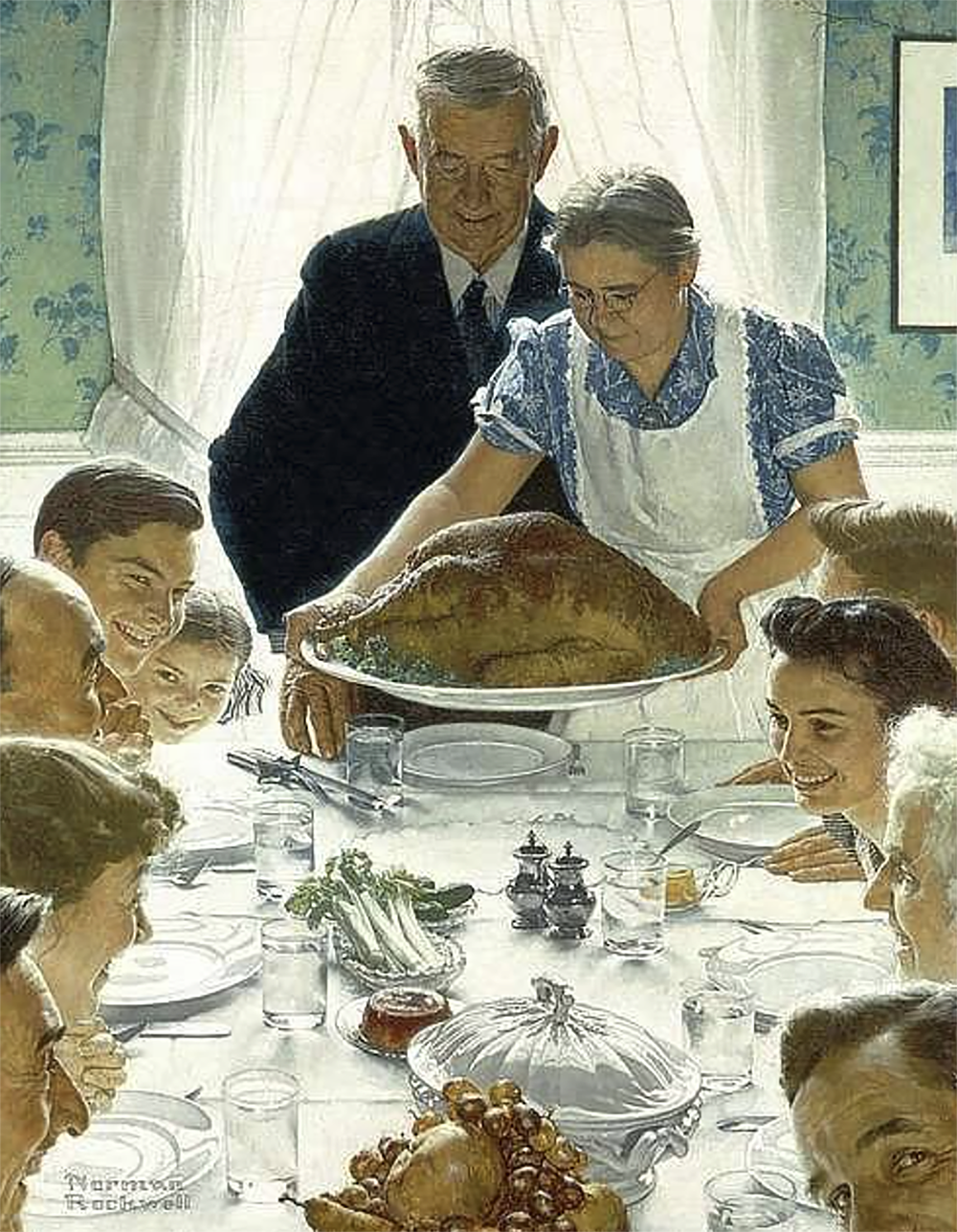
“Freedom From Want” painting by American artist Norman Rockwell.

An early 1940s picture painted by American artist Norman Rockwell, creator of more than 300 Saturday Evening Post covers and some 4,000 paintings during his lifetime, is the image most frequently associated with Thanksgiving. Titled “Freedom from Want,” the painting depicts a family gathering around a celebratory meal. It remains today as a favorite “picture of Thanksgiving.”

Rockwell once said that he painted life not as it was, but what he wished it could be. Maybe that’s what we’re all craving around the holidays, hope for what life should be.

Another American icon offering timeless pictures of America in childhood humor is Hank Ketcham’s cartoons, “Dennis the Menace.” One in particular mirrors Rockwell’s image, with Dennis and his parents sitting down for Thanksgiving dinner, heads bowed. In the caption, Dennis offers, “… and I’m thankful the pilgrims didn’t have liver an’ onions for their Thanksgiving meal.”

Let me say, I’m with Dennis. My father liked liver, so Mom cooked it. Too often. And like most kids of my generation, I dared not question any meal Mom prepared. My sisters and I respectfully ate what was set before us.

“When I left home,” I was telling a friend last week, “One of the things on my list vowing to never eat again was liver. A promise I have kept to this day.”

“You mean your mother didn’t cook a separate meal for you and your sisters,” the longtime acquaintance laughed.

Quick to affirm that we had obviously grown up in the same age, my response was, “Nope! If it was on your plate, you were going to eat it before leaving the table. And leaving a family meal was something you didn’t dare do without first asking, ‘May I please be excused?’”

My mother also played the “Mom card” to shame us for wasting food. “Eat it, don’t waste it. You know there are starving children all over the world.”

“Same with my parents,” reported my friend. “One day my sister and I suggested Mom box up her stewed tomatoes and send them to those starving children. We laughed and laughed. Until we noticed the deafening silence and parental glares of disapproval.”

“There were times when I felt like my parents didn’t have a sense of humor, either,” I sympathized.

Varying from my raising only slightly after I became a parent, I gave my kids a standing offer. I told them they didn’t have to eat what I cooked if they didn’t want to.

“Really,” daughter Robin asked the first time. Lee said nothing. He was always good at keeping his mouth shut a little longer than his older sister.

“Sure,” I said, reaching for her plate. “I’ll just put it in the refrigerator and save it for supper tomorrow night.”

My kids never questioned whether I had a sense of humor. Just how I sometimes applied it.

So, here’s my serious wish for a Happy Thanksgiving. May our hearts be filled with genuine gratitude for the things that make this country the best place on earth to live. Thanksgiving Day and every day.

With a small nod of agreement with Dennis The Menace. Thankful that if the Pilgrims menu did include liver or stewed tomatoes for Thanksgiving dinner, it never made it into the history books.

—Leon Aldridge

(Norman Rockwell’s “Freedom from Want” (above) appeared inside the March 6, 1943, edition of the Saturday Evening Post magazine. The painting was not intended as a Thanksgiving illustration, it was one of the “Four Freedoms” series by Rockwell symbolizing the aspirations of a world with security and well-being as articulated by President Franklin D. Roosevelt. However, it quickly became an iconic image associated with the Thanksgiving holiday )

– – – – – – –

Aldridge columns are featured in these publications: The Center Light and Champion, The Mount Pleasant Tribune, the Rosenberg Fort Bend Herald, the Taylor Press, the Alpine Avalanche,  the Fort Stockton Pioneer, the Elgin Courier, The Monitor in Naples, and Motor Sports Magazine.

© Leon Aldridge and A Story Worth Telling 2025. Excerpts and links may be used, provided full and clear credit is given to Leon Aldridge and ‘A Story Worth Telling’ with appropriate and specific directions to the original content.
My hometown

“Home is not a place … it’s a feeling.”
—Uncredited bit of wisdom I picked up years ago.

– – – – – – –

“So, where’s home,” asked the man whose hand I was still shaking. A mutual friend had just introduced us as we all met for lunch at a local restaurant.

“East Texas,” I replied with a smile. “I live in Center, but I grew up in Mount Pleasant. I claim them both as my hometown.”

Even as I said it for the umpteenth time, that statement still sounded somewhat unusual. Odd that I’ve had a Center mailing address through a dozen presidential terms, and while my home in Mount Pleasant years ago was a fourth of that, I still call it my hometown. And what about the various Texas communities where we lived before settling in Mount Pleasant to stay when I was eleven?

Someday, I’ll examine the paper trail in a cardboard box full of evidence of my parents’ pilgrimage from the time before my own memories began. A collection of letters, receipts, car registrations, repair bills, church bulletins, report cards, and black-and-white school pictures.

It wasn’t until after my mother’s death that I realized she had amassed this veritable family history in her cedar chest. I guess I owe her thanks, or maybe the blame, for my own tendency to hang on to similar seemingly worthless pieces of paper.

My family’s last move to Mount Pleasant was just in time for me to finish fifth grade at South Ward Elementary. But evidence in Mom’s hoarded documents hints at previous addresses in Ballinger, Muleshoe, and Midland. Plus, Pampa up in the Panhandle.

My first and oldest cognitive connections from around the age of three or four are of Pampa. I also remember Crockett where we lived next and where I entered first grade. A move to Seymour, Texas, followed where I completed third and fourth grade, and all of fifth grade except those last few weeks spent in Mr. Mattingly’s home room in Mount Pleasant.

So, I contemplated, what really qualifies one place over another as “my hometown?”

To me, it’s where our heart was first grounded. Places we associate with the “firsts” in life, such as our first friends. Friends remembered from fifth grade in Seymour are tall, skinny Joe, with whom I played basketball at recess. Mike, a neighbor I rode bicycles with to the park. And Carolyn, the first girl I exchanged valentines with in fifth grade.

Many firsts became memories in Mount Pleasant. Some with those end-of-the-year fifth graders from South Ward when we graduated from high school together seven years later. And some of those graduates who became college roommates and long-time friends beyond high school.

First dates, first jobs, my first car, and house—those memories all began in Mount Pleasant.

“Home is sometimes a place you grow up wanting to leave and grow old wanting to return to,” I added to the lunch conversation. I thought about Mount Pleasant, and how after college, I tried to plant roots there twice. But that path just wasn’t in the cards.

I took the path more traveled, rooting in Center many years ago. Enough years to see my children begin school and make their first memories. Enough years to amass many friends and loved ones, and to lose some of both. Enough years to have tasted happiness and to endure heartache.

And even enough years to see good eating establishments come and go. Which is where this missive started. Over lunch.

“So, while my home has been in Center for most of my life, I also consider Mount Pleasant my hometown,” I concluded, thinking about some of my “trips home.”

I return occasionally. Navigating new highways and bypasses makes driving more stressful than it was when I learned to drive there. And, though the old streets are familiar, the places and the faces have constantly changed over time. while the memories of “firsts” linger there like it was yesterday.

“I never thought about having two hometowns,” my new acquaintance offered as we worked on chips, salsa, and sweet tea.

“Yeah,” I drawled. “I think home is anywhere we leave a piece our heart.

“Because hometown is not really a place … it’s a feeling in the heart.”

—Leon Aldridge

(Photo info: My youngest sister, Sylvia, on the front porch at 206 Redbud Lane in Mount Pleasant, Texas, “home and hometown” to me and my sisters Leslie and Sylvia. There is no date on the photo, but I’m guessing about 1962 or ’63. I have no clue what she was modeling on her head. It may or may not have had anything to do with what appears to be Easter baskets behind her. The house that was our home is still there today, but it’s been extensively remodeled and doesn’t look the same as I remember it. Sylvia moved to her eternal hometown December 14, 2023. )

– – – – – – –

Aldridge columns are featured in these publications: The Center Light and Champion, The Mount Pleasant Tribune, the Rosenberg Fort Bend Herald, the Taylor Press, the Alpine Avalanche,  the Fort Stockton Pioneer, the Elgin Courier, The Monitor in Naples, and Motor Sports Magazine.

© Leon Aldridge and A Story Worth Telling 2025. Excerpts and links may be used, provided full and clear credit is given to Leon Aldridge and ‘A Story Worth Telling’ with appropriate and specific directions to the original content.

It all boils down to one thing

“I wish there was a way to know you were in the good old days before you actually left them.”
— Edward Parker Helms, actor, comedian, writer, and producer.

– – – – – – –

“I miss the good ol’ days,” someone said to kick off the coffee klatch last week.

“Yeah? What do you miss the most,” another queried?

Answers from those who had gathered to solve the world’s problems over strong, hot coffee were many. “Drivers who actually understand the concept of turn signals and stop signs.“ “How about people who let you finish a sentence without interrupting?” “Manners. Where did the good old day’s of being a decent person go?” “Courtesy — I remember my mother telling me that if you can’t say something nice about someone, just smile and don’t say anything at all.” “I miss how people could talk about their differences without calling each other names.”

“Yeah,” one of the problem solving coffee sippers agreed, ‘”My grandaddy said when slinging slurs and vulgar names start, be kind and understand that it’s folks who can’t help it. They just never learned an educated vocabulary to have a civil discussion with.”

Thoughts and opinions bounced around before silence fell on my side of the table. Just as I had a story to share.

Imagine that.

“It all boils down to one thing,” I began my two cents and change. “Respect. Years ago, as a young editor, I wrote what I believed was a balanced editorial. Carefully presenting both sides of a controversial local issue before supporting my position with facts. After committing my points to posterity, I sent the piece to press for the next edition.”

In those days, I arrived at the office by 6 a.m. at the latest to get a head start in the morning’s quietness before unlocking the door right before 8. The next morning, a visitor walked up as I was turning the key in the lock. A local attorney, a well-known and respected community leader. He was twice my age, tall and broad-shouldered, and his deep wisdom was matched by his deeper voice.

In his hand was a rolled-up copy of that day’s edition. The one bearing my carefully crafted editorial opinion.

“You got a minute for me,” he asked politely.

I returned his civility with a smile and, “Yes sir — always. Come in. The coffee is on.”

We sat down in my office, and he began, “I’ve read your editorial in today’s paper, and I disagree with your opinion. I think your argument is flawed.”

“OK,” I replied politely. “I did my research, and feel confident in having published it. But that said, with your experience and wisdom, I am eager to hear your viewpoints.”

I listened to him with respect and without interrupting. Respect for my elders, respect for authority, and courtesy in hearing out the opinions of others were virtues my parents instilled in me at an early age. My father summed it up by reminding me that a wise man learns more by listening than he does by talking.

When my morning visitor concluded, I expressed my gratitude to him for taking the time to share his thoughts and views with me. I also told him that I fully respected his opinions and would research them further, but for the moment, I still felt strongly that I was on the right track with mine.

He was quiet for a moment. I likewise sat silently. I had no idea what he might say next. That’s when he smiled and said, “Well, I thank you for hearing me out. I wish I could have persuaded you otherwise about your views, but I respect your right to your opinions, and I support your right to express them. Even if we can’t agree.”

Then he said something that I have come to understand more fully as the years have passed. “If we ever fail to respect each other’s freedom to express an opinion, I fear, we will have lost our country.”

With a hearty handshake and a smile, he rolled up the newspaper, put it under his arm and said, “Feel free to stop my office anytime for coffee.” Then he walked out the door.

“I recall that conversation often,” I started to wrap up my story. “Usually when I consider lifelong friends who might hold views on topics ranging from ‘politics to pole cats,’ as my grandmother used to say, very different from mine. And I value them knowing that our mutual respect exemplifies our belief that true friendship outweighs our differences in opinion. That hate and differences of opinion do not have to travel the same path.

I ended last week’s coffee shop commentary saying, “I had good parenting examples. My dad was a lifelong Democrat. My mother was an unrelenting Republican. Each voted their convictions, effectively canceling the other’s vote in every election. Yet, they were happily married for 63 years. Through love, they respected each other’s opinions, even when they disagreed.

“It worked then,” I said with a shoulder shrug. “And I believe it would work today. If more people just realized that with love and respect, we can salvage some of those good old days.

“Before they are completely gone.”

—Leon Aldridge

– – – – – – –

Aldridge columns are featured in these publications: The Center Light and Champion, The Mount Pleasant Tribune, the Rosenberg Fort Bend Herald, the Taylor Press, the Alpine Avalanche,  the Fort Stockton Pioneer, the Elgin Courier, The Monitor in Naples, and Motor Sports Magazine.

© Leon Aldridge and A Story Worth Telling 2025. Excerpts and links may be used, provided full and clear credit is given to Leon Aldridge and ‘A Story Worth Telling’ with appropriate and specific directions to the original content.

Write so that memories live on

“Tell me facts, and I’ll learn. Tell me truth, and I’ll believe you. But tell me a story and it will live in my heart forever”
— Native American Proverb”

– – – – – – –

We became gas pump neighbors one afternoon a few days ago.

You know, people we meet while watching numbers on the gas pump climb higher than an August afternoon heat index. Exchanging smiles with strangers at the pump while we’re trying to remember where we needed to be ten minutes ago … before remembering that we forgot to gas up last night.

That’s what we do because we were raised to be kind; to be friendly. “Don’t be stuck up,” Mom instructed. Friendliness mission accomplished, I returned to watching pump numbers escalate.

That’s when my new gas pump neighbor engaged me. “I enjoy your stories in the paper.” I did the next thing we were raised to do. Be polite … and don’t let on like you don’t know who they are. “Hey,” I said, buying time. “How’s it going. And thank you, I appreciate you reading my weekly ramblings.”

You have more stories than a book has pages,” he laughed. “I love ‘em. Are those all of those stories real?”

“Sure,” I scoffed. “You can’t make up stuff like that. “Mostly memories,” I added. “Things that happened growing up. Something I remember from a few years ago; a few days ago.”

“Well, I enjoy reading them,” he smiled. “Keep it up.”  

“Thank you,” I said again. “We all share many of the same basic memories. Only the people and the places change. All stories just waiting to be told. I’ll bet you have a story.”

He laughed, and we parted ways going in different directions. The exchange was another reminder of the importance of memories and the value of capturing them. Documenting them. Sharing them as often as possible. Something that didn’t dawn on me until a long time after I had been getting paid to write them.

I probably owe the credit for that to one of my journalism students at Stephen F. Austin State University, a generation of young writers ago.

Charged with imparting writing skills, tools and techniques to aspiring journalists, I enjoyed challenging young minds to find and write their first story. “Everybody has a story,” I offered one day to end a lecture period. “They may not know they do, but that is your first challenge. Strike up a conversation and just listen.”

“That’s easy for you to do,” countered one student. “You have age and experience, and you know a lot of people. It’s not that easy for someone our age.”

“Listening and understanding have no age requirements,” I replied. “Ask questions about what they remember from growing up. About their proudest moments. What they hope to achieve in the years to come. Talk about dreams. Then, be quiet and listen with appreciation. You’ll hear more stories than you can write.”

Long time newspaper mentor and friend Jim Chionsini executed the storytelling technique to a fine art. For instance, when asked for suggestions on the best way to tackle a tough situation at work, he often replied with a story rather than an explanation. “Well, let me tell you how Les Daughtry down at the Galveston News handled issues like that.”

It was also Jim who distinguished between memories that made good stories for publication from the few that are often better left unpublished. “Just because something we did was a bad idea doesn’t mean it isn’t a good memory,” he would laugh. “Just keep those kind among friends.”

Our stories, whether published or simply shared with friends and family, need to be told. And that’s where the value of memories takes root. We all should be writing. Preserving snapshots of our past, moments in our minds, tidbits of history that go untold and lost to time unless we write about them.

That, in my estimation, is the most significant challenge that has no limitations in terms of experience or age for writers. Everyone has a story. Most of us have many. I write as many as I can for weekly columns. And I write some of those just for my personal files, too. But I write so that memories will live on. For family and friends after I’m no longer able to write them.

We all have stories. Even my new gas pump neighbor had one. I’ll be writing his, too.

—Leon Aldridge

– – – – – – –

Aldridge columns are featured in these publications: The Center Light and Champion, The Mount Pleasant Tribune, the Rosenberg Fort Bend Herald, the Taylor Press, the Alpine Avalanche,  the Fort Stockton Pioneer, the Elgin Courier, The Monitor in Naples, and Motor Sports Magazine.

© Leon Aldridge and A Story Worth Telling 2025. Excerpts and links may be used, provided full and clear credit is given to Leon Aldridge and ‘A Story Worth Telling’ with appropriate and specific directions to the original content.

I still remember both

You’ll never relive the moment you got your first car. That’s it, that’s the highest peak… it has a lot of meaning to me” —George Lucas, American filmmaker best known for Star Wars and Indiana Jones.

– – – – – – –

Cooler evenings a couple of days last week were a nice break from summer’s sweltering heat. But don’t be fooled. Mother Nature plays tricks in East Texas, teasing that there will actually be a real fall.

Cool breezes were just enough, however, to entice me into the garage where my ’50s vintage first-love cars spent the hot summer. The garage where I connect to motoring memories dating back some 60-plus years ago when I bought my first car.

Memories of first cars and first dates have been an American phenomenon for generations. Typically beginning with captivating garage aromas—gasoline, motor oil, chrome polish, and unique interior fabric scents lingering longer than the finest French perfume. Or at least until the fragrance worn by your first date in your first car.

Memories of my first car are somewhat more vivid than those of my first date. But that’s no reflection on the attractive young lady who first caught my eye at Mount Pleasant High School. After all, she was the first to take my mind off cars long enough for me to make a stammering attempt to ask her out for a date.

Still, I must admit that my first date memory moments pale ever so slightly in comparison to the time I laid eyes on the first automobile I envisioned as mine. That dark blue 1951 Chevrolet Styleline DeLuxe. Sitting at Rex Kidwell’s Fina Station on South Jefferson Street in Mount Pleasant, Texas.

Everybody knew Rex. The friendly service station proprietor with autographed black-and-white photos of country music stars on the walls. Most of them signed, “To Rex …”

Where customers were always greeted with a smile, gas was pumped while they sat in the car, the oil checked, the windshield washed, and the floor mats hand swept with a whisk broom, one just like every service station attendant used to keep in his back pocket.

And all that for about 30¢ a gallon.

That service was standard for everyone. Not just customers filling up with ethyl gas and getting change from a five. The “Gim’me a dollar’s worth of regular ‘til payday, please,” drivers received the same treatment.

I was no stranger to driving when the car at Rex’s turned my head. My father and grandfather had groomed me in driving skills since I was 12 years old. I made it legal at 14 by taking driver’s ed, the minimum age for becoming a licensed driver in Texas in 1963.

Stopping at Rex’s station on the way home to gas up Dad’s car that night, I saw the old Chevy. It was love at first sight, gleaming in the spotlight beside the building.

Rex was known for acquiring pristine used cars meeting his standards of ‘nice,’ and parking them at his station with a ‘for sale’ sign.

With some meager money pocketed from my after-school job at Beall’s department store and an interest-free loan from my grandmother repaid at five dollars a week, I was back the next day with the $250 asking price in hand.

If I live to be 100, I will never relive that moment of driving home in my first car during my sophomore year at MPHS.

As time and money permitted, personal touches were added. A split manifold with dual exhaust and glass-pack mufflers from Redfearn’s Automotive. Baby moon hubcaps from the J.C. Whitney catalog.

My first car got me to school, to work, to Saturday night drag races, and to church on Sundays. It was a participant in many nights of cruising fun between the Dairy Queen and “Bobby Joe’s,” aka the Dairy Mart, located at opposite ends of town.

Last but not least, it was a trustworthy mode of transportation for a Saturday night at the Martin Theater to see “Goldfinger,” the third film in the James Bond series. With my first date.

Visiting in Mount Pleasant a few years ago, I happened to see her coming out of a store where I was going in. We spoke briefly, and I wondered if she remembered that she was my first date all those years ago. Or if she remembered my first car.

I still remember both.

—Leon Aldridge

– – – – – – –

Aldridge columns are featured in these publications: The Center Light and Champion, The Mount Pleasant Tribune, the Rosenberg Fort Bend Herald, the Taylor Press, the Alpine Avalanche,  the Fort Stockton Pioneer, the Elgin Courier, The Monitor in Naples, and Motor Sports Magazine.

© Leon Aldridge and A Story Worth Telling 2025. Excerpts and links may be used, provided full and clear credit is given to Leon Aldridge and ‘A Story Worth Telling’ with appropriate and specific directions to the original content.

The picture looks great in her house

“City people make most of the fuss about the charms of country life.”  
— Mason Cooley, American writer and educator 1927-2002

– – – – – – –

“Which one do you like?”

The request for consultation from a friend trying to decide between two pieces of artwork was noted. One, a small country farmhouse with a red barn. The second, a white frame country church building.

“I like them both — either will complement the art in your house,” I offered, trying to be helpful but not persuasive. “Visualize each one in your house for a moment; the better choice will come to you.”

Art, like beauty, is the eyes of the beholder. My art collection, I like to call “an eclectic extravaganza.” Some pieces by recognized artists. Some by obscure unknowns. A few, my own personal work from another lifetime spent earning a degree in art.

Likewise, appreciation for where we choose to live is defined by personal tastes and experience. “I like the country farmhouse picture,” my friend smiled. “I wonder sometimes what it would be like to live on a real farm.”

Country life, from a city perspective, often seems charming. Farming, however, is dedication and hard work. I learned this as a city kid in the early 1950s, spending time at my country friend’s house.

His family lived on a muddy county road in deep East Texas near Crockett. Where a dirt driveway circled a huge oak tree. A gate on the left led to the simple four-room farmhouse, and another on the right connected to a cow pasture and hay meadow. Beyond the tree was a shed sheltering a well-worn Ford 8N tractor and an equally used GMC one-ton flat-bed truck, both of late 1940s vintage.

The truck was the only vehicle the tenant farming family owned, serving double duty as a work vehicle and the only means of transportation to town for Saturday provisions or to church on Sunday.

The old frame house sat up off the ground with nothing to keep a cold North wind from blowing under it. Except a couple of hound dogs calling under the house their home that delighted in barking at anything that moved … and some things that didn’t.

A well-worn path from the back door forked about halfway across the yard. One way led to the smokehouse where pork was cured. The other, more heavily traveled trail passed the firewood stack on the way to the outhouse. Also known as the privy. The “John.” Predecessors to indoor porcelain bathrooms with running water.

In fact, the only indoor plumbing was a hand-operated well pump at the kitchen sink. Electricity was limited to four bare bulb lights, one hanging from the ceiling in each room. Heat was supplied by a wood-burning stove in the kitchen and a small fireplace in the living room.  

A telephone was still on the “maybe someday” list. A television was just a dream.

Air conditioning? A rare commodity anywhere in the early 1950s. The few businesses that had it boasted of the luxury, enticing customers with “refrigerated air” signs in their windows. However, it was enjoyed in very few homes then, especially rural farmhouses.

My initial experiences of country life, all those years ago, included many memorable firsts. Things like riding on a horse. On a tractor. And on the back of a flatbed farm truck.

It was also the only time I took a Saturday night bath in a number three washtub in the middle of the kitchen floor. And my first time sitting in a hot outhouse on a summer afternoon listening to dirt dabbers buzzing.

It was also where I saw family love and friendship. Dedication and hard work. Where I enjoyed home-cooked meals in the most literal sense of the word. Vegetables from the garden, milk from the cows, meat from the smokehouse. Where raising crops, cattle, and farm products was not only their livelihood, but also their means of providing food for the table.

Granted, farming and farm living have changed immensely since my so-called city boy childhood experiences eons ago. For the better, thankfully. But many good memories of those brief farm living experiences remain.

Except for outhouses. Those are probably best left to humorous stories and a sense of gratitude that they are gone.

My friend made her artwork selections last week, and we were off to dinner. I had silently picked my favorite; had I been buying one — the church picture. Because without country churches, family farms would be vastly different, yesterday and today.

By the way, the canvas of the country church looks great in her house.

—Leon Aldridge

– – – – – – –

Aldridge columns are featured in these publications: The Center Light and Champion, The Mount Pleasant Tribune, the Rosenberg Fort Bend Herald, the Taylor Press, the Alpine Avalanche,  the Fort Stockton Pioneer, the Elgin Courier, The Monitor in Naples, and Motor Sports Magazine.

© Leon Aldridge and A Story Worth Telling 2025. Excerpts and links may be used, provided full and clear credit is given to Leon Aldridge and ‘A Story Worth Telling’ with appropriate and specific directions to the original content.

Practical application of a good education

“Education is what remains after one has forgotten what one has learned in school.”
— Albert Einstein

– – – – – – –

Mom talked fondly about her father. I remember some things about Arthur G. Johnson, my maternal grandfather. He died February 15, 1951. That I can remember him at all seems incredible when I think about it. Considering that I celebrated my third birthday a month before his death.

The most vivid memory is waiting at the bottom of the stairs leading to his second-floor bedroom at 382 South Main in Winchester, Kentucky. Waiting to hear him call my name when he awoke from his nap. That was my signal to sneak up the stairs and hide under a bedroom dresser while he continued calling my name, pretending he couldn’t see me.

Called Pop or sometimes Poppa by Mom and her four siblings, Arthur Johnson was an educated man. Photos picture him as stoic in stature, exhibiting a state of calm and composure—someone that most might expect to face life with education, practicality, and wisdom.

He came from a long line of Kentucky stock documented back into the 1700s. A schoolteacher and a principal in both Kentucky and Tennessee, he also served as an educational director for the Civilian Conservation Corps, commonly referred to as the CCC. Before the U.S. entered World War II in 1941, the CCC constructed public buildings, fences, and state park facilities still in use today; often recognized by their stone construction.

In addition to his educational and professional presence, however, I learned last week that Arthur Johnson also had a penchant for practical applications of learning.

“Let me tell you one story,” my Uncle Bill said last week at the annual reunion of the descendants of Arthur G. and Bernice Conlee Johnson held near Winchester, Kentucky. Uncle Bill is my mother’s last surviving sibling. He celebrated his 90th birthday in May and has always been a great storyteller.

“Pop had a degree in psychology,” Mom’s little brother began. “He was educated and intelligent, but he applied his education with practicality.

“There was a little boy in the neighborhood, also named Billy. And he was … well, he was bad. I mean, he was a really bad seed. His mother couldn’t control him. He got into more kinds of trouble, but she always defended him. He never did anything wrong; you know. It was always the other person.

“At one point, I had a little dog,” Bill continued. “It got caught up in a wire fence around the back yard and couldn’t get out. But this kid killed my dog rather than help it get loose. That’s the kind of evil bad he was.

“One day, his mother comes down the road,” Bill’s story continued. “I’d had a bunch of run-ins with her son. So, when she came flying down the road and turned in at our house, I thought, ‘Oh, my gosh, what have I done now?’ That woman was as bad as her son was.”

“’Is Mr. Johnson here,’ she asked me? People in the community often sought Pop’s advice since he was a respected teacher. I told her I’d check; that I didn’t know. So, I went up to his room that was his own world in that house. I told him, ‘Billy’s mom is down there and wants to talk to you.’ He sighed and said, ‘OK, let her in.'”

“She went in, but the door stayed open just a little,” Uncle Bill continued. ” I just stood there, you know, and listened. She started telling Pop about Billy. ‘I just can’t control him anymore,’ she said. ‘He’s mean, he’s out of control, and I don’t know what to do with him.’”

“Pop was quiet for a minute,” Uncle Bill related. “Then he gave Billy’s Mom some advice. ‘I’ll tell you what to do. You go down here to the local library, and you check out a book called Elements of Psychology. Remember that title. It’s a big book. It’s a good book. Check it out and take it home. Then when you get home, you take that book, and you beat his butt with it. Two or three doses of some applied psychology will help straighten him out.”

I laughed. I had always heard that the grandfather I barely got to know was a wise man. One who valued education and the value of a good book.

But I never knew just how well he understood the practical application of them.

—Leon Aldridge

– – – – – – –

Aldridge columns are featured in these publications: The Center Light and Champion, The Mount Pleasant Tribune, the Rosenberg Fort Bend Herald, the Taylor Press, the Alpine Avalanche,  the Fort Stockton Pioneer, the Elgin Courier, The Monitor in Naples, and Motor Sports Magazine.

© Leon Aldridge and A Story Worth Telling 2025. Excerpts and links may be used, provided full and clear credit is given to Leon Aldridge and ‘A Story Worth Telling’ with appropriate and specific directions to the original content.

I still hear those words

“Art washes away from the soul, the dust of everyday life.”
— Pablo Picasso (1881 – 1973) Spanish artist

– – – – – – –

While hanging the painting of a sad, wet dog on the wall in my newly refurbished “music room slash library” last week, words from some 30 years ago came back to me.

“You collect some heavy stuff, man.”

They were the words of Judy Snouffer. About July 1993. The day I accepted a generous offer from her and her husband Chuck to help unload truckloads of household belongings at my newly acquired Hill Country home near Pipe Creek, Texas.

As the newest editor and publisher at the Boerne Star, my charge included producing the Boerne newspaper and looking after Granite Publications properties in Bandera, Gonzales, and Fort Stockton.

Judy (better known to friends and co-workers as “Jet”) was composing supervisor and graphic artist at The Star. Chuck worked for the City of Boerne. What I didn’t know was Judy’s artistic skills reached far beyond that of just newspapers.

What Chuck and Judy didn’t know was that I collected unique but heavy stuff. Books, artwork, phonograph records, juke boxes, neon signs, gas pumps …and cars.

I knew Chuck and Judy owned a car. I don’t remember ever seeing it, but I did hear them talk about one. Their daily transportation was matching motorcycles. Not just any motorcycle, but Moto-Guzzis. Manufactured in Italy. Also, the oldest European manufacturer in continuous production.

Jet parked her bike by the newspaper office back door every morning. Far outclassing my Honda Shadow, whenever I rode it.

She was different. A cool kind of different. Like a refugee hippie from the 1960s. An artistic soul who worked and thought outside the dust of everyday life. She wore black fingernail polish before it was a thing. She personalized her work area with stars, moons, and crystals. Motivation for her creative vibe.

And creative she was. Jet surprised me one day with the painting I still have of a sad, forlorn looking dog in the rain. The dog closely resembled Max, the adopted basset hound who made the move to the Hill Country with me. He hung out at the office on Fridays, quickly becoming known to the staff as “Office Max.” Jet was moved by my story one day about Max getting rained on and wet in the back yard before I got a doghouse built. That’s when she gifted me with her painting titled, “Dog Day Blues.” Noted on the back as “No. 507” dated January 22, 1994.

It blew me away. “This is beautiful,” I said. “I knew you were an artist, but I didn’t know you painted.” Jet was humble, shyly showing me photos of her other work plus a feature story from the San Antonio Express News about her artistic awards.

Jet wasn’t the only one who contributed to my lifetime of acquired pieces still hoarding memories today in my music room slash library. “How would you like a Boerne fire hydrant for your quirky collection,” Chuck asked one evening?

“You’re speaking my language,” I quickly responded.

“The city’s replacing old ones. A pile at the yard is headed for scrapping,” he said. Go with me after work tomorrow and we’ll get you one.”

I was thrilled. Until I grabbed one end of it. “You didn’t tell me a fire hydrant weighed as much a Buick Roadmaster station wagon,” I laughed.

‘Bout like your Seeburg jukebox or that Mobil gas pump we unloaded,” he quipped.

I left the Hill Country in 1998. It was a few short years later the day the message arrived from a mutual friend in Boerne. An obituary.

Judy “Jet” Atkins Snouffer died tragically March 18, 2004. The way she would’ve wanted to go – on her motorcycle. She “died with her boots on.”

“Jet” was survived by her loving husband, Chuck Snouffer of Boerne, the obit continued. Judy grew up between Texas and Germany. She worked at the Boerne Star and STPS. Judy was a very free spirit, living life to the fullest. Aside from being a very eclectic personality, Jet was a very creative and talented person; a “’ane of all trades.’ She was a recognized artist having won several awards.”

The obit concluded with, “Ride on Jet!”

I think of Chuck and Jet when I glance at the painting.

And I still hear, “You collect some heavy stuff, man.” 

—Leon Aldridge

– – – – – – –

Aldridge columns are featured in these publications: The Center Light and Champion, The Mount Pleasant Tribune, the Rosenberg Fort Bend Herald, the Taylor Press, the Alpine Avalanche,  the Fort Stockton Pioneer, the Elgin Courier, The Monitor in Naples, and Motor Sports Magazine.

© Leon Aldridge and A Story Worth Telling 2025. Excerpts and links may be used, provided full and clear credit is given to Leon Aldridge and ‘A Story Worth Telling’ with appropriate and specific directions to the original content.

My friend, the belated birthday card

“Since I’m late sending you this birthday card, let’s make sure that doesn’t happen again. Please consider this your first happy birthday wish for the year.”
—  My standard birthday card greeting.

– – – – – – – –

“The difference in Father’s Day and Mother’s day,” Center Church of Christ minister Tim Perkins began last Sunday’s sermon. “… is that some people feel like you don’t have to spend as much on Father’s Day presents as you do on Mother’s Day.”

I laughed. But Tim’s signature humor reminded me of my long-established habits regarding those special days. Father’s Day, Mother’s Day, Christmas, Valentine’s Day. And the big one, birthdays. Each one, a special occasion for remembering those we love and cherish.

“Caring enough to send the very best,” as Hallmark once promoted, I still do. And I still prefer the lost art of sending a real card that can be held, saved, and cherished.

My only problem is I’m always late. Believe me when I say the “belated” birthday card was invented just for me.

Striving to improve over the years, I had one great idea about 40 years ago. And it was genius, if I do say so. Came up with it all by myself.

Instead of sending belated birthday cards all year long, just send everyone a card at the first of the year. Sign them, “Let me be the first one to wish you happy birthday this year.”

The plan was to mail them all between Christmas and New Year’s. However, since February events typically cross my mind at the Fourth of July picnic, it was around St. Patrick’s Day before this stroke of genius came to me. Therefore, the ship had already sailed for January and February birthdays.

“Oh well,” I thought. “They’ll get the belated version one more year. Which is what would have happened anyway.”

“This is going to be a great idea,” I giggled with glee.

My sister Leslie’s birthday is in February. One more belated card for her would be no problem at all. Unless I forgot to mail it.

And the timing was perfect for my grandmother’s birthday on March 6. There was some concern, however. Granny was dealing with some minor heart issues at that time. Would getting a birthday card from me on time be too much of a surprise for her heart?

Next on the list was my baby sister, Sylvia. May 21. A card from me a couple of months early might make her wonder, “What can this be. Leap year? National Pickle Week? Jewish New Year?”

She had never received a birthday card from me on time. So, I knew she would have laughed. She would also have been the first one to say, “Now that is really dumb … even for Leon.”

Next on the list was my mother’s birthday in June. But getting a card in March, she would have still just quietly opened it, smiled, and said, “How nice. Leon remembered.”

Then, she would have put it aside to go into her cedar chest later, with every other card she had ever received, before returning to lunch or the latest episode of All My Children.”

Mark my word, however, sometime between 3:30 p.m. and next Tuesday, the light would have come on, and she would have said out loud, “My birthday is not until June!”

Dad would have opened his card, laughed softly, and shook his head because his birthday was in August. And because for as long as I could remember, he was the only one who knew exactly what I did, why l did it, and most of the time, before I did it.

Dad would have also been the one to explain it all to Mom. Sylvia would be calling Leslie to figure out what marble I’ve lost now. Leslie would then have been trying to understand why she got a belated card when everyone else got a regular card.

It’s an idea that still might work. At the time, I decided it was just too risky. More than everyone could figure out, and too much confusion to explain. Even for me.

But feel free to give it a try. I still think it’s the best idea since the “Vegematic” was promoted on late-night TV.

In any case, remember this. If someone forgets your birthday, take it as a compliment. It could mean you don’t look like you’ve aged enough to have another birthday yet.

—Leon Aldridge

– – – – – – –

Aldridge columns are featured in these publications: The Center Light and Champion, The Mount Pleasant Tribune, the Rosenberg Fort Bend Herald, the Taylor Press, the Alpine Avalanche,  the Fort Stockton Pioneer, the Elgin Courier, The Monitor in Naples, and Motor Sports Magazine.

© Leon Aldridge and A Story Worth Telling 2025. Excerpts and links may be used, provided full and clear credit is given to Leon Aldridge and ‘A Story Worth Telling’ with appropriate and specific directions to the original content.