A monument to the ‘taste of flight’

“Once you have tasted flight, you will forever walk the earth with your eyes turned skyward, for there you have been, and there you will always long to return.”
— Leonardo da Vinci (1452 –1519), Renaissance artist and inventor who documented theoretical flying experiments.

– – – – – –

As a licensed pilot, granted one who hasn’t taken the controls of an aircraft in many years, I can still feel da Vinci’s intoxicating longing for flight.

Even as a kid, my young eyes were turned skyward. Dreaming of a day that I might taste the feeling of flight.

That same longing obviously lingered in two little-known, long-ago aviators from Shelby County in East Texas. Their flying adventures were reportedly the subject of family reunion stories for many years—into the 1980s, for sure.

Standing for a long time as a “monument,” of sorts, to their tastes of flight was the abandoned frame of an old airplane in the Southern part of the county known as the Dreka community.

I first saw what was left of the rusty remains in Florence Duncan’s yard on a dirt road some 40 years ago. A stop at Mrs. Duncan’s house, while visiting family friends nearby, introduced me to her and to the fabled stories of the flying machine. Even then, it was already slowly succumbing to grass and weeds.

“It’s been there since ‘bout 1947,” she said of the old airplane’s skeletal parts. “I keep it there for sentimental value.”

“Two of the boys (family members Ernest Duncan and Duncan Rolland) bought the airplane and wanted to turn one of our fields in front of the house into a runway for it,” Mrs. Duncan reminisced. “My husband, Dean, and I told them ‘No.’ But you know what? They cut my persimmon tree and flew it there anyway.”

“It was an old airplane,” she continued. “Duncan said he gave $150 for it.

When they lit it out there that first time, they hit a terrace and broke one of the wheels.

“They fixed it with bailin’ wire before they decided to go to Center in it,” Mrs. Duncan continued. “They came back in a little while, but they didn’t set down on the field quite soon enough. The wheel they wired up didn’t hold, and the airplane crashed, almost flipped over.

“I was scared to death,” Mrs. Duncan recalled. “I went runnin’ out toward the field. The whole family was right behind me. When I got close enough, I heard Ernest say, ‘I told you we should have lit it down in Center.’ That’s when I knew they were all right. I couldn’t believe they crawled out of that airplane and walked away from it.

“After the crash,” she said, “Van Bertherd, a young man just down the road, thought he could do better. He worked on it and headed down to the corn patch with it. The corn was just coming up at the time, and the plane got stuck.

“We wound up havin’ to take the mule down to the field,” Mrs. Duncan continued, “then towed it to a level stretch on the road. Van got it off, just barely clearing the fence and the pine trees, but came right back. Said it needed lots more work.”

According to Mrs. Duncan, the wrecked aircraft was eventually dragged to a corner of the yard where children climbed and played on it. “Pretending to fly,” she said. “I went out there once and asked where they were flyin’. ‘Way up high over Dallas,’ they said.

“Duncan was shaken up for a long time by that wreck , but he admitted later to wishin’ the airplane had been salvaged,” Mrs. Duncan recalled. “Said it would be an antique now, worth a lot more than the $150 he paid for it.”

When I saw it in the 1980s, the wreckage of the Dreka flying machine had reportedly  spent years serving as a kid’s playground, target practice, and neglect. By then, little remained but the bare frame, which had once been covered in fabric that had long since rotted away. There were no wings or motor. By appearance, it was a small plane with a cockpit just large enough for a pilot and a passenger in tandem.

A visit to the area last week revealed no trace of the old airframe. I couldn’t even locate Mrs. Duncan’s residence in the heavily forested region. She reportedly passed away in the early 1990s.

I do remember her closing remarks during our visit back then, however.

“I’m glad Duncan and Ernest weren’t hurt in the crash,” she said. Then added, “About the only thing I’m still mad about is my persimmon tree.

“It never did come back.”

—Leon Aldridge

(PHOTO ABOVE — Mrs. Florence Duncan standing next to the Dreka airplane wreckage in her yard about 1981 or ’82. Photo taken by Patricia McCoy, a reporter for the East Texas Light during my first tenure at the newspaper as publisher.)

– – – – – – –

Aldridge columns are featured in these publications: The Center Light and Champion, The Mount Pleasant Tribune, the Rosenberg Fort Bend Herald, the Taylor Press, the Alpine Avalanche,  the Fort Stockton Pioneer, the Elgin Courier, The Monitor in Naples, and Motor Sports Magazine.

© Leon Aldridge and A Story Worth Telling 2025. Excerpts and links may be used, provided full and clear credit is given to Leon Aldridge and ‘A Story Worth Telling’ with appropriate and specific directions to the original content.
Time flies and I’m still looking

“I’m having a hard time remembering names,” my friend’s frustration said. “I can’t remember them like I used to!”

“I can relate,” I offered. “Bad news is, it’s the massive amount of data build up in our brains as the years fly by. The searches take longer. The good news is it will come to you. It does for me. In an hour or two. Or a day … or so. Sometimes.”

“Another frustration,” I continued, “is trying to remember where I put things. Like last week searching for a photo of an airplane I owned. I know I have it … somewhere. How do we accumulate so much ‘stuff’ in one lifetime.”

My searching did, however, turn up photos of other airplanes. And a name lost to memory. Reverend Isaac Newton Burchinal, Jr. and his WWII airplanes.

“Reverend who,” my friend inquired? 

“Better known as ‘Junior’ Burchinal. His Flying Tiger Air Museum was a collection of WWII airplanes at a small Northeast Texas crop dusting strip west of Paris. Not exactly museum pristine examples, but airworthy none-the-less.

A story of Flying Tiger’s P-51 Mustang often repeated recounted a demonstration ride during which Burchinal pulled the old fighter plane up and over in a loop for the thrill seeking passenger. As the aircraft reached to top of the maneuver fully inverted, the passenger reported seeing not only a spectacular view of the earth from an upside down perspective, but also an assortment of nuts, bolts, and small parts falling from their hiding place in the bottom of the airplane raining down through the cockpit. This is the same plane that at the time had stenciled on the nose, the nickname “In God We Trust.”

The ‘refound’ photos reminded me of the day Burchinal flew his B-17 bomber to the old Mount Pleasant airport in the mid 1970s.

While learning to fly, I visited the colorful aviator’s field where he flew them often for local shows, and as a stunt pilot for Universal Studios in movies like “The Great Waldo Pepper” and “Midway,” plus the television series, “Baa, Baa, Black Sheep.” 

Not only were the planes fascinating, but I was in awe that anyone could fly the big warbirds off the small asphalt strip that ran uphill on one end with a fence and traveled highway on the other.

Burchinal’s Mount Pleasant visit was at an air show our fledgling Mount Pleasant flying club, the Northeast Texas Aviation Association, staged. I called him to inquire whether we might afford him and one his planes for our show. A deal was sealed; he was bringing his B-25 Mitchell bomber. That was until the afternoon before he called.

“Leon, this is Junior Burchinal up here in Paris,” he said. “I’ve got some bad news. We’re having problems with the B-25. It won’t make the trip tomorrow.”

My heart began rapidly losing altitude. Visions of, “what now,” spiraled out of control. “But, if it’s all right with you,” he added, “we’ll bring the B-17 for the same money.”

“All right,” I stammered, my spirits pulling out of the dive. “Yes sir, that is good news.” He continued to apologize, almost as many times as I thanked him. 

Early the next morning, as club members scurried about working on last minute preparation, I heard the huge four-engine B-17 coming over downtown Mount Pleasant. Mesmerized by the sight and sounds, I watched it make a long straight-in approach to the airport. Just as wheels touched pavement, a WW II “Corsair” fighter made a hi-speed pass over the airport before circling back to land.

Both planes taxied to the ramp. Burchinal climbed out of the single seat fighter, followed by a young lady who appeared literally to unfold and crawl out of a small seat added behind the pilot. He introduced the bomber crew, then the young lady as his daughter, before apologizing again for not bringing the B-25. “But I brought the Corsair to make up for it.”

No one could have dreamed as time was flying by, that the B-25 that couldn’t make the show would later land at the Vintage Flying Museum at Meacham Field in Fort Worth for a few years there. Or that it would decades later find a home at Mid-America flight museum in Mount Pleasant. And I would have never imagined that I saw it in Fort Worth about 20 years ago where I grabbed a fun photo of me in the pilot’s seat, never dreaming I would duplicate that photo just a few years ago at Mid-America Flight Museum.

The good news last week was finding the photo of Burchinal’s airplanes and reminiscing.

The bad news this week is that time still flies, and I’m still looking for that photo of my old airplane. It’s around here somewhere. I’ll find it in a day or two.

Maybe.

—Leon Aldridge

(Photo: Original Flying Tigers pubicicity black-and-white photo from the 1970’s of I.N. Birchinal Jr.’s B-17 Flying Fortress WWII bomber “Balls of Fire” flying above the Red River north of Pairs, Texas. )

– – – – – – –

Aldridge columns are featured in these publications: The Center Light and Champion, The Mount Pleasant Tribune, the Rosenberg Fort Bend Herald, the Taylor Press, the Alpine Avalanche,  the Fort Stockton Pioneer, the Elgin Courier, The Monitor in Naples, and Motor Sports Magazine.

© Leon Aldridge and A Story Worth Telling 2025. Excerpts and links may be used, provided full and clear credit is given to Leon Aldridge and ‘A Story Worth Telling’ with appropriate and specific directions to the original content.

Time flies faster than we realize

“Time flies.”

— 19th Century English idiom. One that I undertsand better with every passing year.

– – – – – – –

That carelessly tossed-about old saying has a special meaning seasoned in humor among old pilots. Like me. Those who smile when standing in the shadow of propeller-driven aircraft as old or older than we are. Feeling goose bumps with every smoky, rumbling startup of an antique radial aircraft engine.

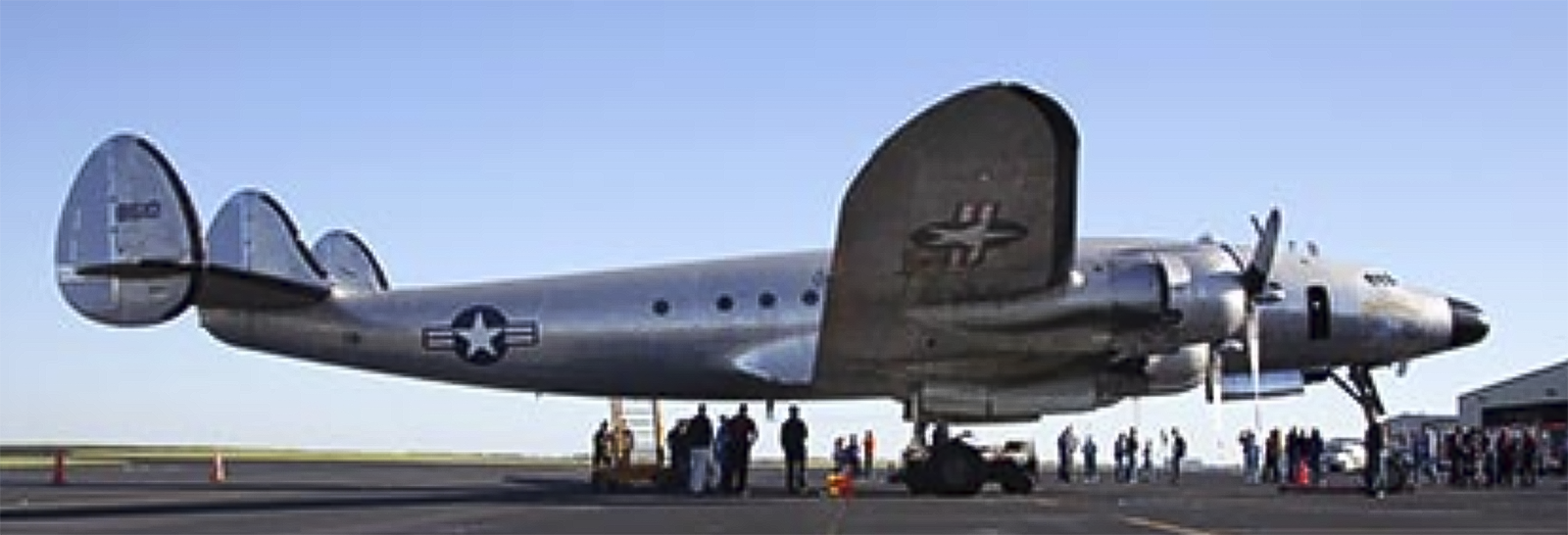
Even so, it still doesn’t seem like it’s been almost ten years since the time Frankie Glover at Mid America Flight Museum up in Mount Pleasant sent me the message. “Columbine II will be arriving in Mount Pleasant tomorrow afternoon. I’ll keep you updated.”

Columbine II was the name given to the U.S. presidential aircraft used by Dwight D. Eisenhower from 1952 to 1954. Better known as “Ike,” the five-star U.S. Army general served as Supreme Commander of the Allied Expeditionary Force in Europe during World War II. He had been elected president by the time I entered the first grade.

Photo above and at top of the page: Leon Aldridge 2016 at the Mount Pleasant, Texas, Airport)

The historic aircraft’s stop in Northeast Texas some 60 years later was no coincidence. Mount Pleasant native Scott Glover and his MAFM team in the Northeast Texas city played a key role in the first phase of efforts to get the historic aircraft back to flying condition after years of neglect, ignored in the Arizona desert. The second step was helping the owners fly it to the restoration shop to Bridgewater, Virginia. The Mount Pleasant based museum helped in that effort as well.

Scott and his crew in the MAFM’s WWII era B-25 “Mitchell” bomber, “God and Country,” escorted Columbine II from the Grand Canyon state to Mount Pleasant. The Texas stop not only gave Northeast Texas residents a chance to see the historic aircraft, but also provided a break in the nine-hour trip from Arizona to Virginia, where it has since been undergoing a long and tedious restoration to its early 1950s configuration as the presidential aircraft.

President Dwight D. Eisenhower air plane landing in Harlingen Texas Oct. 18th 1953. Photo Credit — US ARMY – Harlingen Arts and Heritage Museum

Given its name by First Lady Mamie Eisenhower in honor of the official state flower of her adopted home state, Colorado, the former presidential plane is a military version of the Lockheed Constellation. “Connies,” as they were called, were a highly successful four-engine propeller-driven 1950s airliner. Known for their speed, range, luxury, and pressurized cabin for comfortable long-distance flights, this Connie carries tail number 8610, confirming it as the first presidential aircraft to use the universally recognized call sign, “Air Force One.”  The official designation for any aircraft once the President of the United States is on board.

I kept my camera busy that day in early 2016, capturing fleeting images of time flying by. The beauty of the plane’s porpoise-shaped aluminum fuselage and distinctive triple rudder tail design stood out against the East Texas afternoon sun. Breathtakingly elegant as it floated toward the runway in its landing approach and touched down on its uniquely tall landing gear.

The day reminded me of another time that had flown by, the night Mount Pleasant was host to a sitting U.S. President.

I was an MPHS student, and a member of the Explorer Scout Post called upon to assist with crowd control for the scheduled arrival of President Lyndon B. Johnson. The president was coming to town for a celebratory function at the National Guard Armory on North Jefferson Street, honoring an East Texas citizen and friend.

Darkness arrived as onlookers crowded to the airport, many skeptical that the president was really coming to the small Texas town. Anticipation mounted as the presidential plane touched down and taxied to the apron near the terminal.

Flashbulbs lit up the night sky when President Johnson emerged, waving and smiling. The crowd cheered. Performing our assigned task, we stood firm with backs to the crowd and arms spread wide against the encroaching throng.

I looked to my left and caught a glimpse of the president as he neared. Waving, tipping his hat, and shaking hands. But nothing could have prepared me for what happened next.

As the president neared, he paused, grabbed my hand, and shook it vigorously. “Nice uniform, son,” he said before moving on to the next handshake and ultimately the waiting car taking him to his scheduled event on the other side of town.

All I could think was, “The President of the United States just shook my hand.”

I hurried home on nearby Redbud Street and charged into the house. “I shook the president’s hand tonight. He shook my hand.”

My father, who voted pretty much Democratic in those days, smiled and commented, “Well, how about that.”

You might say time has flown since I shook a president’s hand at the Mount Pleasant airport. Even since the time since I saw another president’s plane, the first Air Force One, at the Mount Pleasant airport.

Looking back, however, the feeling is more like one moment, it’s today, the next it’s a memory.

Because time flies faster than we realize.

—Leon Aldridge

– – – – – – –

Aldridge columns are featured in these publications: The Center Light and Champion, The Mount Pleasant Tribune, the Rosenberg Fort Bend Herald, the Taylor Press, the Alpine Avalanche,  the Fort Stockton Pioneer, the Elgin Courier, The Monitor in Naples, and Motor Sports Magazine.

© Leon Aldridge and A Story Worth Telling 2025. Excerpts and links may be used, provided full and clear credit is given to Leon Aldridge and ‘A Story Worth Telling’ with appropriate and specific directions to the original content.

We were just there for the fun

“Life is about the adventures you take and the memories you make.” 
— Katie Grissom, author

– – – – – – – –

News that Jimmy Mason in Mount Pleasant had passed away reached Center a couple of days ago.

Everybody in town knew Jimmy. Soft-spoken, kind-hearted, and ready to help anyone he came in contact with, he never gave anyone the option of not liking him.

He was also the hardware store guy. Third generation. The Mason Family Hardware store was a reliable resource for nails to nuts and bolts, and gift items to garden supplies. They were located on the north side of the downtown store when I was a youngster in Mount Pleasant. By the time Jimmy retired in 2022, the iconic store was on North Jefferson in the old Safeway building.

After I left Titus County, I stopped in to say “hello” every chance I got when I was back in town. Because Jimmy and I shared a friendship and a couple of common memories related to airplanes. One easily classified as an adventure I’ve recounted before. One worth telling many times.

I was a brand-new licensed pilot in 1974 with less than 100 hours in my logbook. Jimmy was a student pilot working on his license. We shared a common instructor in Grady Firmin, who instigated this adventure turned good memory.

“Let’s go to the CAF air show down in Harlingen,” Grady offered during hanger flying conversation one evening. For decades, the Commemorative Air Force has produced one of the best air shows in the country that celebrates vintage warbirds.

 A plan was forged for flying to the southernmost Texas border, packing bags and bedrolls for camping under the wings. I was designated pilot-in-command for reasons lost to time. Student pilot Jimmy filled the right seat. Grady, the Vietnam veteran combat pilot and military instructor with Huey gunship experience in his logbook, took the back seat. Jimmy and I looked at each other and shrugged. “OK,” we agreed.

Ready for an evening departure with a planned stopover in Corpus Christi, Grady said, “Let’s go.”

“Wait,” I objected.

“Yeah,” Jimmy added, “We haven’t done a weight and balance check with all this baggage and full fuel.”

Grady countered, “Give it ten degrees of flaps, run up full power and release the brakes. If it doesn’t rotate by mid-field, stop and we’ll throw some stuff out and try again.”

Jimmy and I also agreed that we never met a Vietnam vet pilot that wasn’t fearless or fun.

The plane groaned a time or two, hesitated, and lifted off. We were on our way south as sunlight slipped below the right wingtip. In my book, sunsets and sunrises viewed from a mile high or more are the best.

With Jimmy’s navigation, we found the Corpus airport a few hours later, and we were on the runway.

The next morning, I prefilghted the plane and Jimmy went to grab a sectional to get us to Harlingen. Navigation then was with paper “sectionals.” Think aviation version of a Texaco road map.

“They’re sold out,” Jimmy reported. “No problem, though,” He added. “Someone suggested we fly the coastline south until we don’t understand the radio language. Then fly back about 30 miles and we should be pretty close.’”

“He was kidding … I think,” Jimmy laughed.

Airborne again, a welcome stretch of early morning serenity along coastline viewed from low altitudes was soon disrupted by hundreds of other planes swarming the area, all headed for Harlingen.

We tuned to the assigned frequency for air show traffic where a recording repeated, “enter holding pattern over Combes, maintain 500-foot vertical spacing, listen for the last digit of your N number to breakout, switch to tower frequency and enter left downwind for 36 left maintaining one-mile spacing.”

We circled until we had the instructions memorized. Then Jimmy heard it. “Our turn.” In the pattern at Harlingen, we were about to land; a good thing because fuel was low. That’s when the tower instructed, “Green Cessna on final, go around—too close to aircraft ahead.”

“Forget it,” Grady said from the back seat, “Go!” I looked at Jimmy, he looked at me, and we agreed, “OK.” Keying the mic, I replied, “Harlingen tower, green Cessna, negative go around. Insufficient fuel.”

We breathed a sigh of relief when the plane’s tires reconnected with terra-firma issuing a reassuring chirp. We were on the ground.

Two days of memories later, we headed home. After one late-night landing for fuel at a sleepy Bryan, Texas airport, we made our final touch down at Mount Pleasant around midnight with no clue regarding the value those memories made with friends would hold in the years to come.

Because Jimmy, Grady, and I … we were just there for the fun.

Friends we haven’t yet met

There are no strangers here, Only friends you haven’t yet met.

— William Butler Yeats (1865 – 1939) Irish poet

– – – – – –

Friends come from everywhere. Some we have for a short time, some for a lifetime. And a few, it takes a little longer to meet.

I used to ride motorcycles. I used to fly airplanes. Both have taken me to many places where I’ve met many friends.

Like the time about 1978, give or take a year. I left out of Mount Pleasant, heading south on a motorcycle. Harlingen in the Texas Rio Grande Valley was the destination. To an air show. Not just any airshow, but the annual October event staged by the Texas war plane preservation group known today as the Commemorative Air Force. Their trademark was, and still is, a realistic reenactment of the 1941 Japanese attack on the U.S. Naval fleet at Pearl Harbor. Flying authentic 1940s vintage combat aircraft.

At the Harlingen airport, I dismounted my bike and walked toward the entrance gate, camera bag over my shoulder. I saw a small portable building off to one side bearing a sign simply saying, ‘Press.’ So, I pulled out my Texas Press Association card. I was not preregistered for credentials, but as my grandmother always told me, “It doesn’t hurt to ask, all they can say is no.” In this case, the young lady at the desk said, yes. “What publication are you representing?”

“The newspaper in Naples, Texas … The Monitor,” I reported. Then waited for questions.

“Here’s your credentials.” She shoved a lanyard across the table and added, “There’s a golf cart outside. Someone will take you to the media bleachers.” I was disappointed that she didn’t ask, “Where’s Naples, Texas?”

The cart stopped at a grandstand on the flight line and center stage for the show. “Take any seat not marked VIP,” instructed the driver. From where I stood at the moment, it all looked like VIP to me.

Spotting an empty seat just aft of the designated ones, I settled in as a black 1941 Lincoln convertible pulled up. “Ladies and gentlemen …” the PA system blared. “Featured announcer and celebrity guest, Tennessee Ernie Ford.”

Ford, popular singer and television host known in country and western, pop, and gospel musical genres from the 1940s through the 1970s, served as a navigator and bombardier in World War II leading to his involvement with the CAF from 1976 to 1988. He was seated in the VIP section. Right smack dab in front of me.

I would attend many CAF air shows in the years to come, but that first time was memorable for several reasons. Sitting near Tennessee Ernie Ford. Meeting Greg “Pappy” Boyington, the World War II fighter pilot Ace portrayed by Robert Conrad in the 1970s TV show “Baa Baa Black Sheep” about Boyington’s wartime service. And learning the perks of a press card.

I also remembered the Pearl Harbor dramatization. Fighters, bombers, pyrotechnics, smoke, sirens blaring. And that pause in the middle of it all clearing a Southwest Airlines commercial flight for landing.

That trip, and the events of that day, I would remember for a long time. Some 30 years later, in fact, when I was at the EAA Air Venture air show in Oshkosh, Wisconsin watching the CAF reenactment again. Working an outdoor trade show at the largest airshow of its kind in the world. Where every July, aircraft take-offs and landings total 21 to 23 thousand in 11-days. This time, working with Portacool colleague, Jim Altom.

A guy stops and greets Jim as a longtime friend. Jim turns to me and says, “Leon, meet Randy Henderson … best pilot you’ll ever meet.”

We quickly became acquainted as airplanes buzzed overhead. I learned that Henderson was a championship aerobatic pilot flying airshows worldwide and a captain for Southwest Airlines.

I related to my newfound friend, the story of that first CAF event down in Harlingen where the show paused for a Southwest flight to land. “I couldn’t help but think,” I laughed, “what an experience it must have been for passengers looking out the window and seeing WWII “war birds” and a full-scale “battle” underway.

“You were there, too,” Randy smiled? “I was a rookie pilot on that Southwest Flight. And I remember that day.”

Sometime after that simply-by-chance meeting, Randy performed his Texas T-Cart flying skills at a Center, Texas airshow on a Spring Saturday afternoon. We visited again, laughed, and talked about Jim Altom.

Randy is retired from Southwest now, but still dazzles spectators with airshow performances. I haven’t talked to him since our mutual friend, Jim Altom, passed away three years ago. Maybe I’ll catch Randy at a show. Soon.

I don’t ride motorcycles anymore. I don’t fly airplanes anymore, either. Both activities best left to those who keep their skills sharp.

But I do still believe that God sends people into our lives, turning strangers into friends. Some we meet right away. And some we come close to, but have to wait a while for the meeting.

—Leon Aldridge

– – – – – – –

Aldridge columns are featured in these publications: The Mount Pleasant Tribune, the Rosenberg Fort Bend Herald, the Taylor Press, the Alpine Avalanche,  the Fort Stockton Pioneer, the Elgin Courier, The Monitor in Naples, and Motor Sports Magazine.

© Leon Aldridge and A Story Worth Telling 2024. Excerpts and links may be used, provided full and clear credit is given to Leon Aldridge and ‘A Story Worth Telling’ with appropriate and specific directions to the original content.