“Time flies.”
— 19th Century English idiom. One that I undertsand better with every passing year.
– – – – – – –
That carelessly tossed-about old saying has a special meaning seasoned in humor among old pilots. Like me. Those who smile when standing in the shadow of propeller-driven aircraft as old or older than we are. Feeling goose bumps with every smoky, rumbling startup of an antique radial aircraft engine.
Even so, it still doesn’t seem like it’s been almost ten years since the time Frankie Glover at Mid America Flight Museum up in Mount Pleasant sent me the message. “Columbine II will be arriving in Mount Pleasant tomorrow afternoon. I’ll keep you updated.”
Columbine II was the name given to the U.S. presidential aircraft used by Dwight D. Eisenhower from 1952 to 1954. Better known as “Ike,” the five-star U.S. Army general served as Supreme Commander of the Allied Expeditionary Force in Europe during World War II. He had been elected president by the time I entered the first grade.
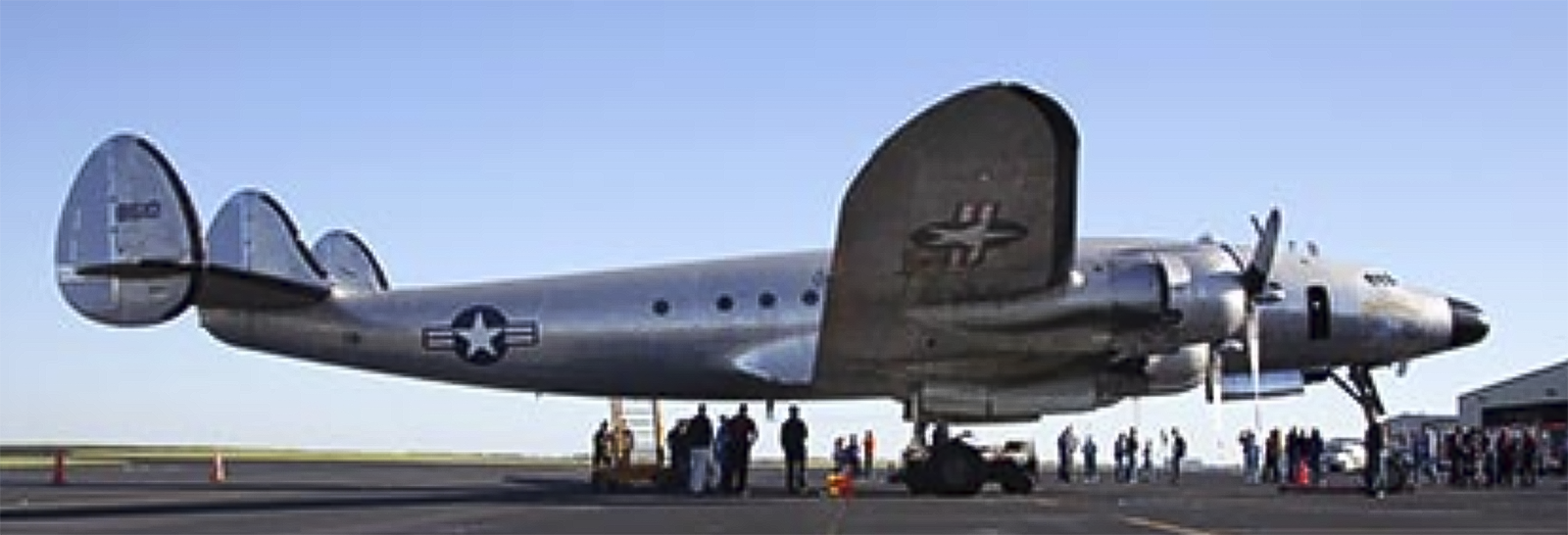
The historic aircraft’s stop in Northeast Texas some 60 years later was no coincidence. Mount Pleasant native Scott Glover and his MAFM team in the Northeast Texas city played a key role in the first phase of efforts to get the historic aircraft back to flying condition after years of neglect, ignored in the Arizona desert. The second step was helping the owners fly it to the restoration shop to Bridgewater, Virginia. The Mount Pleasant based museum helped in that effort as well.
Scott and his crew in the MAFM’s WWII era B-25 “Mitchell” bomber, “God and Country,” escorted Columbine II from the Grand Canyon state to Mount Pleasant. The Texas stop not only gave Northeast Texas residents a chance to see the historic aircraft, but also provided a break in the nine-hour trip from Arizona to Virginia, where it has since been undergoing a long and tedious restoration to its early 1950s configuration as the presidential aircraft.

Given its name by First Lady Mamie Eisenhower in honor of the official state flower of her adopted home state, Colorado, the former presidential plane is a military version of the Lockheed Constellation. “Connies,” as they were called, were a highly successful four-engine propeller-driven 1950s airliner. Known for their speed, range, luxury, and pressurized cabin for comfortable long-distance flights, this Connie carries tail number 8610, confirming it as the first presidential aircraft to use the universally recognized call sign, “Air Force One.” The official designation for any aircraft once the President of the United States is on board.
I kept my camera busy that day in early 2016, capturing fleeting images of time flying by. The beauty of the plane’s porpoise-shaped aluminum fuselage and distinctive triple rudder tail design stood out against the East Texas afternoon sun. Breathtakingly elegant as it floated toward the runway in its landing approach and touched down on its uniquely tall landing gear.
The day reminded me of another time that had flown by, the night Mount Pleasant was host to a sitting U.S. President.
I was an MPHS student, and a member of the Explorer Scout Post called upon to assist with crowd control for the scheduled arrival of President Lyndon B. Johnson. The president was coming to town for a celebratory function at the National Guard Armory on North Jefferson Street, honoring an East Texas citizen and friend.
Darkness arrived as onlookers crowded to the airport, many skeptical that the president was really coming to the small Texas town. Anticipation mounted as the presidential plane touched down and taxied to the apron near the terminal.
Flashbulbs lit up the night sky when President Johnson emerged, waving and smiling. The crowd cheered. Performing our assigned task, we stood firm with backs to the crowd and arms spread wide against the encroaching throng.
I looked to my left and caught a glimpse of the president as he neared. Waving, tipping his hat, and shaking hands. But nothing could have prepared me for what happened next.
As the president neared, he paused, grabbed my hand, and shook it vigorously. “Nice uniform, son,” he said before moving on to the next handshake and ultimately the waiting car taking him to his scheduled event on the other side of town.
All I could think was, “The President of the United States just shook my hand.”
I hurried home on nearby Redbud Street and charged into the house. “I shook the president’s hand tonight. He shook my hand.”
My father, who voted pretty much Democratic in those days, smiled and commented, “Well, how about that.”
You might say time has flown since I shook a president’s hand at the Mount Pleasant airport. Even since the time since I saw another president’s plane, the first Air Force One, at the Mount Pleasant airport.
Looking back, however, the feeling is more like one moment, it’s today, the next it’s a memory.
Because time flies faster than we realize.
—Leon Aldridge
– – – – – – –
Aldridge columns are featured in these publications: The Center Light and Champion, The Mount Pleasant Tribune, the Rosenberg Fort Bend Herald, the Taylor Press, the Alpine Avalanche, the Fort Stockton Pioneer, the Elgin Courier, The Monitor in Naples, and Motor Sports Magazine.
© Leon Aldridge and A Story Worth Telling 2025. Excerpts and links may be used, provided full and clear credit is given to Leon Aldridge and ‘A Story Worth Telling’ with appropriate and specific directions to the original content.
 A Story Worth Telling