A Christmas Wish

Christmas comes in a variety of manifestations in America. To a child, it can be the anticipation of St. Nick delivering a shiny bicycle or a new doll on Christmas morning. To those of us who have seen a number of Christmas seasons come and go already, it can be the comfort of family and loved ones being blessed with one more Christmas together to share a meal, laugh and be thankful to our Creator. To many, it’s a season of thanksgiving and renewing of faith. To someone struggling to find the ends—let along make ends meet—it can be a meal and a warm place to sleep.tree-ball_7169

This morning, as I pondered a sampling of ideas for a column this Christmas weekend, I was at the point of feeling that if any one of those short-circuited brain wave thoughts came together in time to post a few words here, that I would truly be a believer in Santa Claus one more year.

Before I had very long to fret over writer’s block, however, Christmas Eve at the Aldridge household took a sharp, unexpected left turn Saturday morning. With plans for a family gathering at dinner tomorrow taking shape, illness struck the family event planner, chef, Christmas decorator, and household organizer—a.k.a. better half, Terry. What had been shrugged off as a nagging illness all week rose up and swiftly took her out of commission before morning coffee ever reached the second cup stage.

A doctor in Center, Texas on Saturday morning? On Christmas Eve? Not happening. So, before you could say, “On Donner and Blitzen,” we were on the way to urgent care in Nacogdoches. Short version of the rest of the story is that we were thankfully back home with a less than emergency status prognosis. Dinner plans for tomorrow were quickly rearranged with a quick handoff to other family members who pitched in to keep the turkey and dressing flowing, and Terry will be fine soon.

Needless to say, Christmas here for this year is one of thanksgiving—thankful that Terry’s medical diversion was not more serious than it was. Being sick is no fun for anyone at any time, but it’s a real bummer at Christmas.

Medical emergency scare? Taken care of and done. Christmas dinner plans? Rearranged and done. A Christmas story column for the blog? Oh yeah, I knew there was something else hanging. Turning back to face the Grinch of Christmas writer’s muse from earlier this morning, I placed fingers to keyboard, closed my eyes and prayed.

OK, I can’t explain it, but there is something in my twisted sense of perspective about panic attacks during medical emergencies that ratchets up my humor button. Probably some sort of psychological diversion, like Freud’s defense mechanisms, but I‘ve honestly caused emergency room medical staff to break out in laughter while turning an ER into a comedy improv at the slightest suggestion of pain or anguish.

So, it was that on the way home and thinking about the prospect of returning to a silent keyboard hoping to create a Christmas miracle tonight before Santa parked his sleigh back in the garage at the North Pole, an unexpected trip to urgent care was looming … well, humorous, when viewed in the right light, given that all was well in the end with the household event planner, chef, Christmas decorator, and household organizer. Really, it’s OK to laugh afterward, right?

Borrowing from a Christmas classic, and apologizing in advance to the memory of poet author Clement Clarke Moore, today’s trip to urgent care called to mind the time honored immortal poem entitled, “A Visit from St. Nicholas.” We’ll call ours, “A Visit to Urgent Care.”

A Christmas Visit to Urgent Care

‘Twas the day before Christmas, when all through the house
,
Not a creature was stirring, except maybe the mouse.
The stockings were hung, on the mantle up there,

Didn’t matter though, ‘cause we were at Urgent Care.


The dogs were nestled all snug in our beds,

While visions of chew bones danced in their heads.

Mamma watched TV, I was outside in the garage.
Polishing the old ’57 T-Bird, with loving massage.


When from the house, there arose such a clatter,
I tripped over the tool box, to see what was the matter.

Away to the back door, I flew like a turtle,

Hurrying at this age, is somewhat of a hurdle.


The 70-degree weather on the lawn’s dead grass,
Gave the luster of Texas, during winter’s last.
When, what to my blurry eyes should appear,

Mamma was telling me, “Hurry, I’m sick I fear.”


Like a little old driver, so lively and quick,
I knew in a moment we had to get there quick.
To the top of the hill! On past the next ridge!

Now dash away! Past Wal-Mart! After the bridge!

And then in a twinkling, we were finally there.
It all turned out OK said the doc, just a little scare.
I wrote them a nice check, and we turned around,

Out of town we rolled, back home with a bound
.

I sprang to the Tahoe, to it gave a whistle,

And away we flew like a guided missile.
I heard mamma exclaim, ‘ere we smoked tires out of sight,

”Merry Christmas to all, Lord get us home safely tonight!”

Whatever Christmas represents in your heart, I wish for you a modicum of fulfillment of your seasonal hopes, dreams and aspirations. I also wish for you, save travels, good health and happy memories to cherish a lifetime.

Merry Christmas, and best wishes for a glorious New Year!

— Leon Aldridge

Before station wagons were cool

1958-ford-stattion-wagon-sm
1958 Ford station wagon sales brochure photo. Pretty in red and white, but ours in beige and white was cool, too.

“Station wagon—where did that come from,” a good friend laughed loudly after accidentally using the term to reference her Chevrolet Suburban.

Anyone born after 1970-75 or so will likely get that deer in the headlights look while asking questions like, “What kind of wagon did you say?” But, those of us driving the roads prior to the 1970s know exactly what a station wagon was. Still, however, it’s often an awakening to realize that what was once the standard mode of transportation for generations of American families quietly made the last exit off the freeway decades ago. Two things likely paved the road south for the icon of family motoring. One perhaps, the demise of the “full-sized” cruiser automobiles that were the platform for them. The other, likely the introduction of mini vans and the domestication of truck-based work vehicles, gussied up and relabeled as sport utility vehicles—or SUVS (aka soccer mom-mobiles).

Historical note to the previously mentioned younger crowd who never traveled to a ballgame, went on a family picnic or took a vacation riding in the back of a station wagon: The term was coined during the age of train travel, around the 1920s. Designed as utility vehicles and used at depots to transport people and freight lead to, “station wagon.” Primitive metal forming technology was expensive, therefore, the utility bodies were fashioned from hardwood incorporating metal front sections from regular cars and trucks of the period. This manufacturing method lasted through World War II and into the early 50s when advanced technology reduced the cost of an all-metal body. The popular style continued well into the 70s however, but the last of the “woody wagons” were all metal utilizing vinyl to obtain the faux wood look.

Today’s small SUVs and crossovers are occasionally referred to as station wagons. But, take my word for it if you’ve never ridden in a real station wagon, it’s just not the same experience.

Once the words were out of her mouth last week, the brake lights came on as my friend was driving right through her sentence doing about 65 to 70 words per minute and called her plush, modern SUV a “station wagon.” The silence before the laughter was deafening before she plowed into trying to analyze why “station wagon” so easily rolled off her lips.

While she thought about that, I shared with her as how it was actually odd that she used the term while talking to me. Old station wagons are cool today, and I’ve long harbored a secret lust for a ’55 Ford Country Squire wagon to compliment the trio of mid 50s Fords already in my stable. “Black,” I said. “Love the black with wood-grain trim on the side, and a red interior.”

“My father had a station wagon,” she said. “I backed it into a pole and bent the bumper when I started driving. I didn’t think he would notice right away,” she laughed. “I was wrong.”

“We also had one,” I echoed. “A 1958 Ford, beige and white, and huge. When I think about the car, I remember how my grandmother—my father’s mother—could so easily ruffle my mom’s feathers.”

My sisters and I were young, still grade school age, when dad traded the family’s blue ’56 Chevy sedan for the Ford wagon. Mom frequently made the short trip from Mount Pleasant to Pittsburg in Northeast Texas then, checking on dad’s parents, usually after school and always with three kids in tow. Soon after we acquired the big cruiser, mom and granny were engaged in another spirited conversation one afternoon, I’m guessing over one of my grandmother’s critiques on child rearing. Bless her heart, granny meant well, it was just in her personality to be everyone’s life coach.

Mom, in tears by then, loaded us up and gave ‘er the gas, headed south on Cypress Street toward highway 271 that would take us home. About the time the wagon’s motor revved up to shift gears, mom took the column-mounted shift lever and threw it up into second gear position, “three on the tree” style. That would have been just fine had she still been driving the Chevy. It was a standard shift. What mom had forgotten in her aggravated emotional state was that the wagon was not. It had an automatic. The first car with an automatic transmission dad bought.

Warning: Do not try this at home. What happens when you shift an automatic transmission equipped car from “D” to “P” as it’s passing through, oh, probably about 20-miles-per-hour, and still accelerating, is still a vivid memory. Loud and ugly grinding and grating noises emanating from under the car are accompanied by the rear tires violently bouncing up and down on the pavement from their abrupt termination of the ability to continue rolling smoothly. Signs inside the car that something is wrong include three wide-eyed children flying off the seats and into the floor (note: this was also the before seat belts era), the car screeching to a sudden and unexpected stop, and my poor stressed out mother uttering special words that she reserved just for such occasions. Words, that by the way, we were sternly forbidden to repeat.

Once the car came to a screeching stop, mom rested her head against her arms that were folded on top of the steering wheel for a moment, still in tears which soon became subtle, muffled laughter. Mom had that quality about her. She carefully moved the shift lever back into “D” and luckily, the big beige and white behemoth took us home without further incidents.

The wagon remained a part of our family for several years. I remember it being used to transport everything from groceries to bicycles to Christmas trees. I also remember one classic family vacation in the car during the summer of 1960 when we stayed at the Rose Motel located in, I believe it was Mena, Arkansas. We were still a year or two away from buying our first television at home, and I remember my fascination at watching the black and white set in the motel room, gazing at the news proclaiming that John F. Kennedy had been tagged by the Democratic Party to appear on the ballot in November against Republican nominee Richard Nixon.

Definitely before station wagons were cool—so, where did I see that ad for a ’55 Country Squire wagon? Maybe I’ll offer my friend a ride for old time’s sake, but I don’t think I’ll let her drive—not if backing up is required.

—Leon Aldridge

Shopping the ‘five and dime’ for Father’s Day

Does my heart good to hear someone say, “Five-and-dime store.” It’s something heard very little any more. The term is disappearing from American conversation just as the stores vanished from Main Street America some years ago.

5-10 cent store
(Unattributed – Source Unknown)

Friend and fellow wordsmith Gary Borders mentioned Perry Brothers in one of his columns a few weeks ago, resurrecting memories of the long gone variety stores once found in every small community in Texas and adjoining states.

From the early to mid-20th century, the terms five-and-dime, five-and-ten-cent store, or dime store identified a retail establishment offering a wide variety of merchandise, inexpensive for the most part with many items priced at 5¢ or 10¢ — hence the name.

Dad 1975
My Dad – Leon Aldridge 1975

Perry Brothers, just one of the many dime-store chains that marked an era, was where my dad spent the majority of his retail business career. Others similar in size to Perry Brothers included Duke and Ayres and Ben Franklin. They were mainstays in the smaller communities and most were regional. In the bigger cities and at the national level, it was Woolworth’s, Kress Stores, or TG&Y. Five-and-dimes were typically located downtown, the place where everyone went to buy what they needed before urban sprawl gave birth to shopping centers and malls.

My memories of growing up during the era of five and dimes are triggered by smells. The aromatic experience started with the bulk candy case strategically placed just inside the front door. Long glass cases of popular confections like circus peanuts, orange slices, Boston baked beans, haystacks and candy corn—each with their own unique olfactory delight. And forget about prepackaged bags. These sugary delights were displayed in bulk, bought by the ounce, weighed on balance beam scales and served up in paper bags.

The variety store’s heyday was a time before air conditioning was standard fare. When the weather was warm, the front doors were open and ceiling fans were busy churning inviting smells out onto the sidewalk. Shoppers on the street really didn’t need signs. With a keen sense of smell, it was easy to identify a dime store, a clothing store, a bakery or a drug store along the sidewalk.

Once inside a variety store, the nose was still a satisfactory guide for directing a shopper past the candy to the unique smell of sizing in new fabric sold by the yard, to the fragrance counter identified by distinctive scents like “Blue Waltz” perfume, or to the machined metallic odor area of bicycles, tricycles and wagons in the toy department.

For this dime-store brat however, the strongest reinforcement scent was that of the oiled wood floors. Maintenance on the wood floors required a weekly oiling, an undertaking accomplished with a wide push mop. Sweeping floors and pushing the mop was just one of my jobs as the son of a Perry Brothers store manager. Others included assembling bicycles and wagons, taking out trash, washing windows or unpacking freight. All were good jobs for a youngster in junior high school.

The pay was 25¢ an hour. Doesn’t sound like much today, but in the late 1950s a quarter would snag a large bag of the aforementioned candy with change, at least a couple of comic books, or a ticket into the Saturday afternoon matinee at the Martin theater in Mount Pleasant, Texas.

Discount centers in the late 60s were the beginning of the end for variety stores. Perry Brothers, a Lufkin based chain lingered into the early 80s in a few places before closing or selling locations to other retailers or individuals. My dad saw the handwriting on the wall and migrated from Perry’s to Gibson’s Discount Centers before retiring.

When we moved to Mount Pleasant in 1959, Perry Brothers was on North Jefferson where Glynn’s Western Wear is located today. A newer store about 1964 was opened few blocks farther north on Jefferson near the city’s current water department. Gibson’s Discount Center came to Mount Pleasant in 1968, and not long afterward, Perry’s closed.

For one who remembers dime stores, it’s really pretty easy to look at the front of a building, squint just a bit and recognize an old Perry’s storefront. Many places, I’ve walked in the door and was pretty sure I could still smell the old diagonally cut oiled wood floors underneath another generation or two of floor covering. With a little imagination, the smell of candy near the front was not a far stretch, but that’s a sensory trip likely reserved for someone who grew up in an era when the five-and-dime store was the hub of downtown retail.

Happy Father’s Day dad, we miss you … and we miss the five and dime stores.

—Leon Aldridge, Jr.


Everything’s gonna be all right

Linda Ellis’s poem, The Dash, crossed my mind last week. Surely you’ve read it or heard it used in eulogies, the one about the dash that separates the dates of one’s birth and death on a tombstone, and ponders the question of what “that little line is worth.”

Oscar
Oscar Elliott – photo by Oscar Elliott from his Facebook page.

I was thinking about that during the occasion of celebrating the worth of that dash in the life of Oscar Elliott.

My family moved to Mount Pleasant in March of 1959 where I finished the last few weeks of fifth grade at South Ward Elementary School. It was during that time, while wrangling my bicycle from the rack in front of the school building one day at lunch, someone asked, “You new here?” I looked his way and said, “Yes,” guiding my bike toward the street. “Where you live,” he asked falling in beside me to ride along. “Redbud,” I said. “I live on Stella, I’ll ride as far as Redbud with you,” he replied.

Time has blurred anything else we may have talked about in that two-block trip, but the first date separated by the dash in my friendship with Oscar was that Spring day at lunch within days of exactly 57 years ago. I smiled last week after the second date was added, recalling that day as well as another one some years later when Oscar and I were again riding together. We were both employed at Sandlin Chevrolet and Olds in Mount Pleasant—me in the body shop earning money to stay in college and Oscar earning a paycheck to help support his mother and sisters. He had just reassembled a perfectly good, practically brand new car that we had disassembled in order to make it go faster. Making things run better and go faster was one of many things that seemed to come naturally for Oscar.

The car in this story was as fast as any he ever built for me. And it was fast before he took it apart and put it back together, but it was now ready to go faster. On that Sunday afternoon, it was also ready for a test drive. Sans exhaust and in full race trim with me behind the steering wheel and Oscar in the passenger seat, I guided the loud, rumbling car slowly out of Sandlin’s service department and onto highway 67 headed east. I shouted at Oscar above the sound of the car’s motor, “How far down the street you want me to go?” He leaned toward me and shouted back, “Just stab it and steer it, I’ll ride it 50 feet farther than you can drive it.”

Oscar was also good at responses deftly delivered with humor and wisdom rolled into one line. Last summer as I sat at home contemplating retirement, I snapped a photo of a new rescue cat at the Aldridge household, a yellow tom I called B.C. Knowing that Oscar was a cat person, I sent him the photo of B.C. sprawled across my laptop, demonstrating one of his best free style naps. Oscar’s reply was swift and was not disappointing. “It appears BC certainly knows how to relax. Your B.C. is a good looking guy. My complements to whoever does his hair. Just a little free advice from an old friend…NEVER, NEVER, NEVER let your cat balance your check book or do your taxes. –ome”

The ‘ome’ signature was only one of many names by which Oscar was well known. Born Oscar Milton Elliott III, ‘ome’ was what everyone at Sandlin’s called him because it was his standard signature on service tickets. He also answered to OME 3, as well as Moe.  His sisters called him Bubba and Bub was what most of his family knew him as. Family was a dedication with Oscar from the time we were both in high school when I spent time at his house where his mother made me feel like I was family, throughout his life with the family he and Jeanette shared when they married.

On yet another riding occasion, Oscar and I were going somewhere…I’m not sure where at the moment, but I do remember he was driving. What I also remember is that I was about to start teaching communication classes at Stephen F. Austin State University and Oscar was about 15 years into his career at Texas Utilities Mining Company. He said, “I want you to tell your communication students something. Tell them your good friend who never went to college a day in his life has a pretty good office job working for a big company in Dallas because of communication skills he was blessed with. Tell them your friend can walk into the biggest state of confusion imaginable, high-dollar machinery down and people standing around trying to figure out what to do next. Tell them that because your friend is a communicator, he can assess the situation, tell everyone from the suits to the mechanics what to do next, have everything back up and running in short order and file a report that every one of them can read and understand. You tell your students that communication skills are one of the most important skill sets they can learn.”

Oscar blended his ability to communicate with his ability to analyze and simplify the mysteries of life and made everything run better and go faster for all who knew him by giving back more than he received. I don’t know of anyone whose dash is worth more and was better spent than Oscar’s. I will miss him dearly although I’m sure he would tell me the same thing he’s told me many times before, “Everything’s gonna be all right. And even if it’s not, it’s still gonna be all right.”

—Leon Aldridge


Presidents and their planes; heady stuff at any age

President Dwight D. Eisenhower’s presidential aircraft, Columbine II, was going to land in Mount Pleasant, Texas? “Seriously! Can’t miss that,” I thought.

Columbine_4652SM
Lockheed Constellation ‘Columbine II’ served as the presidential aircraft for President Dwight D. Eisenhower from 1952 to 1954.

Several things make the Lockheed Constellation named Columbine II a significant piece of aviation history: Its service as the presidential aircraft for the 34th president; the only former presidential aircraft sold to a private owner; and most notably perhaps, it’s the first presidential aircraft to use the universally recognized call sign of Air Force One used whenever the president is on board any aircraft.

The historic “Connie,” as Constellations are known in aviation circles, was on its way to Bridgewater, Virginia to undergo a cosmetic restoration. Plans call for the plane to be configured just as it was when transporting the president and first lady in the early 1950s, then displayed at airshows.

Stopping in Mount Pleasant was not just a random navigation decision. Mount Pleasant native Scott Glover’s Mid-America Flight Museum in the Northeast Texas city played a key role in the mechanical restoration that brought the plane back to airworthy condition after many years of sitting at an Arizona airport. The Texas stop was convenient, in terms of breaking up the nine-hour trip from Arizona to Virginia, but it was also selected to note the museum’s efforts in getting the plane back in the air, and give the city’s residents a glimpse of surviving history.

Columbine_4675SMWhen I heard about the planned stopover up the road in Titus County, I knew I had to be there for a number of compelling reasons. First, as an old pilot and aviation buff, if there’s anything I get excited about as much as old cars, it’s old airplanes. Second, I vividly recall news stories as a youngster in the 1950s about President Eisenhower with pictures and mentions of Columbine. And, as a Mount Pleasant native, friend of the Glover family, and fan of the Mid-America Flight Museum, the opportunity was simply something I could not miss.

Numerous articles detailing the aircraft’s history can be found online, including the Mid-America Flight Museum’s Facebook page, or just pop “Columbine II” into Google for enough information to keep even a speed reader busy for a couple of days. But, a Reader’s Digest version for quick background here is that this Air Force Constellation tail number 8610 served as a presidential aircraft for a couple of years until Columbine III, another Constellation, went into service. During it’s tenure, confusion over the plane’s tail number coinciding with a commercial flight bearing the same number in 1953 led to a near miss prompting the creation of the Air Force One call sign. It was a backup for Columbine III for a short time before seeing service in other assignments and eventually being retired to Davis-Monthan Air Force Base in Arizona, the large outdoor military storage facility in the desert for retired and “mothballed” aircraft.

The Connie was sold by the government to a private owner as a part of a package deal of several Constellations in the late 60s and was almost cut up for scrap before the aircraft’s heritage was discovered. A second owner returned it to flying condition around 1990, but the plane was once again relegated to a long nap in the Arizona desert awaiting its next step in destiny. That happened about this time last year, and mechanical restoration to get the plane back in the air, with Mid-America Flight Museum personnel assisting, was competed just last week.

Columbine_4630SMThe Constellation is an icon from the era of propeller driven commercial airliners. It was one of the last of the breed and remained in service several years even after jets began replacing propellers. The sight of Columbine II completing its approach into Mount Pleasant last week personified the beauty of the plane’s porpoise shaped fuselage and distinctive triple rudder tail design. It was breathtakingly elegant as it floated toward the runway, touched down and rolled out on landing gear tall enough to elevate it well above other planes. The sound of the four 2,500 horsepower 18-cylinder radial engines as it taxied to the ramp gave rise to goose bumps on my arms. However, the symphony of that many cylinders rumbling in delightful cacophony is pure pleasure to any vintage airplane buff’s “music appreciation” senses.

My camera stayed busy for a couple of hours capturing images of the majestic airship, as well as the Mid-America Flight Museum’s stunning North American B-25 WWII bomber, God and Country, that had served as escort for the Arizona to Texas leg. Mellowing in the thought of Columbine being in Mount Pleasant called to mind another time that the Mount Pleasant airport was host to presidential history.

Columbine_4644SM
‘Columbine II’ on the apron at the Mount Pleasant Regional Airport with Mid-America Flight Museum’s B-25 ‘God and Country’ in the background

It was a night sometime about 1964, give or take a year. I have a clipping from the old Mount Pleasant Daily Times documenting the event. However, my somewhat-sorta filing system defied attempts to locate the article, so I’m flying solo from memory on this one.

A student at MPHS and a member of the local Explorer Scout Post, I was part of the crowd control program for the scheduled arrival of President Lyndon B. Johnson at the old airport on the other side of Highway 271 and closer toward town from the new airport where I stood last week photographing Columbine. The president was coming to town for a celebratory function honoring a local citizen and friend at the National Guard Armory on North Jefferson.

Darkness arrived prior to the president as onlookers crowded the airport, many in disbelief that the president was actually coming to the small East Texas community. Then, the presidential aircraft’s landing lights appeared. The plane touched down and taxied to an apron close to the terminal building and a car awaiting the chief executive. Explorer Scouts were posted along a designated walkway and instructed to assist in reminding the crowd to stay off the walkway.

President Johnson stepped out of the airplane, waving and smiling, and the night sky lit up with flash bulbs. The crowd cheered and clamored to get a glimpse, waving outstretched arms, each hoping the president would shake his or her hand. Young scouts stood with backs to the crowd and arms spread wide attempting to keep the walkway clear. I looked to my left as the president neared, surrounded by secret service personnel. He made his way along the narrow path, waving, tipping his hat and shaking hands before pausing in front of me. He smiled, grabbed my hand, shook it vigorously and said, “Nice uniform, son. Thanks.” Then quickly, he and his entourage moved on to the car and off to the event on the other side of town leaving me among the rapidly dispersing crowd. All I could think was, “You just shook hands with the president of the United States.”

The crowd was gone in short order and I went home to nearby Redbud Street where I charged in the house to tell my parents, “I shook the president’s hand tonight.” My dad smiled and exclaimed, “Well how about that.” My father pretty much voted Democratic in those days, and I’m reasonably sure that he cast his vote for “Landslide” Lyndon Johnson in his resounding victory over Republican Barry Goldwater.

Seeing and photographing the first Air Force One last week at Mount Pleasant was pretty heady stuff for an old pilot and airplane buff. Just about as heady as shaking the president’s hand at the Mount Pleasant airport was to a teenager in the 1960s.

—Leon Aldridge


Enjoying the 60s all over again

They were two different concerts with 50 years separating them, however at least two people were present at both concerts.

The second event was Saturday night, March 19 at the S.E. Belcher Jr. Chapel and Performance Center on the campus of LeTourneau University in Longview, Texas.

Hermans Hermimts 16
Photo from Peter Noone and Herman’s Hermits Longview, Texas performance — March 2016

The evening’s playbill in the East Texas city on a chilly night was Herman’s Hermits starring Peter Noone. If your birth certificate bears a date that is anywhere near mine, and you grew up listening to popular music of our youth, you’ll recognize the name. For generations younger or older than you and me, Herman’s Hermits was one of the more popular groups associated with the period in American pop music dubbed the British Invasion.

At a time when names like Elvis Presley, Ricky Nelson, Pat Boone, and Fats Domino dominated buttons on the juke box at the hamburger joints and malt shops, a group from England calling themselves the Beatles appeared on the Ed Sullivan Show. That national broadcast on a Sunday night in February of 1964 changed music forever. The Beatles opened musical gates between England and the U.S. shores, and British singing groups flooded America’s music listening youth who greeted them with open arms.

Herman's Hermits
Poster from Herman’s Hermits Dallas, Texas performance — July 1966

One of those bands was Herman’s Hermits whose lead singer was a 15-year-old by the name of Peter Noone. According to Noone’s website, Peter Blair Denis Bernard Noone was born in Manchester, England, studied voice and acting at St. Bede’s College and the Manchester School of Music and Drama. As a child, he played in the long-running British soap opera Coronation Street and other television series before becoming known as “Herman,” lead singer of the legendary 60s pop band Herman’s Hermits.

At the Longview, Texas show last Saturday, Noone and the Hermits performed most of their classic hits from the mid 60s including: “I’m Into Something Good,” “Mrs. Brown, You’ve Got A Lovely Daughter,” “I’m Henry VIII, I Am,” “Silhouettes,” “Can’t You Hear My Heartbeat,” “There’s A Kind of Hush,” “A Must To Avoid,” “Listen People,” “The End of the World,” and “Dandy.” Noone also demonstrated remarkable skill as an impersonator pulling off believable mimics of Johnny Cash, Mick Jagger and Tom Jones, much to the delight of the audience that was dominated by a gray haired, retirement age demographic.

Noone’s site also reports that Herman’s Hermits sold more than sixty million recordings producing fourteen singles and seven albums that reached Gold Record status. The Hermits were also twice named Cashbox magazine’s “Entertainer of the Year.”

The group was on the cover of Time Magazine, performed on top-rated television programs including appearances with Ed Sullivan, Jackie Gleason, Dean Martin and Danny Kaye. Noone starred in ABC’s musical version of The Canterville Ghost, Hallmark Hall of Fame’s presentation of the classic Pinocchio (in which he played the title role) and three feature films for M-G-M.

When music changed once again moving into the 70s and 80s, Noone’s success continued in other arenas. He performed, composed songs and produced recordings with artists such as David Bowie, Debby Boone and Graham Gouldman. His album with the Tremblers, Twice Nightly and his solo effort One of The Glory Boys were both critically and commercially successful. He had leading roles in numerous theatrical productions and in the 80s, starred on Broadway in the New York Shakespeare Festival’s production of The Pirates of Penzance. He also enjoyed an acting career with guest-starring roles in prime-time television shows such as: Married With Children, My Two Dads, Quantum Leap, Dave’s World, Easy Street, Too Close For Comfort and Laverne and Shirley.

Accompanied by his band, Herman’s Hermits, Noone still plays to venues the world over, and enjoys a faithful following of not only aging fans who enjoyed the music back in the day, but also newer generations of fans that has prompted VH-1 to select him as their viewer’s choice for the “Sexiest Artist of the Year.”

All this for a guy whose performance Saturday night looked and sounded like he was still a teenager as he joked about being 68, and thereby “enjoying the 60s all over again.”

Oh, the first concert? That was at the Dallas Memorial Auditorium in July of 1966 where the performers were also Herman’s Hermits and the Animals, another 60s Band from England. That group headed by Eric Burdon was known more for music with a little more bluesy and edgy sound than the polished and squeaky clean sound of Herman’s Hermits, but no less popular among young Americans filling the concert halls and buying the records.

Oh yes, I did say at least two people were at both concerts, didn’t I. Who were they? Well, one was Peter Noone, obviously. The other one was me. Enjoying the music and enjoying smiles from memories generated by Saturday’s performance in Longview was was a throwback to the summer following my high school graduation when I watched Noone and his band perform the same songs in Dallas. That was a time when Noone and I both were enjoying the 60s…the first time.

— Leon Aldridge

Think I’ll cruise tonight in my ’55 Ford

Read somewhere recently that many young adults today have no desire to own a car. Moreover, that many of them don’t even have a driver’s license.

55 Ford Crown Vic 2
The author’s 1955 Ford Crown Victoria

Before I had time scoff at the silliness of the idea that a generation of Americans lack the DNA necessary for the desire to drive a car by junior high, a columnist writing in one of the dozen or so automotive magazines on my subscription list offered a similar notion.

The earlier opinion was based on young urban dwellers with little or no need for their own mode of transportation. The latter was pegged on the view that nine of every ten automobiles seen on the road in the last 20 years more closely resemble each other than first cousins at a family reunion. That, combined with the thought that legislation based on politics more than real science leaves hot rodding, custom cars and auto racing with a dim future.

And restoration of antique automobiles? Even if there were any cars on the road today that held enough mystique for an auto historian down the road to appreciate, automotive offerings of the last few decades have been crafted from a myriad of disposable materials that offer little hope of leaving behind enough of a relic to restore or modify.

Either way you look at it, that’s somewhat disturbing for anyone who grew up in a time when most young males were reading hot rod magazines in history class by the seventh grade, drawing cool looking cars on book covers and building plastic model cars on weekends.

Every single car rolling out of Detroit then had its own personality. Not only could you tell a Chevrolet from a Ford or a Dodge at a quarter of a mile, but even the youngest novice had no problem distinguishing the various model lines within each manufacturer’s offerings. There was no mistaking a Bel-Air for an Impala, a Mainline for a Fairlane, or a Coronet for a Meadowbrook at a hundred yards.

Getting a driver’s license was once a right of passage, something that was nurtured by playing Auto Bingo in the back seat of the family sedan out to “See the USA in a Chevrolet” during summer vacation trips. Innovation and individuality were paramount during the years when Ford ads featured their newest in styling and performance innovations with the slogan, “Ford has a better idea.” Not to be outdone, Dodge touted the distinctiveness and flair of their designs with marketing that proclaimed, “One look and you’ve got Dodge Fever.”

Then there’s the makes that have faded into history in the last couple of decades. Names like Oldsmobile, Pontiac, Plymouth, Mercury and other marks that succumbed to the homogenized history that once took pride in their own individual looks, colors, and engines, even within the ranks of the big three.

So how did we get from a society built on the automobile to one that’s content with the city bus or Uber? From generations based on the legends and mystique of the new model unveiling every year to a generation that seemingly could care less?

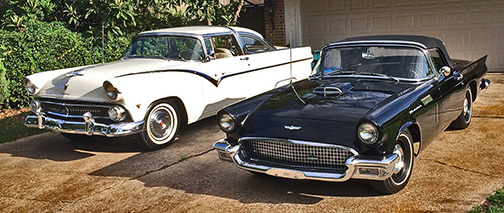
Don’t ask me. My small fleet is more mid-fifties than later current year makes. It includes a ’55 Ford Crown Victoria, a ’57 Ford Thunderbird and a ‘57 Ford purchased off the show room floor by my grandparents in North East Texas. It’s a survivor of America’s automotive hey day and the very car in which I learned to drive, and in which I dated my first girl friend. My second one too, now that I think about it, but that’s a different column.

It’s fair to say my personality would be much different had American automobiles and internal combustion engines not been an incentive to survive afternoon classes in high school just to watch the pilgrimage of rolling stock leaving the school parking lot carrying classmates to after school jobs, or to the local Dairy Queen.

The anticipation of cruising the Mount Pleasant city streets at night and blazing the asphalt at East Texas drag strips on the weekend made automobile ownership my top priority by age 12. My first year or so of driving was the family sedan until an after school job sweeping floors provided enough money for a set of wheels to call my own. But, when that first car deal was made, it had to be different. A young man’s car was an extension of his personality.

That’s a concept to which dad didn’t necessarily subscribe. “It’s just something to get from point A to point B,” I can still hear him saying. “True,” I admitted, but added that the trip had to be made in distinctive style making it possible for your friends to identify you simply by the car you drove. One trip by the local theater on a Friday night, and you knew exactly who was at the movies that night just by the cars parked around the square.

Even if dad was right, for me that trip from point A to B also had to be made in the shortest amount of time possible. Whatever I drove had to be fast which usually also meant that it was loud. Switching off the ignition and coasting the last block into the driveway at home was my only hope of preventing my parents from knowing exactly what time I got home.

That need for speed did two things. It kept me on a first name basis with most of the local police officers, and it spawned a brief career in drag racing during high school and college.

A love for American iron shod with four tires has been a part of our culture all my life. There’s never been a time when I didn’t own something interesting, different or unique to drive.  My motto is that life is too short to drive anything generic or slow.

Personally, I’m not writing off the car just yet. Once you get past the econo-sedans that the government has tried to make us love, the pickups and SUVs still outnumber the cars on lots. And once you peek beneath the look-alike skin of today’s cars, there’s comfort, economy and technology that wasn’t even dreamed of before the days of space exploration. In addition, the likes of Mustang, Camaro, Charger and Challenger, all throw backs to the 1960s, make up a large part of today’s car sales. And they produce horsepower that was unheard of even in the days of muscle cars. Unique and fast rides are far from extinct.

Maybe there is a generation lurking in the inner cities that doesn’t put as much emphasis on cars as those of previous years. Every generation is different and there’s a lot to be said for that as well.

But as for me, I think I’ll go cruising tonight in my ’55 Ford Crown Victoria.

— Leon Aldridge

A child’s dream of a world to come

Searching for a couple of needed replacement parts for Blackbird on EBay

Model cars blog
Model car kits built by the author in 1959 and 1960

this week failed to yield the desired results, but it did inspire me to research another long forgotten topic from a long time ago. Model cars.

An adult’s vision begins with the dream of a child and model kits are in many ways one of those visions.

While searching for real world car parts needed for my classic ’57 Thunderbird last week was less than fruitful, the number of model car kits and parts for sale online was an eye-opener. To clarify, we’re talking about plastic model car kits that were produced and sold on store shelves when Blackbird was still a very young chick on America’s highways. The model kits allowed youngsters like me to build, customize and dream about cars that we were not yet old enough to own or drive.

The surprise to me was learning these glue together kits are now collectible and fetching much more than the $1.29 they sold for at the five-and-dime stores in Mount Pleasant, Texas when I was buying them prior to reaching teenage years. Some of the like-new kits (unassembled model car kit, all the parts and instructions still in the box) were on EBay at asking prices of $30-$50 or more. Even assembled cars, or partially assembled cars, were bringing bids of $20-$30.

What great memories the thought of building model cars conjured. Quickly forgetting Black Bird’s needs, I was lured into a memory land of kits I gazed at though the eyes of a 10-year old on a 25-cents a week allowance for taking out the garbage and pulling weeds from my mother’s flower beds. Models I had not seen or thought of in half a century.

At the peak of my model car building days, my bedroom was garage to some 100 assembled and painted model cars displayed on shelves. Most of the them were customized to some degree: lowered, smoothed bodies, custom painted, fashioned after real cars of the era.

The popular scale was 1/25th and the preferred brand, at least In my circle, was the AMT “three-in-one” kits. Build ‘em stock, custom or in racing trim. Monogram and 1/24-scale boulevard cruisers and hot rods were a close second. Opening the box exposed the builder to all of the parts needed that were molded, most in white plastic, on “runners” or “trees” to facilitate manufacturing of the kit. Removal of each part from the tree was required by gently twisting them to snap off. After that, each part had to be painted the correct or desired color, depending on individual preference for stock appearance or a customized version. Bumpers, grilles and wheels were typically chrome plated as were some engine parts on custom cars. So, each kit also required the purchase of Testor’s paints and plastic glue. Then an X-Acto knife, sandpaper and other tools were required. Before long, I had a model car custom workshop in my parent’s garage on Redbud Street turning out what I was certain would be the finest scale versions of the cars. Models that looked exaclty like the cars I saw in the hot rod magazines sneaked into history classes at school.

Moore’s Discount Center on the west side of the square in Mount Pleasant staged a handful of model car contests in the very early 60s. The pride for winning came not only in the trophy awarded, but for also having your winning custom car on display in the store window for a week.

Scale model cars were soon exchanged for the real thing as attaining driver’s ed age rolled around. The models collected dust as spending money on kits, glue and paint escalated into buying gas, oil and tires for the real thing.

Years had passed when one day my mother called some 20 or more years ago to deliver an ultimatum. “I’ve cleaned out closets and the attic,” she said, “and there’s several boxes of things you may want to keep. If not, I’m throwing them away.”

Much to my surprise, one of the boxes contained a half dozen or so of the model cars I had built and displayed in my bedroom circa 1960 or so. They were suffering a little from box wear and maybe some attic heat, but these were the model cars I had built. As I looked at each one, blowing the dust away and pushing on parts that were turning loose, the memories flowed faster than model plastic glue on my mom’s dining room table on a summer afternoon.

I’ve saved them, sometimes placing them on display for not only my own enjoyment, but to share memories with others. Learning recently these icons of an era and a part of my past were becoming collectible caused me to find them in the closet this week and get them out one more time. Maybe I’ll put them on a shelf in the garage to take their respective place among my automotive culture alongside Black Bird, Miss Vicky and Liz.

If you are acquainted with her, and possibly concerned about my mention of shopping for parts for the ’57 Ford Thunderbird in my garage dubbed and affectionately referred to as Blackbird, she’s fine. I was simply seeking to upgrade some of her carburetor linkage. Cars knocking on the door of 60 years old tend to acquire incorrect parts over the years and other parts tend to wear out. Not unlike me, now that I think about it.

But not to worry, Black Bird and I can always sit in the garage and gaze on the model car survivors, the dreams of a child from an era long, long ago.

—Leon Aldridge


Advice and inspiration from good friends

MoonFB_2330
“Moon Over Murvaul” —photo by Leon Aldridge

Sage advice gleaned from a good friend and business associate some years ago suggests that reaching desired goals sometimes requires utilizing the 25th, 26th and 27th hours of the day. Being one who has never hesitated investing the time required for completing a task, I have been on a first name basis with those three hours most of my life. The only drawback is they typically are available only when it’s dark outside and everyone else is enjoying a good night’s sleep.

Arriving at a time in life that I used to envision as one when I would slow down and take things a little easier, I instead find myself with foot still on the accelerator and gaining speed, still depending on those three elusive hours. Compounding matters is the fact that I more often than not, tend to take on more than I can get done. Some delight in crossing things off their “to do” list, but not me. I throw everything on it and feel great if I get half of them done.

While I’ve long wondered whether this was a healthy approach to feeling any sense of achievement, I may have moved closer to an answer recently. An ex-military fighter pilot and former Navy Blue Angels flight demonstration team pilot got my attention a couple of weeks ago on one salient point while applying military planning to business strategy. Paraphrasing his comparison of flying combat missions in the Middle East to running a business, as long as you return from the mission, there are no failures. Some are successful, the others you learn from in order to increase the success rate of future missions. Maybe that’s been my subconscious mind set all along. I succeed at completing some, I learn from the others that I’m not going to get the rest done, but at least it gives me something to look forward to.

One of those learning missions for me in 2015, a year wrought with more surprises and adjustments than most, was posting a regular column or two in this cyberspace hole every week as I cheerily promised I would do at the outset. Started great off the line and built some speed early in the mission, then along came some of those surprises and challenges rendering the column space more a learning experience than a successful mission.

Also on my list was to recapture some fun in my photography endeavors. Years of using a camera as a tool to put food on the table neutralized a desire to get out and shoot purely for pleasure. Therefore, two of my “goals” in 2016, as I addressed them in this same space as the new year rolled in, was to resume regular writing for fun and to regain pleasurable photo pursuits.

Already well into the new year, I was still fumbling for the switch to ignite these endeavors when along comes long-time friend and photographer Susan Prewitt from my hometown of Mount Pleasant, Texas. She unknowingly fanned the flames for one, if not both, of those personal goals when she challenged me last week to a seven-day Nature Photo Challenge on Facebook. The objective was to post a new nature photograph every day for seven days.

Something else on my list to do? Will this one be a successful mission or a learning experience? I already knew the answer because on the list with working extra hours and putting too much on my “to do” list in the first place is the fact that I can’t say “no,” especially to a good friend like Susan.  My smiling response to her? “I accept your challenge. I’m on it.”

Sunday was four days in, and I’m already lamenting that it’s only a seven-day mission. Posting Sunday night’s photo, a “moon set” picture taken at Lake Murvaul in Panola County reminded me of two things. One, capturing that set of images was fun. Two, it required several sessions at 3:00 to 4:00 a.m. during full moon phases meaning I was working on the moon’s schedule as opposed to mine.

Accepting Susan’s challenge helped fire up my return to photography purely for fun, ensuring that learning experience would become a successful mission. The fact that this column was posted soon after, I’m thinking, is no coincidence. I’m leaning more toward the theory that returning to photos for fun was also the stimulus to remember that I was writing for fun as well.

Also not coincidentally, I’m pretty sure the 25th, 26th and 27th hours of the day are found somewhere around 3:00 to 4:00 a.m.

— Leon Aldridge

————————

About “Moon Over Murvaul”—While living on Lake Murvaul in about ’04, I woke up early one morning and couldn’t go back to sleep. Part of why I couldn’t sleep was because the moon light was so bright, you could have read a newspaper in the bedroom. Despite the fact that it was between 3:00 and 4:00 in the morning, the moon light lured me into the back yard and down to the pier with camera in hand where I spent the next half hour or so shooting frame after frame of the setting full moon.

This became a ritual with me for the next several months during the ensuing full moon phases. The result was a collection of fantastic full-moon-setting shots that I treasure. The one I posted to Facebook for the challenge, the same one accompanying this column, resembled what I would call a harvest moon. I’ve seen many harvest moons rising, but this was my first setting harvest moon to witness.

I’m not sure whether that’s because a harvest moon set is that unusual, or if my being up that early in the morning is really unusual.

Resolutions are not my strong suit

Made your resolutions for 2016? A good friend asked me that question this week to which I responded, “I’ve always had problems with resolutions, I do better setting goals.”HNY16

Honestly, my response was a lame way of dodging the fact that yours truly hadn’t made any resolutions yet. And as long as we’re speaking honestly, that’s because keeping resolutions has never been one of my strong suits. For me, resolutions are just something that goes in one year and out the other, in a manner of speaking.

However, after popping off to my friend, I felt as though resolving to something was in order. So, goals it’s going to be for 2016.

Goals, so the experts say, are supposed to be well defined, have a time line and a target date, and include a reward for attaining them. Check back with me this time next year for a progress report, and we’ll try to answer the proverbial question, “So, how’s that working for you?”

In fact, I think I’ll make my first goal: being here this time next year for a progress report, and we’ll try to answer the proverbial question, “So, how’s that working for you?”

Certainly, most of us desire to enjoy as many years as possible while we’re here. Personally, I’ve always favored what comedian Groucho Marx said on that topic. When reportedly asked in an interview what he hoped people would say about him a hundred years from now, he responded, “Boy, doesn’t he look good for his age?”

Getting the maximum mileage toward reaching a ripe old age and looking good along the way begs an entirely new set of goals altogether, the primary one being a positive and happy outlook on life. Marx had something to say about that as well, possibly one of the very few serious Groucho Marx quotes recorded. “I, not events, have the power to make me happy or unhappy today. I can choose which it shall be. Yesterday is dead, tomorrow hasn’t arrived yet. I have just one day, today, and I’m going to be happy in it.”

So, if we seek a longer life, my question would be why would we want to live it being unhappy? Hopefully, we would not, unless you’re like one of my relatives about whom I jokingly say, “… was in a good mood last time I saw them, but was able to get over it.” Funny? Yes, unless you know my relative.

Two of my favorite theories on how to be happy were put forth in a book entitled The Upward Spiral by Alex Korb. The postdoctoral researcher in neuroscience at UCLA says listening to music from the happiest time of our life is one key to happiness. Korb, says that we love our favorite songs because they’re associated with an intense emotional experience in our life, adding that the music we enjoyed when we were around the age of 20 is the type of music we will probably love for the rest of our life.

If you know me, you know that I’m walking, talking, living, breathing proof of that premise. The happiest memories of my life have always been centered in music. Listening to music, studying music, making music, thinking about music—makes no difference. I can’t be involved with music and be unhappy.

As for music being rooted in an intense emotional experience in life, let me tell you about my Uncle Bill, my mom’s baby brother (no, he’s not the crabby relative, he’s likely the happiest family member we have) who taught me a great game many years ago. It works like this: get a bunch of friends together and a bunch of tunes from the time period Korb suggests. Start the first song and have everyone shout out (1.) the name of the first city that comes to mind, (2.) the car they were driving at that time, and (3.) the name of the girl or guy they were dating. Guarantee a happy person won’t make it through the first verse of any song, which makes me pretty sure my aforementioned crabby relative has never played the game.

The next thing you’ll notice when you play the game is that everyone is all smiles. When a favorite song and the memory of an emotional experience collide, you can’t keep me from smiling, even around my aforementioned crabby relative.

And, this gives credence to another of Korb’s happiness factors that I like. Smile. Smile when you are happy. Smile when you’re not happy. Smile all the time. “Why would I want to do that,” my aforementioned crabby relative might ask. My mom had the answer for that. She said it makes everyone wonder what you’ve been up to.

Korb has a different theory, though. He says, “The brain isn’t always very smart.” His explanation is that the brain tries to sort out random information by looking for clues on how to react. He says that when you smile, even when you aren’t happy, it fools the brain into thinking you must in fact be happy. So, it therefore sends out happy signals counteracting how you really feel. I think Korb is on to something there as well because aforementioned crabby relative never smiles.

So, there’s my goals, aka resolutions, for 2016. I’m going to keep on enjoying my favorite music and relishing in those intense emotional memories it evokes. That will make me smile which will keep my brain thinking that I’m happy all the time and make everyone keep wondering what I’ve been up to … especially, my aforementioned crabby relative.

The reward will be living another year to do it all again. Then, as Groucho Marx also said, “Getting older is no problem. You just have to live long enough.”

Happy New Year! My wish for 2016 is a happy, blessed and prosperous year for us all, even my aforementioned crabby relative.

Leon Aldridge