It’s a generational thing

“The thrill is in the chase.” — Popular old saying

Old car hobbyists can be an easily entertained bunch. Three or four-hour drives to a swap meet with nothing in mind to buy, just to look around. Then coming home with a collection of rusty and dusty car parts unrecognizable to most people. All in a day’s fun.

“So, what did you score at the Conroe meet,” a friend asked last weekend. “Set of ’57 Ford hubcaps for myself and a ’52 Packard hood ornament for my buddy, T-Mac.” I replied.

“Hubcaps,” my befuddled friend responded with a questioning look. “And, a hood ornament? What’s a hood ornament?” Worthy of mention is that said friend was maybe half my age, and let’s just say that old car parts is not one of his conversational strong suits. I sighed and responded, “You’re kidding, right?”

57 Ford hubcaps-sm
1957 Ford “pot lid” hub caps now residing in the Aldridge garage

Maybe it’s a generational thing if you didn’t grow up when a driver’s license was a right of passage. When the memory of a guy’s first car lingered longer than that of his first girlfriend. Reading hot rod magazines in study hall is where you learned that early automobiles had radiator caps with a built-in thermometer mounted on top of the radiator where the driver could keep an eye on it and have a ball-park idea as to when the car was about to overheat. That was an era when the radiator had nothing to do with the hood that opened to either side of the radiator rather than covering it.  It was also an era when “dash boards” contained little more than a speedometer crude by today’s standards and an on-and-off ignition switch—before there was a need for the term “instrument panel” because there were between few and no instruments.

Into the 20s and 30s, radiator cap thermometers became works of art that were focal points of the car’s styling. Some were large and ornate often with wings or birds, and they were all either chrome or brass. That was also an era when cars were constructed of metal.

As cars became more modernized into the 40s and 50s, gauges moved inside the car and hoods grew to cover the radiator, but the artistic forms remained as adornments on the leading edge of the hood thus becoming “hood ornaments.” Designs grew to include elegant graceful birds, animals, even aerodynamic concepts mimicking airplanes, rocket ships and long sweeping spears with fins as reflections of the jet age.

While Cadillacs are T-Mac’s first choice in collector cars with a ’56 limo, ’67 convertible and a ’59 two-door hardtop in his garage, he’s fond of a hood ornament from any make, as long it’s “cool looking.”

Walking the swap meet in the spirit of the chase, scanning tables of junk in hopes of spotting a gem to justify the long drive, I saw the prize. Lying among rusty parts and old tools languished the graceful form of a long-necked swan, curved neck and head down with long, backward flowing wings. With dulled chrome supporting a degree of surface rust, I had no idea what make or model of automobile it once adorned. However, while lingering in condition, it was still elegant in form.

A cell phone photo dispatched to T-Mac garnered a response within minutes. “How much,” he queried? “It’s a ‘52 one-year-only Packard.”

Packard was an American luxury automobile marque produced in the United States from 1899 to 1956. They bought a failing Studebaker company in 1953 and the final Packards were actually Packard-badged 1958 Studebakers. The last Studebaker rolled off the assembly line in 1967.

I told him I didn’t know about a price, but I would find out. Rule number one at swap meets: If you find something you like, either buy it or map the exact location of the vendor. Swap meets are like huge outdoor flea markets, just all cars and parts. Returning to the scene of something like a tired, faded chrome swan hiding in a box of car parts can be a challenge.

Once I was successful in locating the vendor again, negotiations were on. The thrill is in the chase, but half the fun is bargaining over prices. Deal done, the Packard swan was acquired, and the rusty old bird was headed toward a new home.

Thrilled with the find, T-Mac renewed his standing invitation for me to see his collection. When I do make the trip to his garage in the Longview, Texas area to see it, I’m thinking I’ll invite my young friend who didn’t know what a hood ornament was. And just maybe, we’ll make the trip in a car with hub caps … before he asks, “What’s a hub cap?”

—Leon Aldridge

Aldridge columns are also published in the Center, Texas, Light and Champion (http://www.lightandchampion.com) and the Mount Pleasant, Texas, Tribune newspapers (http://www.tribnow.com).

I would hug him and thank him again

Thank a veteran every day for their service to our country.

– – – – – – – – – – – – – – – – – –

Today is Veterans Day, but truthfully, every day should be Veterans Day. We are the home of the free, only because the brave sacrifice to serve.

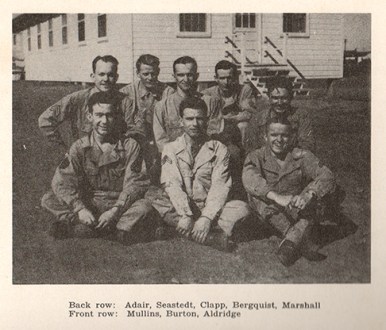
While I am grateful to all veterans, my favorite, of course, was my father. Between the day he answered the call to serve his country in the spring of 1942 and V.E. Day, Leon D. Aldridge attained the rank of Master Sargent serving with the U.S. Army 276th Engineer Combat Battalion. He returned home to Pittsburg, Texas, wearing battle ribbons for participation in three campaigns: Ardennes, Rhineland and the Central Europe Campaign.

Leon Aldridge Sr 1945-100
All photos on this page were mailed home to my mother from my father. She compiled them in an album of his Army years: Immediately above: Aldridge, Leon D. T/Sgt. — Germany 1945 — with a note scribbled to my mother. Photo at the top of the page: In my father’s handwriting on the back: “Ludendorf Bridge before its collapse. On west bank looking east. Bailey bridge in foreground built by us. Sign on bridge says, ‘This bridge built by 276th Engr. Combat Bn.’ Of course – that has reference to the Bailey!” Below: The joys of Army bivouacs.

Every veteran has stories to tell, but like most, dad talked little about his with one exception. That was in 1984 in Cologne, Germany during a trip to the Netherlands, Germany and France, the areas where he spent his service years in World War II. As we walked around the perimeter of the majestic Cologne cathedral on the banks of the Rhine River, he began to tell stories that day I had never heard. I was 36 and he was 61.

He talked in detail, often with tears in his eyes, about a night of gunfire huddled close the base of the cathedral. “See that spot,” he said pointing to a sheltered area created by two of the many huge buttresses supporting the 750-year old structure. “I spent a night there with a half dozen guys. We were engaged in gun battles with the Germans, separated from the rest of our detail while attempting to occupy the village. “

“We returned fire until it was secured at daybreak,” he said recalling obviously painful memories stirred by standing on the same ground 40 years later. “I wasn’t sure I was going to make it out that night…and I sure never expected to be here again.”

When we reached the side of the cathedral facing the Rhine, he pointed south and said, “Remagen. That’s where I was standing on the abutment when the bridge fell.”

The 276th Combat Engineers were also at the Ludendorf Bridge at Remagen, Germany, March 17, 1945 when the bomb damaged structure collapsed and fell into the Rhine River. “We returned the damaged bridge to operational status under gunfire,” he said. “We  had the Germans on the run, and they tried to blow up the bridge to stop our advancement.”

“We were still working on the bridge on the day it fell,” he continued. “Steel trusses began to groan, rivets started ‘popping like gunfire,’ and the bridge collapsed into the Rhine. Some scrambled for safety,” he said, “but many were not so fortunate. I had been on the bridge earlier that morning. Part of us fell back for materials and supplies. We were back at the abutment, waiting for the unit ahead of us to advance. Just as we started onto the bridge, it fell into the river. Five more minutes and I would have gone into the river with it and the others who were lost that day.”

Once my father began to talk, he shared many experiences. Like a story about sweeping fields near a combat zone when he stepped on a land mine. “I knew what it was when put my foot on it,” he said. “But at that moment, it was too late. I honestly thought I had taken my last breath. I fell and rolled, hoping for the best but fearing the worst. Only by the grace of God,” he said, “the land mine failed to detonate, and I lived to tell the story.”

His stories included details about artillery lighting the night sky like daylight, bright enough “to read a newspaper,” as he put it. His memories of the weather were many, things like freezing weather in which they used newspaper to line boots and clothing, hoping to avoid frostbite, or sleeping on cots in tents that were flooded with water.

Flooded campMy father died in 2007, and never talked as much again about his service years as he did on that trip. He was proud of his service and I was proud of him. His stories of duty and sacrifice as part of the nation’s military are but tiny, individual examples of why America has survived for 240 years as a free and proud nation.

As I wrote a few years ago in a similar Veterans Day column, I am glad I got the opportunity to thank him. And, I will end this one the same way saying that if he were here today, I would hug him and thank him again.

—Leon Aldridge, Jr.

Aldridge columns are also published in the Center, Texas, Light and Champion (http://www.lightandchampion.com) and the Mount Pleasant, Texas, Tribune newspapers (http://www.tribnow.com).

Laugh with those who see the humor in life

 “I don’t have any out-of-body experiences. I had indeed seen a bright, beautiful light once and had followed it, but it turned out to be a Kmart tire sale. – Lewis Grizzard

Laughter is still the best medicine. It’s essential to living, or at least to living a worthwhile life. I’ve long worried about people who find fault and criticism in life quicker than finding something to laugh about.

That’s likely why the work of columnist, author, philosopher and speaker Lewis Grizzard has remained one my favorites since attending a newspaper conference in Atlanta many years ago where he was the keynote speaker.

Without any particular specialty, Grizzard was noted for commenting on just about everything in life, exposing the humor in every topic. That included politics, culture, women, men, mothers, fathers, dogs, sex, honor, racism, the past, the present, the future, and the South—there were few topics Grizzard didn’t tackle.

A true Southerner he was, born at Fort Benning, Georgia on October 20, 1946 and claiming Moreland, Georgia as his hometown. An internet article last week, noting he would have been 71, recalled the unique, easy-going humor that made his columns a favorite in the Atlanta Constitution, and led to his publishing some 20 books (18 of them New York Times bestsellers) which put him in great demand for speaking engagements.

My library includes several of his works, including a few I can recall as favorites. “If Love Were Oil, I’d be About a Quart Low,” about his three marriages and three divorces; “Elvis is Dead and I Don’t Feel So Good Myself,” about a child of the 50s coping with life in the 80s; and “Shoot Low, Boys–They’re Riding’ Shetland Ponies: In Search of True Grit,” about Americans he considered to possess genuine true grit.

Grizzard died in 1994. Shortly afterward, I wrote a column expressing my disappointment in “Life” magazine when they failed to include Grizzard’s death in their yearly review recognizing significant individuals lost that year.

Perhaps it was because Grizzard did not achieve greatness through many years of writing. He was just 47 years of age, and had really just “come into his own.”

Perhaps it was because his writing was not eloquent or culturally philosophical. He wrote about things he loved from chicken-fried steaks to his beloved Georgia Bulldog’s football. He lauded American institutions from family to a solid work ethic and the importance of education. In his own skillful manner, he often wove many subjects together successfully reminding us of the simple humor in life, and often the importance of laughing at ourselves—something he did frequently.

Writing about “That There Education,” Grizzard said, “Mother began saving for my college education with the first paycheck she ever earned. She bought bonds. She put cash in shoe boxes and hid them in the back of the closet. Having enough money to send me to college when the time came consumed my mother. Besides the bonds and the shoe-box cash, she kept a coin bank, bought day-old bread, sat in the dark to save on the electric bill, never had her hair done, quit smoking, and never put more than a dollar in the collection plate at church. She used some simple logic for not tithing the Biblical tenth: ‘If the Lord wanted me to tithe that much, he wouldn’t have made college so expensive.”’

Perhaps it was because his writing often laughed at things some hold sacred. He rallied against political correctness, and was often described as “politically incorrect and proud of it.” Grizzard fought to preserve a sense of humor, maintaining that it was impossible to be politically correct and smile.

Grizzard never won a Pulitzer Prize. In fact, he poked fun at that institution, too: “They handed out the annual Pulitzer Prizes, journalism’s highest awards, the other day, and once again, I didn’t get one. It’s becoming an all too familiar occurrence. Each year, I call my friends over, we ice down the beer and await the word from the Pulitzer committee. Word never comes, but my friends drink all the beer I bought, anyway. How two people can drink that much beer is beyond me.”

Grizzard died of complications from heart surgery, something else at which he poked fun with his book entitled, “They Tore Out My Heart and Stomped That Sucker Flat.” Prior to his fourth heart procedure to repair a valve, he was told that his chances of survival for the risky surgery were less than 50-percent to which he replied, “I just have one question: When’s the next bus to Albuquerque?”

Humor was the common factor in everything Lewis Grizzard addressed, and he didn’t waste a single day—right to the end.

Some have considered Grizzard to be a contemporary, southern version of Will Rogers who said, We are all here for a spell, get all the good laughs you can.” Lewis Grizzard made that easy to do.

—Leon Aldridge

Aldridge columns are also published in the Center, Texas, Light and Champion (http://www.lightandchampion.com) and the Mount Pleasant, Texas, Tribune newspapers (http://www.tribnow.com).

100-percent sure it’s a story worth telling

“Flight is the most profound metaphor for pushing our boundaries, reaching beyond ourselves, and freedom. And don’t we ALL . . . fly in our dreams?” — Fantasy of Flight founder Kermit Weeks

I’m 95-percent sure the name Isaac Newton Burchinal, Jr., or Flying Tiger Air Museum, means little to anyone who didn’t know Junior Burchinal, or never visited his small air strip west of Paris, Texas.

In aviation circles however, stories of his flying skills and his “less than museum quality” collection of WW II flying relics are classic. That includes one worth telling about a B-17 bomber visiting the old Mount Pleasant airport in the mid 1970s—although it wasn’t the plane that was supposed to have been there.

A recent interview with Burchinal’s son and grandson on Scott Glover’s Mid America Flight Museum Facebook page stirred memories of that story and of visits to Burchinal’s facility more than 40 years ago.

I.N. Burchinal, Jr. founded Flying Tiger Air Museum in the early 1970s although he bought his first warbird in the 1950s when they were little more than military surplus. Working out of his Northeast Texas crop dusting facility, he collected leftover military planes and fulfilled dreams for anyone wanting to learn to fly them. He also flew as a stunt pilot for Universal Studios along the way. His planes were featured in movies like “The Great Waldo Pepper” and “Midway,” plus the television series, “Baa, Baa, Black Sheep.”

Flying was a childhood dream for me. It became a dream come true when I soloed in the early 70s, and weekend trips to Flying Tiger field from Mount Pleasant were frequent. Not only were the planes fascinating, but I stood in awe of anyone flying big warbirds off a small asphalt strip, uphill on one end with a fence and highway on the other.

That fascination remained when business took me to Vintage Flying Museum at Meacham Field in Fort Worth about ten years ago, landing me a photo op in the pilot’s seat of a B-25 bomber. Cool stuff for a lifelong hobby pilot flying nothing bigger than a Piper Cherokee. Then discussion a couple of years ago with Frankie Glover while touring the Mid-America Flight Museum in Mount Pleasant revealed that museum’s B-25 was the same one I cross paths with in Fort Worth. Follow that with the aforementioned video interview identifying it as once owned by Junior Burchinal, and it became apparent that the world of old airplanes is small and getting smaller.

I’m also 95-percent sure it was about 1975 when our fledgling Mount Pleasant flying club planned an air show, and I called Burchinal to see if the club could afford one of his planes. Discussing prices and budgets sealed a deal for his B-25 to make the show. But, a late afternoon call on Saturday before Sunday’s show changed that. “Leon, this is Junior Burchinal up here in Paris,” he said. “I’ve got bad news. We’re having problems with the B-25. It won’t make the trip tomorrow.”

My heart was rapidly losing altitude. Visions of, “what now,” spiraled as he continued. “But, if it’s all right with you, we’ll bring the B-17 for the same money.”

“All right,” I stammered, my spirits pulling out of the dive. “Yes sir, that’ll be all right.” He continued to apologize, almost as many times as I thanked him.

Early the next morning with club members scurrying around working on last minute preparation, I heard the huge four-motored bomber coming over Mount Pleasant before I saw it. I watched it make a long straight-in approach to the airport, mesmerized by the sound and the sight in the early morning sunlight. Wheels were just touching pavement when a WW II fighter “Corsair” made a hi-speed pass over the airport, then circled around to land.

Both planes taxied to the ramp. Burchinal climbed out of the single seat fighter, followed by a young lady who appeared literally to unfold and crawl out of a small added seat behind the pilot. He introduced young men embarking from the bomber, introduced the young lady as his daughter, and resumed apologizing for not bringing the B-25. Then added, “But, I brought the Corsair to make up for it.”

I thanked him again noting that I was sorry for his problems with the B-25, but folks at the air show that day got a great deal.

Junior Burchinal’s planes graced Mount Pleasant air shows after that creating memories for many. However, I’m 100-percent sure that in the small world of old airplanes, the story of a B-25 that was a no-show, but eventually found a home in Mount Pleasant, the B-17 that subbed, and memories of the legendary pilot who owned them is one worth telling.

—Leon Aldridge

Photo credit: Tom Griffith and Mid-America Flight Museum in Mount Pleasant, Texas (One of the best aviation museums in the country—check it out if you haven’t already)

Aldridge columns are also published in the Center, Texas, Light and Champion (http://www.lightandchampion.com) and the Mount Pleasant, Texas, Tribune newspapers (http://www.tribnow.com).

Happiness is a journey of friendships

“The journey is what brings us happiness, not the destination.” — Dan Millman, author of Peaceful Warrior

Do you ever pause to consider the, “what if?” You know, taking a little time to reflect on the journey—reviewing the course of events responsible for meeting someone or experiencing something that changed your life? Then trying to visualize how different your life might have been had you chosen the other path at any crossroads, knowing that not only the journey, but also the destination, would have been vastly different.

That’s where I found myself last week while crafting a magazine story about an old car. I watched the words I typed as they appeared on my computer screen…. “The white ‘55 Ford Crown Victoria calling my garage home for the last five years made a short trip coming across the Texas / Louisiana border from Bossier City to Center. But, it was a familiar trip. My long-time, very good friend, Joe Greene, had owned the car for almost as long as I had been calling him my friend.”

The story I was writing told of an old car, but my mind focused on the friend I found in Joe Greene. Sadly, we lost Joe earlier this year. Our 30-plus year journey with him left me cherishing wonderful memories made with Joe and his wife, Mary, and the many car shows, club meetings, road trips and garage sessions we shared as classic car enthusiasts and as best of friends. His trademark laughter was contagious, and his teasing personality with a desire to make others laugh made him an instant friend to everyone he met. Generous to a fault, he was always concerned more for his family and friend’s well-being than he was for his own.

The journey leading me to meet Joe and Mary was accomplished in old cars. Restoring old cars was a second career for Joe after 30-plus years in the military. He always had several projects of his own in progress, plus a number of customer’s cars to which he was applying his skills. But, the “car in the story” last week wasn’t the path to our meeting. That honor goes to a common passion for the Ford Thunderbirds known as “Little Birds” from the mid-50s.

Old cars and fast cars were my passion growing up in Mount Pleasant, one that continues today. Truthfully, it is still a disease for which I can find no cure—not that I’m looking for one, mind you. But, I was looking for my first “Little Bird” in the early 80s when I found one in Dallas. The seller told me the first thing to do was join a local chapter of the Classic Thunderbird Club International, adding that the closest one to me was the Ark-La-Tex Bayou Birds in Shreveport.

That ’57 Thunderbird purchased in Dallas, that took me to a car club meeting in Shreveport was the journey to shaking hands with Joe Greene. That meeting, however, was not a destination, but the beginning of a new journey.

The “car in the story” ’55 Ford started as one of Joe’s projects soon after we met. Not long after, I also bought one the same cars in Lubbock. After ten years of our making memories together, that car went to a new owner in Fredericksburg during a temporary lapse of good judgement on my part. I regretted the sale before the car was ever out of sight.

I don’t know how many years Joe worked on the “car in the story,” but progress was slow with little spare time from customer’s cars to devote to his own. Over time, however, it was immaculately restored in typical Joe Greene fashion, and shared garage space for several years with others in his personal collection.

When Joe decided to part with the car a few years ago, he remembered how much I missed my first one and gave me first opportunity to buy his. He knew the answer he would get before he called me.

I’ve put less than 1,000 miles on the car in the last five years. It gets out of the garage during nice weather for weekend pleasure cruises and for events with our Center car club, the Shelby County Cruisers.

Life is filled with wonderful journeys. For me, some of the best have been meeting people along the way with common interests in preserving the best generation of automobiles that ever rolled on American roads. While the cars are fun and rewarding experiences, writing the story last week about the destination of one 1955 Ford Crown Victoria and recalling the journey, makes me appreciate even more that the happiness in the journey is forming friendships with people like Joe and Mary Greene.

—Leon Aldridge

Aldridge columns are also published in the Center, Texas, Light and Champion (http://www.lightandchampion.com) and the Mount Pleasant, Texas, Tribune newspapers (http://www.tribnow.com).

In the right place at the right time


“No amount of planning will ever replace dumb luck.”— Old saying

I love this time of the year. Harvest moons. Fall festivals. The U.S. Supreme Court …

An opportunity to cover a small town event, writing stories as it became national news, provided me the first-hand opportunity to see a case argued before the U.S. Supreme Court. That experience instilled in me an appreciation for the first Monday in October, the start of each new Supreme Court session.

I also love old sayings, like, “No amount of planning will ever replace dumb luck.” Granted, a more sensible adage is the Old Italian saying, “Success is 90-percent hard work. And, if you aren’t lucky, just work harder.” However, much can also be said for being in the right place at the right time. It has been a factor in many memories from my years in journalism that I would not swap for anything.

It certainly was a factor in Boerne, Texas, where I published the newspaper and wrote most of the stories covering a lawsuit that was ultimately heard by the highest court in the land. In 1996, the Catholic Archbishop of San Antonio, Patrick Flores, applied for a permit to replace the 1920s mission style St. Peter’s Church atop a hill at the south of end of Main Street. The city denied saying the church sat within a historical district. The Archbishop sued based on the Religious Freedom Restoration Act (RFRA) of 1993. Boerne won in District Court, Flores appealed. The Fifth Circuit in New Orleans reversed the ruling, and Boerne filed to the Supreme Court for review. It was accepted and hearing was set for February 19, 1997 at 10:00 a.m.

At first, I didn’t plan to go. “Time and expense,” was my rationale. Picking up major stories from a number of sources is easy and often more practical for small town papers. All great logic before I had lunch with long-time and well-respected Boerne attorney and friend, Gordon Hollon. Mr. Hollon was a good lawyer and therefore naturally astute. I suspect he already heard I wasn’t planning to go. When I affirmed it, he replied, “I’ve been in the legal profession all my life and never seen the Supreme Court in action. How many small town editors do you know who have had the opportunity you have before you?”

I‘ve counted many lawyers as friends over the years, and all bore one common trait: it’s hard to argue against them. This would be not only a once in a lifetime news reporting for a small town newspaper, but also a once in a lifetime story for the reporter to tell. Press credentials were easy to obtain once they learned the Star was the Boerne newspaper—easier than physically getting into the court room. That required three metal detectors and a briefing: no cameras or recording devices, only a note pad and a pen allowed. Oh, and don’t touch the press gallery railing. I momentarily forgot that one putting my hand on it to straighten my chair and was swiftly reminded by a bailiff.

Seated in the second row, I was surrounded by BBC, CNN, AP and others with much larger audiences than the Boerne Star enjoyed. Beyond that, watching Justices Rehnquist, Kennedy, Breyer, Souter, Stevens, Thomas, Ginsburg, O’Connor and Scalia was sobering. Nothing regarding the historically steeped significance of where I sat that day escaped me.

The court rules only on the constitutionality of the law on which cases are based. Each is allotted 30 minutes—15 minutes per side, then it’s over. Keeping up and taking notes was near impossible as neither attorney enjoyed the luxury of finishing many of his or her statements. Two of the finest church-and-state attorneys in the country at the time—Marci Hamilton from San Antonio representing Boerne, and Jeffery S. Sutton for the Archbishop—fielded almost constant interruptions by the justices questioning their application of precedent case law, or finer points of interpretation . One would swear the justices knew where the attorneys were going before either finished making a point.

Arguments over, time for phase two of the small-town editor rubbing elbows with the major news outlets. Out the door with my camera, I hurried to the front steps where reporters gathered around Ms. Hamilton. Finding a perch on the wall beside the steps, I shot several frames looking down at the press bombarding her with questions. Digital photography and email still a vision of the future then, I walked three blocks with the film to a FedEx office and checked, “Early Next Day,” for Boerne. Moments later, I was on the phone dictating the story to our editor, Travis Priddy.

On my flight home the next day, reading a USA Today story about the case already dubbed as “landmark” made me smile for two reasons. One, knowing readers of the Boerne Star would be reading the same news the same day, with photos, because a small town publisher was in the right place at the right time and had luck on his side. And, two, because the small town publisher had one more story worth telling.

Epilogue—The court sided with Boerne’s argument and ruled the RFRA unconstitutional. The city extended the Archbishop the same offer it had before legal action began—build a new facility attached to, but preserving, the original. That’s what you will see at the end of Main Street if you drive through Boerne today.

—Leon Aldridge

Aldridge columns are also published in the Center, Texas, Light and Champion (http://www.lightandchampion.com) and the Mount Pleasant, Texas, Tribune newspapers (http://www.tribnow.com).

Something best done sooner than later

“If you don’t recount your family history, it will be lost.” — American writer Madeleine L’Engle

Better late than never, I always say. I’m saying it again as I start researching my father’s family history. Never mind that I said it 30 years ago when my father, and presumably many of his family members, were still alive. “Presumably” is a subtle hint that my father was not close to his family. I can count on my fingers all of the Aldridge family members I’ve met.

In stark contrast, my mother’s family would travel halfway across the country for a reunion, for Christmas or just because someone said “let’s get together.” They are still like that.

A couple of books on mom’s family history, plus reams of research, already exists thanks to two people. One is a cousin in mom’s generation who some years ago explored family lineage tracking an inherited illness prevalent in the family. The bonus was an excellent family history dating to the 1600s and the arrival of the Johnson family’s ancestors in America.

The other contributor was mom’s youngest sister, the unofficial family historian for their generation—the children of Arthur G. Johnson in Kentucky. It was a job she took seriously, researching to supplement what was already done. It became a passion and the volumes of photos and records that occupied a room in her Ohio home still exists today with her children.

Our sum total of knowledge regarding dad’s family consists of those few relatives we met personally, scant stories from my grandmother, and a few pages of notes my youngest sister obtained from a source neither of us remembers. What we do know is that our father was the last of 13 children born to a family of South Louisiana and Mississippi heritage. His mom died giving birth to him, and his two oldest sisters set out to raise him, also providing his name. One was dating a boy named Leon, the other, a boy named Dallas. Thus he became Leon Dallas Aldridge. The name with most uncharacteristic of origins would be carried through two more generations.

Not long after birth, he was reported to have contracted one of the childhood deadly diseases of the 1920s—some type of “fever.” His father (Willie Aldridge) wrote to his own brother (Sylvester Aldridge) telling him “the baby was sick” and they didn’t think he would survive. Sylvester’s bride of three years, a feisty, little woman from West Texas named, “Hattie Lois,” who was 17 years his junior, wrote back to reply, “no way,” that she was coming to “get the baby.”

March 26, 1950 Granny-Leon-sm
Hattie Lois (Farmer) Aldridge (left) with her grandson, Leon Aldridge, Jr., (yours truly), and Hattie’s sister, Ruby Lynn (right) and her granddaughter, Teresa,  in Fort Worth in March of 1950.

Sylvester and Hattie drove from Mineola, Texas to Doyle, Louisiana in a Ford model T, and took the child home with them. She nursed him back to health, they legally adopted him at the age of 11, and he grew up in Pittsburg, Texas, living to the age of 83.

I met only two of dad’s many siblings, his oldest brother, Zebadee, and a sister, Willie Lee who was named after her father. Zebadee ‘s wife, Vada, had family in Terrell, and that’s about all we know about her. Zebadee was the only Aldridge family member I recall coming to visit us, something they did frequently.

Willie Lee and her husband, whose name I don’t recall, lived just outside Baton Rouge near the Mississippi River in the tiny community of Tickfaw, Louisiana.

My one and only trip to visit dad’s family was with my father and his brother, Zebadee, to pick up a new 1961 Ford Zebadee had purchased in Baton Rouge.  On that trip, we visited my dad’s sister and his biological father who lived nearby. To my knowledge, that was one very few times my father ever visited his real father. Willie Aldridge lived alone near the Mississippi River in an old Southern dog-trot style home that I’m pretty sure had never known a coat of paint.

My favorite memory of that trip was Willie making coffee by stirring grounds in a skillet and boiling them in a coffee pot before straining the resulting liquid through a cloth. Zebadee was never without a coffee thermos wherever he went, and I’m guessing everyone in the family knew that. When we left, Willie told Zebadee to get his thermos out of the car, and he would put the rest of that coffee in it for the trip home.

Just like it was yesterday, I remember sitting in the back seat on the way back to Texas listening to my uncle and my dad talking. Zebadee asked dad if he wanted some of the coffee. Dad looked at him and said, “No, but save it. I’m pretty sure we can use it if we run out of gas.”

One facet of this genealogical exercise is to document as much family history still lurking in my mind as I can—stories and memories for my children while a sufficient number of active brain cells to get it done reamin. It’s something that for most families, if you don’t do it yourself, no one else is going to do it for you. Looking back, it’s something I wish I had started sooner rather than later.

—Leon Aldridge

Aldridge columns are also published in the Center (Texas) Light and Champion (http://www.lightandchampion.com) and the Mount Pleasant (Texas) Tribune newspapers (http://www.tribnow.com).

More than a mother-in-law, she was a friend

Paul and Ann-2
Paul and Ann Jones

Annie Laura Jones ended her earthly journey Wednesday, September 20, 2017. She was born May 8, 1937, and blessed with 80 years and a little more than four months here on earth. Ann, as she was known to just about everyone, was a wife, a mother, a friend and family member to many. She was also my mother-in-law for the last 20 years.

I knew Ann many years before she became my mother-in-law. That’s because I knew her daughter, Terry, many years before she became my wife. Ann and Terry were both hairdressers working together in a salon they owned in Center, Texas, and that’s how I came to know them. Terry kept my family’s hair styles looking nice for a time until life took us in a different direction. A few years down the road, our paths crossed again, and this second intersection of pathways brought Terry and me to marriage, and Ann to be my mother-in-law.

Ann was a good mother-in-law, most likely because she was first a good person. Reflecting on Ann’s life the last few days caused me to think a little about what qualities make a mother-in-law a “good” one. Any couple joined in holy matrimony already knows that families can make a marriage wonderful, or can make it miserable. Ann and Paul, her husband of 62 years, have been nothing short of supportive and encouraging of their daughter’s marriage to me. From day one, I was welcomed into the family as if I had been born into it.

Mother-in-laws are classically characterized among humorists in our society as meddlesome and quick to offer more advice than is needed. While Ann was not one to appear bashful about offering advice to anyone on almost any topic, she offered very little to me in terms of marriage. I quickly learned, however, any wisdom she felt was appropriate for me to hear was sincere and was something that I needed to hear. Truthfully, there were times when I wished she had more freely shared some of her wisdom with me when I needed it the most. In any case, Ann’s advice to me was just that, honest and sincere advice that was never judgmental or discouraging.

I’ve also heard it said that a good mother-in-law never says anything that she wouldn’t appreciate being told. Honestly, that’s a philosophy that all of us would do well to adopt. I’m confident Ann never said anything to me, or anyone for that matter, that she would mind them saying to her. In fact, it’s a good bet that any advice she offered, that wasn’t gained from personal experience, was guidance given to her by family and friends.

I learned a lot from Ann by simply listening and absorbing whatever she shared with me and accepting it as good advice. Because it was.

A mother-in-law who is a good cook is always regarded as a “good” mother-in-law, and Ann lacked nothing in her culinary capabilities. When Terry mentioned, “mom’s cooking,” I dropped anything that might have stood in the way to make sure I was there when the table was set. Special holiday, birthday or any day for no special occasion at all, there was more than enough food when she cooked, regardless of the number of people helping themselves to a plate in her kitchen. Mother-in-laws are sometimes regarded as a little secretive with prized recipes, but not Ann. She readily shared hers, most likely because she no longer needed them. Another trait of a good mother-in-law: cooking without a recipe to make dishes filled with love. She did that, she loved to cook and when she did, everyone was invited.

We gathered to say goodbye to Ann last Saturday at the North Jericho Cemetery just outside Center, not far from where she lived most of her life. In my heart, she was a good mother-in-law for a myriad of reasons and a good friend as well. I can’t begin to tell you how much I will miss her.

Aldridge columns are also published in the Center, Texas, Light and Champion (http://www.lightandchampion.com) and the Mount Pleasant, Texas, Tribune newspapers (http://www.tribnow.com).

Perhaps I just need a refresher course

Roots, stems, leaves, flowers, fruits and seeds,
That’s six plant parts that people need.
—Children’s learning song by the ‘Banana Slug String Band’

An email last week announcing an upcoming forestry seminar related to my day job in marketing for a forestry and ecology firm in Center caught my attention. Seminars and workshops on just about any topic are as plentiful as weeds in the wild. This one, however, had me at the very first sentence.

The author of the short introductory message confessed that after following biologists and ecologists in the woods listening to them noting common and Latin names for plants, he always had just one question: “Can I eat that?”

The clever method of calling attention to a class on foraging caused me to laugh out loud. But, after a little thought, I decided that part of the human species genetic structure must certainly be to wonder, “Can I eat that.” Otherwise, how did things like eggs, caviar and pickled pig’s feet ever make it onto the menu.

The question certainly crossed someone’s mind a long time before my fifth-grade days at South Ward Elementary in Mount Pleasant, Texas, where many years ago my buds and I spent numerous recess periods “foraging” for sour dock weeds along the edge of the playground fence. I’m pretty sure the plant has a more scientific name, but identifying  it was not a priority then, chewing it for the tart taste was. We, by no means, were the first brave souls to look at a stalk of the skinny green and red-hued wild weed and ask, “Can I eat that?”

While I can’t vouch for its nutritional value, I’m assuming sour dock was not toxic. At least I don’t recall any of us becoming ill or dying from consuming it. Never heard one of my teachers say, “Oh yeah, he ate that funny weed out behind the school house. That’s what got him.”

Tasty and also non-toxic is sassafras. There’s surely more value to sassafras trees than just the root, but once again as kid, the idea was not to study the species, it was chewing on the root with the distinctive taste, or boiling it to make a tasty tea. That’s what we did on hiking cookouts and overnight campouts in Coach Sam Parker’s Boy Scout Troop in Mount Pleasant. The best sites for cookouts and for camping were near a sassafras tree providing ingredients for a hot drink to complement our campfire cuisine and something to chew on afterward while we swapped manly stories about the rugged outdoors.

As with the sour dock, someone had to be the first. Someone had to think about digging up a root, cleaning off the dirt and chewing on it a while before thinking, “Can I make tea with that?”

Being the first to evaluate grapevine had to be a little easier. After all, it obviously produced a tasty edible fruit of its own readily available for the picking. More than half a century ago, a bunch of young bicycle riders on a Saturday morning expedition in Mount Pleasant discovered a large, brush-filled ravine near the site of a new bypass following Highway 49 on the south side of town that was to become Ferguson Road. Deep into a grape vine forest spanning the construction chasm, our first fascination was swinging on the maze of gnarly vines. That soon turned to sampling the wild grapes which eventually lead to turning our attention back to the vines and asking…?

No, this time it wasn’t, “Can I eat that?” We looked at each other in silnce, knowing the common question in our minds was the “big boys” braggadocios stories. The question that day was, “Can I really smoke this?” It turned out to be a question left begging an answer once we discovered none of us possessed anything with which to produce fire. We then resorted to the more common question, “Can I eat that?”

“Why not,” we decided? Having already proven sour dock and sassafras as delicious delicacies of the wild, why would a vine that already produced a fruit, and from all accounts a pretty good smoke as well, not do the same thing?

Such juvenile exploits could be considered foraging, in a manner of speaking. While it was adventurous as a youngster, I honestly can’t remember the last time as an adult that I looked at a plant growing in my yard and thought, “Can I eat that?”

Perhaps I just need a refresher course…what was the date on that seminar?

—Leon Aldridge

Aldridge columns are also published in the Center, Texas, Light and Champion (http://www.lightandchampion.com) and the Mount Pleasant, Texas, Tribune newspapers (http://www.tribnow.com).


The lost art of front porch sitting

“If the world had a front porch like we did back then,
We’d still have our problems but we’d all be friends.”
—by Tracy Lawrence

A friend called Saturday afternoon. I answered the phone, then went to the front porch and sat down, got comfortable and enjoyed the conversation.

The front porch on my house is big. It spans the full 45-foot width of the house and is all under the roof line. That means it is protected from weather and harsh sunlight, and also means it is more than half the square footage of the first house I owned many years ago.

Potted plants and a variety of furniture adorns the big old porch. The focal point is a wicker love seat and two chairs originally purchased for watching sunsets from the back porch where we lived on Lake Murvaul in East Texas One of the obligatory reproduction park benches and a couple of old rocking chairs provide additional places to sit a spell.

It’s a really great front porch, and I really enjoyed sitting there Saturday afternoon…which makes me really wonder why I don’t sit out there more often than I do.

Front porch sitting is a wonderful pass time, a relaxing ending to any day, and can be excellent therapy. My grandparents were avid front porch sitters. If they ever missed a day, it was a sure bet someone was deathly ill, the weather was awful, or some similar catastrophic circumstance.

The small white frame house at 323 Cypress Street in Pittsburg, Texas, where my father was raised, had a small wooden-floor front porch—small compared to mine today in Center, Texas. Two old rockers fit the porch perfectly and were year-round permanent fixtures. As long as company didn’t exceed two additional people, another one or two chairs recruited from the living room could be squeezed in. It was a little crowded, but also sort of cozy for friends or family. And, that included just about everybody invited to sit on the porch, because if they were not friends or family before the visit, they surely would be before the evening was over.

The routine seldom varied. With supper over and the kitchen cleaned, everyone migrated to the porch. Things got underway by simply relaxing and visiting about anything that came up, but conversations typically were a recap of the day’s highlights. Maybe a discussion about one of my grandfather’s trees. They were his hobby before he retired and his passion after his paycheck days were over. Huge pecan trees lined the front of the house, trees he planted when they moved in the house in 1930. The back yard was shaded all day with just about any variety of fruit tree imaginable.

The mail was another frequent topic. Mail was a big deal then. The postman’s daily delivery was a highly anticipated event.. Things like the newspaper, a Fort Worth Star-Telegram every day, or a Pittsburg Gazette once a week. Perhaps a letter or postcard from a family member like “Aunt Ruby” in Fort Worth, my grandmother’s sister. They were all read and talked about on the porch. Most family news traveled via the mail as long distance phone calls were reserved for birth and death events. It was just too expensive for chit chat.

The sound of a train coming might prompt my grandfather to reach for his pocket watch before announcing something like, “The 6:15 to Texarkana’s right on time this evening.” Habits formed working for the railroad from the age of 13 were hard to break. He always carried his pocket watch and he knew the time of every passing train and its destination.

We knew it was time to go in when my grandmother softly started singing a hymn. While my grandfather’s favorite was “Blessed Assurance,” whatever the song for the evening was, songbooks weren’t needed. They both knew the words to every verse.

Just like my grandparent’s front porch, the mood on my front porch last Saturday afternoon was perfect for relaxing and chatting with a friend, albeit via the modern contrivance of cell phones. In fact, sitting on the porch was so enjoyable that when the chat was over, I lingered a while longer before leaving. A couple of neighbors walked by. We exchanged a “howdy” wave, and I smiled thinking they must have suspected something was terribly amiss since I never sit on the front porch.

Oh, and those two rocking chairs that were front porch fixtures at my grandparent’s house for decades? Although they are in need of repairs, I still have them. Maybe I’ll get them fixed now, add them to my front porch collection and spend more time porch sitting.

Not only is it relaxing and therapeutic, it reminds me of summers evenings at my grandparent’s house many years ago. Plus, it’s also kind of fun making the neighbors wonder what I’m up to.

—Leon Aldridge

Aldridge columns are also published in the Center, Texas, Light and Champion (http://www.lightandchampion.com) and the Mount Pleasant, Texas, Tribune newspapers (http://www.tribnow.com).