More than a mother-in-law, she was a friend

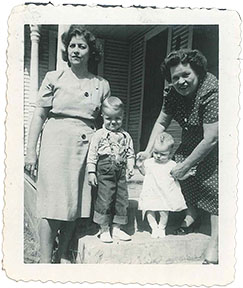
Paul and Ann-2
Paul and Ann Jones

Annie Laura Jones ended her earthly journey Wednesday, September 20, 2017. She was born May 8, 1937, and blessed with 80 years and a little more than four months here on earth. Ann, as she was known to just about everyone, was a wife, a mother, a friend and family member to many. She was also my mother-in-law for the last 20 years.

I knew Ann many years before she became my mother-in-law. That’s because I knew her daughter, Terry, many years before she became my wife. Ann and Terry were both hairdressers working together in a salon they owned in Center, Texas, and that’s how I came to know them. Terry kept my family’s hair styles looking nice for a time until life took us in a different direction. A few years down the road, our paths crossed again, and this second intersection of pathways brought Terry and me to marriage, and Ann to be my mother-in-law.

Ann was a good mother-in-law, most likely because she was first a good person. Reflecting on Ann’s life the last few days caused me to think a little about what qualities make a mother-in-law a “good” one. Any couple joined in holy matrimony already knows that families can make a marriage wonderful, or can make it miserable. Ann and Paul, her husband of 62 years, have been nothing short of supportive and encouraging of their daughter’s marriage to me. From day one, I was welcomed into the family as if I had been born into it.

Mother-in-laws are classically characterized among humorists in our society as meddlesome and quick to offer more advice than is needed. While Ann was not one to appear bashful about offering advice to anyone on almost any topic, she offered very little to me in terms of marriage. I quickly learned, however, any wisdom she felt was appropriate for me to hear was sincere and was something that I needed to hear. Truthfully, there were times when I wished she had more freely shared some of her wisdom with me when I needed it the most. In any case, Ann’s advice to me was just that, honest and sincere advice that was never judgmental or discouraging.

I’ve also heard it said that a good mother-in-law never says anything that she wouldn’t appreciate being told. Honestly, that’s a philosophy that all of us would do well to adopt. I’m confident Ann never said anything to me, or anyone for that matter, that she would mind them saying to her. In fact, it’s a good bet that any advice she offered, that wasn’t gained from personal experience, was guidance given to her by family and friends.

I learned a lot from Ann by simply listening and absorbing whatever she shared with me and accepting it as good advice. Because it was.

A mother-in-law who is a good cook is always regarded as a “good” mother-in-law, and Ann lacked nothing in her culinary capabilities. When Terry mentioned, “mom’s cooking,” I dropped anything that might have stood in the way to make sure I was there when the table was set. Special holiday, birthday or any day for no special occasion at all, there was more than enough food when she cooked, regardless of the number of people helping themselves to a plate in her kitchen. Mother-in-laws are sometimes regarded as a little secretive with prized recipes, but not Ann. She readily shared hers, most likely because she no longer needed them. Another trait of a good mother-in-law: cooking without a recipe to make dishes filled with love. She did that, she loved to cook and when she did, everyone was invited.

We gathered to say goodbye to Ann last Saturday at the North Jericho Cemetery just outside Center, not far from where she lived most of her life. In my heart, she was a good mother-in-law for a myriad of reasons and a good friend as well. I can’t begin to tell you how much I will miss her.

Aldridge columns are also published in the Center, Texas, Light and Champion (http://www.lightandchampion.com) and the Mount Pleasant, Texas, Tribune newspapers (http://www.tribnow.com).

Perhaps I just need a refresher course

Roots, stems, leaves, flowers, fruits and seeds,
That’s six plant parts that people need.
—Children’s learning song by the ‘Banana Slug String Band’

An email last week announcing an upcoming forestry seminar related to my day job in marketing for a forestry and ecology firm in Center caught my attention. Seminars and workshops on just about any topic are as plentiful as weeds in the wild. This one, however, had me at the very first sentence.

The author of the short introductory message confessed that after following biologists and ecologists in the woods listening to them noting common and Latin names for plants, he always had just one question: “Can I eat that?”

The clever method of calling attention to a class on foraging caused me to laugh out loud. But, after a little thought, I decided that part of the human species genetic structure must certainly be to wonder, “Can I eat that.” Otherwise, how did things like eggs, caviar and pickled pig’s feet ever make it onto the menu.

The question certainly crossed someone’s mind a long time before my fifth-grade days at South Ward Elementary in Mount Pleasant, Texas, where many years ago my buds and I spent numerous recess periods “foraging” for sour dock weeds along the edge of the playground fence. I’m pretty sure the plant has a more scientific name, but identifying  it was not a priority then, chewing it for the tart taste was. We, by no means, were the first brave souls to look at a stalk of the skinny green and red-hued wild weed and ask, “Can I eat that?”

While I can’t vouch for its nutritional value, I’m assuming sour dock was not toxic. At least I don’t recall any of us becoming ill or dying from consuming it. Never heard one of my teachers say, “Oh yeah, he ate that funny weed out behind the school house. That’s what got him.”

Tasty and also non-toxic is sassafras. There’s surely more value to sassafras trees than just the root, but once again as kid, the idea was not to study the species, it was chewing on the root with the distinctive taste, or boiling it to make a tasty tea. That’s what we did on hiking cookouts and overnight campouts in Coach Sam Parker’s Boy Scout Troop in Mount Pleasant. The best sites for cookouts and for camping were near a sassafras tree providing ingredients for a hot drink to complement our campfire cuisine and something to chew on afterward while we swapped manly stories about the rugged outdoors.

As with the sour dock, someone had to be the first. Someone had to think about digging up a root, cleaning off the dirt and chewing on it a while before thinking, “Can I make tea with that?”

Being the first to evaluate grapevine had to be a little easier. After all, it obviously produced a tasty edible fruit of its own readily available for the picking. More than half a century ago, a bunch of young bicycle riders on a Saturday morning expedition in Mount Pleasant discovered a large, brush-filled ravine near the site of a new bypass following Highway 49 on the south side of town that was to become Ferguson Road. Deep into a grape vine forest spanning the construction chasm, our first fascination was swinging on the maze of gnarly vines. That soon turned to sampling the wild grapes which eventually lead to turning our attention back to the vines and asking…?

No, this time it wasn’t, “Can I eat that?” We looked at each other in silnce, knowing the common question in our minds was the “big boys” braggadocios stories. The question that day was, “Can I really smoke this?” It turned out to be a question left begging an answer once we discovered none of us possessed anything with which to produce fire. We then resorted to the more common question, “Can I eat that?”

“Why not,” we decided? Having already proven sour dock and sassafras as delicious delicacies of the wild, why would a vine that already produced a fruit, and from all accounts a pretty good smoke as well, not do the same thing?

Such juvenile exploits could be considered foraging, in a manner of speaking. While it was adventurous as a youngster, I honestly can’t remember the last time as an adult that I looked at a plant growing in my yard and thought, “Can I eat that?”

Perhaps I just need a refresher course…what was the date on that seminar?

—Leon Aldridge

Aldridge columns are also published in the Center, Texas, Light and Champion (http://www.lightandchampion.com) and the Mount Pleasant, Texas, Tribune newspapers (http://www.tribnow.com).
 

The lost art of front porch sitting

“If the world had a front porch like we did back then,
We’d still have our problems but we’d all be friends.”
—by Tracy Lawrence

A friend called Saturday afternoon. I answered the phone, then went to the front porch and sat down, got comfortable and enjoyed the conversation.

The front porch on my house is big. It spans the full 45-foot width of the house and is all under the roof line. That means it is protected from weather and harsh sunlight, and also means it is more than half the square footage of the first house I owned many years ago.

Potted plants and a variety of furniture adorns the big old porch. The focal point is a wicker love seat and two chairs originally purchased for watching sunsets from the back porch where we lived on Lake Murvaul in East Texas One of the obligatory reproduction park benches and a couple of old rocking chairs provide additional places to sit a spell.

It’s a really great front porch, and I really enjoyed sitting there Saturday afternoon…which makes me really wonder why I don’t sit out there more often than I do.

Front porch sitting is a wonderful pass time, a relaxing ending to any day, and can be excellent therapy. My grandparents were avid front porch sitters. If they ever missed a day, it was a sure bet someone was deathly ill, the weather was awful, or some similar catastrophic circumstance.

The small white frame house at 323 Cypress Street in Pittsburg, Texas, where my father was raised, had a small wooden-floor front porch—small compared to mine today in Center, Texas. Two old rockers fit the porch perfectly and were year-round permanent fixtures. As long as company didn’t exceed two additional people, another one or two chairs recruited from the living room could be squeezed in. It was a little crowded, but also sort of cozy for friends or family. And, that included just about everybody invited to sit on the porch, because if they were not friends or family before the visit, they surely would be before the evening was over.

The routine seldom varied. With supper over and the kitchen cleaned, everyone migrated to the porch. Things got underway by simply relaxing and visiting about anything that came up, but conversations typically were a recap of the day’s highlights. Maybe a discussion about one of my grandfather’s trees. They were his hobby before he retired and his passion after his paycheck days were over. Huge pecan trees lined the front of the house, trees he planted when they moved in the house in 1930. The back yard was shaded all day with just about any variety of fruit tree imaginable.

The mail was another frequent topic. Mail was a big deal then. The postman’s daily delivery was a highly anticipated event.. Things like the newspaper, a Fort Worth Star-Telegram every day, or a Pittsburg Gazette once a week. Perhaps a letter or postcard from a family member like “Aunt Ruby” in Fort Worth, my grandmother’s sister. They were all read and talked about on the porch. Most family news traveled via the mail as long distance phone calls were reserved for birth and death events. It was just too expensive for chit chat.

The sound of a train coming might prompt my grandfather to reach for his pocket watch before announcing something like, “The 6:15 to Texarkana’s right on time this evening.” Habits formed working for the railroad from the age of 13 were hard to break. He always carried his pocket watch and he knew the time of every passing train and its destination.

We knew it was time to go in when my grandmother softly started singing a hymn. While my grandfather’s favorite was “Blessed Assurance,” whatever the song for the evening was, songbooks weren’t needed. They both knew the words to every verse.

Just like my grandparent’s front porch, the mood on my front porch last Saturday afternoon was perfect for relaxing and chatting with a friend, albeit via the modern contrivance of cell phones. In fact, sitting on the porch was so enjoyable that when the chat was over, I lingered a while longer before leaving. A couple of neighbors walked by. We exchanged a “howdy” wave, and I smiled thinking they must have suspected something was terribly amiss since I never sit on the front porch.

Oh, and those two rocking chairs that were front porch fixtures at my grandparent’s house for decades? Although they are in need of repairs, I still have them. Maybe I’ll get them fixed now, add them to my front porch collection and spend more time porch sitting.

Not only is it relaxing and therapeutic, it reminds me of summers evenings at my grandparent’s house many years ago. Plus, it’s also kind of fun making the neighbors wonder what I’m up to.

—Leon Aldridge

Aldridge columns are also published in the Center, Texas, Light and Champion (http://www.lightandchampion.com) and the Mount Pleasant, Texas, Tribune newspapers (http://www.tribnow.com).

Fixing things that ain’t broke

 “If it ain’t broke, don’t fix it.” —Bert Lance

– – – – – – – – – – – – – – – – – – – – – –

Cooler temps this week are a sure sign Fall is near. And Fall, to the old car addict, has special meaning—car shows and comfortable cruising weather.

It also means Fall maintenance before hitting the road. And, that means facing one of the hardest decisions for old car tinkering types afflicted with the insane hobby of keeping 50, 60 and 70-year-old cars on the road—avoiding temptation to change something that is working fine just like it is. It’s true, “If it ain’t broke, don’t fix it,” also affects the classic car cult.

“I have a long list for this ride,” I noted as Dickie Gilchrist, my long-time friend and fellow car fanatic, silently looked on. He didn’t say anything right away. Sort of made me think of how Granny used to say, “If you can’t something nice, don’t say anything at all.” Dickie’s polite like that. But, he also knows about, “If it ain’t broke, don’t fix it.”

Trying to think of something to break the silence, I struggled with what really needed to be done to keep the aging auto on the road, and what constituted things I simply wanted to do to it. The difference is a very fine line, and the price tag for “want to do” items that glimmered brightly through the summer was quickly losing its luster. However, I tried to remain positive.

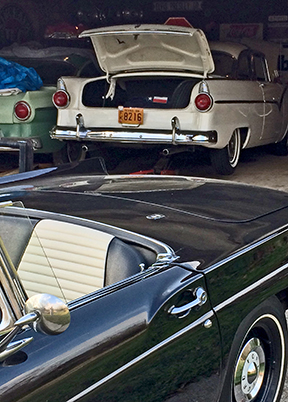
Garage 2-sm
It’s just an axle bearing. “Not too difficult.”

“I’m positive it’ll be a good investment,” were the first words out of my mouth. “Put a little money in it, and when it’s time to sell … just wait and see,” I said, slapping Dickie on the shoulder. “You know how this works. Come on, let’s go for a ride.”

The old Ford fired up and drove like a dream. It just had a few, uh … minor problems. “What’s that noise,” Dickie asked?

“Exhaust leak. “I said, waving off his question with a sweeping hand gesture. “We’ve all dealt with exhaust leaks before, right? No big deal.”

“So, how’s the radio working,” Dickie inquired, twisting the knobs?

“Not very well, hums, makes a little static.” I responded. “You know those old tube radios. Just another minor problem to fix. Besides, who listens to the radio when the motor sounds that good?”

The exhaust repair proved to be easy, but an electronics expert, I’m not. Off the radio went to one of the few remaining shops still working on them.

Executing exhaust repairs greatly improved noise levels inside the car. That was good news. The bad news was the assortment of other noises that were now discernable. “What’s that noise, ” Dickie asked?

“Could you be a little more specific,” I teased. “I hear several.” Defining the one Dickie was detecting, I replied, “Doesn’t sound good, does it?” Back in the garage, I offered as how I thought it was an axle bearing. “Not too difficult,” I said. Several hours later, time enough for Dickie to go home for a while and come back to check my progress, I was still at it. “What’s the problem,” he quizzed me. “Can’t get the bearings off?”

“Well, you know how it is,” I stuttered. “These old parts haven’t been off in years, just a little stubborn,” I added, exchanging the sweat on my face for the grease with my hands. “I’ll just run over to a local shop and get these bearings replaced.”

Several days and many dollars later, we were back in the garage. “Time to check ‘er out,” I said. Job completed, we were on the road again for another shakedown cruise. We weren’t even up to speed yet when Dickie tilted his head, frowned and asked, “You hear that? Is it … ”

“Yeah,” I agreed, frustration creeping in. ” It’s the same noise.”

“Know what that sounds like,” he said.

“Did I really want to know,” was the more poignant question?

“Stop the car,” he said. After a quick inspection under the car, and some precision fine tuning adjustments with a big hammer on a bracket rubbing against the drive shaft, we turned the old car around and headed for home. No more noise, just gentle breezes and warm sun while cruising with the top down.

“I think that worked,” Dickie said.

“Yeah,” I replied. “Now, if I can just get the radio back in.”

“Good music on a Fall afternoon cruise would be nice,” he followed.

“Actually,” I said, hesitating. “I was thinking more along the lines of so I can’t hear any more noises. Fixing things that ain’t broke is wearing me out.”

—Leon Aldridge

Aldridge columns are also published in the Center, Texas, Light and Champion (http://www.lightandchampion.com) and the Mount Pleasant, Texas, Tribune newspapers (http://www.tribnow.com).


Questionable calls we live to tell about

“The magic moment is that in which a ‘yes’ or a ‘no’ may change the whole of our existence.” — Paulo Coehlo

This week’s column was written while watching news coverage of the havoc Harvey heaped on the Texas Coast and the historic Houston flooding.

Hurricanes are violent, damaging, devastating acts of nature claiming lives and costing billions when crossing paths with civilization. Staying out of their path is the wisest course of action. Not everyone chooses to do that, including yours truly on one occasion. I fared better than some have during my one lapse of good sense, and am fortunately here to tell about it. Also, to say that doing so is taking a risk, so as the disclaimer says, “Do not try this at home.”

Twice in the mid-to-late 80s, a caravan of ’55 to ’57 Ford Thunderbirds from the Shreveport chapter of the Classic Thunderbird Club International (CTCI) traveled to Daytona Beach Florida for an annual October fall classic Little ‘Bird event staged there. The first year, only three cars made the journey. However, when we returned with a glowing report of fun and adventure, more than twice as many cars signed up the next year.

tbird-blog
Author’s 1956 Ford Thunderbird, veteran of two trips from East Texas to Daytona Beach, Florida and back, and hurricane survivor.

On the way back, our one caravan split into two when some of us elected to stop at the Cypress Gardens attraction that operated near Winter Haven, Florida from 1936 to 2009, while the others continued on toward home.

Leaving Cypress Gardens late that afternoon, we decided to travel as far as possible before stopping for the night. This is probably a good time to share little things about the little Thunderbirds. One, factory radios in the Little ‘Birds were tube-type AM only, and usually offered very little entertainment traveling with windows or the top down—the preferred style of most T-Bird owners . Also worth mentioning is that listening to a radio is not a high priority for a road trip in an old car. This one time, however, a radio of any kind might have proven helpful. Minor tidbits of news we missed included something about a hurricane named Juan headed for the Gulf Coast.

Two, old car vacuum wipers are not great for clear vision, and running into rain about dark was not fun. Deciding we had endured enough, pulling into a hotel on the beach somewhere in Mississippi seemed like a prudent idea. Spotting one with an indoor parking garage was an answered prayer traveling in a classic car. Why we didn’t notice there were no other cars around, or no one in the lobby except the desk clerk reading a newspaper was unusual escapes me now.

“Got four rooms,” I asked brushing the water off my jacket?

“Sure do,” he replied. “Got lots of rooms. No one else here.”

When it all came together, I heard it, “You are about to enter another dimension, a dimension not only of sight and sound but of mind. A journey into a wondrous land of imagination. Next stop, the Twilight Zone!”

Obviously recognizing the bewildered look on my face, the desk clerk offered, “Guess you haven’t heard? There’s a hurricane coming in tonight.”

If I appeared bewildered before, my next look had to be disbelief. “A hurricane,” I gasped.

“Yep, not sure where it will hit yet, somewhere between here and New Orleans, they say.”

By this time, half our group was already at the door. Me, and my friend Joe Greene were still processing.

“I’ll be here all night,” said the clerk, “Unless something changes. If it does, and I decide to leave, I’ll wake you up first.”

Joe and I looked at each other, then at the others standing near the door. Almost in unison, their heads were shaking, “no.” We bid them farewell and watched as tail lights disappeared in the rain heading north.

Winds howled all night and rain pelted the hotel room door overlooking the Gulf. I would be lying to say that I slept soundly rather than spending most of the night debating the wisdom of our decision. However, come sun up, we were all present and accounted for—Joe and me, our wives, and the guy at the front desk. Juan had reportedly gone in near Morgan City, Louisiana.

Oh, one other feature of the ’55-’57 Thunderbirds is they leak in rainstorms. A lot. Hurricane driven rain followed us all the way home, a very long, challenging and dangerous trip endured only by stopping frequently to dry towels used in futile attempts at keeping water out of the passenger compartment…and to have one more cup of coffee.

Tempting fate is seldom a wise choice. Luckily, this experience resulted in a story that can be recounted with a smile 30 years after the fact, as some of the questionable calls we live to tell about do. But, this experience I also remember soberly when another hurricane is headed our way, and one that leads me to extend special prayers when one like Harvey comes ashore.

—Leon Aldridge

Aldridge columns are also published in the Center, Texas, Light and Champion (http://www.lightandchampion.com) and the Mount Pleasant, Texas, Tribune newspapers (http://www.tribnow.com).

More than just a dog

“If there are no dogs in Heaven, then when I die I want to go where they went.”—Will Rogers

Saying goodbye to a pet is difficult, especially if you are like me—one who loves a pet and treats them like family. A message from a friend enduring that difficult time in Mount Pleasant last week reminded me of my first dog and how my heart broke when it was time for him to go. I should add I was way past 40 when that happened.

“Max is fine dog.” Those words on a note accompanying the 75-pound lemon basset hound said it all. “He likes to play. Take good care of him.” With that note and one puppy picture, Bob Morgan in Lufkin passed ownership of the long-and-low dog to me and my kids. There was also a letter of apology to Max from one of Bob’s friends who mistakenly referred to Max as, “Just a dog.” That was more than 20-years ago coinciding with our move to Boerne, just outside San Antonio.

Max un Boerne

It was a significant time for both of us. Here was an uprooted old basset hound making a move across the state, taking up a new residence with a single newspaper editor raising two kids. One, as I noted earlier, who had survived more than 40 years without becoming a dog person. Despite those odds, we hit it off on the back porch that very first night, inspiring a column posted to my blog a couple of years ago at:

https://wordpress.com/post/leonaldridge.com/109

Max transitioned from “East Texas dawg” to “Hill Country hound” in style, becoming somewhat of a celebrity in the process. A dog is said to be man’s best friend, but where is it written they are allowed to steal the show?

“How’s Max,” a friendly voice asked one day as I walked in the Valley Mart convenience store in Boerne, near the newspaper office? My mission was trading pocket change for “sweet tooth satisfaction.” It was break time. “When are you going to write about Max again,” the lady at the register followed?

“Max is fine,” I reported. “He’s doing just great.

“Well, then you need to write something about him,” she said.

“I’ll do that.” I promised, heading back to the office, snack in hand.

“Max,” I told him that evening during our usual walk. “Folks in town want to know how you’re doing and why I haven’t written about you lately. You’re a celebrity.”

Max was impressed. I could tell by the way he let loose with a deep-throated bay, and darted off under cedar branches in pursuit of a rabbit.

Soon after, a friend called from Center. “You’ll never believe, I met some folks from Boerne. And, they know you…sort of.”

“Define sort of,” I retorted suspiciously.

“I told them I had a friend there, Leon Aldridge. They asked, ‘Who?’ Aldridge, I said—he publishes the paper there—The Boerne Star.”

“I was about to decide they didn’t know you,” my Piney Woods friend continued, “when somehow, Max’s name came up. ‘Oh Max,’ they said. ‘Yeah, we know Max—you’re talking about that newspaper guy with the basset hound. Yeah, why didn’t you mention Max to begin with.’”

That evening as we walked among the cedars and oaks, I told Max, “You’re a charmer. Your reputation extends all the way from East Texas to here and back.”

Max was again impressed. I could tell by the way he sniffed the underbrush searching for scents of another Hill Country critter.

The realization of how the ol’ dog’s charisma even spanned age barriers struck me one day while delivering my children to classes. First order that day was to get the kids to school, second was to get Max dropped off at the veterinarian’s office where he had a standing boarding reservation—pool side with margarita service.

Almost late and rolling up the driveway at Bandera High School, my children were hanging out the window, their ears flapping in the breeze while Max was stoically seated, seatbelt fastened. Pulling to the curb, the kids bounded out of the car as the ol’ dog stuck his nose out the window. All at once, hands across the campus waved and fingers pointed, but instead of greetings for my children, what I heard was, “Max—there’s Max! Hey, Max.”

The big dog just smiled, panting with his tongue hanging out as we drove away.

“Max,” I said as we headed toward the vet’s office, “Bob was right. you’re a fine dog. We should all follow your example and not take ourselves so seriously.”

Once again, he was impressed. I could tell by the way he stared out the window. Max knew he was more than, “Just a dog.”

—Leon Aldridge

Aldridge columns are also published in the Center, Texas, Light and Champion (http://www.lightandchampion.com) and the Mount Pleasant, Texas, Tribune newspapers (http://www.tribnow.com).

In search of lucky stars

Twinkle, twinkle, lucky star
Can you send me luck from where you are?
Can you make a rainbow shine that far?
Twinkle, twinkle, lucky star.
—Written and performed by Merle Haggard

With a little luck, maybe there would be one glimpse remaining of the Perseid meteor showers predicted to light up the night skies last weekend. At least that was my plan for getting up at 5:00 a.m. Sunday morning, a plan that sounded really good the night before.

After sleeping right through five, I was hoping there might be just a twinkle or two left at six—the time my feet finally met the floor. Both times were incredibly early to rise and shine after a festive wedding that had ended scant hours earlier.

No lucky shooting stars for me, however. The skies were clear enough, and it was still plenty dark enough 15 miles into the Medina Lake Hills area from Bandera, the nearest city to where I was that morning in the Texas Hill Country. Reports touted the area as an optimum viewing spot for the predicted showers, but no sign of a meteor or falling star could I see.  Half a cup of coffee into scanning the skies, the only celestial light besides every morning’s array of the moon and stars was a hint of imminent sunrise on the horizon.

The Hill Country west of San Antonio is beautiful at any time of day or night. Coffee and a morning walk along country roads, startling deer that moved about in the cedars and live oaks, made the effort expended to get up early worthwhile…even if the meteor showers failed to show.

Twenty years ago, give or take a year or two, half a cup of coffee on a starry night just a couple of miles as the jack rabbit travels from where I was walking this past Sunday morning proved to be worth every bit of the effort. The heavens above the Lake Medina region south of Pipe Creek, Texas, that night rendered a spectacular meteor shower to entertain my son, Lee, and me. From the backyard atop our five-acre hilltop home site where we lived at the time, Mother Nature put on a spectacular show of light splashing across the night sky as the always-brilliant Texas stars looked on.

Time seemed to go by quickly before falling stars faded and the hour grew late, ending a great night of star gazing with my son. The memories we made marveling at the beauty of nature, I will never forget.

On this recent Sunday morning, I was hoping to add another Hill Country heavenly light show to the memories made years ago with Lee. Whether it was because of my inability to roll out of bed earlier, or because this year’s meteor showers failed to produce predicted performances, there were no new memories to add this time. Meteor shower memories, that is.

Lee and Holly-sm

My reason for being in the Hill Country, almost 20 years after moving back to my native East Texas, was to attend the wedding mentioned earlier,  Lee’s wedding. Lights illuminated the night sky Saturday, all right. But this time, it was electric lights providing the glow, hanging in the huge live oak tree in his bride’s parent’s back yard where the nuptials were celebrated. Mother nature was again showing off, albeit with beautiful evening skies and a gorgeous sunset. As darkness fell, stars beamed brightly, both in the sky and in Lee and Holly’s eyes, as they vowed to forever be one.

So it was that lucky stars really were, in a manner of speaking, falling once again last weekend in the Texas Hill Country. This time, they were for my son and his new bride providing beautiful Hill Country memories for them we will never forget.

—Leon Aldridge

Aldridge columns are also published in the Center, Texas, Light and Champion (http://www.lightandchampion.com) and the Mount Pleasant, Texas, Tribune newspapers (http://www.tribnow.com).

Lee and Holly’s wedding photo by Eric Acevedo, Spunky Cloud Photography, Bandera, Texas 830-370-2478 spunkycloudphoto.com

Elvis, Abilene, Graceland and the reporter

Tuesday, August 16, 1977— Jimmy Carter was president. Chart music included “Don’t Stop” by Fleetwood Mac and “Margaritaville” by Jimmy Buffett. Theaters featured the tenth James Bond movie, “The Spy Who Loved Me.” Colleen McCullough’s “The Thorn Birds” was a best-selling book. On TV people watched, “All in the Family” and “Three’s Company.” But, that wasn’t all …

– – – – – – – – – – – – – – – – –

Abilene, Texas was hot that August afternoon. My desk at Eighth and Pine Streets downtown was stacked with sales receipts, where I worked on reports. Barely audible was Glenn Campbell’s “Southern Nights” on the radio behind my desk.

Suddenly, the music stopped in the middle of the song. Abrupt silence commanded my attention long enough to hear the stumbling voice, speaking between short phrases, as if the reader was still comprehending what had happened. “This just in … from Baptist Memorial Hospital in Memphis …”

“Baptist Memorial Hospital in Memphis” was all I remember. In the silence that followed, something about the tone of the bulletin and its origin from Memphis said it all. I knew what had happened. Presumably, I heard the rest of the news bulletin, but I don’t remember. I do remember employees gathering around my desk, listening as details came in as the station played Elvis Presley’s latest release, “Moody Blue.” The King of Rock and Roll was dead at the age of 42. Within hours, evening news casts on every channel and every network focused on the life, and now the death, of one of the most influential entertainers of the era. Avid fans, casual appreciators, even those who didn’t like his music at all—the whole world knew who Elvis Presley was that week in 1977.

Elvis performed in Abilene less than five months earlier. Saturday, March 26, 1977, the marquee at the Taylor County Coliseum on Texas 36 announced Elvis was going to be “in the building” the very next day. In town for the weekend surveying the city I was about to call my new home, I got excited about the prospect of seeing Elvis. I sighed, however, knowing that the concert was likely sold out, as was every concert he performed. “Next time,” I thought, never imagining the news I would hear on an Abilene radio station in less than five months.

Fast forward ten years. Saturday, August 15, 1987. There was no end in sight as midnight grew near. Tiny flickering flames plotted a candlelight path from the crowd on Elvis Presley Boulevard up the winding driveway to the Meditation Garden at Graceland.

Candleight VIgil Program-sm

We had taken­­ our place in line sometime after 11:00 p.m. and still had a ways to go. Soft candle light illuminated my daughter’s smile and highlighted the twinkle in her eyes while she stared at the magic of the dancing flame. Robin had celebrated her ninth birthday just weeks before.

A Florida newspaper reporter, one of many walking the trail of glowing candles, paused beside Robin and asked where she was from. “Center, Texas,” she answered. “How far away is that,” he quizzed her with a smile. She looked my direction for an answer. “Tell him it’s just a little over 400 miles,” I said.

“Can I take your picture,” he asked, directing the question toward me for approval. “OK with me,” I said, adding, “Robin, you want your picture in the newspaper?” She responded with a smile. “Think you might send me a copy of what you publish,” I asked the reporter as he knelt with his camera to capture the same candlelight portrait of my daughter I had seen. “Sure,” he replied, taking my business card. Desired photos done, he thanked us and walked on that humid August night in Memphis.

With the anniversary of the last time Elvis left the building coming up next week, it’s hard to believe that 40 years has passed since that hot August afternoon in Abilene. It’s equally hard to believe it’s been 30 years since the steamy Memphis night at Graceland with several thousand other close friends—a.k.a. Elvis fans. It’s also hard to believe I never saw one of his 1,684 sold out performances although I’m pretty sure I saw him at a high school show early in his career in Seymour, Texas. More about that at:

https://wordpress.com/post/leonaldridge.com/77

I always think about Elvis and Abilene in August. It would have been memorable to have seen Elvis in concert, but I never did. And, I always think about Graceland and Memphis in August. It would have been nice had the Florida reporter sent me a copy of his newspaper with my daughter’s picture. But, he never did either.

—Leon Aldridge

Aldridge columns are also published in the Center, Texas, Light and Champion (http://www.lightandchampion.com) and the Mount Pleasant, Texas, Tribune newspapers (http://www.tribnow.com).

What’s old becomes new again

“There is nothing new under the sun.” —Modern day proverb generally attributed as being derived from Ecclesiastes 1:9 in the Bible.

The old adage suggesting there is nothing new without some sort of precedent from the past came to mind last week while I sat in a doctor’s waiting room filled with people sending and receiving messages on cell phones. I smiled thinking the current generation “typing” on devices using only their thumbs had nothing on me. I was typing with two fingers decades ago. Did it until I learned to use three, then graduated to four. I’m up to about five fingers now. It’s a very well-known system for those of us who skipped typing classes in high school. We call it “hunt and peck.”

Admittedly, devices used in 2017 to communicate written thoughts have come a long way since the days of my grandfather’s old manual typewriter currently displayed in my office. The contrast of his typewriter positioned near my computer speaks volumes.

Underwood 1 crop-smMy dad’s father, S.V. Aldridge, retired in 1954 from the Cotton Belt Route railroad line that is part of what we know today as Union Pacific. The railroad was his sole lifetime occupation, one that he embarked on in 1901 at the age of 13 as a laborer on the rail crews. His last 24 years were spent as a section foreman with an office at the Pittsburg, Texas, depot. That same building, the last I knew of, was still doing time as a barbecue restaurant on Greer Boulevard in the same city where it sat downtown for decades between two crossing rail lines at the end of Main Street. It was also where my grandfather typed his reports and other forms of communication on the same typewriter.

After he retired, he kept it in his desk at home in Pittsburg where I vividly remember typing simple words on it as a youngster, slowly using one finger at a time. It was nothing short of sheer magic to a grade-schooler to push a metal tab back and forth and watch the color of the type change from black to red.  I’ve been the typing machine’s custodian since shortly after he died in December of 1967. The old black Underwood with gold lettering and pin striping has since sat idle in numerous locations in my home, at other businesses where I’ve officed, and sometimes in storage.

With each move during the almost 50 years I’ve owned it, advancements in communication devices have become increasingly more profound. Moving it to my office at Advanced Ecology in Center, Texas, recently served not only to remind me of those advancements, but this time seemed also to promote the idea that it just might be true—perhaps every new idea really does have some sort of precedent or echo from the past.

By any name, (and yes I know it’s not typing any more, it’s now “keyboarding”) tapping a key to communicate a thought is truly magic—hit the keys you want, and watch letters appear in front of you. To say the process and the method first patented in 1714 has improved would be a gross understatement. During its day, however, the old manual typewriter was just as revolutionary as computers are today.

For instance, the keyboards on today’s devices are exactly the same as they have been since 1874 when Remington updated the layout by introducing the “QWERTY” keyboard, so named for the sequence of keys that begins the top row of letters. Thus, the typing class exercise, “The quick brown fox jumped over the lazy dog’s back,” employing every letter of the alphabet is typed the same way, whether on a 19th century typewriter, or a 2017 computer, tablet or phone.

Come to think of it, the typewriter was one up on the computer. It had its own built-in printer. Need multiple copies? No problem. You do remember carbon paper, don’t you? Plus, power outages and dead batteries were never a problem. A typewriter required neither. Software updates? That was a new cushion for your desk chair. And obsolescence wasn’t an issue either. My grandfather’s machine that is more than 80-years-old has never required the first update, and it produces documents just as well as it did when new.

Quaint, but just a relic of the past, right? Hold on. Just like vinyl records that came back from the dead about the time their obituary appeared in print, brand new manual typewriters are now appearing on the market. Specialty retailer Hammacher Schlemmer has rolled out one new model promoting it as if it’s the “newest thing under the sun.” Just one more reminder that if you stick around long enough, what’s old becomes new again.

Just one piece of advice, though. Don’t ask your office IT department to network it into the system…unless they have a really good sense of humor. Luckily, mine did.

—Leon Aldridge

Aldridge columns are also published in the Center, Texas, Light and Champion (http://www.lightandchampion.com) and the Mount Pleasant, Texas, Tribune newspapers (http://www.tribnow.com).


If this old car could talk

“If these walls could talk, the tales they would tell.” —Unknown

The old saying insinuating profound curiosity toward interesting stories old buildings might tell about things they had witnessed, if they only possessed communication skills, is not limited to just walls.

The same thought has no doubt been extended to a variety of objects. For instance, I’ve often thought, “If this old car could just talk …”

A few of the old cars for which I’ve been privileged to serve as temporary custodian have lived interesting lives, but the one with perhaps the most intriguing stories to tell might be one red 1957 Ford Thunderbird.

TBIrd column photos-after-sm
1991 photo of “one of 15” supercharged “D model” ’57 Thunderbirds after restoration. From left, your author and seller Leon Aldridge; “Little Bird” restoration guru then and now Gil Baumgartner; and buyer Amos Minter. One unique red 1957 Ford Thunderbird with stories to tell.

Owning and driving old cars is fun on many levels. However, one of the more fascinating aspects of the experience is prying into their history. From where did it come and how did it get here? What stories did it accumulate along the way?

Joe Greene in Bossier City, Louisiana, knew some of the red Thunderbird’s stories. When I first met Joe about 1983, he had owned it for 14 years. It already had a storied life by then, but the years to come would only add to one fascinating “auto” biography. Stories Joe passed on with the car included the one about where he found it in Virginia in the late 60s, about how the woman who owned it used it for drag racing, and that the car was gray although the data plate indicated it left the factory adorned in bright red.

Joe’s stories also included how he painted the car white, turned it to driver status, and enjoyed driving it for several years. A few years later after he and his family were settled in Bossier City at Barksdale Air Force Base as his last assignment in a 30-plus-year military career, Joe disassembled the car with plans for a full and accurate restoration.

This was when the old car’s story took a dramatic turn. By that time, factory invoices for the Little Birds were available via a Michigan T-Bird club that had acquired them from Ford Motor Company. Joe ordered the invoice for his car, not prepared for what he was bout to learn. The little red then gray, then white ‘Bird was one of 15 “special production” cars built January 29, 1957 equipped with “experimental” factory supercharged motors to promote the 1957 Daytona Beach race. According to the invoice, the one Joe owned was shipped to Heintzelman Ford in Daytona Beach, Florida, and displayed at the race by Ford Motor Company.

Still reeling from his discovery, Joe put the restoration on hold to accumulate the hard-to-find motor parts needed for such a rare and historically significant car. That “on hold” period lasted a few years before a deal was struck making me the car’s newest historian. The picture at the top of the page was made on the day in 1987 that it came to live with  me in Center, Texas.

Sorting through the boxes of parts and pieces that came with the body still mounted on a rolling chassis, I took the car a little farther down restoration road before ultimately deciding such an automobile would be worth more with a professional restoration. Gil Baumgartner in the San Francisco valley area of California, then and still today, considered to be the ‘55-‘57 Thunderbird restoration guru, was assigned the task. Two years and lots of dollars later, the skillfully restored piece of automotive history returned to Texas.

Family demands and a relocation left me without a place to keep or care for the jewel of Thunderbird history, and I passed ownership to a friend in Dallas who buys, sells, and collects the Little Birds. This is where the car remained, in climate controlled storage, for 17 years during which time it won every award Classic Thunderbird Club International bestows, and was featured in several magazines and hardback books.

The next owner sold it at auction in 2012 for a reported $235,000 at which time the super rare red Thunderbird migrated to Australia. As far as I know, it’s still down there.

Born in Dearborn, Michigan, in January of ’57 for display at the 1957 Daytona Beach race; up the East Coast to Virginia by 1969; west to Bossier City, Louisiana in the early 70s; to my custody in Center, Texas, in 1987; out to California in 1989 for restoration; to Dallas in 1991; sold to Australia in 2012. Where it resided between Dallas where it was sold in 2008, and the 2012 auction that took it to the continent down under, I don’t know. What is known about the car is fascinating enough, but imagine the still unknown tales the automobile might tell.

If we could talk, sadly, I would have to tell the red ‘Bird we lost our friend, Joe, in February of this year. Beyond that, we would likely agree the sum the ‘Bird fetched in 2012 would have been a nice nest egg in my IRA and maybe have sent me to Australia for a vacation, too—that is, if this old car could talk.

Aldridge columns are also published in the Center, Texas, Light and Champion (http://www.lightandchampion.com) and the Mount Pleasant, Texas, Tribune newspapers (http://www.tribnow.com).