Celebrating the brief time of our mutual friend

 “There is some talk of lowering (the income tax), and they will have to. People are not making enough to pay it.”—Will Rogers

 Uncle Sam gives and he takes away.

Thank you for joining me today to celebrate the short life of our departed friend, Hard Earned Money, as we share our grief on the occasion of his departure last week on Tax Day.

Money and I were friends. We lived close to each other, sadly, not for very long at a time. I tried to spend more quality time with him, but always seemed to be watching him come and go. Perhaps I could have been a better friend to Money had I known when we met, what I know now.

We remember Money as a communicator. He was always a part of our conversations. I recall him best for all the times he was telling me, “Good bye!”

One personal memory illustrating the often impulsive nature of Money’s sojourn on earth is about the time a good investment netted me a tidy profit. Part of it bought me new a car, the rest I invested. Little did I know that in short time, I would lose the car and the investment putting together enough money to pay taxes: a reminder that we know not the day, nor the hour … or in some cases, the who, that will mark the time of our Money’s departure.

 Our friend Money was the type that never met a person in need to whom he didn’t respond for me. If we could assist someone in getting back on their feet, paying a bill, or loaning them a down payment, we never hesitated to pitch in, be they family or friend. And, we always kept them in our heart for years afterward, mostly in hopes that they would remember to pay us back.

Money’s passing last week is a reminder that while compassionate souls take risks; it’s never with the IRS. We find comfort, however, in knowing why money ventured out and was unexpectedly taken from this life on Tax Day—it was to keep me out of prison.

So, it is that we can find peace in the fact that Money left us doing something he knew had to be done. He never wanted to pay the ultimate price as a tax bill, but I can tell you his only regret about leaving was that need for old car parts, a vacation this summer and that new refrigerator was left to carry on without him.

In closing, I smile at how Money was celebrated in music. There is one song in particular that always reminds me of him, one we both liked. He asked that should he go first, would I read the lyrics at his memorial, and I’ll do that now.

I’m going back to the country,
Cause I can’t pay that rent.
I’m not completely broke,
But, brother I’m badly bent.
 
I can’t understand where my money went
I ain’t broke, but brother I’m badly bent

And now, if you will turn in the hymnal to number 1040-EZ, we’ll join in a congregational singing as a final remembrance of Income Tax Day 2018, and our dearly departed friend, Hard Earned Money. May he rest in peace, at least until next April.

Some bright morning, on tax day this year,
I’ll fly away.
To that home in Uncle Sam’s big vault.
I’ll fly away.

Time will heal our pain, because life does go on … even without Money after Tax Day.

—Leon Aldridge

Aldridge columns are also published in the Center, Texas, Light and Champion (http://www.lightandchampion.com) and the Mount Pleasant, Texas, Tribune newspapers (http://www.tribnow.com).

Spring fever can strike in many ways

“O, how this Spring of love resembleth the uncertain glory of an April day.” —William Shakespeare

Spring—one of my two favorite seasons, the other one being Fall. But, likely for reasons you might not be thinking. For me, they are best seasons for car shows and swap meets.

Sure, Spring blooms in nature’s beauty and Fall leaves add to their season. But, it’s hard to top the beauty of a classic car gathering, or acres of rusty, hibernating parts waiting for new life as part of someone’s restoration project, transporting them back to the memories of their first car.

Memories of first cars and first dates last a lifetime. It’s been a natural American phenomenon for generations, particularly among young and young-at-heart males that the aroma of gas, oil and polish emanating from that first automobile lingers longer in a man’s memory than the fragrance of the world’s finest perfume.

Memories of my first car are at least as vivid than those of my first date. Understand, that’s no reflection on the attractive young lady who caught my eye, causing me to stammer long enough to ask her out. It’s just that the set of wheels I first called mine captured my heart before she ever had the chance.

Those wheels were attached to a blue 1951 Chevrolet Styleline DeLuxe sitting quietly under the night lights at Rex Kidwell’s Fina Station on South Jefferson in Mount Pleasant the first time I saw her. Rex was a friendly fellow and customers always got a smile, gas pumped, oil checked, windshield washed and the floor mats hand swept with a small broom Rex kept in his back pocket. Everyone got that service whether they filled the tank with higher-priced ethyl gas and got change back from a five-dollar bill, or just said, “Gim’me a dollar’s worth of regular ‘til payday, please.”

The Chevy that caught my eye was not a new car. The year was 1964, but Rex was known for acquiring pristine used cars that met his standards of ‘extremely nice,’ which he would park on the lot beside his station with a ‘for sale’ sign in the window.

Between money from my after-school job sweeping out at Beall’s department store downtown and a short-term, interest-free loan from my grandmother repaid at five dollars a week, I came up with the $250 asking price. That Spring night, some 54 years ago, I drove home in my first car just a few weeks before the end of my sophomore year at MPHS.

As time and money permitted, I added my touches—a split manifold with dual exhaust glass-pack mufflers from Redfearn’s automotive on East Third Street next to the Martin theater, and dual carburetors. To this day, there is no sweeter melody to my ears than the sound of Chevy six with a split manifold and dual exhaust—beautiful music cruising through downtown Mount Pleasant late at night.

Through the streets of Mount Pleasant and beyond, the faithful Chevy transported me to school in the mornings, to work in the afternoons, to the drag races Saturday night and to church on Sunday. Oh, and also on my first date on a Friday night to the Martin theater.

I saw my first date in Mount Pleasant a couple or three years ago, and we enjoyed a short, but nice visit. As we talked, I wondered if she remembered that car. I sure do.

—Leon Aldridge

Aldridge columns are also published in the Center, Texas, Light and Champion (http://www.lightandchampion.com) and the Mount Pleasant, Texas, Tribune newspapers (http://www.tribnow.com).
Right communication, right place, right time

The way we communicate with others and with ourselves ultimately determines the quality of our lives. —Anthony Robbins

The best standard for finding a good doctor, for my money, is communication. Making a good friend is often an exercise of “the right place at the right time.” Bill Ginn was a perfect example of both axioms in my life.

What good is medical advice you don’t understand because the good doctor can’t communicate it? What better doctor or friend is there than one who is honest to a fault? Dr. Ginn never failed on either point, administering a healthy dose of his trademark wry humor with both.

Dr. William “Bill” Ginn, Jr. passed away March 8, 2018, in Center, Texas, at 87. He came to Center in 1977 to join Memorial Clinic with Doctors Mallory and Hooker. I arrived a couple of years later, and he became my physician and a good friend.

Common interests and humor lead to our friendship, but he remained my physician earning my trust as a no-nonsense communicator. Patiently explaining how my niacin “OD” before breakfast one morning had me thinking I was done for, he was also quick to discredit the list of vitamins I felt was contributing to my healthy status. He pulled no punches telling me how and why I was wasting money, adding, “Just eat healthy, it’s the better option.”

On another visit, one seeking help with my expanding waistline from eating too much healthy, his no nonsense advice was, “It’s easy. Eat anything you want.”

Before I could question this unorthodox prescription for weight loss, he added with a smile, “And, if it tastes good, spit it out.”

Office visits became routinely predictable. “How are you today,” was his standard greeting as he reviewed my file.”

“Fine,” was my usual reply.

This is when he would drop his chin, look over his glasses and reply, “Don’t lie to me. We wouldn’t be having this conversation if you were fine. Now, tell me why you’re here … but first, how’s the family? How are things at the newspaper?”

In the beginning, this seemed like friendly chat, and I’m sure to some degree it was. However, it soon dawned on me that he was following the teachings of the older physicians that many today have foregone—knowing what’s going on in the patient’s life is the beginning of diagnosing medical issues.

Those conversations were also the revelation of common interests that included things like flying. His path to medicine and our conversations included a stint in the U.S. Army as a helicopter pilot and instructor. My path was earning a fixed-wing pilot’s license in Mount Pleasant, Texas before moving to Center.

Dr. Ginn had a newfound interest in ultralight aircraft at the time, so I offered to fly him up to Mount Pleasant where a manufacturer was located. Capitalizing on the trip to my hometown, I left him at the airport to research while I enjoyed lunch with my parents.

During his tour of the facility, the owner suffered a heart attack. So it was that while in Mount Pleasant to glean knowledge about his hobby interest, the physician recognized someone having a heart attack, summoned help and stayed in constant communication with both until help arrived.

Recounting the unpredictable events of the day while flying back to Center, I noted that his decision to look at an airplane very likely saved a life. “Right place at the right time,” he smiled as he watched the East Texas country side passing below us.

I entrusted my health care to Bill Ginn for many years. The bonus was a friend and many memories of his wit and wisdom, stories I delight in communicating any place and any time.

—Leon Aldridge

Aldridge columns are also published in the Center, Texas, Light and Champion (http://www.lightandchampion.com) and the Mount Pleasant, Texas, Tribune newspapers (http://www.tribnow.com).


If he could have just seen it coming

“It ain’t over ‘til it’s over.” — Yogi Berra.

The right-handed batter from East Texas stepped to the plate, took a stance and waited for the pitch to come.

In his trademark windup, the left-handed pitcher from Oklahoma threw his right leg skyward and sent the ball scorching across the plate.

The batter would later say many times, “Heard it hit the catcher’s mitt, but never saw the ball coming.”

The year was 1944. The pitcher was Warren Spahn who spent 21 years in the National League, retiring in 1965 with 363 wins—more than any other left-handed pitcher in major league baseball history, and a record that still stands today.

Spahn started in 1942 with the Boston Braves remaining all but one year with the franchise that moved to Milwaukee in 1953 before moving to Atlanta the year after Spahn retired. He played his final year with the New York Mets and the San Francisco Giants. He ranks sixth in history for MLB wins following right handers Cy Young (511), Walter Johnson (417), Grover Cleveland Alexander (373), Christy Mathewson (373), and Pud Galvin (364).

He was named the 1957 Cy Young Award winner and elected to the Baseball Hall of Fame in 1973.

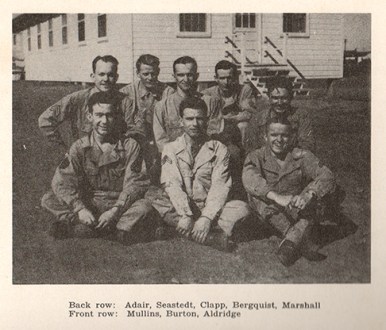
That young East Texas batter in 1944? That was my dad, Leon Aldridge, Sr., from Pittsburg, Texas. No, he never played professional baseball, but loved to tell the story of feeling the heat of a Warren Spahn pitch. They served together in the U.S. Army 276th Engineer Combat Battalion in World War II, and played baseball during training at Camp Gruber in Oklahoma.

276th at Gruber-sm
Photo at top of page: PFC Warren Spahn at Camp Gruber 1944. Above: Group photo at Camp Gruber before shipping out for Europe. PFC Leon Aldridge in the front row row, far right.

According to the history of the 276th “Rough and Ready” written and edited in 1946 by Allen L. Ryan and Clayton A. Rust, after training in Camp Gruber, the unit went to Tennessee for maneuvers. They returned to Oklahoma to await orders for shipping out to the European Theater.

The book reports, “… among the exploits of the 276th during this period was winning the 1944 Camp Gruber baseball championship … defeating all comers. Much of the credit for the fine performance of the 276th team must be given to our pitcher, S/Sgt. Lefty Spahn, formerly of the Boston Braves.”

“Very few of us got any hits off him in practice,” said dad. “But, neither did the batters on the other teams. How can you hit something you can’t see?”

Spahn volunteered for service at the end of the 1942 baseball season. Dad was drafted while a student at Texas A&M University. Before WW II was over, they saw combat duty together in the Battle of the Bulge and at the Ludendorff Bridge becoming good friends along the way.

As a kid who enjoyed school yard baseball and a couple of Little League summers in the late 1950s, I thought it was pretty cool that my father got a Christmas card every year from a major league pitching star that I watched on television.

My father was never a big sports fan, with the exception of a few high school football games. But, if the Braves were on television and Spahn was pitching, he was tuned in.

Before it was over, in Spahn’s final season while playing for the Mets, Yogi Berra came out of retirement to catch a few games, one in which Spahn was pitching. Spahn was 42 and still playing. Berra was 40 and had retired the previous year. Berra was quoted as saying, “I don’t think we’re the oldest battery, but we’re certainly the ugliest.”

Spahn died in 2004, three years before dad in 2007. Until it was indeed over, if you had asked dad what he remembered most his Army service, you would likely have heard about the time he thought he might have gotten a hit off Warren Spahn … if he could have just seen the ball coming.

—Leon Aldridge

(Photo credit, all photos: Rough and Ready Unit History 276 Engineer Combat Battalion by Allen L. Ryan, edited by Clayton A. Rust)

Aldridge columns are also published in the Center, Texas, Light and Champion (http://www.lightandchampion.com), the Mount Pleasant, Texas, Tribune (http://www.tribnow.com) and the Fort Bend Herald (http://www.fbherald.com) newspapers.


It’s called common sense parenting

“You can’t legislate intelligence and common sense into people.” ―Will Rogers

Read in the paper where Utah legalized a child-rearing method they call “free-range parenting.” Lawmakers there say it will encourage children to be independent.

I’m pretty sure we had that when I was growing up, it was just called something else.

Reportedly, the bill allows children to engage in situations that would not be considered parental neglect: like going to and from school alone, playing unsupervised, or sitting in a car unattended under safe conditions—every day things in my childhood.

Sen. Lincoln Fillmore, the bill’s sponsor said, “I feel strongly about the issue because we have become so over-the-top when ‘protecting’ children that we are refusing to let them learn the lessons of self-reliance and problem-solving that they will need to be successful as adults.”

On that point, I wholeheartedly agree.

Then Fillmore added this ironically profound statement. “What I have found out lately is how much childhood and coming to maturity affects the rest of your life and shapes you for future years.”

Wait! You are just now realizing that? Granted, life in the U.S. was different when I grew up in Mount Pleasant, Texas, eons ago. But, we were taught skills needed to be successful adults by parents who already knew what the good senator has just lately found out.

Teaching a child started at home when home was a safe haven. Didn’t have a security system because you didn’t need one. We were taught to respect what was not ours.

We were also taught to respect war veterans like our dads and uncles. And, respect public servants and law enforcement officers, thanking them for our rights and privileges they protected.

Self-reliance? We were taught that. I walked, or rode my bike alone to school at South Ward Elementary in Mount Pleasant, Texas. Bad weather was the only time mom provided transportation. We also learned family togetherness and respect for our parents. We all sat down for a meal. We ate what mom prepared without question. And, we never left the table without asking permission.

There were rewards for practicing what we were taught. In the summer time, we played outside in the evening with every kid within a two-block radius of Redbud Street. Games like hide and seek and Red Rover. We were in the house before dark, and no one had to look for us because we also learned that we could lose that privilege if they did.

Accountability was learned knowing that if we got a paddling at school, we got one at home as well, no questions asked.

We were taught to be imaginative and creative without every new toy. When we rode bicycles, it was cool to clothespin a playing card to the frame allowing it to pop in the spokes as we pretended we were riding motorcycles.

We learned about financial responsibility. Getting money without earning it? Unheard of. For completing my chores—taking out trash, keeping my room clean, pulling weeds in mom’s flowerbed, and other household duties—I earned 25-cents, paid on Saturdays and not before.

We were taught that many good things in life come with inherent risks, like climbing trees or playing on “dangerous” playground equipment. We sometimes got hurt, but learned that allowing risks to outweigh rewards would preclude us from valuable lessons in life.

We were taught to respect our time. Permission was required to watch television, but not to screen content. There were no program ratings because television producers were socially and morally responsible enough to offer only programming the whole family could watch.

Progress and change can be good things. But, it does seems ironic that we have “progressed” to the point we apparently now need “free range parenting” legislation aimed at reviving what we had back then when it was called parenting with common sense.

Maybe law makers today should simply study the common sense philosophy of Will Rogers.

—Leon Aldridge

(PHOTO—”Look ma, no hands!” Author’s sister Sylvia (Aldridge) Crooks (center right) with her life-long friend, Susan (McAlister) Prewitt (center left) beside her having fun on “dangerous” playground equipment at South Ward Elementary in Mount Pleasant, Texas, in the mid-60s.)

Aldridge columns are published in the Center, Texas, Light and Champion (http://www.lightandchampion.com) and the Mount Pleasant, Texas, Tribune newspapers (http://www.tribnow.com).


Wonderful when it works, but when there’s a problem?

Technology is anything that wasn’t around when you were born.
— Alan Kay, American computer scientist

– – – – – – – – –

Granted, technological advancement has improved quality of life, saved time and increased productivity. The advent of fax machines early in my career was hailed as futuristic. Quick to install one at the Light and Champion in Center, Texas, we marveled at documents magically transferred through the phone lines. It was the age of “Star Wars.”

My summary judgment since is that technology is wonderful when it works, but when there’s a problem?

The late Lewis Grizzard, Southern humorist and author, wrote, “Elvis is dead and I don’t feel so good myself.” With his trademark insightful humor, he poked fun at aging baby-boomers like me trying to fit in with today’s world.

That includes advancing technology such as home security systems that electronically perform what a bad dog and Smith and Wesson used to take care of, given the dog was awake and the gun within reach.

Like most today, the system at my house not only monitors security, but also the thermostat, lights and selected appliances. For all I know, it could be monitoring a lot more than that. The neat part is that it can be controlled by a smart phone, a great concept provided good cell phone service is available and the phone user is smarter than the smart phone.

A quirky control panel in my system required summoning a technician who installed a new panel quicker than you can key in a pass code, and was gone. Everything was looking good later as bedtime approached. Cats out, dogs in, doors locked, alarm set and pillow fluffed, I drifted into blissful slumber confident in the security of a sophisticated alarm operating on sketchy Center, Texas cell service, but backed up by my “three dog night” system.

My money’s on the dogs, plus they do one thing the alarm doesn’t—wake me without fail at 5:30 a.m. every morning informing me of their need to go out.

Blurry eyes on the new alarm panel at 5:32 a.m., I entered the pass code. Blurry vision or not, the flashing “Incorrect” was easy to see. Another attempt with glasses, was equally unsuccessful. With dogs standing at the back door, legs crossed and tears in their eyes, I touched each digit carefully once more. No luck. Third time was not the charm.

First thought was to simply open the door and within seconds, I would be talking to someone from the security company. Problem is, I could also be talking to uniformed police officers, possibly with guns and looking for intruders.

Deciding that calling the alarm company was a better option, I was greeted with a cheerful, “How may I help you today?”

“I’m being held hostage in my house,” I joked about the non-functioning panel. Note: if you’re faced with a similar situation, this response is not considered humorous among security people at 5:32 a.m.

Chat complete about what constitutes humor and what does not, we determined the technician had failed to program the new panel with my security code before leaving. “No problem, I can walk you through it, the agent assured me” However, said agent’s realization of not only dealing with someone who could not program their VCR, but also with talking to someone who really still owns and uses a VCR, dashed all hopes of a speedy solution.

Working around my technology-challenged skills, we stumbled through it to the delight of three, by  now, howling and agonized dogs who burst out the back door once it was safe to open it.

Crisis over, my thoughts turned to caffeine and again to Grizzard’s humor. Perhaps it’s not as funny as it was 30 years ago, but I felt like I really understood what he meant when he said, “the world around me is a tuxedo and I’m wearing brown shoes.”

—Leon Aldridge

Aldridge columns are also published in the Center, Texas, Light and Champion (http://www.lightandchampion.com) and the Mount Pleasant, Texas, Tribune newspapers (http://www.tribnow.com).

Pressed to choose, I’ll take living on the lake

“A lake carries you into recesses of feeling otherwise impenetrable.” —William Wordsworth

I love living on a lake.

That would seem obvious for someone who has owned three lakeside homes over the years. So, if peaceful, serene and tranquil lake living beckons to me, then why am I currently living on a corner city lot where the only serene water is a patio fountain?

Wallace J. Nichols best describes the benefits associated with being near water in his book with the really long title, Blue Mind: The Surprising Science That Shows How Being Near, In, On, or Under Water Can Make You Happier, Healthier, More Connected, and Better at What You Do.

“When we’re near water,” Nichols says, “Our brains switch into a different mode which can involve mind-wandering, creativity, and sleep, which are all known to be important to health, resilience, and productivity.”

While my brain of a different mode couldn’t have said it so eloquently, I just know that early morning pier sitting with a coffee cup in my hand is hypnotic. Lake life, like fish topping the water, frogs crooning, water fowl searching for breakfast, birds singing, water lapping against shorelines: it all melds in the early morning light to induce “take me away” therapeutic moments.

One such glimpse of lake life at Lake Murvaul in Panola County one morning became the beginning of a nature study of sorts. A nutria (water rodent best described as looking like a beaver with a ‘possum’s tail) passed my pier swimming his way north. Watching him for several mornings, his punctuality impressed me, although he was always going the same direction. Surely, I thought, he’s going back the other way later in the day.

My question was answered another afternoon by a small wake heading south, rippling the silky smooth sunset-hued water. Sure enough, it was him. It could have been a family member, but it makes a better story to assume it was the same critter.

Like clockwork, this routine continued for weeks. It became a ritual for me to look for him, morning and afternoon, wondering where he was going, and fascinating me that he made the same trip every day.

Storms on a lake fascinate me as well. Something about the water seems to energize a developing thunderstorm, bouncing menacing echoes of thunder off the lake’s surface. From my deck on the north side of Lake Murvaul, the view of clouds engulfing the lake with a curtain of rain was captivating. Mesmerized by nature’s display of a storm’s might, I would watch them and marvel at their power until the storm’s fury was right on top of the house.

Also mesmerizing are stunning sunrises and sunsets on the lake. Granted, they can be the most beautiful displays of nature anywhere on earth, but add a body of water as the backdrop and they can become breathtaking. Years of lake living resulted in a large library of gorgeous photos and an equally sizable store of memories watching them.

Wonderful memories from having lived in a variety of regions in Texas and appreciating the unique magic of each, I would be hard pressed to pick a favorite. However, pressed to make a choice, it would be one with a lake outside my back door.

Which brings me back to my original question as to why I’m not still living on the lake. Truth is, I still wonder about that and about where that nutria was going … as I sit and enjoy the sounds of my water fountain on the patio.

—Leon Aldridge

Aldridge columns are also published in the Center, Texas, Light and Champion (http://www.lightandchampion.com) and the Mount Pleasant, Texas, Tribune newspapers (http://www.tribnow.com).

Road trip … count me in

“A good traveler has no plans, and is not intent on arriving.” —Philosopher Lao Tzu

Do you have coffee in the thermos,” he asked from the driver’s seat?

“Yes, I do,” she replied from the other side of the car and closed the door. “Our suitcases are in the trunk. Do you have the map,” she asked? “Did you get the oil changed and have the tires checked?”

Content that every preparation was complete, that everything was in the car including me in the back seat with a blanket and pillow, a road trip was ready to begin. It was 3:00 a.m. with a cooler trip in the morning air anticipated since air conditioned cars were uncommon, and the goal was reaching the destination before lunch.

Map 2 3-10-18
Image above and map at top of the page are from a 1940s Esso map. Esso was a Standard Oil Company brand from 1911 that became Exxon in 1972.

The six to seven-hour road trip my grandparents were about embark on was from Pittsburg to Seymour, a distance of about 295 miles. The year was 1958, give or take a year.

Today, Google maps report that trip requires four and one-half hours of driving time via I-30 to Dallas and up highway 190 and 380 through Jacksboro, then 114 to Seymour. Sixty years ago, however, the first stretch of I-30, the Dallas Fort Worth turnpike, had been open only one year. Expansion east to Greenville and beyond was still just a plan on paper. The trip, if you dodged Dallas and went due west at Greenville, was two-lane roads through every small town with numerous reduced speed limits. Reduced meaning from the Texas speed limits then of 60 in the daytime and 55 at night.

Slow by today’s standards, however that speed limit was appropriate. New cars were built for cruising about 60, and anything more was considered reckless. Plus, a fair number of cars sharing the roads in 1958 were older and slower cars.

Fast forward to 2018. Contemplating an offer to join a quick road trip to Tennessee in a couple of weeks started me to thinking about travel today compared to travel in my parent’s and grandparent’s day.

Someone says, “Road trip,” to me, and I’m in. Give me a couple of hours to pack a bag and I’m good-to-go with the assurance of picking up any forgotten items at one of the carbon-copy mega-stores in every city of 3,000 or more inhabitants along the way.

“How long will it take and what route will we travel?’ Don’t worry about it. Got GPS in the car and got WAZE on the phone. “Is the car ready to travel?’ No problem. Today’s cars stay ready. Maintenance intervals are fewer and farther between, and any car that carried you to work last week will likely get you across the country this week.

Even if an “change oil” or the “low tire pressure” light should come on along the way, detour into the same carbon-copy mega-store and pull around to the automotive bays. An hour or two later you’re on the road again.

Coffee in the thermos? Don’t need it. How many drive-thru coffee spots do you pass every day just going to work?

Hey, we even have autonomous, self-driving cars.

The rest of the story on my grandparent’s trips between northeast and west Texas is they arrived in time for lunch all right. That was followed by an afternoon of visiting and supper, and they were back on the road the next morning headed home to Camp County.

I’m thankful for the “road trip” gene I inherited. I’m thinking that faster and convenient travel makes road trips more fun. And, I’m also wondering what my grandparents would think about today’s autonomous cars.

—Leon Aldridge

Aldridge columns are also published in the Center, Texas, Light and Champion (http://www.lightandchampion.com) and the Mount Pleasant, Texas, Tribune newspapers (http://www.tribnow.com).


As fine an honor as I’ve ever had bestowed on me

“Live your life. Laugh out loud. Love your family.” —Old Cajun Wisdom

The landscape of South East Texas differs little from that of Louisiana, but the culture on either side of the Sabine River can be vastly different.

The Cajun culture is unique in many wonderful ways, one being the always prevalent celebration of good things in life: family, friends, food and fun. My friend and fellow newspaper columnist, Bill Hartman, nailed it in his column a couple of weeks ago when he said, “Cajuns are funny, smart, a bit quirky and nearly every one of them I’ve met has a heart the size of a bucket of boudin.”

I learned that during my short time tending a struggling Louisiana weekly in the 70s. It proved to be a memorable stint in terms of the community and the people with whom I worked.

People like Brenda and Dale Broyles who tirelessly matched my long hours while Brenda fed the office with some of the best homemade dishes I had tasted since crossing the border. The entire staff, to a person, was all folks whose lively spirit and positive attitude offset the challenging circumstances at the small publication.

A prized possession still displayed at my house is a certificate with which the staff honored me, proclaiming my status as “Honorary Cajun.”

My dad was born in Doyle, Louisiana, to a family of Mississippi descent living in Cajun country, but was reared in East Texas. He was not—as Cajun humorist Justin Wilson used to say—a “full bleed Ca-john,” but it was enough for him to lay claim on some bragging rights.

Justin Wilson-crop
From the Tuesday, April 17, 1984 edition of the Center Light and Champion newspaper—“Cajun humorist Justin Wilson entertained the near 400 in attendance at the Center Chamber of Commerce banquet Friday.“

Justin Wilson visited my house in the mid 80s while in Center, Texas, as the chamber of commerce banquet guest speaker. Tradition then was for the incoming president to host a reception, to which I invited the Cajun comedian and cook. He first declined, but I later answered a knock at the door to see him smiling and hear him proclaiming, “How y’all are? I’m glad for you to see me, ah gar-own-tee!”

The situation was anything but funny however, when I found him backed into a corner by my 80-year-old grandmother who was lecturing him about the colorful language he used in telling his South Louisiana stories.

In true Cajun fashion, he spent the evening lacing his accounts of Boudreau and Thibodaux with an occasional four-letter expletive, but concluded with an eloquent apology—sort of.

“Lady and gentlemens,” he began in a serious tone vastly differing from that of the jokes that had kept the audience rolling. “I just wanna say dat when a Ca-john tell a story, we sometime use dat cuss word sorta like spice wit what we cook. I’m gonna told you, we don mean nuttin’ by it, it just de way we talk. But, if I have offended anyone here tonight, I just wanna say from de bottom of my heart…I really don give a damn.” He delivered the closing remark with his trademark smile, and the “apology” brought the biggest round of laughter and applause for the evening.

He was also smiling at my house when he looked straight over my 4-foot-11 grandmother’s head while she was still shaking her finger at him, and he saw me standing behind her with my jaw hanging open.

He just winked at me and continued to nod his head at Granny, saying, “Yes ma’am, yes ma’am, yes ma’am.”

Looking back, “Honorary Cajun” is as fine an honor as I’ve ever had bestowed on me.

—Leon Aldridge

Aldridge columns are also published in the Center, Texas, Light and Champion (http://www.lightandchampion.com) and the Mount Pleasant, Texas, Tribune newspapers (http://www.tribnow.com).

What was it that was so funny

“There are three signs of old age: loss of memory and I forget the other two.” —Comedian Red Skelton

A phone call from a friend summoned me to take a look at some old car parts. That’s kind of like asking my dog if he wants to take a look at a pork chop. We agreed early Friday would be good time. Problem was, my “light didn’t come on” until late Friday.

Offering a mixture of apology and admission, I threw in a little of my frustration with the increasing frequency of these “little” memory lapses lately. I concluded with a story about Cortez Boatner. Mr. Boatner was a well-known, successful businessman in my hometown of Mount Pleasant, Texas, when I was a youngster. He owned a furniture store, and he always wore a white dress shirt and tie when he came in Perry Brothers to visit with my father. For that matter, my father and most of the other businessmen in town also wore dress shirts and ties then.

Conspicuous in Mr. Boatner’s shirt pocket was an ever-present small spiral notebook and a pen. At some point during many conversations, out came the notebook and pen as he felt the need to document something from the discussion.

“Back then,” I related to my friend, “I thought that was funny. But you know, now that I’ve gotten older, I’m trying to remember exactly what it was that I thought was so funny about it.”

Same thing goes for my sisters and I who delighted in teasing our mother about her memory, or her lack thereof. She probably wasn’t any worse at forgetting things, it’s just that she had this comical way of doing it that we thought was funny.

Banana pudding was dad’s favorite dessert and mom made it often. About three bites into dessert one evening, dad stirred his as if searching for something, He stopped and announced, “I don’t think there’s any bananas in mine.”

“Oh no,” mom exclaimed. “Did I forget the bananas?” Sure enough, the unpeeled bananas were still lying on the kitchen counter. As a consoling gesture, we quietly ate every morsel of her banana-less banana pudding while extolling its magnificent taste.

Then there was the time her “good” sewing scissors disappeared. “They were right here,” she said, her voice registering a note higher with each word. “I just had them in my hand. Did one of you get my good scissors,” she quizzed us.

“No,” we chimed in unison. As mom continued searching, I checked the refrigerator in hopes of finding leftover banana pudding, preferably some with bananas. No pudding, but what I did find was scissors. Mom’s sewing scissors. Behind the ironing bag.

Although ironing clothes is becoming a lost art today, time was when freshly washed clothes awaiting the application of a hot iron were sprinkled with water and stored in a plastic ironing bag in the refrigerator. My mother ironed everything. She ironed school clothes, church clothes, play clothes, my father’s work clothes. She ironed tablecloths, sheets and pillowcases.

“Mom,” I called out, attempting to conceal my laughter upon finding her scissors in the refrigerator. “Were you ironing before you were sewing?”

I think about my mother on days when I arrive at the grocery store while trying to remember what was on my shopping list, the one I left at home. And, I’m still trying to remember what seemed so funny about Mr. Boatner’s habit of carrying a note pad in his pocket.

—Leon Aldridge

Aldridge columns are also published in the Center, Texas, Light and Champion (http://www.lightandchampion.com) and the Mount Pleasant, Texas, Tribune newspapers (http://www.tribnow.com).