I always tried to obey my mother

“My mother had a great deal of trouble with me, but I think she enjoyed it.” —Mark Twain

Saw a ’55 Cushman Highlander motor scooter for sale last week at $5,500. That’s considerably more than the one I came within a heartbeat of calling mine when I was 12 years old.

Sixth grade was winding down at South Ward Elementary in Mount Pleasant, Texas, in the Spring of 1960 when my friend Gary Cornett did something that kindled one of the more serious unrequited love affairs of my life.

Just as I threw a leg over my bicycle headed home for lunch, Gary rolled up on his Cushman Highlander. “Nice looking scooter,” I said. Before I could start peddling, he hit me with, “Wanna ride it to lunch?” Some questions have only one logical answer at 12. I thanked him, jumped once on the kick-starter and was gone.

Cushman 1961 annual-smlores
Photo credit—1961 Mount Pleasant, Texas, High School annual “The Arrowhead”


The wind in my face and the single-cylinder motor thumping below me while cruising up Redbud Street turned an ordinary lunch into a life-long memory. I parked under a shade tree and went in the house. Whether mom heard me coming, or it was just a keen mother’s intuition, I’ll never know.

“How did you get home?”

“Gary’s scooter,” I said nonchalantly, thinking that would soften her reaction. It didn’t.

“What are you doing riding someone else’s motor scooter,” she asked in that “mom” tone of voice.

“He offered to let me.”

“You know better,” she continued, her voice growing louder. “I don’t like those things. You could get killed … and damage Gary’s scooter. Eat your lunch right now and get it back to school. And, I don’t ever want to hear of you getting on one again—do you understand me?”

“Yes ma’am,” I said.

Scant weeks later while spending summer days with my grandparents down the road in Pittsburg, Texas, my grandfather invited me to ride with him up to W.R. DeWoody’s Western Auto. Another question with only one logical answer because I knew the drill: a stop at the Piggly Wiggly parking lot where he would let me drive. Guiding his ’57 Ford off the parking lot, I awaited his instructions that I already knew by heart, “Shift to second, turn on the back street, park at the back door. And, don’t tell your grandmother I let you drive.”

Once inside, he headed toward the front seeking help for whatever it was he needed. I went straight to the new Cushman scooters sitting near the wall helping myself to some daydreams. I was still dreaming when he came over, took the price tag that dangled from the handlebars in his hand, and said loudly, “Two hundred and nineteen dollars?” He followed that with a loud whistle to further underscore his opinion of the price.

Several seconds of silence passed. Then he asked, “Reckon you could ride that if I bought it?”

“I rode my friend’s,” I said as my heart raced at the thought of taking the scooter home. Then as fast as it had taken off, my heart flatlined when he decided, “I better not. If I bought that for you, your mother would have my hide.”

“We can keep it at your house,” I pleaded.

“Then your mother and your grandmother would have my hide,” he chuckled.

Mom also objected years later when I bought my first motorcycle at age 20, and again every time for some 35 years that I told her about one of my many trips riding throughout much of the U.S.

I was almost 40, however, before the next time I felt the wind in my face riding on a Cushman motor scooter. It was a nicely restored red Super Eagle acquired from Dennis Leggett at Leggett Cycle in Joaquin, Texas, and riding it was just as exciting as that lunchtime ride was at 12.

However, I honored my mom’s warning from the sixth grade. “I don’t ever want to hear of you getting on one again—do you understand me?”

She didn’t. Because I never told her about the one I bought from Dennis.

—Leon Aldridge

Aldridge columns are also published in the Center, Texas, Light and Champion and the Mount Pleasant, Texas, Tribune newspapers.

Photo credit—Top of page: 1959 Cushman Motors subsidiary of Outboard Marine Corporation magazine ad

You go ahead, I’ll watch from here

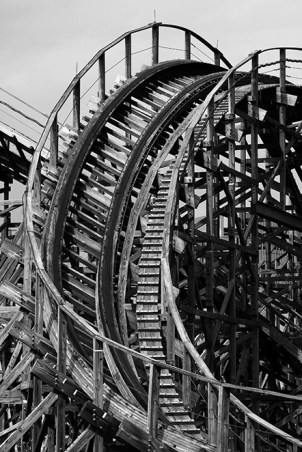
“Everybody likes a roller coaster ride.” –Pete Wasserman, English record producer, songwriter, and railway enthusiast.

“That looks awesome,” responded my son, Lee. “I would go there to ride that one.”

His reply was to my message last weekend asking if he had plans to ride the world’s tallest, fastest, scariest, baddest roller coaster ever that debuts at Canada’s Wonderland park next year.

Lee’s been a coaster junkie since reaching the minimum height requirement. He’s closing in on 40 and still loves them. I’m betting he’ll ride the Yukon Striker billed as the fastest dive coaster at how fast … 80 mph? My last 80 mph “dives” were at places like a stretch of Titus County, Texas, road appropriately dubbed the “roller coaster” when I was a teenager or the old “thrill hill” in Shelby County.

The Canadian coaster is also touted as the longest dive coaster at how long … 3,625 feet? Can’t be any worse than that Delta Flight I was on landing at Chicago one morning during a thunderstorm. The freefall squeezed three inches off my waist and created enough airspace between my wallet and the seat to accommodate a Sears catalog.

The tallest dive coaster at 245 feet “including underground.” Falling that far into a hole in the earth? No, thanks. I was out on the first two.

Despite my scoffing, there was a time when challenging the best wooden coasters from Panama City Beach, Florida to Santa Monica, California was my passion. My son came by his honestly.

Unlike Lee, my passion soon turned to excitement with both feet planted on terra firma and without all the blood in my body shoved up between my ears.

I still believe every ounce of blood and a couple of organs were behind my eyeballs on The Starliner, an attraction at what was the Miracle Strip in Panama City Beach in the 60s and 70s. The wooden coaster ran the entire length of the park along the beach.

Panama City Beach is a different place now than it was in 1973 when a bunch of bike riders from Mount Pleasant rode to Florida spending a week at the “luxurious” Barney Gray Motel. Besides taming the Starliner, we basked on the beach, suffered the sunburn of a lifetime, and got our first flash from a genuine streaker. Sorry, Ethyl, we looked.Wooden roller coaster

I also looked one night a few years earlier riding the Sea Serpent on the opposite side of the continent at Pacific Ocean Park in Santa Monica, California. The 1926 wooden coaster offered a dive with an ocean view. Mine was a memorable view of a moonlit Pacific Ocean in the summer of ’67 just months before the once popular pier closed for good.

It was one night at the long closed-for-good Hamel’s Park in Shreveport that I walked away from my last ride. After a youth spent on the best coasters in the country, it was a small kid’s ride beside the Red River where I silently prayed for it to end. I was riding with daughter, Robin, who was about ten at the time. Both of us were shrieking through the night air. For her, they were expressions of joy.

Mine were more along the lines of long-time good friend Petey Gandee’s response to Lee’s message last weekend after watching the video of the Yukon Striker, “I just threw up watching it.” Doubters: Google “Yukon Striker coaster” and see for yourself.

Last week’s coaster conversation ended when Lee said, “I went to Fiesta Texas yesterday and rode The Goliath, The Batman, The Superman and The Wonder Woman (all coasters). I had a blast!”

“Cool! Ride them again and call it my turn,” I told him. “I’ll watch from the ground.“

—Leon Aldridge

Aldridge columns are also published in the Center, Texas, Light and Champion and the Mount Pleasant, Texas, Tribune newspapers.
A city dweller’s perspective of country charm

“City people make most of the fuss about the charms of country life.” — Mason Cooley, American writer and educator 1927-2002

Country life may indeed appear more charming when viewed from inside the city limits. However, viewed from the perspective of those who grew up living and working on a farm, the definition of charm may vary a little.

Response to last week’s offering on outhouses in this space was brisk. Feelings fell between humor and appreciation—humorous stories about outhouses, appreciation for their having faded into history, or some of both. The difference is again likely a matter of perspective.

I grew up from the city perspective to whatever degree living in small Texas towns could be defined as city living. Maybe dad’s wearing a white shirt and tie to work at Perry Brothers five-and-dime store qualified us.

This city dweller’s introduction to a country perspective was provided by the Hales, a family of farming folks near Crockett, Texas, in the mid-50s, and their son, Wayne, who was my friend.

A dirt driveway connected the Hale’s simple four-room house to a dirt county road and circled a huge tree. From that circular path, one gate on the left led to the house and one on the right revealed a pasture that was home to some milk cows.

Circumventing the tree and driving straight ahead led to a shed under which was parked an old gray Ford tractor and farm trailer. It was also where they parked their green, late-1940s GMC one-ton flat-bed truck although only the cab would fit under the shed. It was the only form of transportation the Hale’s owned.

Their house sat way up off the ground with nothing to stop a cold North wind blowing under it but a couple of resident hound dogs that delighted in barking at anything that moved and some things that didn’t.

At the end of that legendary path out the back door of the house, and sort of in line with the tractor shed, sat the outhouse: aka the privy.

It was a time when air conditioning was new and still scarce enough that the few businesses enjoying it enticed customers with “refrigerated air” signs in the window. It was even scarcer in homes. An oscillating fan provided the only breeze not only in the Hale’s house but also at our house in town.

Heat at the Hale’s was a wood-burning stove in the kitchen and also where the only water in the house was available. There was no television, but as with air conditioning, there was also no TV at our house in town.

My initial taste of country life at the Hale’s was where I first rode a horse, rode on a tractor, rode sitting on the back of a one-ton truck, and the only time I took a bath in a number-three washtub in the kitchen. And, yes, it was my first time to sit and ponder dirt dabbers buzzing in an outhouse.

It was also where I enjoyed home cooked meals in the most literal sense of the word. Vegetables from their garden, milk from their cows, eggs from their chickens and cured meat from their smokehouse went into any meal they put on the table.

Maybe it is true that country life viewed from this side of city dwelling is charming because of horses, tractors, home-cooked meals or riding in the back of trucks. Granted, I was never around to plow fields, harvest crops, build fences, chop wood, or milk cows.

But, it sure seemed like a lot of fun to me. Except for outhouses … those are probably best left to both humorous memories and being thankful they are no longer a way of life.

—Leon Aldridge

Aldridge columns are also published in the Center, Texas, Light and Champion and the Mount Pleasant, Texas, Tribune newspapers.

Privy to discussions on an American way of life

“If you wish your outhouse was as nice as those at the state park, you might be a redneck.”—Jeff Foxworthy

What do outhouses, my kids, and a small book written in 1929 have to do with education?

Charles “Chic” Sale, vaudeville and movie actor in the 1920s and 30s, authored a small book, The Specialist. It was about a carpenter whose specialty was building outhouses. My mom’s father bequeathed to my dad, his prized copy of the book, and it’s now in my library.

My library of column writing from over the years yielded one last week that I penned 25 years ago chronicling my efforts to school son Lee and daughter Robin on the finer details of life with an outhouse. Class convened one day when I mused that the well house at our new Pipe Creek, Texas, Hill Country home “looked like an outhouse to me.”

“A what,” asked my then-young son Lee. “What’s an outhouse?” For the educational experience that ensued in answering his question, recollections of Sale’s book from many years ago served as my text.

“Nowadays, ‘three rooms and a path’ will bring a snicker even in rural areas,” I began. “There was a time, however, when it described a way of life with an outdoor toilet also known as a privy.”

“The bathroom was outside,” they gasped in disbelief?

“Yep, and you could spot well-to-do families with their three-holers sporting fancy leaf designs for door ventilators,” I said. “While regular folks had just one or two-holers with a crescent carved in the door.”

While my kids processed the concept of “privies,” I imparted the importance of the path. “The path needed to be straight so that on rainy days when you had to run, you didn’t wind up in the mud, or the woodpile.”

“Are you sure about all this,”  they continued to scoff.

“Absolutely. And, it was smart to make sure that the path went by the woodpile. With an average of five or six trips a day, family members could easily keep the wood box in the kitchen filled.”

I would like to report that the look on my kid’s faces told me they were duly impressed so many things had to be considered in outhouse construction. Truth of the matter was, they were more duly impressed there really was such a thing as an outhouse.

“Little things like the door swinging in was critical,” I added. “Mid-day in August, when the dirt-dabbers buzzed up in the corners, it was nice to open the door to catch a breeze. But, if the door swung out, you just couldn’t risk leaving it open and have someone coming up the path before you knew it. Getting up off the seat and reaching outside to grab the door to close it, you might get caught.”

“Speaking of being caught, it was a good idea to anchor it down securely, too,” I said. “Halloween night was risky when devilish youngsters prowled with evil pranks on their minds.”

“Couldn’t take risks with the inside either,” l added. “Especially with the seat. Making the hole round and sanding the edges nice and smooth could cause one to lose his or her garden to crabgrass. But, cut the holes square with an old ragged saw, and about four minutes flat was the average stay.”

“Another important construction detail was adding beams under the seat: made it a lot stronger. Nothing caused a bigger ruckus at the homecoming picnic than that cousin from up north falling through if the seat gave away.”

“Last, but not least was a hook or a nail for the Sear‘s catalog. While that was standard equipment, you might occasionally see a box to hold corn cobs, too. Generally speaking though, the cob box was an indication of old timers in the family since it was always hard to teach an old dog new tricks.”

“Catalogs? Corn cobs?” Robin asked. “I’m really glad we don’t have outhouses anymore.”

“Me too,” I agreed. “But, just remember what I’ve told you. And, when you happen upon an old retired privy out in the weeds, stop and place your hand over your heart kids. You are in the presence of an unsung hero of the American way of life.”

—Leon Aldridge

Aldridge columns are also published in the Center, Texas, Light and Champion and the Mount Pleasant, Texas, Tribune newspapers.

Elvis must have enjoyed the coffee at Floyd’s

“It is inhumane, in my opinion, to force people who genuinely have a medical need for coffee to wait in line behind people who apparently view it as some kind of recreational activity.“—Dave Barry, American author and columnist

Coffee is indeed somewhere between medicinal and therapeutic. It’s also plausible to me that the benefits of coffee may be to some degree determined by what sort of container from which one’s java is enjoyed.

Such was the topic of office conversation last week when comparisons arose about the virtues of caffeine consumption from one of the increasingly popular insulated metal cups versus my favorite: the classic curved-side, thick bottom, porcelain mug.

Honestly, I’ll drink good hot coffee out of almost anything, but I do like the old-fashioned mugs.

The classic mug revered by many coffee drinkers is actually a product of World War II. Research notes the military commissioned Victor Insulator Company to design a mug employing thick walls for insulating properties and durability, plus extra weight on the bottom to avoid tipping over. The result quickly became an American eatery icon and what has come to be commonly called the “diner mug.”

The diner mug is also the basis of many coffeeshop and cafe memories for me growing up in a coffee drinking family. It was a pre-interstate highway time of small roadside cafes in every Texas wide-spot. If reducing your speed was required to get through a town, you could bet it had a cafe or diner.

Each one had not only tables and booths but also offered a counter near the kitchen where the coffee-only klatch or the dine-alone dinner clientele perched on stools. Chatter was constant as white-dress uniform wearing waitresses moved about rapidly refilling coffee mugs. They already knew what the regulars wanted and they greeted everyone as “sweetheart” or “honey.”

It was also a time when these small roadside cafes and diners were known for their coffee, good or bad. My grandfather always looked for one crowded with trucks on the parking lot. He swore that’s where the best cup in town was served.

His guaranteed first coffee stop on regular trips between Pittsburg in East Texas where I spent summers with my grandparents and Seymour out west of Wichita Falls where we lived at the time was a small cafe in Greenville. The inconspicuous eatery sat on the north side of what is now I-30 but was known then by its original designation of U.S. Highway 67. A simple sign noted the name of the place as, “Floyd’s Cafe.”

Floyd’s was known for good coffee. I know it was, or my grandfather would not have stopped as often as he did. But with every visit, my attention was fixed on a brightly colored plate hanging on the wall adorned with the hand-printed words, “Elvis Ate Here” and the date, “3-14-58.”

A music fan since about the time Elvis ate at Floyd’s, the anticipation of stopping there grew with each trip. My grandparents got their coffee, and I got to see the “Elvis plate” in the same cafe where Elvis ate.

By the late 60s when I was a student at nearby East Texas State University in Commerce, Floyd’s was still a good place for coffee…or a chicken fried steak or hamburger for that matter. And  Elvis’s plate was always there.

Floyd’s and Elvis were both gone way too soon after I left ETSU, and presumably Elvis’s plate as well. Also fading from Americana by then were uniformed waitresses and lunch counters.

Through it all, though, the venerable diner mug filled with hot medicinal coffee has remained. And for that, I am truly thankful every morning.

—Leon Aldridge

Aldridge columns are also published in the Center, Texas, Light and Champion and the Mount Pleasant, Texas, Tribune newspapers.

Sometimes, sharing is not an easy thing to do

“Sharing is good, and with digital technology, sharing is easy.”— Free software movement activist and programmer, Richard Stallman.

With all due respect to Mr. Stallman, I beg to differ on the easy part. At least for some of us on some days.

Experience teaches that “learning curve” and “over the hill” are synonymous terms commonly shared to gauge different points on the same journey. Being able to now see over the top of the hill has shown me this is the point where that learning curve thing isn’t quite as easy as it used to be.

A typically easy Saturday morning last week quickly exploded into exasperation when I clicked the “publish” button on my blog site. That’s the button that magically catapults this column into cyberspace every Saturday morning, automatically sharing it with social media.

The magic was missing this time, however. Instead of receiving acknowledgment that my column was on digital newsstands everywhere, a warning label screen declared something to the effect of, “Not today, new rules.”

New Facebook rules had just turned a routine Saturday morning task into anything but routine. In a flash, “easy” went out the window and that learning curve thing? It shot exponentially straight off the chart. In non-geek terms, the warning label screen shared that Facebook no longer allows third-party sites like WordPress that I use to automatically share posts with them in the same manner that it has previously.

A frantic message to WordPress customer support returned information on how to restore harmony between Facebook and my column. Their prompt and understandable (for non-geeks like me) response spelled out two realizations: one, there is a difference in a Facebook page and a profile. Who would have thought it? Not me, I thought they were all “pages.” Two, I would have to create a brand new Facebook “page” just for my column, separate from my Facebook “actually not a page” I had been using ever since I learned how to spell Facebook.

In the meantime, Saturday morning was slipping away and concern for my faithful readers was mounting by the moment. The newspaper business makes you that way. Fortunately, it didn’t require much of a learning curve to think, “Hey, just post the link to Facebook manually and sort out the other stuff later.”

Done, I checked my “actually not a page” to make sure the column link was there, albeit late, and then it was back to my easy Saturday morning and coffee. Hours later, still in my routine, I checked Facebook to see what the court of public opinion was returning on the current edition of, “A Story Worth Telling.” Being a column writer makes you that way.

That’s when the second wave of exasperation hit. The column had garnered some “likes” and even three comments. Oddly though, the comments were from my two children and my sister, all of whom quickly let me know they could not see the column by clicking the link.

So, what was up with this? Others were obviously connecting to the column because they “liked” it, right? Checking the blog site provided a different answer. The column had never published to the web. This is where that “seeing over the top of the hill” thing comes in—this one was on me. I failed to follow through with the final phase when I became frustrated over falderal about new rules.

So, what did the Facebook “likers” like? Obviously, just the posted photo and teaser. But, to a person, they politely never mentioned I had posted a link that went nowhere.

Just goes to show that while sharing your love, your world or your thoughts isn’t easy for everyone, polite “friends” never share your mistakes. But family? Oh, they will share it with you in a heartbeat.

—Leon Aldridge

P.S. If my learning curve issues prevented you from accessing last week’s column, you can catch up here: Some people with cats go on to lead normal lives  I’m pretty sure this link will work …

Aldridge columns are also published in the Center, Texas, Light and Champion and the Mount Pleasant, Texas, Tribune newspapers.

Some people with cats go on to lead normal lives

“You can train a cat to do anything it wants to do.”—Uncredited wise cat lover.

“There’s a cat in the travel trailer.”

My wife is a cat person managing a nice size herd. Her frantic declaration on the phone last week caught me off guard, but offered so many creative responses that were beckoning. I struggled to choose the right one. The potential for one-liners was limitless. Not liking the thought of eating alone or conversations with myself, however, I went with, “The door’s not locked, let it out.”

“No,” she said with a tone that let me know even that was a wrong response, “Not inside the trailer, in one of the storage compartments.”

“Impossible,” I countered. “They stay locked.” Clearly, something was amiss that further phone conversation was not going to fix. “I’ll be there in ten minutes,” I said.

The critter’s pathetic pleas were loud. But, a thorough search of every nook and cranny in the RV revealed nothing that would not be needed at the nearest KOA. And, the last time I checked, a cat was not one of those needs.

Sliding out from under the trailer, I noticed the cries for help now appeared to be coming from a higher source—the massive sweet gum tree right behind me.

At the top of a 12-foot extension ladder, they were still way above me—far enough that I saw not a trace of fur in the forest of green.

“I see her, there she is way up at the very top,” Terry said.

“And, you know it’s a she…how,” I asked. Even as the question rolled off my lips, I had the perfect answer. Fortunately for me, reminders of eating alone and talking to myself crossed my mind again before I verbalized it. “Mystery solved,” I said. “See you later.”

“We can’t just leave it up there,” she rebutted.

“You’re forgetting the incident with Miss Kitty some years ago,” I suggested. Miss Kitty came with my wife. The cat’s seniority outranked mine. She found herself way up a tall pine one day, and I felt compelled to rescue her. My arms were barely long enough to reach the aging and overweight cat from a point on my ladder way past where my fear of heights kicks in. Turns out that was not relevant anyway. In a heartbeat, my extended offer of help was not only rejected, it was met with caterwauling and claws.

I could attempt an explanation of what transpired next, but if you were a fan of Mississippi humorist, Jerry Clower, just envision his ‘coon-hunting story. The one about ol’ John Eubanks’ efforts to extract a raccoon from way up high in a sweet gum tree and the moment he discovered he was face-to-face with a “souped-up wildcat”—not a raccoon.

“Just shoot up in here amongst us,” ol’ John cried out amidst the fight, “one of us got to have some relief.”

Scratched up and trembling, I descended the ladder back to earth where our retired neighbor, Mr. Bud, greeted me. He had witnessed the whole thing, beginning to end.

“That cat will make it down just fine,” he drawled. “Did ‘ja ever see a cat skeleton in a tree?”

Seeing as how that theory held true with Miss Kitty years ago, I opted to test it again last week. It still works. Later that evening, said cat was lounging on the patio, purring and washing its face. No, I still have no clue as to the cat’s gender and truthfully, I don’t care.

I’m just glad there are no cat skeletons in the tree and glad that I’m still enjoying company for meals and conversation.

—Leon Aldridge

Aldridge columns are also published in the Center, Texas, Light and Champion and the Mount Pleasant, Texas, Tribune newspapers.

Roads traveled since one night up the road in Longview

“I believe that all roads lead to the same place – and that is wherever all roads lead to.”—Willie Nelson

I’ve been a music fan since Willie, Waylon and the boys first attained outlaw status, and Willie was “On the Road Again” forever changing country music.

That was also about the time I was on the roads around Mount Pleasant, Texas, in my Chevy van: the one with the desert mural outside and orange shag carpet inside. The same one in which life-long friend Oscar Elliott and I cruised back then while listening to “Blue Eyes Crying in the Rain.”

The Red Headed Stranger was on my mind again last week for a couple of reasons. One was an article about him in the recent issue of the AARP magazine. The other was the 1,500 or so slides from my early photography work I’m sending off for conversion to digital media. Those Kodachrome moments include shots from my first Willie concert—the concert that almost wasn’t.

It all started with a phone call from another long-time Mount Pleasant friend, Randy Brogoitti. “Willie is doing a concert in Longview,” he said. “You wanna go?”

We were both recent graduates of what was East Texas State University in Commerce, Texas. I was in Mount Pleasant. Randy was just down the road in Kilgore. “Sure,” I responded. I was all in and all excited.

willie-ray-2
Willie Nelson and Ray Price at the Texas Country Music Hall of Fame Museum in Carthage, Texas in 2003.

The excitement was short-lived when a few days later, Randy called back, “Bad news,” he said. “It was a scam. Somebody sold tickets and took the quick road out of town.”

I’ve seen Willie several times over the years since, but what happened next is one of the best Willie stories I can tell.

“Good news,” was Randy’s next call. “Willie heard about what happened and he’s coming to Longview to do a free concert; doesn’t want his fans to be disappointed.”

We arrived early at the Jaycee Expo Hall at the Longview fairgounds securing seats near the front, then watched as the faithful fans flocked for the night that Willie was on the road to Longview.

People watching is something I’ve long enjoyed, but the people coming in that night were a little different than what a naïve twenty-something-year-old from a small East Texas town was used to watching.

Pocket half-pints and strange smelling smoke slowly surrounded us as show time neared. Fearful of a second-hand smoke buzz or worse, we surrendered and escaped toward the back near an exit where both crowd density and atmospheric quality was substantially improved.

Sometime later, K.C. and the Sunshine Band took the stage for two hours delivering what has remained with me as the quintessential 1970s live performance.

It was way after 10 p.m. when a white Mercedes stopped outside the expo hall, doors opened and the high-flying crowd enthusiastically cheered Willie, unmistakable with signature ponytail, headband and entourage of musicians.  Straight off the road without rehearsal or warm up, Wille and his band performed for three hours without a break staging what I have remembered as the second quintessential 1970s performance of that night.

Fast-forward 30 years and up the road from Center to Carthage at the Texas Country Music Hall of Fame where the reveal of inductees for 2003 was set and an older Willie, accompanied by Ray Price was making the official announcement.

An older me with press credentials snagged a spot mere inches from the podium where I captured pictures of Willie as he shared the news that Kris Kristofferson, Lefty Frizzell and Johnny Bush were soon to be the newest hall of fame members. I was also afforded the opportunity to follow and photograph the legendary duo through the Country Music Hall of Fame Museum where they viewed exhibits and reminisced about old times making music together.

I savored the moment myself recalling all of the roads and the years between Mount Pleasant in a shag carpeted van and the almost wasn’t a concert by Willie that lead to that day in Carthage.

The levity of those roads and years did not escape me last week. Neither did the fact that they have led to now reading about Willie in the AARP magazine and an increased appreciation for the improved air quality at most Willie venues since one night long ago up the road in Longview.

—Leon Aldridge

Aldridge columns are also published in the Center, Texas, Light and Champion and the Mount Pleasant, Texas, Tribune newspapers.

(All photos by Leon Aldridge)

Something mesmerizing about that label going around

“I like the phonograph best.”—Thomas Edison’s response when asked, “Of your thousand-fold patents, which is your favorite invention?”

A trip to the big city chain book store a couple of weeks ago searching for a current record price guide got me to thinking. My first thought was that price guides today are more expensive than many of the records I bought when I first became serious about collecting them almost 40 years ago.

Honestly, that was the second thought. My first was thinking, “It’s time for an updated evaluation of my accumulation,” that had me in the book store to begin with.

I’ve been accumulating records since grade school when I began buying them at White’s Auto store in Mount Pleasant. However, I didn’t consider my accumulation a collection until the late 70s when records began disappearing in favor of the then new format: CDs.

Record 45-smLike many kids in the 50s and 60s, I watched American Bandstand after school. Also like others, I bought records based on who appeared on Dick Clark’s popular TV show, plus what I heard on the radio. A record was the only format available then except reel-to-reel tape, a format typically used only by serious audiophiles and recording musicians like Burton Harris in Mount Pleasant.

It was also the format that lead to 4-track and 8-track cassette tapes in the mid 60s that morphed into cassette tapes in the 80s before CDs replaced tapes, and eliminated records. In recent years, digital downloads and online buying has relegated CDs and music stores to a fraction of their former glory. Time changes everything

And, time often comes full circle just as records have done. Today, whatever your taste in music might be, it’s instantly available. It’s free on YouTube, streamable on Spotify, or buyable on iTunes. So, why is technology that was allocated to history almost three decades ago now making this miraculous comeback?

Partially because at the time when vinyl records began to disappear, I remember serious audiophiles arguing that an LP’s vinyl grooves produced a warmth and depth that digital code could not.

When records started a comeback a few years ago, those sentiments were echoed by one musician born after records were history. Shelby county singer and songwriter, friend and mentor to my guitar-picking efforts, Thomas Morrison said it best. He termed the “unbelievable sound” of some old records his father had given him an “amazing discovery.”

He also discovered something I’ve always said about records. “When you listen to a record,” Thomas said, “It’s like you’re listening to a tangible piece of history—something you don’t feel when you listen to a digital music file.”

What he discovered is the same feeling I get when listening to Elvis Presley on an original Sun label record. For both the quality and the connection Thomas described, I still play records on a regular basis. Plus, there’s just something mesmerizing about watching those labels going around.

What goes around comes around. Or, in my case, it just never went away. And it would appear the same is true as far as vinyl LPs spinning on a turntable are concerned.

In 2017, 14 million LPs were sold in the U.S., up more than 1,000-percent from 10 years earlier. While researching that sales figure, I was disappointed to learn that I missed “Record Store Day” last April celebrated in honor of independently-owned record stores.

Not only did Edison celebrate the phonograph as his favorite invention, but he was also prophetic in stating, “The phonograph will undoubtedly be liberally devoted to music.”

I wonder if he had any idea phonograph records would be enjoying a second hurrah more than 100 years later, or that people like me would spend a lifetime accumulating…make that “collecting” them.

—Leon Aldridge

Aldridge columns are also published in the Center, Texas, Light and Champion and the Mount Pleasant, Texas, Tribune newspapers.

Appreciating the difference in the trip and the journey

“Are you traveling or just going somewheres?”—Hattie Lois Aldridge, 1905-1993.

I used to think my father’s mother asked that question with a smile simply as one of her signature funny quips: no meaningful content other than a “hello” greeting.

The fact is, Granny was onto something even back then. Some people “travel” whereas the majority tends to be just “going somewheres.”

She would have known the difference. My grandfather was notorious in the 1950s for leaving Pittsburg in East Texas at 3:00 a.m. intent on arriving at my parent’s house in Seymour out west of Wichita Falls for breakfast. If he stopped, it was because the car needed gas or his thermos needed coffee.

Even today, we all know that drill when only fuel or food will interrupt our fervent rush to get somewhere. In the car complaining because we’re late getting started, hit the interstate, set the GPS and drive over the speed limit while complaining about the “Sunday driver” ahead.

Windows up, air on, satellite radio jamming. Skip the slower secondary roads missing local flavor and historical sites while thinking one more time, “Some day, I’m going to stop there.” Eventually, we arrive at our destination tired, grumpy and complaining about the trip.

Complaints were few in this space a few weeks ago when we praised changes in travel speed and convenience since the days when my grandfather made his trips. There are times, however, when going from point A to point B focusing on the trip rather than the destination is the better choice.

Times like now as I’m contemplating my next road trip in a car that’s almost as old as I am. I’ve toured most of the lower 48 and bits of Canada and Mexico in the comfort of modern motoring machines, and I do enjoy the luxury. But, the best memories are those of adventures in a car that was new during Eisenhower’s first term in the oval office.

Journeys like jaunts to Florida’s east coast in a ’56 Ford Thunderbird, or the numerous short trips around Texas and Louisiana in my ’55 Ford Crown Victoria.

Windows down, no air conditioning, radio off. Aware of the surroundings recognizing the fragrance of newly mowed hay fields or flowers blooming. The fresh feeling of rain in the air from the distant thunderstorm. The mechanical music of vintage motors clicking and tapping under the hood.

During my grandfather’s day, that was the only way to go. Cars were yet to be offered with air conditioning, and radios were still an extra cost option. For the ones that had one, AM was the only option. Didn’t matter, you couldn’t hear it with the windows down any way, or if you were more than 40-50 miles from the station.

More than 40-50 miles from home meant stopping at places like Stuckey’s or Pecan Joe’s for snacks and perusing the souvenir post cards, salt and pepper shakers, and key chain picture viewers branded with the region’s claim to fame.

It also meant seeing billboards punctuating pastures across the country like, “See Rock City,” or the pithy sayings displayed on rows of red shaving cream signs attached to fence posts.

Passing cars
When you can’t see
May get you
A glimpse
Of eternity
“Burma Shave”

Nothing compares to traveling in a car that’s old enough to qualify for social security, following the backroads and stopping whenever you desire.

I’m looking forward to my next vintage auto trip. Going to places I have not been, “traveling” like few enjoy it any more instead of rushing just to get “somewheres”…unless it’s Stuckey’s or Pecan Joe’s.

—Leon Aldridge

Aldridge columns are also published in the Center, Texas, Light and Champion (http://www.lightandchampion.com) and the Mount Pleasant, Texas, Tribune newspapers (http://www.tribnow.com).