Share some stories that need to be told

“God gave us memory so that we might have roses in December.” ― author J.M. Barrie

“You have more stories than a book has pages,” a long-time reader teased last week. “Are those all real stories?

“Sure,” I scoffed. “You don’t think I could make up that kind of stuff, do you?”

Focusing this week on things for which I am thankful, the song title made famous by entertainer Bob Hope came to mind: “Thanks for the Memories.” Among the many things for which I am most thankful are memories. Among them are many stories waiting to be told.

The importance of recounting all the stories we “have in storage” didn’t dawn on me until a long time after I was getting paid to write some of them. I probably owe the credit for that awakening to one of my journalism students at Stephen F. Austin State University a generation of writers ago.

After imparting a sufficient degree of writing basics to aspiring journalists, I then challenged them to find and write their first story. “Everybody has a story,” I offered. “They may not know it’s a story, they may think it’s just an old memory. But, if you listen closely, you’ll hear that story that is waiting to be written.”

”That’s easy for you to do,” that one student said. “You have age and experience, and you know a lot of people. It’s not that easy for someone my age.”

“With time comes experience in all things,” I agreed. “But forget age for a minute. Listening and understanding have no age requirements. Ask someone what they remember about growing up. About their interests. About their moments of pride or their regrets of defeat. About their hopes, their dreams. Stir up the memories and listen with an appreciation for what those memories mean to them.”

While I still think that advice was on target back then, the years since have given me an added appreciation for the value of those treasures we call memories and the resulting stories just waiting to be recorded. With that appreciation also came an awareness of the obligation we have to preserve them before they are lost to time.

After a lifetime of writing, I am still amazed at things that come to mind, whether from decades ago or from last week, fueling the fire for a column: a story worth telling.

Granted, a few things that come to mind, mostly from my youth when as they say ” was back before I got good sense,” might best be left to memory and with good cause: possibly ‘cause of that thing known as the statute of limitations. That’s when I smile and remember something else. Just because it was a bad idea then doesn’t mean it isn’t a good memory now. It just depends on whether or not you want to tell it.

However, the much larger volume of things remembered remain as part of the story of our lives that do warrant sharing. And that’s where gratitude for the importance of memories take rise. The snapshots of times past captured on the film in our mind are tidbits of history that need to be recorded for future generations.

In my estimation, that is the most important challenge not just to writers, but to all of us. And it has no limitations of experience or age. Everyone has a story, most of us have many. Let’s make sure we preserve as many as possible before losing them to time.

I hope your Thanksgiving was wonderful. I also hope you shared some memories with family and friends, sharing some stories that need to be told.

—Leon Aldridge

Aldridge columns are also published in the Center, Texas Light and Champion and the Mount Pleasant, Texas, Tribune.
Dum, Da, Dum-Dum … Dummmm

“The story you are about to hear is true. Only the names have been changed to protect the innocent.” — Sergeant Joe Friday, Dragnet

“Looks like there’s no one at the bank,” my friend informed me as we finished our phone conversation one day last week. “If I walk into a holdup, it’s been nice knowing you.”

I’ve done that,” I replied.

“Held up a bank,” she chuckled.

“No, walked into a holdup.”

“I can’t wait to hear about that.”

“Just the facts, ma’am…I drove into a holdup.” It was hot in Mount Pleasant. I was working a summer job out of necessity. For college money. Driving a truck. My mission was peaches.

“Peaches?”

That’s right. Fresh from Jerry Benton’s orchards on the Monticello highway. I had to have them at the farmer’s market in Dallas every morning by 5 a.m. Prior to that job, my only acquaintance with early a.m. hours had been sneaking up on them from the other side after a night of fun.

It was not fun herding a refrigerated truck along I-30 for two hours at that time of the morning. It required liberal applications of caffeinated coffee. On the morning in question, I was in dire need as I exited at a small cafe near Greenville. This was before 24-hour restaurants dotted the roadside, even on interstates.

Perusing the parking lot for a place to position the peach hauler, I was pleased by the presence of only a pair of cars. Driving a truck and earning a commercial license to do so were recent experiences during my 18th summer. Desiring to get in and out easily once I had hot java in hand was my priority.

The truck was still rolling, and I was still looking when a commotion near the dimly lit front door of the eating establishment caught my attention. What I saw in fleeting seconds was a scene straight from black-and-white TV. Two men exiting the building seemed in a large hurry. One was grabbing a gun. “A gun,” my brain begged in the bleak morning darkness?

A flash of fire from the barrel pointed toward the door and the deafening report that accompanied it answered all my questions. It took less than 40 acres to turn my rig around and choose the shortest dirt path back to the highway, away from any more gunfire.

I never looked in the rear-view mirror. I didn’t slow down until I reached Dallas. I had peaches to deliver. Besides, I really wasn’t sleepy anymore.

Still rattled from the morning melee as I headed out of Dallas after lunch, I decided that in case anyone had reported a Hertz rental truck making a hasty haul out of the cafe parking lot during the fireworks, it might be a good idea to check in with Greenville’s finest.

“This is the city—Greenville, Texas,” the sergeant said. “I’m a cop. This is my partner, Gannon.” Why I got a grilling about waiting until the afternoon to drop by troubled me. It didn’t seem as important to them as it did to me that I had this fear of hostile gunfire, or that I had peaches to deliver on time. Luckily for me, the cafe caper culprits were already in custody.

Ready to roll again the next morning at 3:00 a.m., I wasn’t taking any more chances. No sir. When I climbed into the peach hauler, I was packing heat—fresh hot coffee filling a brand-new thermos from Mason’s hardware. A trial was held in and for the case of making the peach delivery deadline non-stop.

“In a moment, the results of that trial.”

—Leon Aldridge

Aldridge columns are also published in the Center, Texas, Light and Champion and the Mount Pleasant, Texas, Tribune newspapers.

Humor—something generally lacking in politics today

“You’ll never find a rainbow if you’re looking down.” —Charlie Chaplin

Face the unexpected with humor and optimism, and you always come out on top. That’s the theme of an election story that has been around for as long as I have, the one about Horace the mule.

I first heard the story of Horace some 40 years ago as an East Texas tale, although I’ve seen it published over the years with varying regional adaptations. Accurate origins point toward a storyteller by the name of Edmund Harding who first told it at a Rotary Club meeting in Asheville, North Carolina sometime in the 1940s. In any form, it’s a great story, one in which I saw an apropos connection between the election behind us and Veteran’s Day on Sunday.

A Monday deadline for publishing in the newspapers prior to my blog on Saturday means this was penned prior to this week’s big election. I note that to preface saying there was no current political intent with the story, simply an old election yarn with some humor—something generally lacking in politics today.

Horace was a widow’s farm animal and both were getting on in years. Just before an election one year, Horace was feeling droopy, and the widow was worried about him. “Doc,” she pleaded on the phone, “Horace is sick. Can you please come over and take a look at him?”

“Madam, it’s after six in the evening and I have already sat down to supper,” the good doc retorted. “Give Horace a dose of mineral oil. I’ll drop by tomorrow when I’m over in that neck of the woods and see how he’s doing.”

She inquired about how one gives a mule a dose of mineral oil, and the doc informed her on the technique of using a funnel. “But, he might bite me,” she objected. “Now, you’re a farm woman,” the doc reasoned. “You know about these things—administer it through the other end.” She pondered this advice for a few minutes, then headed out to the barn where poor ol’ Horace was in misery.

She turned up her lantern and searched for a funnel, but the closest thing she found was Uncle Jake’s old fox hunting horn hanging on the wall, a beautiful instrument with tattered gold tassels still intact. Nervously, she took it down and cautiously attached it to Horace’s southern-most end as the ailing mule lay prostrate with his nose pointing due north. Keeping a cautious eye on Horace, she reached behind her for the mineral oil, but mistakenly picked up the turpentine bottle instead and without looking, dosed ol’ Horace liberally through the bugle.

Horace’s “recovery” was instantaneous. His head jerked upright, and his eyes widened as large tears developed in the corners. He screamed like a panther, kicked down the barn door and galloped off down the road, pausing every so often to kick his hind legs in the air—an action that caused Uncle Jake’s horn to blow.

As Horace ran through the valley, hound’s ears perked up everywhere. They knew the sound of Uncle Jake’s horn meant a hunt was on, and Horace gained a following of baying hounds as he continued to kick and run.

Eyewitnesses said it was a sight to behold: ol’ Horace running, pausing to kick his heels, mellow notes issuing from the gold appendage, tassels flying in the breeze and every fox hound within twenty miles barking joyously.

Old man Johnson, who hadn’t drawn a sober breath in 20 years, was sitting on his front porch when the spectacle passed his house. Reports were he gave up drinking that very day and joined a temperance movement the next morning.

It was dark when Horace reached the river. The bridge tender, who was running for public office and considered by most to be an easy winner, heard the horn and thinking it was a boat, raised the drawbridge. Horace bounded up the bridge and off into the water with dogs still trailing right behind him. The hounds swam to safety, but poor old Horace drowned, and Uncle Jake’s fox horn was never recovered.

Come Election Day, the bridge tender lost garnering only seven votes: his own and six others from three close relatives. The assumption was that voters figured anyone who didn’t know the difference between a boat horn and a mule with a bugle in his behind wasn’t qualified to hold public office.

Regardless of your leanings on the election, try to maintain your humor and your optimism. And thank a veteran or current member of the armed services this Veteran’s Day and every day for keeping us a strong and free nation through our sometimes humorous history of election outcomes.

—Leon Aldridge

Aldridge columns are also published in the Center, Texas, Light and Champion and the Mount Pleasant, Texas, Tribune newspapers.

Praying for an excuse from that doctoring book

“I was feelin’ so bad, 
I asked my family doctor just what I had.”
—“Good Lovin’”1966 by the Rascals

“It’s a reaction to something I’m taking,” I told my doctor last week, just like I knew what I was talking about.

In less time than it takes to say, “common side effects,” she listed my meds and supplements in a phone app. “Vitamin C might be reducing the efficiency of the antibiotic you’re taking, that’s all.”

You looked it up on your phone, I thought to myself? Seriously? Doctors are supposed to just know that stuff. That was not the first time I had that thought, however. That same question crossed my mind in the late 60s at East Texas State University before it became Texas A&M University at Commerce.

Time blurs the names of those in Coach “Boley” Crawford’s PE class that day. You’d think I could at least recall the unfortunate student’s name who misjudged a trampoline bounce buying him a painful landing on his arm.

“It’s broken,” Coach Crawford said, then asked who had a car parked nearby. I volunteered, being careful not to reveal that my car was in a faculty lot via a counterfeit parking pass purchased from some guy at Pope’s Pool Hall in downtown Commerce.

A couple more guys volunteered to help, like me, sensing the opportunity to miss PE and maybe another class, too. We were off on our mercy mission for medical help when I remembered my next class was E.W. Rowland’s civics class.

Warnings spread every semester about Rowland’s class: don’t sign up for it. At registration, I needed one more class to meet my 15-hour minimum load and fit my work schedule at LTV Aerospace Systems in nearby Greenville. They helped fund my education in exchange for painting skills acquired in my uncle’s body shop the summer before: skills that I was applying to Lockheed C-130 Hercules aircraft bound for Vietnam faster than you can say, “Ho Chi Minh Trail.”

“Civics—that’ll work.” It wasn’t until after I had paid my outlandish $400 tuition fee and was out the door that I looked at the instructor’s name: Rowland.

“How hard can he really be,” I scoffed in an attempt to make myself feel better. My question was answered faster than you can say, “epic fail.” He was still checking roll when I slipped in the first day of class. He finished, then asked, “Have I missed anyone?”

“Aldridge,” I said.

Looking at the names on his list then at me, he said, ”Mr. Aldridge, I called your name, why didn’t you respond.”

“I came in after that.”

“Well, Mr. Aldridge, that means technically you’re late. Would you share with us why you were late to the infamous E.W. Rowland’s class? Was it an elephant stampede; a swarm of locust; or worse?”

“No sir,” I said softly. “I work nights.”

“If you are to succeed in my class, Mr. Aldridge, you will find some means to overcome trivial excuses. This won’t happen again, will it?”

“No sir,” I replied.

Shaking that encounter from my mind as I parked at the doctor’s small office, obviously once a residence, we helped our wounded classmate inside.

Old doc “whatever his name was” ushered us into his only exam room, saw the arm, and confirmed Coach Crawford’s diagnosis. “It’s broken.” He then pulled a book off the shelf, laid it on a table and started flipping through the pages mumbling, “… broken bones, broken bones.”

Panic filled the injured’s face. He looked first at the doc then at us with eyes pleading, “Get me out of here.”

Quicker than you can say, “this won’t hurt a bit,” the arm was set, and we were headed back to the gym. PE was over, as was most of the next class period. I had missed Rowland’s class.

As everyone exited my car, one of the guys asked, ”You going to class?”

“No,” I said. “I’m going back to the doc’s office. I need an excuse for an elephant stampede or a locust swarm, and I’m just praying one of them is covered in that doctoring book of his.”

That’s a fine-looking dog you have there

I’ve always said money may buy you a fine dog, but only love can make it wag its tail. —Kinky Friedman

Walking along Avenue B in Galveston’s Strand District one afternoon last week was a sensory sensation of food, music, and wares adorning windows in the 19th Century Victorian commercial buildings. A setting sun’s rays provided the crowning touch of warmth painting late afternoon shadows to brighten up what had been a cloudy afternoon.

The brief change of pace after a day of business meetings on the other end of the island was refreshing. Pieces of dark chocolate for my sweet tooth and another cool Hawaiian shirt for my collection scored, it was time to return to the hotel. “It just doesn’t get any better than this,” I thought.

That’s when I saw shadowy outlines of what looked like three guys sitting in chairs up against the building under the shade of the large canopy.

Weathered faces and gray hair suggested this might be a retiree’s retreat likely meeting at this same spot on a semi-regular basis to swap stories, watch people and maybe drink an occasional cup of coffee.

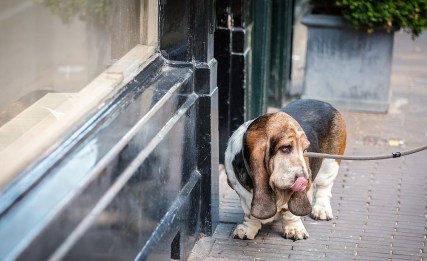
It was another shadowy outline, however, that really captured my attention. One of a magnificent specimen of a dog relaxing with the trio and tethered on the end of a leash. Sitting on stubby legs and the profile of long droopy ears were dead giveaways. This was no ordinary dog, it was a basset hound.

Continuing my stroll toward them, I nodded in a “Howdy” sort of manner and followed with, “That is a fine-looking dog you have there.”

Basset hound on the street

“Thank you,” the gentleman holding down the middle chair and clutching the other end of the leash said.

Some scratching between the dog’s ears and stroking his back a time or two earned me a look of gratitude from sad basset eyes and a slow wag of the tail—certification that we were officially new best friends.

“I had a basset hound like that,” I told the gentleman holding the leash. “He and I were best friends. We went everywhere together. If Max couldn’t go, then I didn’t go.”

“That’s about the way we are,” he chuckled.

I didn’t start out as a dog person. A small brown mutt dubbed, Brownie, was my dog for a brief time in about the first grade. But, it was a basset wagging his tail at me 40 years later that made me understand there’s no such thing as “just a dog.”

Max became my best bud by default after I caved in to the pleas of my kids to adopt the old fellow in need of a new home. He was supposed to be my kid’s pooch, but destiny had other designs. The first night he spent with us, I woke up to the melody of a forlorn basset hound howl. The old dog was alone in a strange place and singing the blues. I went out to the porch to talk to him and we wound up sharing a rug and a pillow dozing until daylight.

The laid-back basset blessed my years in the Hill Country publishing the Boerne Star before we both moved back to East Texas to make more memories there.

Max stories have been documented in more than one of my columns. In fact, the episodes of Max, published and unpublished, would fill a book—one I may get around to writing someday.

“Yes sir, he certainly is a good-looking dog,” I noted one more time bidding them all a good day and waving as I walked on. “Thank you,” the old fellow said again returning the wave.

I smiled at remembering Max. And then smiled even more at how I foolishly thought just moments earlier that the day couldn’t get any better.

—Leon Aldridge

Aldridge columns are also published in the Center, Texas, Light and Champion and the Mount Pleasant, Texas, Tribune newspapers.

If only money could buy manners

“Top 15 Things Money Can’t Buy: Time. Happiness. Inner Peace. Integrity. Love. Character. Manners. Health. Respect. Morals. Trust. Patience. Class. Common sense. Dignity.” ― Roy T. Bennett, inspirational author

Manners were important to my parents and grandparents. They were incorporated into my upbringing along with an understanding of the importance of that effort, something for which I am deeply grateful.

So it was that I learned things about a civilized society that were important to two generations of my family, and I tried to instill some of the same in my children as well.

Things like a gentleman removes his hat when entering a building or sitting down to eat with others.

“Take your cap off. It’s ill-mannered to wear a hat in the house, ” Granny informed me the first time. “And don’t ever sit down at the dinner table with a cap or hat on your head.” The second time, she wasn’t so subtle. Her reminder consisted of snatching the cap off my head and handing it to me while she asked rather sternly, “What did I tell you about taking off that cap?”

A gentleman always opens the door for a lady.

My father took time to make sure I understood that one. Especially one time that I forgot it when he was with me. As we walked into Perry’s 5¢ and 10¢ store in Mount Pleasant, Texas, where he was the manager, he quickly stepped up to hold the door for the lady behind us, then apologized. “Please pardon my son’s rudeness. I’ve tried to teach him some manners, but he seems to have forgotten them today.”

When asking for something, say, “Please.” When given something, say, “Thank you.”

Granny got her point across on that one at the soda fountain in Lockett’s Drug Store in Pittsburg one summer afternoon where she treated me to a strawberry ice cream cone. Delight was headed my way as the treat was placed in my young hands, but short-lived when she abruptly took it from me.

I looked up with what had to be a terribly startled expression to hear her say, ”Thank you,” to the man who had just delivered the delectable delight to me. She took a bite of it, then looked at me and said, “You must not have wanted it very badly, you didn’t thank the man.” I looked at him, looked at Granny, then back at the man behind the soda fountain and offered my most humble, “Thank you.” I got the ice cream cone back, minus one bite for being minus my manners.

Address others, especially your elders, with respect.

“What do you say,” I remember having drilled into me when speaking to someone. “Yes,” was my response. “Yes … what,” would be the next question coming my way? “Yes, ma’am,” had better have been the next words out of my mouth if I was addressing a lady. “Yes, sir,” if speaking to a man.

“Manners are not important just because I say so,” my father was careful to point out. “They are a measure of how you respect people. If you show people respect, they will come a lot closer to respecting you.”

That upbringing caused a news story that I read last week to strike me as deeply troubling. According to the story, a school teacher reportedly punished a student for including, “Ma’am,” in his response to her because she didn’t like it.

For doing what any properly reared child is expected to do in order to be respectful, the student was reprimanded and made to write, “Ma’am,” four times on each line on each side of a piece of ruled notebook paper.

It’s painfully obvious that not everyone was blessed with parents and grandparents like mine, or with parents like this student is obviously fortunate to have.

True enough, money can’t buy respect, manners, or for that matter common sense. But if it could, there sure are some people these days who would be in dire need of a “Go Fund Me” account.

—Leon Aldridge

Aldridge columns are also published in the Center, Texas, Light and Champion and the Mount Pleasant, Texas, Tribune newspapers.

Loving the memories that last for a lifetime

“To reminisce with my old friends. A chance to share old memories and play our songs again.” —Ricky Nelson

Waxing philosophical or romantic was not what I set out to do at the car show last Saturday. That’s what crossed my mind, however, as I sat comfortably perched in my folding chair in the shade while visitors admired the shiny waxed cars and trucks on display.

What crossed my mind were the bonds formed early in life and how they continue as lifelong memories becoming more precious with time…like appreciation for an old car. Maybe it’s reminiscing about a car we had, one a friend had, or often the one we had when, “in the spring of our life, a young man’s fancy lightly turns to thoughts of love.”

While pondering such deep thoughts on a warm October day in East Texas, I noticed a couple pausing for a moment to inspect “Miss Vicky,’ my ’55 Ford Crown Victoria. They caught my eye walking the rows of cars together, often holding hands. They were, like me and Vicky, vintage—give or take a few years. When they paused to inspect her, looking her over and talking about her, that was my cue.

Leaving my perch, I ventured out into the sun for one of my favorite parts of attending car shows—sharing memories with people and making new friends.

Offering my best hello, the lady responded saying she was looking for the number on “this car” to vote for it. I told her “this car” was number 16 and since it was my car I would be most happy for her to know the number.

Her companion began talking about how he liked it because he had a good friend in high school who drove one similar to it and then talked about his car from school days. He described a Ford from the same era as mine in which he swapped out the original motor for a more powerful one from another car. That was common practice in early hot rodding days when Olds, Cadillac, and Lincoln motors often found their way under the hoods of lighter, less powerful cars. A transmission and rear axle swap reminiscent of the late 50s with components from the local wrecking yard completed his recollection of the exact style of cars I grew up with and still love.

“All right,” I said jubilantly, “A real hot rod like they used to build them, using parts from other cars and not out of a catalog.”

“Oh yeah,” he agreed, “Got everything out of wrecking yards. Bought the motor out of a wrecked car for fifty dollars.” We reminisced about the old days of hot rods, wrecking yard parts, and untold hours spent on our backs underneath them to keep them running—fun stuff.

As they left, I walked with them, extended my hand to shake his and said, “It’s been a pleasure visiting with you.”

always by your sideHe acknowledged the same. Nodding toward the lady I assumed to be his wife, I reached to shake her hand when he introduced her as a friend from school days and how they had just recently reunited. Recalling with a smile, he recounted memories from how they became acquainted and classes they had together many years ago.

I told them I enjoyed not only the car memories but also loved hearing their special story. Then I watched them walk away as they had arrived: holding hands.

Comfortably perched back in the shade, I smiled, sighed and returned to my earlier thoughts of bonds formed early in life that dominate lifelong memories: “…sharing old memories and playing our songs again.”

 —Leon Aldridge

Aldridge columns are also published in the Center, Texas, Light and Champion and the Mount Pleasant, Texas, Tribune newspapers.

Some good first impression attempts just miss the mark

“You never get a second chance to make a good first impression.” —Old saying

A questionable first impression as a neighbor that has always, you might say, “bugged me,” came to mind last week in a conversation. The topic was tales of good first impression attempts that went badly.

Right out of college and starting a new job, life was making a good impression on me when I bought my first house. Located on a quiet extension of Dogwood Street in Mount Pleasant, Texas, just around the corner from where I grew up, my closest neighbors were across the street.

Mr. and Mrs. Hoggatt were the nicest people anyone could ever want for neighbors. The retired couple with a “yard of the month” home set a high standard for me to follow as the newest neighborhood participant in the water, fertilize, mow and trim game.

While finishing my gourmet TV dinner one evening in my still sparsely furnished “castle,” the phone rang. “Hello, this is Mrs. Hoggatt across the street. We would like to come over and welcome you to the neighborhood if it’s convenient.”

“Sure,” I said. “Come on over.” I had met the Hoggatts once during high school and looked forward to making a good impression on them as their new neighbor. Hastily gathering up leftover aluminum TV dinner plates from previous meals, I carefully filed them under my used couch with copies of car magazines that had been lying here and there.

While dusting off one of the two pieces of furniture in one of my two furnished rooms, I got a glimpse of the tiny moth that flew out of the lampshade and fluttered around my head. I paid no attention as I swatted at him, but he gained my undivided attention once he winged his way into my ear.

I had no concept before that moment that one little moth, once inside your head, could create the acoustical resonance of the Texas A&M Aggie marching band.

First futile attempts to extract the critter with a cotton swab succeeded only in driving him deeper. “Float him out,” was my next plan of attack. My head was still in the sink with warm water running freely in my ear when I heard it.

“Ding-dong!”

“Was that the doorbell,” I wondered raising my drenched head from the sink? “The Hoggatts.” Hastily arranging wet hair with a towel did little to alter the effect of being soaked to the waist.

“Hello, please come in,” I said, stepping back from the door. I wondered what sort of picture I must have presented, but one look at their faces erased any doubt.

“I have furniture in this room,” I said directing them to the rear of the house where my “one couch and lamp den” was set up.

“Well, hasn’t it been hot lately,” Mr. Hoggatt offered as a conversational starter? “Yes, it has,” I responded, shaking my head to one side like a swimmer emerging from the pool, an action that served only to revive the soggy moth and provoke him to resume his thrashing around.

“And, you just graduated from East Texas State University,” Mrs. Hoggatt stated. “Yes, ma’am. That’s correct,” I said, “And I have a bug in my ear.”

“I beg your pardon,” they said simultaneously. “A moth … and he’s having a heyday in there,” I confessed.

Rising and moving toward the door, Mr. Hoggatt said, “We’ll get together another time. But, it’s been nice visiting with you.”

A trip to the ER quickly remedied the moth melee. What took a while longer was my second attempt at a more favorable first impression. Let’s just say there were some bugs that had to be worked out first.

 —Leon Aldridge

Aldridge columns are also published in the Center, Texas, Light and Champion and the Mount Pleasant, Texas, Tribune newspapers.

Talk can be cheap, but it’s not always easy

“Long distance information,
Give me Memphis, Tennessee
Help me find a party
That tried to get in touch with me.”
—“Memphis” song lyrics by Chuck Berry

Phones have come a long way since the days of talking to an operator to place a call. Now, you just talk to Siri.

Our first home phone was simple, black and utilized a rotary dial to reach out and touch others for talking, provided they had one, too. It was also the days of party lines. If you picked up while another party was using the line, you just had to hang up and wait for them to finish talking. Or, if you were mischevious, just pick up on it every couple of minutes to irritate them.

Phones were amazing then, but it sure could be frustrating when I had to wait for someone on the party line in order to talk to my friends.

When I entered the workforce a few years later, the simple, black devices for talking gained a row of buttons across the bottom allowing for more lines. That must have been the system our Dallas newsprint supplier used in the early 1980s when I was the publisher at the Center, Texas, Light and Champion. The young lady who took my call for an order just before 5:00 one afternoon said, “Please hold one second. I have someone on the other line.” A click followed and immediately she was back with me. “I have to go,” she said, “can we get together later for a drink and talk?”

Recognizing what she had done, I calmly replied, “Absolutely, but can you take my order first?” A moment of silence preceded, “Oh my goodness, I am so sorry. I hit the wrong button. I am so sorry.”

“That’s all right, I laughed. “It would take me three hours to get there anyway unless you wanted to meet me half way.”

The trip would have been more than halfway last week when Valerie Cosby at KTBS TV in Shreveport called. She wanted to show me what their marketing programs could do for Bird and Crawford Forestry Monday at 3:00 p.m.

Appointment made, the “goodbyes” had started when I said, “I think I know you.” I was the marketing director at Portacool a few years ago, and we talked about advertising. Your reporter Rick Rowe did a feature story on the company.”

“Oh yes,” she said. “I remember, and I remember you. So how did you wind up in Shreveport?”

“I’m not in Shreveport,” I replied, I’m still in Center.”

Silence followed. Then she said, “I called your number in Shreveport and was told I was being transferred to you.”

“And, you were,” I said. “We also have an office in Houston. Would you like to talk to someone there … I can transfer you?” After explaining how the phones in our offices in Center, Shreveport and Houston were all one system, she laughed and said, ” I’m glad we didn’t hang up before I learned that, otherwise I would have been at your Shreveport office Monday afternoon.”

Phones are still amazing. I don’t have to wait on party lines. Offices can be seamlessly connected between any number of cities as one. Phones have assumed the function of many everyday things like cameras, watches, calculators and more, all while connecting you to the outside world.

Yet with all of the advancements, I still ask myself when I stand in a chair on my patio trying to reach out and touch a cell phone signal: “How long will it be before the major phone company that can do these amazing things learn how to provide Center, Texas, with a decent cell phone signal past the second bush on the left side of Main Street?”

Long distance information? Operator? Siri? Anyone … hello?

The road to success is not always a straight shot

“The road of life twists and turns, and no two directions are ever the same. Yet our lessons come from the journey, not the destination.” —Don Williams, singer and songwriter

Roads to success are not always easy … or easy to explain, for that matter. But, whatever path to success each of us finds, we like to do our best and know that our work is appreciated.

Feedback is a good gauge to help writers know when their readers are engaged. I love all comments, especially from fans I’ve never met and just happen to cross paths with somewhere. I not only get support, ideas, or suggestions for improvement, but I also gain new friends … like the lady in the grocery store last week. We both had that “searching for something” look when we passed in the aisle. She smiled and asked if I knew where the Velveeta was located. “With the baking supplies,” I replied, adding, “Why they put it there, I’ve never understood.”

“You write that column in the paper,” she said. “I recognize your picture.”

“Guilty!”

“I can’t wait to read it every week,” she said. “I can tell by the way you write, you enjoy what you do.”

“Guilty again … and thank you.”

“It must be wonderful to enjoy a career having always known what your passion was and loving what you do.”

I looked around then said with a chuckle, “I’m sorry. I thought you were talking to me.” Knowing my impulsive humor needed an explanation, I continued. “My road to writing was long and winding. Went to college to be an architect but came out with a degree in psychology and art.”

“So, you started writing with a liberal arts degree. That’s fascinating,” she smiled.

“No,” I continued. “I taught special education for a couple of years but learned that just wasn’t for me. So, on the strength of high school mechanical drawing classes, I got a job drafting house plans for a construction company. When it closed, a friend offered me a job at his weekly newspaper as a photographer utilizing skills acquired at racetracks when I was a drag racing driver.

“Education, construction, photography, drag racing …” she said pausing between each word.

Hoping to dig my way out of a hole that was getting deeper by the minute, I added, “That was just until I decided what I wanted to do. I remained in the newspaper business a few years before also working as an office manager for a tire store chain, a brief stint in the office supply business and a nursing home office manager,” I concluded. “Following those diversions, I knew communication is where I belonged, so I returned to journalism.”

“But, you wound up in newspapers without a journalism education,” my newfound friend followed.

“Well not exactly, I have a master’s in communication and post-graduate work toward a Ph.D. in journalism,” I said, “earned while teaching journalism at Stephen F. Austin State University.”

“And, so you also taught journalism …” she said. “So how long have you been with the newspaper here?”

“I’m not employed by any paper,” I said. “But, I’ve worked as editor and publisher for several newspapers, plus owned a newspaper at one time. My writing is part-time freelance now. My full-time profession is marketing director for an environmental and forestry firm. I was the marketing director for an international manufacturing company for 14 years before that.”

“That is some resume you have,” she said. “It is so nice to meet you, but I better move along. Where did you say the Velveeta is located?”

“Go down about three aisles,” I pointed, “Then …”

“I really do enjoy your columns, please keep writing them,” she said walking away before I could finish the directions.

Guess she figured someone with so many twists and turns in their road of life might not be the best source for the shortest route to the Velveeta.

—Leon Aldridge

Aldridge columns are also published in the Center, Texas, Light and Champion and the Mount Pleasant, Texas, Tribune newspapers.