Reminders that the best life is one lived one day at a time

“Yesterday’s gone, sweet Jesus, and tomorrow may never be mine …”

— “One Day at a Time” 1975 song lyric written by Kris Kristofferson and Marijohn Wilkin.

– – – – – – – – – – – –

One day at a time. It’s more than a song or a saying. In the years since I first heard it in the 70s, the words have become a constant reminder that the best life is one lived one day at a time. Granted, I forget that from time to time, but the reminders get closer together with each passing year.

One reoccurring reminder is the story of the “weirdest and most surreal adventure” embarked upon by a trio of friends. We dubbed the vehicle employed for this journey the Starship Enterprise, but our version of the well-known stellar exploration vehicle bore no resemblance to the TV show ship. It was a well-seasoned old motorhome rescued from a wrecking yard.

We had no idea what lay in store before embarking on our first mission chosen for the newly acquired ship. To loosely quote Captain Kirk, “Our mission: to explore strange new worlds, to seek out new life and new civilizations, to boldly go where no man has gone before.”

Our 1987 mission: blaze a trail to Indianapolis, Indiana, for the 71st running of the Indy 500 classic auto race on May 24 and return successfully to Center without the loss of a single soul. And do it in an old Winnebago that should have been scrapped at least 100,000 miles ago.

“I have been, and ever shall be, your friend. Live long and prosper.” — Spock

Oscar Elliott and I were grade school friends in Mount Pleasant in 1959. We had survived numerous adventures, living to tell about the ones that we dared repeat. Gary Hart and I became friends when he moved to Center in the mid-1980s to open the community’s first McDonald’s restaurant. New galaxies were already being discovered in East Texas.

The three of us set out in Gary’s newly acquired project. Gary accumulated projects—neat old vehicles that needed anything from lots of major work to complete restoration. However, the Winnebago was different. It ran. Under its own power. Or at least he assured us it did.

“Don’t let all the corrosion, dents and duct tape fool you,” Gary smiled.

“Ahh, Mr. Scott, I understand you’re having difficulty with the warp drive. How much time do you require for repair?” — Spock

The wrecking yard refugee that was to be our trusty transportation sat quietly rusting in the parking lot next to Gary’s fast-food franchise at 9 a.m. on the designated departure date. After finishing lunch about noon, we rumbled out of Center, rolling north with plans to drive without stopping. The schedule was four-hour shifts at herding the old heavyweight with a refrigerator full of food and a heart full of hopes that the noisy little fridge functioned.

 “She’s in tip-top shape.” Gary assured us about ten minutes before the alternator belt gave up the ghost with a nasty noise. Lucky for us, it expired within sight of a garage.

Later, somewhere in northern Missouri at about 2:00 a.m. on a highway with expansion joints the size of speed bumps, Oscar was bouncing through his sleep shift in the back bedroom. Gary was piloting, and I was riding shotgun. Sleeping was no easy endeavor with the smell of musty drapes flapping in the window and rotting plywood the only thing preventing us from plummeting to the pavement. Any sleep ended abruptly when a tire on the inside rear dual exploded, sending the elderly RV rocking and its passengers praying.

Once again, lady luck lingered when we determined the glow ahead to be an all-night truck stop. It was at that very moment on the side of a dark highway that we christened the worn-out Winnebago as the, “Star Ship Enterprise.”

“Ru’afo, we’re getting too old for this.” — Admiral Dougherty

The trip to Indy eradicated a few issues in the old Winnie. The races were great, the trip home uneventful, and the experience endearing.

“I think that is the weirdest and most surreal adventure we ever went on. I can barely remember anything that happened.” — Oscar Elliott

Yesterday is gone, and since I am now the sole survivor of that trip still on this side of eternity, it’s a “one day at a time” treasured memory.

Finding an escape in the seat of an old chair

“Sitting in the morning sun, I’ll be sitting when the evening comes.”

— Otis Redding (1941-1967) American singer and songwriter.

– – – – – – – – – – – – – – – – –

We all find ourselves sitting there from time to time. Work piles up and finding the hours necessary to catch up looms. Time for chores on the home front suffers as a result, adding to already high stress levels. Then August arrives, turning up the heat on all of it, and we start looking for escapes.

Escape was on my mind a couple of weeks ago when I looked toward the heavens. News of the Perseid meteor showers reminded me of stargazing in the Hill Country, where my hilltop home was the perfect spot. Miles from the city without a neighbor in sight was the setting for many memorable nights of staring in wonder at the millions of stars, planets, and heavenly bodies not visible near city lights.

Remembering that late-night showing from more than 25 years ago, I loaded up my old folding chair and armed with astronomical information, set out seeking a celestial event encore. Lacking a good viewing spot from my city dwelling, I headed out into the countryside. That journey ended in Nacogdoches at the Pecan Acres Park near Stephen F. Austin State University. Finally, the darkness beside Bayou La Nana provided a place to settle back in my folding chair and wait for meteor sightings to begin.

Perseids did not disappoint. Long before the publicized peak of 6:00 a.m. rolled around, I was back in Shelby County, having left the cobwebs in my mind beside the creek bank under the stars.

Lake living on Murvaul some years ago provided sitting sessions of another form; that time by the water where coffee was relished while absorbing early morning sights and sounds. Birds flying just above the water, looking for breakfast. Turtles bobbing up then quickly disappearing. And that one faithful Nutria that swam slowly past the pier every morning heading north toward the dam, returning every evening to the cove.

I can’t say for sure that it was the same creature making both trips. From my lawn chair, they all looked alike. I pictured it as a family breadwinner on the way to work in the morning and returning home in the evening. It made a good story.

So it was no surprise that last weekend found me searching for that tranquility at Lake Murvaul in nearby Panola County. After driving around the lake, the marina at Decker-Hill Park was my first stop to watch end-of-day activities. The story from my chair last weekend was watching boaters loading up and leaving for the day as the night anglers began arriving. Some on the water and others along the bank, they all set up shop for whatever species of fish are caught after dark.

A vacant vantage point on the end of a pier opened up, so I unfolded my chair to relax. As darkness prevailed, soft strains of soulful songs were coming from a nearby dock where a couple was fishing. Presumably oblivious to their lines in the water as they relaxed in lawn chairs, the mood of the music prevailed as they quietly enjoyed each other’s company.

That’s when I realized what I had been overlooking; how to find the escape for which I had been searching. Stargazing, lake watching, even the solitude of the night might have been the escape, but the missing link was my chair. Moments of peace and solitude were around me all the while, but they went unnoticed until I unfolded my old chair and ignored time for just a little while—long enough to sit still and relax in the moment.

—Leon Aldridge

. . . . . . . . . . .

Aldridge columns are published in these Texas newspapers: The Center Light and Champion, the Mount Pleasant Tribune,  the Rosenberg Fort Bend Herald, the Taylor Press, and the Alpine Avalanche.

© Leon Aldridge and A Story Worth Telling 2021. Unauthorized use and/or duplication of this material without express and written permission from this site’s author and/or owner is strictly prohibited. Excerpts and links may be used, provided that full and clear credit is given to Leon Aldridge and A Story Worth Telling with appropriate and specific direction to the original content.

Words penned with inspiration

“It’s only words, and words are all I have, To take your heart away.”

Song lyrics, “Words” recorded by The Bee Gees 1968

– – – – – – – – – – – – – – – – –

“Your words are perfect,” a friend commented recently about something I had written. The comment humbled me. I don’t accept compliments very well. And perfect? That’s a tall order in the realm of writing.

It wasn’t that long ago when someone asked me how I found writing as my calling. Calling: another lofty word with connotations. Whatever you call it, I must admit it wasn’t a direct path, but one with many crooks and turns. There were clues along the way, but I was a long time learning the difference between those so-called left brain and right brain concepts. You’ve heard about them: people described as left-brain thinkers are told they have strong math and logic skills, while those described as right-brain thinkers are told that their talents are more on the creative side of things.

Through the educational process, my grades in math and science were lacking, for lack of a better word. But my grades in English, literature, and related courses were good. That included my junior year at East Texas State University. Four semesters of English were required for all disciplines, and a passing grade on the dreaded “Junior English Usage Test” was needed to escape another semester of training in the proper use of the Queen’s English before being released into society.

No easy hurdle, that “Junior English Usage Test.” Requirements allowed only a Blue Book, a small commonly used notebook for writing essays in college back when handwriting was still taught, and a ball point pen. Nothing else. Test takers were given simple instructions: write an essay on one of the three topics supplied. Granted, the topics were not terribly difficult because subject knowledge was not as much a criterion as that of word choice, sentence structure, organization of thoughts, and penmanship.

That was in about 1968 or ’69. As a side note, in 2021, I’m wondering … why did we ever let those communication concepts escape the educational process?

My passing grade garnered heckling from my circle of so-called friends. They wondered as to what kind of crazy I must have been signing up for additional English and literary pursuits not required instead of things like archery and trampoline P.E. courses. Oh wait, I took those, too.

Admittedly, my weekends then were filled with hot rods, race cars, and other activities not commonly associated with wordsmithing. Despite that, I still had a propensity for sticking words together to express my feelings, and some of those efforts in poetry and short stories made their way into an ETSU literary publication. Were they good? Not really, but they were my introduction to what was to come.

After five of the best years of my life spent in college classrooms taxing both sides of my brain, I escaped with an education preparing me to educate others. Unfortunately, even that did not tap enough of my right brain to achieve satisfaction. So I left that profession in search of … well, that was my next problem. I wasn’t sure what for.

That’s when longtime friend and newspaper mentor Morris Craig at The Monitor in Naples said, “I know you can take pictures; why don’t you come work for me while you make up your mind about what you want to do.” So, I guess this is the place to interject those well-worn words, “And the rest is history.”

Words are assigned definitions by people working for companies like Merriam-Webster, American Heritage, and Random House. They can be arranged in a variety of random patterns to get one’s point across. But words begin to touch other people when penned with inspiration.

Inspiration can come from memories, life experiences, friends, family, love, or heartache: the source for inspiration is unlimited. But when your words move someone to feel as though they are perfect, maybe — just maybe, you’ve found your calling.

—Leon Aldridge

(Photo at top of the page: My first words printed on newsprint (for a paycheck). “The Final Shuffle” about the every afternoon gathering of domino players in Naples, Texas. Published in The Monitor in Naples, April 3, 1975.)

. . . . . . . . . . .

Aldridge columns are published in these Texas newspapers: The Center Light and Champion, the Mount Pleasant Tribune,  the Rosenberg Fort Bend Herald, the Taylor Press, and the Alpine Avalanche.

© Leon Aldridge and A Story Worth Telling 2021. Unauthorized use and/or duplication of this material without express and written permission from this site’s author and/or owner is strictly prohibited. Excerpts and links may be used, provided that full and clear credit is given to Leon Aldridge and A Story Worth Telling with appropriate and specific direction to the original content.

Another story and another great coffee shop memory

“I have often wondered what it is an old building can do to you when you happen to know a little about things that went on long ago in that building.”

—Carl Sandburg (1878-1967) American poet, biographer, and journalist.

– – – – – – – – – – – – – – – – –

A few years ago, before making my return appearance at The Light and Champion, the local newspaper featured a photo of the Farmers State Bank building in Center and asked for recollections about the building from the community.

Not one to miss telling a story, I dusted off my keyboard and submitted my thoughts.

It’s usually the people that make a building memorable, I wrote.  The most memorable part of the Farmers State Bank for me was the third-floor coffee shop and the people who frequented the downtown coffee spot.

While serving as editor and publisher of the Center newspaper during the 1980s, I worked diligently at mingling with people hoping to pick up on a news story or snag an ad or two in the process. Part of my daily routine was going to the post office, the old one on the corner of Tenaha and Logansport streets where the law offices of Don Wheeler are located today.

Not only was the post office a great place to see people every morning, but to get there, I had to walk right past the bank. At that time, the long-time Center financial institution occupied just the tall building with the columns on the front. The addition between that building and Morrison’s Insurance was yet to come.

Morning coffee drinkers flocked to the third-floor break room at the bank where, at times, finding a table required precise timing. And truth be known, coffee was way down the priority list. It was a great place to stay updated on the local news with details often shared with the disclaimer familiar to those of us in the news business, “Now this is off the record.”

Over time, my business at Farmer’s Bank was divided among several of the loan officers, including then-president Jack Motley, better known as Mr. Jack. As an avid hot rodder and drag racer, I heard the stories about Mr. Jack’s reputed stash of old cars. They were accepted as fact because he had himself been a hot rodder and drag racer in his day along with another familiar face at the bank, W.I. Davis.

During a coffee stop one morning, Mr. Jack walked over and sat down beside me. Then, with his signature smile and deep voice, he asked, ‘What kind of old car are you foolin’ with now?’

I responded with a story about the ’56 Thunderbird I had driven in a local parade most recently. Then he did it. I couldn’t believe my ears when he said, “You know, I’ve got a couple of chicken houses full of old cars I need to do something with. Reckon you could help me figure out what I’ve got and what they’re worth?” He even offered me “pick of the litter” rights if I would help him.

The sun, the moon, and the stars had aligned perfectly that morning in the Farmers Bank coffee shop. I had been blessed with the map to the mysterious mother lode of old cars.

A couple of weeks later, when all the dirty work was done, I gave him an inventory of about 25 cars I think it was and noted the four I would like to have. I really wanted two, but I had to move two others to get the two I wanted out, so I said I would take all four.

“I’ll make you a deal on all of them,” he said, leaning toward me as he customarily did when talking to someone.

“Mr. Jack,” I countered, “I can’t afford all of them.”

“I’ll finance them for you,” he quickly replied.

“Mr. Jack,” I said slowly. “I appreciate that very much. But if you did, I couldn’t afford to pay you back. And I don’t think those are the kind of loans you enjoy making.”

He agreed, and we laughed together. I left the coffee shop that day decades ago with a smile, thinking about my chance part in uncovering the mysterious stash of Mr. Jack’s cars and with plans to get my four moved. I also smiled, knowing that another story, another ad, and another great memory awaited me on my next trip to the Farmer’s State Bank coffee shop.

—Leon Aldridge

. . . . . . . . . . .

Aldridge columns are published in these Texas newspapers: The Center Light and Champion, the Mount Pleasant Tribune,  the Rosenberg Fort Bend Herald, the Taylor Press, and the Alpine Avalanche.

© Leon Aldridge and A Story Worth Telling 2021. Unauthorized use and/or duplication of this material without express and written permission from this site’s author and/or owner is strictly prohibited. Excerpts and links may be used, provided that full and clear credit is given to Leon Aldridge and A Story Worth Telling with appropriate and specific direction to the original content.

The therapeutic value of a smile-to-smile purchase

“You don’t realize how much you miss human interaction until it is removed from your life.” 

—Alessandra Torre, American novelist.

– – – – – – – – – – – – – – – – –

Sunday morning sermons touch our hearts in unique ways. Some in a manner that the minister delivering the message probably would never guess. 

“The little lady walked into the post office and stood in the long line of customers patiently waiting to purchase stamps at the window,” Tim Perkins began his message last Sunday at the Center Church of Christ. He continued the story by relating how the postal clerk who watched the elderly patron repeat this behavior over time decided to offer some helpful advice. “You do know you can purchase your stamps at the machine in the lobby and not have to stand in line, don’t you?”

“Yes,” the lady replied as she paid for the stamps. “But the machine doesn’t tell me hello and ask about my arthritis.”

The message in Sunday’s lesson that kindness is the spontaneous response of a loving heart was not overlooked by me. Nor was the thought that kindness is something we all seek and should likewise give in return. 

But the message resonated with me as I thought about how we have let automated and online business, texting, and other forms of convenience and communication replace personal interaction. While they are all good tools, we’ve allowed them to take the place of our facial expressions, the tone of our voice, the sound of our laughter, even the touch of a handshake.

For all of their advantages, automation and digital technology will never replace the feeling the little lady in the post office enjoyed by doing business with another human being. Sort of like one of my favorite memories about Center businessman Vance Payne at Payne and Payne Hardware.

“What ‘cha looking for,” delivered with a smile, was the greeting customers typically heard from Vance when entering the “big red hardware store on the corner on the square.”

“Need a rubber mat ‘bout three-feet wide,” was my response that summer day some years ago.

‘Wha ‘cha gonna do with it,” Vance inquired. The question was standard fare, and I regarded it as being friendly and inquisitive. However, regular customers soon learned that the quizzing was based on his desire to find the best solution for the customer’s need.

“Top of my workbench,” I explained.

“Follow me,” Vance replied as he turned and headed for the back door. Crossing Shelbyville Street, I followed him to a building that once occupied what is currently the First Baptist Church parking lot. Rummaging around for few minutes, he produced a dusty roll of rubber material.

“Perfect,” I told him. “How much for about six feet?”

“Five dollars,” he said.

Reconsidering my need based on this unexpected bargain price, I updated my quantity. “How much for 15 feet.”

“Five dollars,” he said again.

The silence was deafening while I did the math and racked my brain for an understanding of his business logic. So, I floated another quantity. “I think I’ll buy 20 feet, just to be sure I have enough.”

“Five dollars,” Vance said, his ever-present smile growing larger.

Deciding I was all in on this one, I teased him, “So what if I want the whole roll.?’

“Five dollars.”

“Well then, I guess I would be silly not to buy the whole roll,” I laughed. “But why price the whole roll the same as six feet?”

“Because I need to get rid of it,” Vance said. 

This was not my first negotiation with Vance Payne. I already knew that every question was drawing me closer to a punch line. But I had to ask. 

“So, why didn’t you just price me the roll for five dollars to start with,” I laughed.

“You said you needed six feet,” he retorted, laughing out loud. “And the customer is always right.”

Handing him a five delivered with a smile and a handshake, I headed off with my prized purchase. “A pleasure doing business with you, my friend,” I waved.

“Come back to see us,” Vance replied. 

Granted, automated machine purchases and “interweb” online shopping have their place. But they can’t deliver the therapeutic value of a smile-to-smile purchase or a sincere inquiry about someone’s arthritis delivered with kindness in our hearts.  

—Leon Aldridge

. . . . . . . . . . .

Aldridge columns are published in these Texas newspapers: The Center Light and Champion, the Mount Pleasant Tribune,  the Rosenberg Fort Bend Herald, the Taylor Press, and the Alpine Avalanche.

© Leon Aldridge and A Story Worth Telling 2021. Unauthorized use and/or duplication of this material without express and written permission from this site’s author and/or owner is strictly prohibited. Excerpts and links may be used, provided that full and clear credit is given to Leon Aldridge and A Story Worth Telling with appropriate and specific direction to the original content.

‘Slow down’ was not in Rick’s vocabulary

“If everything is under control you’re not moving fast enough.”

—race car driver Mario Andretti

– – – – – – – – – – – – – – – – –

“I’d like to talk to you about a job,” the caller said.

It was a fast-paced day at the newspaper office in the Northeast Texas community of Naples. I had answered the phone cradling the receiver between my shoulder and my neck to talk while working on a stack of stories still needing my attention. Pausing long enough to get past the surprise of a job offer just out of the blue, I stopped typing and took the phone in my hand to reply. “I appreciate the thought, Rick. But I kind of … already have a job. I bought a newspaper.”

Undaunted by obvious challenges as he always was, Rick quickly fired back, “I know, but I’d like to at least talk to you.” Maybe to be polite, and because Rick was an old friend, I told him I would be in Center Thursday or Friday and would give him a call.

Rick Campbell and I became friends during my first stint in Center as editor and publisher at The Light and Champion in the 1980s. The Center native with seven generations of Shelby County family before him and I worked together on community and civic endeavors. But honestly, anyone who met Rick would be his friend before the conversation was over. He was quick to make friends that way.

The talk he called about happened and it included a tour of the Portacool manufacturing facility in Center. Not a walking tour of the plant that is eight acres under one roof. Not even a golf cart tour like the ones I often provided guests and business associates during the 14 years I was employed there.

Rick’s tour was in his truck. He began telling me about the business he and Fred Wulf launched in 1990 as he drove toward the company’s manufacturing plant located just north of the city. He was still talking when he drove right up into the building. Maybe he slowed down a little; I don’t recall. My eyes were closed for fear we were going to hit something or someone, and I didn’t want to see it. Twisting and turning through the vast complex, pointing out every facet of the production process, he exited the building just as he had entered it. On the move and still talking about Portacool.

That day set the pace for many trips I would make with Rick working trade shows or attending Portacool sponsored auto racing events as marketing director for the international company. Rick’s enthusiasm and approach to life matched his driving speed and his love for race cars. “Slow down” was not in his vocabulary.

The Light and Champion, Center, Texas. Thursday, July 22, 2021 edition.

“We’ll take my truck to the airport,” he said one morning as we walked out of the office behind schedule to catch a flight in Shreveport. Knowing there was no way we would get there on time, I mumbled something about another flight in an hour or so. “No problem,” he responded as the city limits sign rapidly disappeared behind us. Turns out he was right. We made the flight with five minutes to spare and with my knuckles solid white from grabbing anything I could find to hang on to.

Some color was returning when we landed in Dallas for the connecting flight. That was when I learned Rick’s pace for walking through airports matched everything else in his life. Catching my breath after boarding, I paused to reflect on how I thought that no one could walk faster than me. I was wrong.

I also thought I knew Rick Campbell before working for Portacool. But the Rick I came to know in the years that followed that phone call was one who lived life at a pace faster than anyone I had met. Quick to make the next friend, quick to get to the next destination, quick to live the next adventure, quick to help anyone who needed it, quick to care about those around him.

Walking (rapidly) through the Atlanta airport on one of the last trips we made before he sold the company he helped found, I laughed and called ahead to him, “Slow down, enjoy life.” He looked back with a smile and replied, “Life wouldn’t be as much fun if it was slower.” For him, I think he was right.

I don’t know if Rick ever met Mario Andretti, but I would not be surprised to learn that he did. He knew just about everyone else.  

Rick Campbell lived at a fast pace, and he left too soon at just 62. But his love for life in the fast lane and the things he was quick to do for others will not quickly be forgotten.

—Leon Aldridge

Photo at top of the page: Rick Campbell (left) during the time he served as president of the company he helped found, Regional Manager Ramon Garcia (center), and Senior Vice President Bill Lloyd (right) who served as president and CEO after Rick sold the company. —Photo credit: “PORTACOOL – Building an American company 1990-2015″

. . . . . . . . . . .

Aldridge columns are published in these Texas newspapers: The Center Light and Champion, the Mount Pleasant Tribune,  the Rosenberg Fort Bend Herald, the Taylor Press, and the Alpine Avalanche.

© Leon Aldridge and A Story Worth Telling 2021. Unauthorized use and/or duplication of this material without express and written permission from this site’s author and/or owner is strictly prohibited. Excerpts and links may be used, provided that full and clear credit is given to Leon Aldridge and A Story Worth Telling with appropriate and specific direction to the original content.

One musical instrument sits quietly as a reminder

“The music is not in the notes, but in the silence between.”

— Wolfgang Amadeus Mozart

– – – – – – – – – – – – – – – – –

Let’s make one point perfectly clear. I have zero natural talent for music. I am not musically inclined. And to that end, I own one musical instrument that sits quietly as my daily reminder.

I grew up watching my mother enjoy listening to records she bought when she was in high school and college. Glenn Miller, Artie Shaw, Frank Sinatra, Patti Page. Also, fond memories are those of her playing the piano and singing.

I began buying records when I was in grade school. Elvis Presley, Fats Domino. Chuck Berry. That lifelong inherited love for music instilled in me a desire to play something like Mom did, play anything—fulfill that yearning to make music while enjoying it.

My first venture in that direction was signing up for band at Mount Pleasant High School in the 1960s. Looking back, that was probably because I wasn’t an athlete, so I followed my friends who enrolled in band classes. Through those years at MPHS and Kilgore College, I played a bass horn. Not an instrument one would have in their home for fun and parties unless they played traditional German tunes like the Zimmerman Polka with the Boerne Village Band. But it did teach me the fundamentals of music. Unfortunately, it also taught me that I am not musically inclined.

Despite that, I never gave up. A love for bluegrass music led me to The Old Time String Shop in Nacogdoches some years ago, where I met Steve Hartz. I told him I wanted to play the banjo, he sold me one and signed me up for lessons. Weeks of studying bluegrass styles of playing a five-string went by but getting the hang of it was an uphill battle. Further evidence that I am not musically inclined.

With some diligence and lots of patience on Steve’s part, I managed to stumble through a very slow reasonable facsimile of “Foggy Mountain Breakdown.” However, any dreams of a career picking in a bluegrass band faded when the musical instrument was relegated to a life of living in its case.

What I do recall about that experience is the exact date of one lesson. While driving from Nacogdoches back to Center one night after a lesson, I listened as the radio newscast reported the death of John Lennon. December 8, 1980, in New York City.

Fast forward to about 2012 when Center native, good friend, singer, and songwriter Thomas Morrison confronted me with a “put up or shut up” deal. He and I worked together, and after repeatedly telling him, “You know, I always wanted to learn how to play guitar,” he called my bluff one morning. Laying one of his guitars on my desk, he said, “Here’s your opportunity if you’re serious about learning to play. I’ll make you a deal on this guitar and teach you how to play it.”

It was a do-or-die day in my “I’m not musically inclined” endeavor.

Maybe it’s true that it’s never too late in life for some things, especially things we love. Between Thomas, my musician friend Dickie Gilchrist, and a copy of “Guitar for Dummies,” I must honestly still say, “I am not musically inclined.” But I have learned enough to render as recognizable a few songs. At least to me. I really think I turned the corner when the dogs quit leaving the room whenever I started playing and singing.

It’s a joke, sort of, that a guitar player can never own just one. Maybe that’s the reason I have four of them out where I can pick one up and play anytime that desire strikes.

But taking its prominence with the guitars is the banjo I bought from Steve at The Old Time String Shop the same year that John Lennon died.

I know it’s an aberration of Mozart’s quote, but maybe someday there will be more than silence between the notes for the old banjo that reminds me I am not musically inclined.

—Leon Aldridge

. . . . . . . . . . .

Aldridge columns are published in these Texas newspapers: The Center Light and Champion, the Mount Pleasant Tribune,  the Rosenberg Fort Bend Herald, the Taylor Press, and the Alpine Avalanche.

© Leon Aldridge and A Story Worth Telling 2021. Unauthorized use and/or duplication of this material without express and written permission from this site’s author and/or owner is strictly prohibited. Excerpts and links may be used, provided that full and clear credit is given to Leon Aldridge and A Story Worth Telling with appropriate and specific direction to the original content.

Social media is like many things in life, we find what we look for

“Midnight is the time when we think, ‘Well, we should probably send our last email; let me just check Facebook one more time.'” 

— Matthew Walker, English scientist, and professor of neuroscience and psychology sleep subjects at the University of California, Berkeley.

– – – – – – – – – – – – – – – – –

Social media has come under fire lately. In my opinion, rightfully so, but that’s another topic for another time. Today’s topic is more along the lines of the old saying that cautions against throwing the baby out with the bathwater. Like most things in life, we find what we look for. With social media, I look for good things like last week’s surprise message.

“Hi Leon, reaching out to ask if you are the same Leon my husband and I met in Abilene, Texas, in the late 70’s,” that message read.

My stay in Abilene 40 years ago where I resided on Piedmont Street was only two years but seems now like decades. So many things happened in a short time. Those same four decades won’t allow me to recall exactly how we met the couple from Ohio. I do remember I was new in town and turned down a night city editor’s job at The Abilene Reporter-News looking for something different. Youth affects your mind like that.

After landing an office manager’s job, part of that job was making daily deposits at the bank where Donna was a teller. Her husband, Chuck, was in the Air Force stationed at Dyess. We spent time together at each other’s house and other inexpensive activities that young couples on limited budgets did then; probably still do.

We had moved back to Mount Pleasant when Chuck and Donna called to schedule an overnight visit on their way through East Texas going to, again I don’t remember. An overnight snowfall made the stay memorable, and our Abilene friends were soon on their way. As too often happens with friends separated by time and miles, communication trailed off. I thought of them often, wondering where they had gone.

“The Leon I know was married and had a son Ashley who passed. Are you that person?” last week’s message ended.

The words kicked my mind into warp speed, trying to bridge 40 years in ten seconds. “I am that Leon,” I responded.” Wow, that has been a few years ago. My wife’s name was Evon, but we are no longer married. We lived in Abilene from 1976 to 1978. Ashley died November 22, 1977, a week before his first birthday. I live in Center, Texas, where I’ve lived most of the time since I first moved here in 1979.”

“I remember Evon,” was Donna’s message the next night, “… and sad to hear you are not together. I hope life has been good to you. I have such nice memories of you bringing Ashley through my teller window at First National. Life has been good. Chuck retired from the military in ’98 and has been working in aerospace 21 years. Then switched jobs this past year doing the same job. We live in Virginia. Would love to schedule a chat and catch up one day. Best, Donna.”

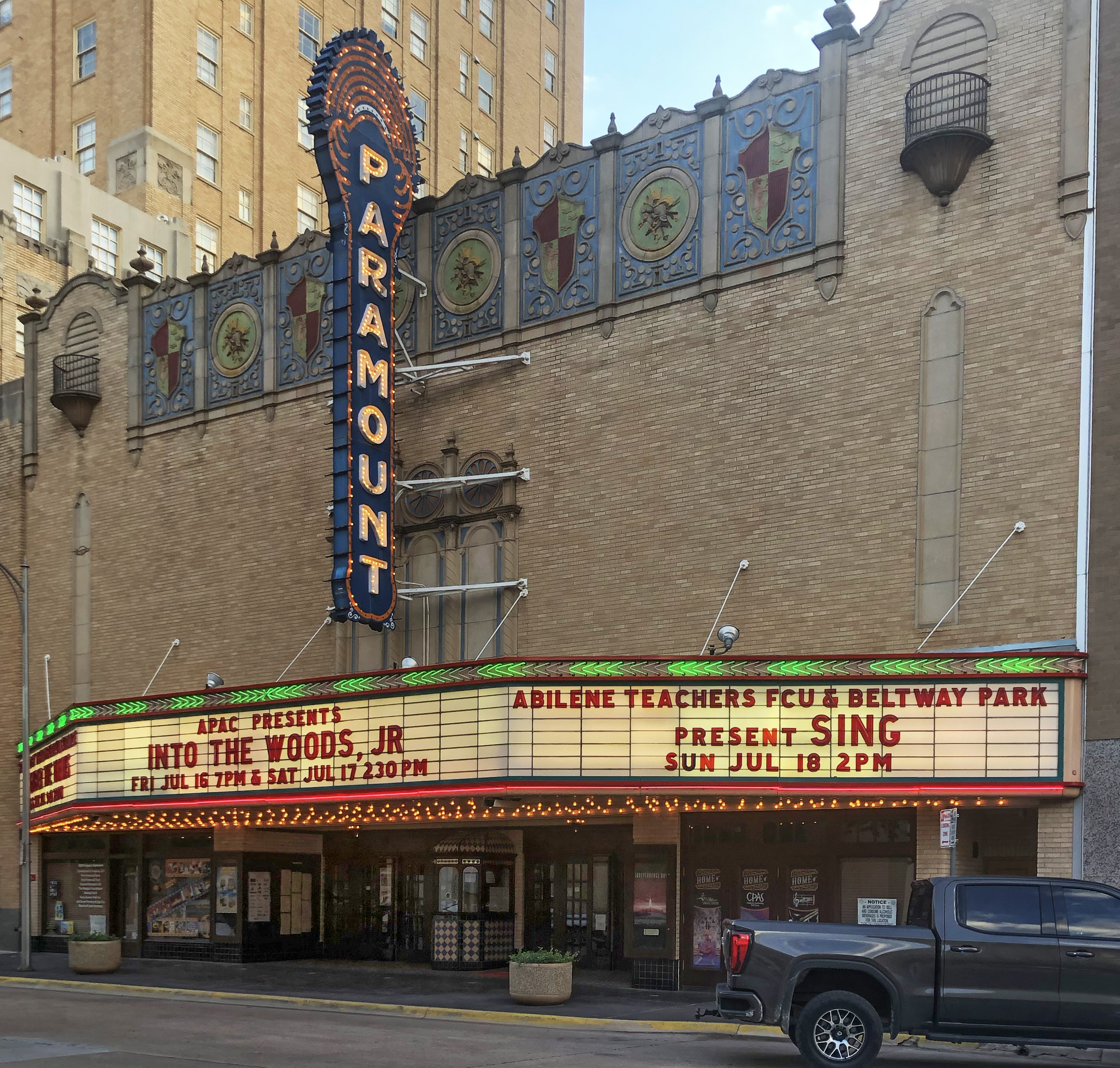
Another photo taken last weekend to send Chuck and Donna, the Paramount theater in Abilene still looks as it did 40 years ago and probably 40 years before we were there.

“I smiled when I saw your message,” I wrote back. “I’ve thought about you and Chuck often wondering where life had taken you. I remember those days of making deposits at your drive through window. I remember when you and Chuck came to our house in Mount Pleasant. It snowed, a rare treat in East Texas, and Chuck and I went for a hike in through the city park. I would love to talk and catch up,” I wrote back. “Ironically, I am driving to Abilene tomorrow and will be there through Sunday attending a family reunion. Any place there you would like a picture of?”

“Enjoy your trip to Abilene,” Donna responded. “It’s been so long since I have seen anything of the Abilene, not sure I want to see a picture. It’s nice remembering places the way they were. But, if you see something you think I would enjoy, then send a pic along. Safe travels and enjoy your family reunion.”

I look forward to getting reacquainted with Chuck and Donna soon via Zoom, as discussed in our last message.

Zoom – another marvel of the digital age putting people together.

Social media is not so different from real life. It’s best enjoyed scrolling past the drama, hatred, and negative politics that at times dominate both. I just know that abandoning social media would have cost me the opportunity to reunite with friends of more than 40 years ago.

And that’s worth checking Facebook one more time around midnight any day of the week.

—Leon Aldridge

(Photo at top of the page — Piedmont Street in Abilene where we lived in the late 70s, one of the photos I took last weekend to send our friends of more that 40 years ago. It was difficult to find places that had not changed since then.)

. . . . . . . . . . .

Aldridge columns are published in these Texas newspapers: The Center Light and Champion, the Mount Pleasant Tribune,  the Rosenberg Fort Bend Herald, the Taylor Press, and the Alpine Avalanche.

© Leon Aldridge and A Story Worth Telling 2021. Unauthorized use and/or duplication of this material without express and written permission from this site’s author and/or owner is strictly prohibited. Excerpts and links may be used, provided that full and clear credit is given to Leon Aldridge and A Story Worth Telling with appropriate and specific direction to the original content.

Appreciate the moment, cherish the memory, capture the dreams

“Time is not measured by clocks but by moments.” — Author unknown 

— Author unknown 

 – – – – – – – – – – – – – – – –

It’s about time. 

In the beginning, it was time as a youngster in the Northeast Texas community of Pittsburg watching my grandfather’s ritual. He was a man of rigid routine. The old clock high atop his chifforobe required a weekly winding. So, he wound it every Saturday night at bedtime with a big brass key, gently twisting it until the timepiece was ready for another seven days. That clock and his pocket watch marked every passing hour of his life.

I could hear the clock, but I saw only rare glimpses from my childhood vantage point. Finding a banana or an apple in the cut-glass bowl on the dining room buffet required reaching above my head. But I knew where Granny kept them. A few more years of growth would be needed before I appreciated seeing the top of the buffet or the clock.

Why he placed it up there, I never questioned. At that age, perhaps I assumed that was where everyone kept their old windup clock, although I didn’t know anyone else who had one.

After his funeral just days before Christmas of 1967, the clock was gone from its lofty perch. Granny’s story was something about a family friend who had given it to him many years ago and wanted it back after he died. I was still in college, and all I knew was he and the clock were both gone leaving only fond memories of both.

It was another time in 1977 that I met W.D. Parker in Shelby County when his daughter, Evon, and I planned to marry. Having her in my life included a tall “grandfather” style clock he made for her. Her father was a master craftsman with wood. He not only made clocks, but he also made our daughter’s bedroom furniture after she arrived. Everything he fashioned from wood was a work of art, but clocks were his specialty.

His clocks not only kept track of the hour by striking like my grandfather’s, but they also chimed a melodic verse on each quarter-hour before announcing the hour. And where winding my grandfather’s clock utilized a key, winding his big clocks was accomplished by resetting a series of weights and chains. Like the smaller clock, the mechanism required winding every seven days, but it was less of a ritual at our house. At times, winding occurred after the clock stopped. That was life with little ones.

Time and life one day went in different directions for Evon and me. All that remained were memories that included the clock’s melodic chime marking our time together when our children were young.

My children were grown and had children of their own a few years ago when I walked into an antique store in Center. I was headed for the restaurant in the back, a favorite downtown lunch spot at the time. Greeting Randall at the front counter as I had before, I glanced at the treasures for sale as I went. One old clock smiled at me as I passed, but I didn’t stop; that is until I was halfway to the back and my mind had properly processed the visual image.

I turned and walked back to face the clock identical to the one Evon’s father had made for her some 40 years ago. Surveying the tall timepiece and absorbing memories it evoked, my eyes landed on the small metal plate inscribed, “Designed and Built by W.D. Parker 1975.”

Time stood still as I ate lunch. I never took my eyes off the clock where it sat near the entrance. Lunch hastily finished; I also wasted no time telling Randall I wanted it. While it wasn’t the clock Mr. Parker built for his daughter, he made this one about the same year, and it was identical to the one in my timeless memories.

Every day since then, it has chimed reminders of the fleeting nature of time and encouraged me to keep dreaming of memories yet to be made. 

Time moves at the same pace for everyone. There’s no changing it as much as we would like to speed it up or slow it down. The old clock Mr. Parker handcrafted going on 50 years ago makes sure that I never forget. It’s about time.

And it’s always time to appreciate every moment as it comes, cherish every memory after it’s gone, and capture every dream it promises for the future.

—Leon Aldridge

– – – – – – – – – – – – – – –

Aldridge columns are published in these Texas newspapers: The Center Light and Champion, the Mount Pleasant Tribune,  the Rosenberg Fort Bend Herald, the Taylor Press, and the Alpine Avalanche.

© Leon Aldridge and A Story Worth Telling 2021. Unauthorized use and/or duplication of this material without express and written permission from this site’s author and/or owner is strictly prohibited. Excerpts and links may be used, provided that full and clear credit is given to Leon Aldridge and A Story Worth Telling with appropriate and specific direction to the original content.

Celebrating America’s birthday and her dining traditions

“I learned early in my years, that soppin’ biscuits was the best way to finish off a meal.” 

Grandma’s Kitchen blog spot

Independence Day is Sunday. In keeping with American tradition, it’s one of the holidays celebrated on the correct date and not morphed into a Monday holiday by the Uniform Monday Holiday Act in 1968. That is unless it falls on a Sunday like it does this year. Then, for businesses that close in observance, Monday becomes the holiday.

Monday holidays are not always a day off for those who produce local newspapers. In fact, the missed business day often comes with its own unique challenges because readers expect a paper the same day every week regardless of whether Monday is a holiday or not. But that’s a good thing. It’s part of what we do: being there for readers and subscribers when expected. 

Sometimes though, that missed day provides an opportunity for Murphy to get involved. You know him, the one known who menacingly creates problems when least expected. One of the more memorable Murphy Mondays recalled was not a July Fourth. Still, it did involve a great American holiday tradition: eating. 

Our intentions were good in the editorial piece that week when we urged readers to “shop at home.” The holiday rush to press, however, produced one of those problematic typos; not simply a misspelled word but the kind that changes one word into another and offers a whole new meaning to the published piece. So it was that on that memorable Monday holiday we missed a proof, and just like that, we were extolling the virtues of “sopping” local.

Believing there is a hidden opportunity in every perceived problem, we underscored the merits of shopping at home in the very next issue … with one twist. That “sopping” at home is also good and should be practiced at every Southern meal. 

My father, born near the Mississippi River banks just north of Baton Rouge, thought biscuits and gravy were an essential food group. It was his favorite breakfast. And it was my good fortune to inherit his nutritional notions. Not limited to breakfast; however, it’s a good rule for any meal in Southern dining etiquette. When gravy is left after a chicken-fried steak is gone, all it takes is one leftover biscuit or dinner roll to complete a balanced meal.

As difficult as it may be for my close friends to believe, I might hesitate long enough to see if anyone is watching me in a public setting. But at home or while attending a family reunion, if there’s gravy left and at least one biscuit not spoken for, sopping the gravy until both are gone is entirely acceptable.

Grandma’s Kitchen blog spot validates the practice of sopping by establishing guidelines. “If you didn’t save that last big bite of biscuit, then it was okay to pinch off a piece from another ‘good’ biscuit. I do believe that was the only food that you could touch, take off what you wanted and put the rest back. You always knew that someone would use the rest of the biscuit, or it would be eaten as we cleared the table.”

Borrowing from Irish poet and playwright Oscar Wilde, “I can resist anything except temptation.” So, whether it’s a Monday holiday or any other day of the week, pass that leftover roll or biscuit, please. 

Whatever your Independence Day menu may include, take time to reflect on this great day, the birthday of our nation. Let’s unite in a pledge to lead America on a path of prosperity and peace. Let’s salute the brave men and women in uniform who are on duty and working to maintain our freedom while we celebrate. And let’s all enjoy a happy and safe Fourth of July holiday.

God bless America … and her dining traditions.

—Leon Aldridge

. . . . . . . . . . .

Aldridge columns are published in these Texas newspapers: The Center Light and Champion, the Mount Pleasant Tribune,  the Rosenberg Fort Bend Herald, the Taylor Press, and the Alpine Avalanche.

© Leon Aldridge and A Story Worth Telling 2021. Unauthorized use and/or duplication of this material without express and written permission from this site’s author and/or owner is strictly prohibited. Excerpts and links may be used, provided that full and clear credit is given to Leon Aldridge and A Story Worth Telling with appropriate and specific direction to the original content.