Thankful for the glow of wood burning flames

“The joy of the open fireplace is playing with fire without being accused of playing with fire.” ― Gene Logsdon, “You Can Go Home Again: Adventures of a Contrary Life” 

– – – – – – – – – –

Despite the challenges imposed on family gatherings this year, I hope that Thanksgiving was blessings and good times at your house.

Thanksgiving weekend a few years ago, this space was used to opine about flames flickering in a fireplace. I described how the warmth and the fall colors outside my breakfast room window combined to inspire a holiday mood as I nurtured words into a newspaper column for the next edition. 

That same breakfast room window has again debuted picture-perfect Fall hues for my favorite time of the year with family and friends (shhh … don’t tell the holiday gathering police). Again I am crafting a column for another Thanksgiving season, and what better place to do that than by a fireplace. 

Column writing or a journalism career were neither one on my radar in 1971 when I finally accumulated enough hours to wrangle a degree in psychology and art from East Texas State University. That credit likely belongs to my reading Paul Crume’s weekly column, titled “Big D,” that appeared every day on the Dallas Morning News‘ front page for 24 years.

Crume’s best-known column was “Angels Among Us.” The last time I checked, running that piece is still a Christmas tradition for the newspaper 45 years after Crume’s death. My favorite, “Christmas Fires,” spoke to my love for the hypnotic effect of flames, something I still enjoy whether in a cozy fireplace, a backyard burn pit, or a good brush pile on a drizzly fall afternoon.

Ironically, this season’s flickering fireplace flames serve to recant opinions expressed in that column I penned a few years ago declaring my new gas logs as, “an intelligent advancement in the right direction.” I made that declaration saying, “For the first time in all my years of home ownership, I am now relaxing in front of a fire that rises from gas logs.” I rambled in glee about, “Gone are the days of buying or cutting firewood, hauling and stacking it, cleaning the fireplace and the chimney in springtime, and a smoke-filled house when I forget to open the damper.”

Honestly, making that transition to fake fire did not come easy. The gas logs were purchased before procuring a plumber to make the connection. His sobering news that installing a proper gas line to supply the logs would cost nearly three times what the logs themselves cost was a setback, to say the least. But after weeks of watching the glowing fireplace picture pasted on the cardboard box of burner-equipped ceramic timbers sidelined near the fireplace, I bit the bullet bringing fireplace flames to life as easy as turning a knob.

Ironic perhaps was my admission, “Truthfully, when considering the switch from a real fireplace, I feared missing the satisfaction of poking at glowing late-night coals and the smell of wood-burning.” In retrospect, that was probably the most accurate statement in that piece. So, out the faux logs are coming making way for the return of warmth, glow and smell of real wood burning. I’m looking forward in the weeks ahead to once again enjoying mornings reading a good book with coffee by the fireplace, afternoons of fireside naps on the couch and nights of column writing inspired by Paul Crume’s “Christmas Fires” column. Oh, and the satisfaction of poking at glowing late-night coals. I have to admit there really is something to playing with fire without being accused of playing with fire.

As the aforementioned weeks ahead pickup speed toward Christmas and the last vestiges of 2020, the “most thankful award” may be seeing this year come to an end.

But, despite the conflict, catastrophe, and confusion we’ve endured in 2020, I am thankful that the U.S.A. remains the best place on God’s green earth to live … and that I have my real fireplace back.

—Leon Aldridge

. . . . . . . . . . .

Aldridge columns are published in these Texas newspapers: The Center Light and Champion, the Mount Pleasant Tribune,  the Rosenberg Fort Bend Herald, the Taylor Press, and the Alpine Avalanche.

© Leon Aldridge and A Story Worth Telling 2020. Unauthorized use and/or duplication of this material without express and written permission from this site’s author and/or owner is strictly prohibited. Excerpts and links may be used, provided that full and clear credit is given to Leon Aldridge and A Story Worth Telling with appropriate and specific direction to the original content.
Let me envision that dream one more time

“Sit back and dream of a soft June night when spring and summer join together, and the stars twinkle in the velvet cushion of sky overhead. And you two are one with the night and the mood, moving in the breeze in the open splendor of your Buick Convertible.” —1954 Buick magazine ad

– – – – – – – – – – – –

It would be a decade after that ad appeared before I bought my first car as a high school sophomore, but what I wanted that car to be came into focus early. I connected with that vision of the breeze blowing through my hair and those stars twinkling overhead. I wanted a convertible. 

Even before DPS Trooper Gene Campbell approved my ticket to drive by stamping “Restrictions Removed” on my learner’s license, I had my eye on a Model A Ford roadster rusting in a Titus County field. I remember it like yesterday waning in the weeds with its deteriorated cloth top waiting for someone to rescue it for some summer fun: someone like me.   

Summer 2020 looms in the rear-view mirror now, although in East Texas, that just means it’s bearable to get outside the house in “the heat of the day” as my grandmother used to say. My love for automobiles in any season has always led me to believe a journey is not about the route you take or where you are going as much as it’s about the vehicle in which you are traveling. And that’s especially true when the scenic route is in a car with a top that goes down. 

As the ad suggested, convertibles put you at one with nature, unlike anything else except a motorcycle, which is probably why I’ve owned several of those, too. They let you become a part of the countryside instead of just passing through it. You get an unobstructed view with all the sights, sounds, and aromas to go with it.

Although my first car was not a convertible, I came close to buying one while still in high school. One summer night while at the Dairy Queen in Mount Pleasant, I heard that Ray Baker was selling his ’59 Chevrolet drop-top, and I was knocking on his door before I finished my chocolate shake. As I looked up at the stars from the driver’s seat, I fantasized about the old car ad and almost heard the song “One Summer Night” by The Danleers playing on the radio. The car and the moment caught my heart, but the reality of my “after school job” budget let it slip through my fingers. I still think about it. 

A couple of years later, a 1929 Ford Model A roadster like the one I had fallen in love with before I had a driver’s license turned my head. While working a summer body shop job for my uncle in California, I bought one with a 50’s vintage DeSoto Hemi motor, no fenders, and no top. The original Ford soft top was long gone and of little concern for a Southern California hot rod. Thus, my first genuine moving in the breeze moments under the stars were experienced in Southern California in the summer of 1967.  

My first genuine convertible with a top that went up and down was a few years later in East Texas. The 1970 VW rag top purchased from John Paul Jones used car lot in Naples was the same color as the ’59 Chevy I had drooled over some years earlier and was one of the most fun cars I’ve owned. 

Convertibles of any kind are fun, at least in my book. In the decades since those early flings, I’ve enjoyed 23 automobiles equipped to allow breezes to flow through my hair and afford me a view of the stars at night. Recalling that list last week with fond moments of each one, I’m now contemplating selling my ’57 Thunderbird convertible … without plans to replace it. The herd needs thinning as three classic cars are becoming more than I can properly care for. And sentimental value would make it difficult to part with the other two, both hardtops. 

But that’s all right. At this age, what gray hair I have left is thin and doesn’t catch much of a breeze. Plus, I’m usually in bed asleep these days by the time the stars come out anyway.

Where is that ad? Let me envision that dream one more time before I put out the ‘for sale’ sign.

—Leon Aldridge

(Photo at top of the page: A summer night shot of “Black ‘Bird” as I call her. While I do like the car a lot, that ray of light is not from on high, it’s a streetlight. And yes, my shoes are the same kind immortalized in song by Carl Perkins and Elvis Presley.)

. . . . . . . . . . .

Aldridge columns are published in these Texas newspapers: The Center Light and Champion, the Mount Pleasant Tribune,  the Rosenberg Fort Bend Herald, the Taylor Press, and the Alpine Avalanche.

© Leon Aldridge and A Story Worth Telling 2020. Unauthorized use and/or duplication of this material without express and written permission from this site’s author and/or owner is strictly prohibited. Excerpts and links may be used, provided that full and clear credit is given to Leon Aldridge and A Story Worth Telling with appropriate and specific direction to the original content.

If he were here today, I would thank him again

“Six of us huddled there returning fire for several hours until the village was secured. Two of us walked out.” 

— Master Sergeant Leon Aldridge, U.S. Army 1942-1945

– – – – – – – – – – – – – – – – –

My father and I stood at the base of massive stone buttresses supporting the majestic Cologne Cathedral that has towered above Germany’s Rhine River since 1248.

That sentence introduced this column some 25 years ago for Veterans Day. I still get requests for it, and it was used again this week for Veterans Day in the newspapers that publish my column. I may write a better one some day, but for now it remains my favorite Veterans Day column about my favorite Veteran.

That November in 1984 when we stood together, I marveled at the incredible sight, not realizing until I saw Dad’s tears that he was reliving a night 40 years earlier. “See that spot there,” he said, pointing into a crevice between two spreading buttresses supporting the more than 700-year-old structure.

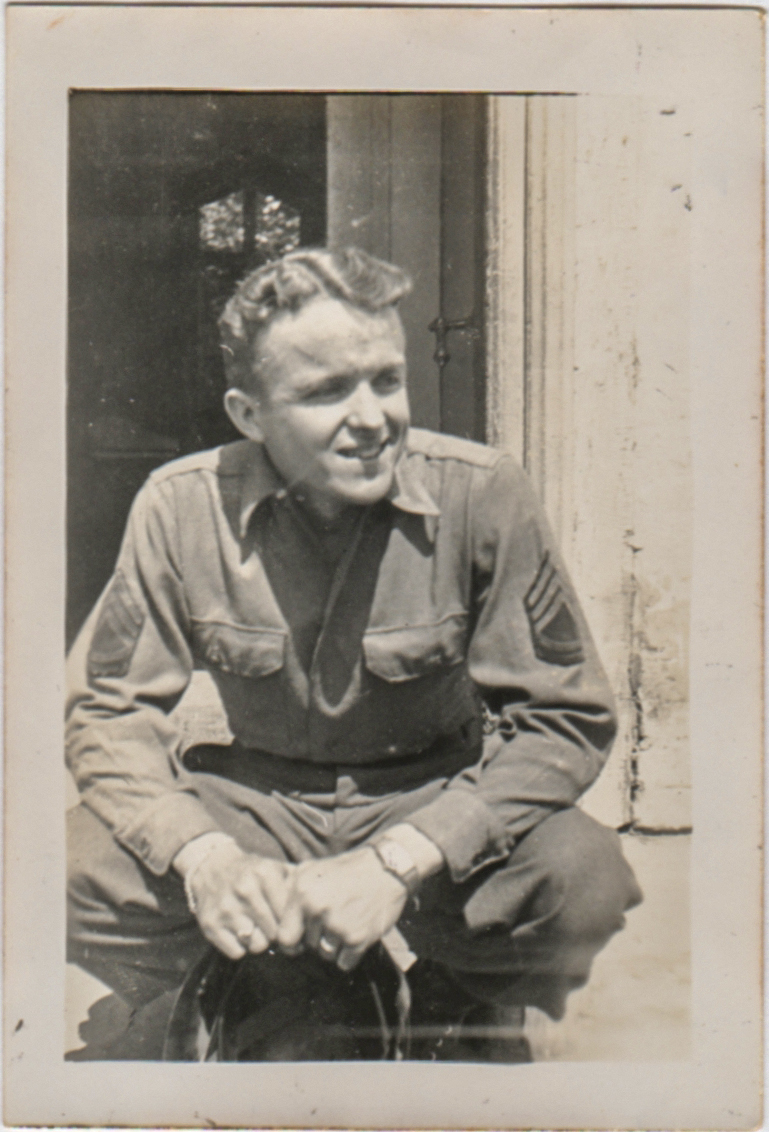
Leon D. Aldridge in a photo from a scrapbook my Mom assembled as he sent photos to her. There is no notation about where or when it was taken. The sergeant’s stripes on his sleeve indicate it would have been toward the end of his service which would indicate about 1945 in Germany.

“Forty years ago,” he said solemnly, “half a dozen of us huddled there all night. The rest of our outfit was scattered down toward the river. We secured the road for the infantry behind us before encountering what was left of German defenders in the village. The gunfire was bright as day. We weren’t sure we’d see the sunrise,” he said before pausing. “Six of us huddled there returning fire for several hours until the rest of the unit moved up to secure the village. Two of us walked out.”

Dad talked very little about his service, at least not about battlefield experiences. On this rare occasion, I just listened. “When I walked out of this spot, I never expected to return here again,” he said.

Leon D. Aldridge graduated from Pittsburg High School in 1941 as Hitler was marching through Europe. He was a freshman student at Texas A&M in December when Japan attacked Pearl Harbor. Not long after, the letter arrived. “Greetings, having submitted yourself to a committee composed of your local neighbors and friends, you have been selected …..” 

After reporting to Camp Gruber, Oklahoma, he was assigned to combat engineers training in Dixon, Tennessee, with the U.S. Army 276th Engineer Combat Battalion known as “Rough and Ready.”

After training, Private Aldridge shipped out for Belgium, but not before meeting a 1941 graduate of Winchester, Kentucky High School who would be his wife of 63 years and my mother. Before V.E. Day arrived, he would rise to the rank of Master Sergeant. And the 276th Combat Engineers would return home wearing battle ribbons for three major campaigns: Ardennes, Rhineland, and the Central Europe Campaign. 

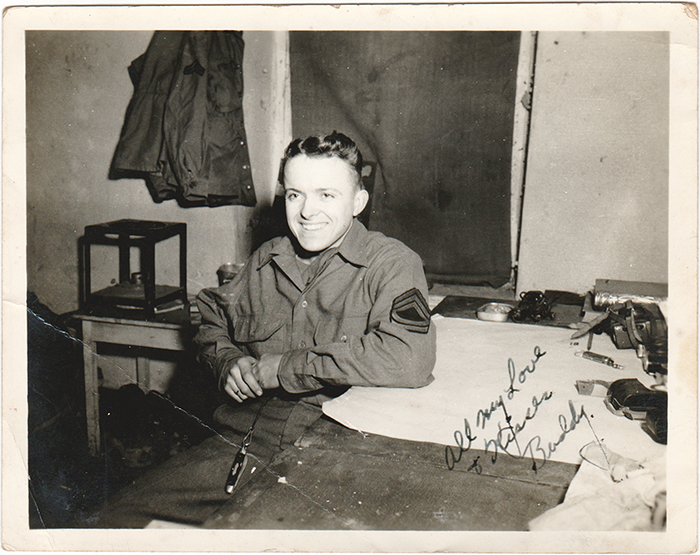
On the back of many of the photos Dad sent Mom, he wrote: “All my love to my darling wife,” and signed them “Buddy,” a childhood nickname given him by his mother that was used by most family members all of his life. On this one, he wrote his notation on the front. “All my love & kisses, Buddy.”

“Remagen, about an hour down the river,” he pointed as we walked, “is where I was standing on the abutment when the bridge fell.” Combat engineers preceded infantry and armor to build roadways and bridges. Hence, his presence at the Ludendorff Bridge at Remagen, a pivotal point in the European campaign and the eventual defeat of the Axis powers. The bridge across the Rhine River was the last German hope against the advancing Allies. After allowing German forces to cross, Hitler’s troops attempted to destroy the structure with explosives, substantially damaging the bridge but not destroying it.

According to “ROUGH AND READY Unit History 276th Engineer Combat Battalion” by Allen L. Ryan, The “Rough and Ready” worked under gunfire for five days to complete repairs while units attached to the 276th built floating structures called “Bailey Bridges” downstream. On March 9, 1945, they returned the bridge to operational status, and American troops crossed as combat engineers continued working to strengthen it. On March 17, as the battalion replaced wooden flooring, steel trusses began to creak and groan, rivets started “popping like gunfire,” according to my father, and the structure collapsed into the Rhine. “Some scrambled for safety,” he said, “but many were not so fortunate.”

“I had been on the bridge earlier that morning,” he continued. “Part of the unit fell back for materials and supplies. We were waiting for the unit ahead of us to advance. Just as we started onto the bridge, it fell. Five more minutes and I would have gone into the river with it and the others who were lost that day.”

My father died in 2007. He was proud of his service. His story of duty and sacrifice as part of the nation’s military is but one small example of why America has survived for 244 years as a free and proud nation. Fortunately, I got the opportunity to thank him. If he were here today, I would hug him and thank him again. 

We live in the land of the free because of the brave who have served. Thank a veteran today and every day for their service to our country. 

—Leon Aldridge

Photo at top of the page: Leon D. Aldridge (far right) at the entrance to Battalion CO, Olpe, Germany. — Photo credit “ROUGH AND READY Unit History 276 Engineer Combat Battalion” by Allen L Ryan.

. . . . . . . . . . .

Aldridge columns are published in these Texas newspapers: The Center Light and Champion, the Mount Pleasant Tribune,  the Rosenberg Fort Bend Herald, the Taylor Press, and the Alpine Avalanche.

© Leon Aldridge and A Story Worth Telling 2020. Unauthorized use and/or duplication of this material without express and written permission from this site’s author and/or owner is strictly prohibited. Excerpts and links may be used, provided that full and clear credit is given to Leon Aldridge and A Story Worth Telling with appropriate and specific direction to the original content.

Maybe walls can’t talk, but frightened folks will tell it all

“If these walls could talk, I wonder what secrets they’d tell.”

— quote from “Just One Day” by American young adult fiction author, Gayle Forman

– – – – – – – – – – – – – – – – –

Who hasn’t looked at an old building and thought, “If only these walls could talk?” As quickly as the world changes around us today, a structure doesn’t really have to be that old to have witnessed events worthy of remembrance including some that make for great stories.

While admiring renovations that are changing the looks of Center’s downtown square last week, I began to think of the buildings that I could see by standing in just one spot that have changed since I first traveled the square some 40-plus years ago.

Although I had heard the saying about old buildings talking long before a trip to Europe in the early 80s, my travels provided new meaning. “Old building” in many parts of the world covers a lot more history than it does in the U.S. Many structures in Europe had already qualified for historical markers by the time Paul Revere took a night off from silver smithing to make his famous midnight ride in the infancy of the American colonies.

Old buildings were still on my mind as I left the square to ride over to Pineywoods Seafood for supper. James and Anita moved their restaurant to its current location on Hurst Street some 20 years ago from a small building at Southview Circle. I had always thought the Hurst Street building was built as a Pit Grill in the 1970s. However, someone corrected me saying they thought it was an eatery called Mr. Winkie’s before it was the Pitt Grill.

Whatever the restaurant’s history, looking toward the far end of the building from the front door, the familiar floor tile design was even more noticeable with fewer tables for COVID prevention seating requirements. A flashback of my favorite story about the place made me smile. While bricks and mortar cannot relate the story, it’s one I’ve shared many times.

During its Pitt Grill time, about 1980, a big drug bust went down in Center one afternoon. State agencies arrived with 50-some-odd warrants in hand to round up dealers. The J.P.’s desk was moved to the courthouse lawn to expedite processing of arrestees into the local jail. Shreveport television stations swarmed with mobile news units, and law enforcement vehicles were moving on every street well into the evening setting the community abuzz with the news.

Hardly noticed that very same afternoon was the arrival of a newspaper owner from up in Arkansas to discuss the potential sale of his business over a dinner meeting planned at the Pitt Grill.

Then owner of the East Texas Light newspaper in Center, Jim Chionsini, our Arkansas visitor, and I drove around the square during the peak of the activity headed to the Pitt Grill for dinner marveling at the biggest drug bust in Shelby County history.

The evening’s meeting to discuss business warranted dressing nicely, therefore all three of us were sporting jackets and ties for dinner. And being as how it was a business meeting; we were also toting brief cases and files.

So, three guys completely out of context for the Pitt Grill enter and pause at the door to be seated. The first person to spot us was a young waitress bounding out of the kitchen delicately balancing a tray loaded with water glasses above her head on one hand. She took one look at us, stopped dead in her tracks, threw both hands in the air sending the tray of glasses flying while loudly exclaiming, “It wasn’t me. It’s my boyfriend you’re looking for … and I told him he shouldn’t be sellin’ that stuff. I had nothing to do with it, I promise. I promise. Please don’t arrest me.”

Silence filled the restaurant before Jim, struggling to maintain a straight face, said with a smile, “We just want a table for three please.”

Leaving Pineywoods with my take-home order last week, I was still laughing at the memory trip I had just taken back some 40 years. Maybe walls can’t talk, but if they could, they might tell the story about the night a young waitress was talking—and she was telling it all.

—Leon Aldridge

. . . . . . . . . . .

Aldridge columns are published in these Texas newspapers: The Center Light and Champion, the Mount Pleasant Tribune,  the Rosenberg Fort Bend Herald, the Taylor Press, and the Alpine Avalanche.

© Leon Aldridge and A Story Worth Telling 2020. Unauthorized use and/or duplication of this material without express and written permission from this site’s author and/or owner is strictly prohibited. Excerpts and links may be used, provided that full and clear credit is given to Leon Aldridge and A Story Worth Telling with appropriate and specific direction to the original content.