Delayed reactions seem to run in the family

“A man never sees all that his mother has been to him until it’s too late to let her know that he sees it.”

—W.D. Howells, American author, editor, and critic

– – – – – – – – – – – – – – – – –

June 12 starts the same way for me every year. Over the years, I’ve observed the date in many ways, but my first thought is always, “Happy birthday, Mom!” Indianola Johnson Aldridge, better known to most as “Inky,” saw 87 birthdays before going to her eternal reward ten years ago this coming December.

The infrequent schedule of those aforementioned thoughts of mine means I crafted this column about Mom’s birthday more than week ago by the time you are reading it now. It’s a deadline thing that has to do with submitting my column to the newspapers a few days before they run there which is a few days more before it’s on the blog on Saturday. All that is to say that anything that far in advance to coincide with the date these days is an iffy proposition for me—sort of  like getting my Christmas shopping done early.

Christmas shopping was a routine for Mom, though. It included stashing away a meager amount every month in her Christmas Club account at the First National Bank in Mount Pleasant and making sure some gifts were on layaway by the time many folks were enjoying the last days of summer at the beach.
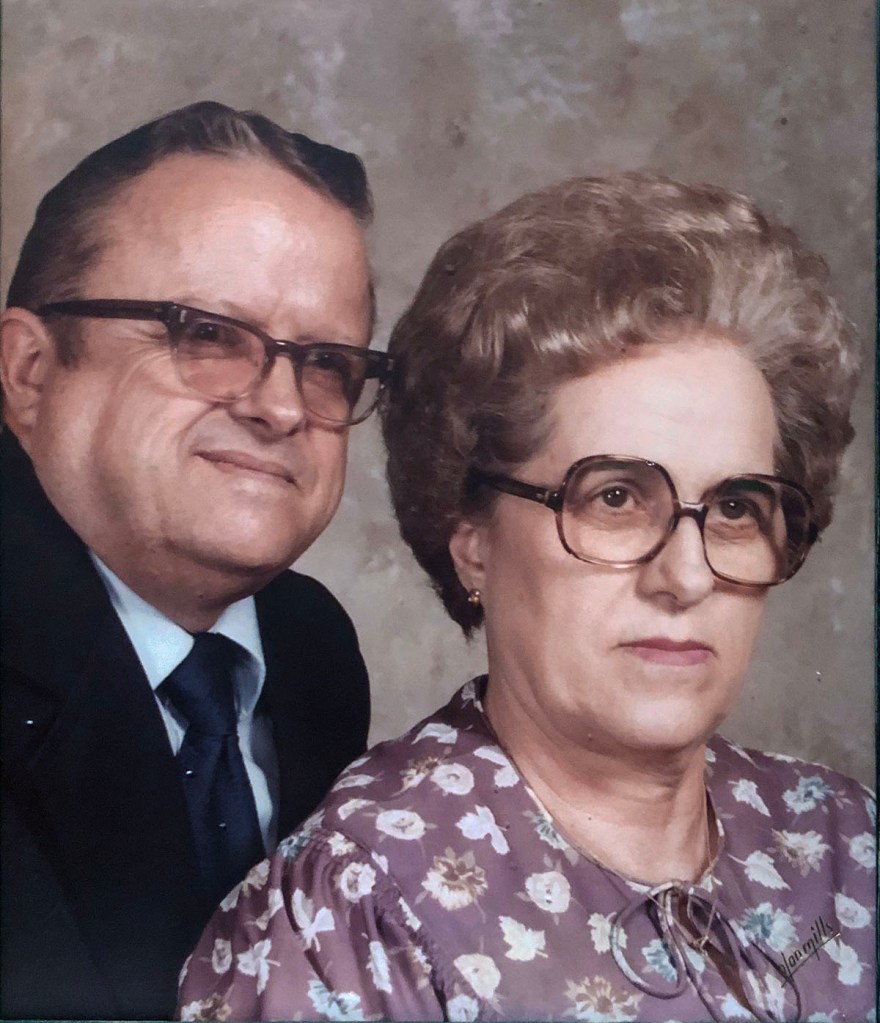
Mom and Dad, aka Leon and Indianola (Inky) Aldridge about 1978. Since I missed Father’s Day, I thought I would include Dad in Mom’s birthday column.

Maybe that was easy for her because to my knowledge, she never set foot on a beach. Traveling very far from home for pleasure was a rare indulgence for my mother. The scope of her travel was primarily Johnson family reunions between Texas and Kentucky and camping at Albert’s Pike in Arkansas. Add one conventional family vacation in our ’58 Ford station wagon to Arkansas in 1960, one “girl’s trip” to the Northeast with her sisters in the 70s, and an 80s trip to Europe on which I took her and Dad, and that about sums up the extent of her travels that I recall. At home with Dad and whatever cat she cared for at the time is where she could usually be found.

Mom loved cats. Pictures of her youth in Kentucky depict a black cat she talked about frequently. Maybe it was just coincidence, but the last cat she had was a carbon copy of that one. I think it’s more than coincidence that pets often live up to the image of their names. Mom’s final feline was tagged “Taz,” a namesake derived from the Tasmanian Devil cartoon character the critter easily emulated. But while that was without a doubt the meanest cat I’ve ever seen, in her own funny manner, she loved him.

Mom was funny in many ways though, not the least of which was her reaction time to a joke. Now I’m not saying Mom was slow to get it, but she was usually the last one to laugh. It wasn’t unusual to hear her chuckling alone long after everyone else’s laughter had subsided. It was one day at the vet’s office that humor and her cat crossed paths for a story that she shared many times. Seems that Taz’s reputation was shared with many including Mount Pleasant veterinarian and my fellow MPHS classmate of 1966, Jerry “Gus” Skidmore. Humor is Gus’s specialty in life. If there is humor to be had, Gus never misses an opportunity to be the instigator.

Mom entrusted the care of her favored feline to Gus, but getting Taz to the vet’s office required special handling beyond that of coaxing him into a conventional cat carrier. He went kicking, hissing, and caterwauling in a tow sack or a pillowcase. Mom’s recounting of her very first bagged cat delivery for annual inoculations always focused on how office onlookers glanced suspiciously at her “cat carrier” as it thrashed about emitting evil noises.

In true Skidmore fashion, when Gus returned the cat to Mom in the waiting room a short time later, he played the part for a laugh. According to Mom, when the vet emerged holding the still thrashing and howling bagged cat at arm’s length, his arms and head were haphazardly wrapped in loose and skewed white bandages that suspiciously resembled toilet tissue. In her allotted time to comprehend what was going on, Gus announced with a laugh, “It was close Mrs. Aldridge, but I got it done.”

Mom laughed whenever she told the story, adding how thoughtful Gus was to risk life and limb caring for her ornery cat, and that his joking always made her laugh. But as if she still weren’t sure, she usually added with some delay, “At least I think he was joking.”

Funny how my fully appreciating how much I’m like Mom has come with some delays of my own.

—Leon Aldridge

. . . . . . . . . . .

Aldridge columns are published in these Texas newspapers: The Center Light and Champion, the Mount Pleasant Tribune,  the Rosenberg Fort Bend Herald, the Taylor Press, and the Alpine Avalanche.

© Leon Aldridge and A Story Worth Telling 2020. Unauthorized use and/or duplication of this material without express and written permission from this site’s author and/or owner is strictly prohibited. Excerpts and links may be used, provided that full and clear credit is given to Leon Aldridge and A Story Worth Telling with appropriate and specific direction to the original content.

Renewing an old love that’s lingered for years

“True love stories never have endings.”

—Richard Bach, American writer and author of ‘Jonathan Livingston Seagull’

– – – – – – – – – – – – – – – – –

Frequent followers of this forum are already familiar with many of my vices and will understand when I say my heart fluttered the first time I saw her. She was a beauty, and she filled my heart with music.

That first meeting was innocent enough. I was out of town with spare time on my hands when she caught my eye. I almost kept walking but stopped to glance over my shoulder for a second look. She was looking back at me. Beckoning to me. Calling my name. Better judgment told me not to go back, but my heart pleaded for a closer look—maybe just one touch.

Having admired others like her before, I began the flirting process. You know—asking questions, acting interested, lingering. She had seen better days but one could say the same for me. Besides, I knew some old-fashioned TLC and devoted attention would give her a new lease on life.

In her heyday of the mid to late 50s, she was the center of attention where fun flourished in places like late-night greasy spoon cafes when Hank Williams was, “So Lonesome I Could Cry.” Burger joints where the bobby-sock crowds swayed to “Sixteen Candles.” Or lakeside concession stand pavilions where teens rocked to Chuck Berry’s “Johnny B. Goode.”

Alone and forlorn when I found her, most would have said she was over the hill. Retired many years ago and relegated to linger in silence as a reward for her part in the history of music just didn’t seem fair. Without help, the old girl was down to her last dime.

She still had her pride though, she wasn’t cheap. And this wouldn’t be the first time a wild impulse would come between me and my money. I knew better. I really needed to get past these kinds of things at some point in my life, but that day was not to be the one. I wanted her. My heart won, and she went home with me to Center where she entertained family and friends for several years before we moved to the Texas Hill Country. Even there, she was often still the center of attention for gatherings at my house.

But then came our return to Center some years ago where something went wrong. Looking back, I have no explanation. Maybe it was the small house we started out in, maybe it was too many moves in too few years. For whatever reason, she sat ignored, waiting for me to come to my senses and throw more money at the aged dance hall queen. I thought of her often, recalling the good times we had together. Those memories lingered until last week when the words of a Willie Nelson song, “… forgetting seems to take the longest time,” stayed on my heart, and I finally brought her out of retirement again.

It took all afternoon to uncover her, move her out of storage, and haul her home on a trailer. She’s no lightweight at 355 pounds. After a couple of days spent cleaning, polishing, and inspecting, I flipped the power switch. She flickered for a moment then in all her radiant beauty, lit up the room for the first time in many years.

Dropping a dime down the coin chute and selecting K-1 sent a record spinning that produced booming “High Fidelity” notes of Big Joe Turner’s “Shake, Rattle, and Roll” to compliment her glowing lights. The sentimental sensory overload of the long overdue reunion filled my heart with the same joy she had given me when I first brought her home some 35 years ago.  

I’ve promised her this time that she and I will never be apart again. After all, there just aren’t that many 1955 model 100-J Seeburg jukeboxes still around.

—Leon Aldridge

. . . . . . . . . . .

Aldridge columns are published in these Texas newspapers: The Center Light and Champion, the Mount Pleasant Tribune,  the Rosenberg Fort Bend Herald, the Taylor Press, and the Alpine Avalanche.

© Leon Aldridge and A Story Worth Telling 2020. Unauthorized use and/or duplication of this material without express and written permission from this site’s author and/or owner is strictly prohibited. Excerpts and links may be used, provided that full and clear credit is given to Leon Aldridge and A Story Worth Telling with appropriate and specific direction to the original content.
Inspiration for learning comes from many sources

The more you read, the more you will know, the more you learn, the more places you’ll go.

— Dr. Seuss

– – – – – – – – – – – – – – – – –

A desire for learning can be inspired by many factors unique and personal to each individual. Learning can come from classrooms, trade schools, military service, experience, on-the-job training, or one of the best teachers around, the “school of hard knocks.”

Center friend Tim Perkins expressed his inspiration for learning a couple of weeks ago explaining how a particularly hard summer job instilled in him the drive to get a college education to avoid jobs like that one in the future. Tim’s story was reminiscent of a summer job in 1968 that was no doubt the reason I persevered to get a four-year degree as well, something I proudly accomplished in just five years.

I had walked the stage at Mount Pleasant High School a couple of Texas summers earlier, and inspired by Mr. Murray’s mechanical drawing classes, knew I was going to college to be an architect. However, first-semester math classes with names I couldn’t pronounce didn’t calculate well for me and sent me searching for new inspiration.

Psychology lured me down the road to a degree and work in special education before forks in my career path led me to an offer that paved the highway for my future. Based solely on hobby-level photography skills, Morris Craig offered me a job at his newspaper, The Naples Monitor “ as he put it, “until you find what you’re looking for.” As it turned out, something for which I was not looking and for which I had no experience or education, turned out to be my path to a rewarding career in communication doing something I loved.

First lesson learned: selecting a profession for the rest of your life at 18 can be a toss of the dice. Second lesson learned: Even if you miss the mark to begin with, that drive to acquire knowledge will take you many more places than you would have gone without it.

If I possessed a drive for learning before that summer of ’68, it got a dose of steroids when classmate and friend since the seventh grade David Neeley and I worked for Hinton Production Company in the Talco oil fields of northern Titus County. Those were the days when derricks dotting the skyline readily identified an oil field, and Talco was well defined by hundreds of the tall structures as well as a plethora of pump jacks steadily extracting black gold from the depths of Northeast Texas.

David’s job was helping repair and overhaul the massive oilfield pump motors. I worked on the maintenance crew responsible for every hot, dirty, sweaty, oil-covered, heavy-lifting, back breaking, knuckle-busting, repair job in the oil field. The “exciting and character-building job,” as my father liked to call it, usually involved a derrick or a pump jack and included things like replacing a broken sucker rod, one of the series of rods connecting the pump jack above ground to the pump itself hundreds of feet in the ground. That meant capturing and extracting the broken piece from somewhere way down in the hole, a process requiring a team of healthy and able bodies, a large “gin-pole” truck and an assortment of large and heavy specialty tools.

The goal, of course, was to keep that “Texas Tea” flowing which other days could mean replacing a broken “bridle” on a pump jack: the big “horse head” looking things going up and down like a see-saw. The heavy cable bridle apparatus attached to the horse head out on the end of the arm called the “walking beam.”

The “exciting and character building” part of that job was enjoyed by the person privileged to climb the ladder up to the walking beam, throw one leg over and shinny out toward the end while lugging an assortment of large and heavy tools. Once at the end of the walking beam, the objective was to remove the broken bridle and replace it with the new one being hoisted up.

It wasn’t enough that this duty was challenging to begin with, but a second and often overlooked objective was watching for wasp nests of gargantuan proportions hidden in nooks and crannies along the walking beam. Encountering one unexpectedly required a rapid reverse shinny and daring descent on the ladder utilizing no more than every other rung until jumping appeared as the better alternative to dealing with the agitated and angry insects.

For reasons I don’t recall, I always assumed I would go to college and always knew my ticket would be whatever jobs I could work. There was plenty of love and encouragement from my parents, but very little money for college.

As for Dr. Seuss’s “… the more you learn, the more places you’ll go” admonition, all I can say is the Talco oil field was one place I didn’t ever want to go again if I didn’t have to. If the notion of quitting school before earning a diploma ever crossed my mind, that summer in Talco—as Tim succinctly said of his experience—“made a college boy out of me.”

—Leon Aldridge

Aldridge columns are published in these Texas newspapers: The Center Light and Champion, the Mount Pleasant Tribune,  the Rosenberg Fort Bend Herald, the Taylor Press, and the Alpine Avalanche.

© Leon Aldridge and A Story Worth Telling 2020. Unauthorized use and/or duplication of this material without express and written permission from this site’s author and/or owner is strictly prohibited. Excerpts and links may be used, provided that full and clear credit is given to Leon Aldridge and A Story Worth Telling with appropriate and specific direction to the original content.
Feats accomplished only in the bliss of youth

“Age is not how old you are, but how many years of fun you’ve had.”

—Matt Maldre, Senior Web Marketing Strategist at Tribune Content Agency

“How’d we do that,” I quizzed a friend a couple of weeks ago. “Man, I don’t know,” was his reply. “But we sure had fun doing it.”

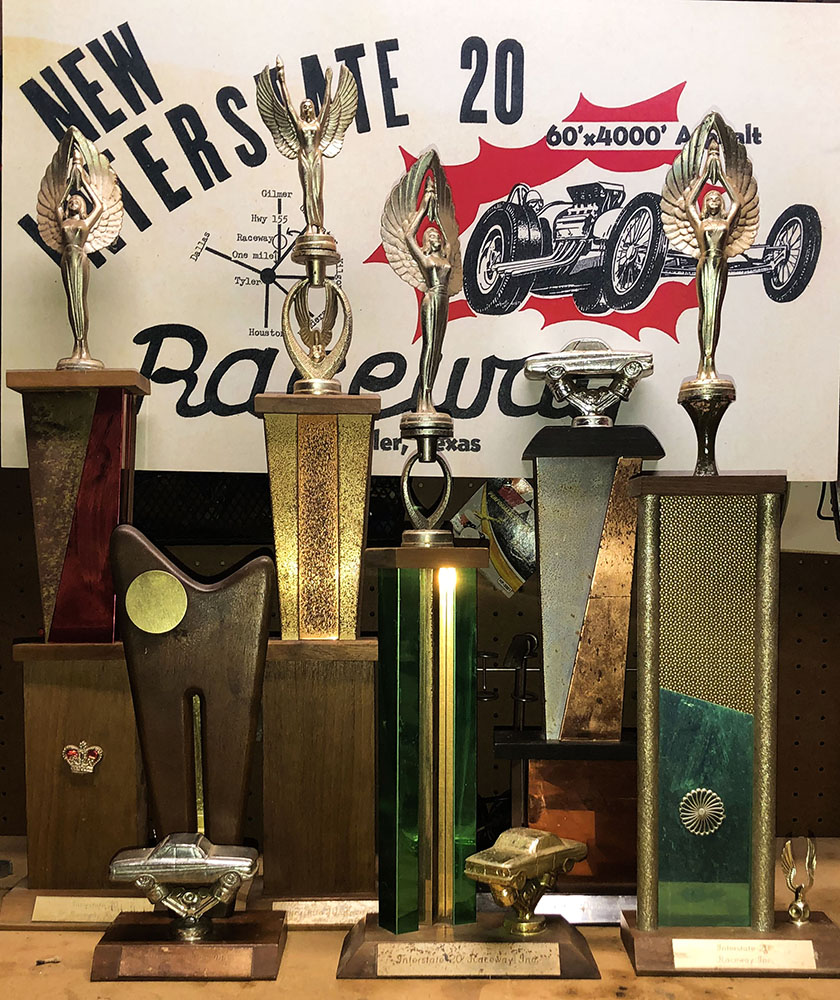
That conversation convened over recently found memorabilia: photos and drag strip trophies stirring fond memories of fun with fast cars at race tracks more years ago than seems possible. Looking at the pictures made it seem like yesterday but looking in the mirror reminded me it was more like 50 years ago.

That was a time when seemingly superhuman feats were accomplished fueled only by the blissful confidence of youth and an addiction to speed. Where the money and time came from, well that remains as big a mystery as where the years went.

That recent East Texas conversation ironically coincided with a Facebook comment I read written by someone in Canada I’ve never met, but someone who undoubtedly was making very similar memories way north of East Texas during that same era. Paul Polly’s post on the Oldsmobile W-31 Owner’s Group page about the cars we raced and the things we did to race them then was hauntingly familiar, “… every dollar I had went into that race car, best I could afford. Many a summer night I slept in the tow car. I worked two jobs back then wages were not like today. You raced, you loved it, you slept it and all you ever wanted to do was be at that race track. My parents thought I was nuts … but I would never trade one moment nor change one thing I did to race my W-31!”

East Texas in the spring of 1969 found me about halfway through a college education, give or take a party or two, at East Texas State University, (Texas A&M at Commerce today). My self-funded education program included commuting from Mount Pleasant so I could work an almost full-time job in the Sandlin Chevrolet-Olds body shop, plus a few hours for another local shop some nights.

Although already a racetrack regular with whatever used car hot rod daily driver I kept running at the time, dedicating a brand new special-order high-performance Oldsmobile W-31 muscle car to full-time race car status that year was a bold new venture for me.

Where Paul remembered, “Every dollar I had went into that race car … I worked two jobs and back then wages were not like today,” I could have written the same thing. As long as I had gas money and a few bucks for school and eats, the rest of my minimum-wage paychecks went into the race car.

To Paul’s comment, “My parents thought I was nuts …,” down here in Texas, my father simply shook his head every Friday when he saw the racecar on the trailer.

“Many a summer night I slept in the tow car,” Paul wrote. For me back then, that meant the bed of a pickup. My friend since grade school, Oscar Elliott, worked in the service department at Sandlin’s and turned all the wrenches on my car. We used his pickup for the tow vehicle because it had a camper shell to provide lodging many nights including those spent at the long-defunct Dallas International Motor Speedway. But the most memorable was perhaps at another long-gone track, LaPlace Dragway near Houma way down in south Louisiana. So far south that getting to New Orleans requires heading north.

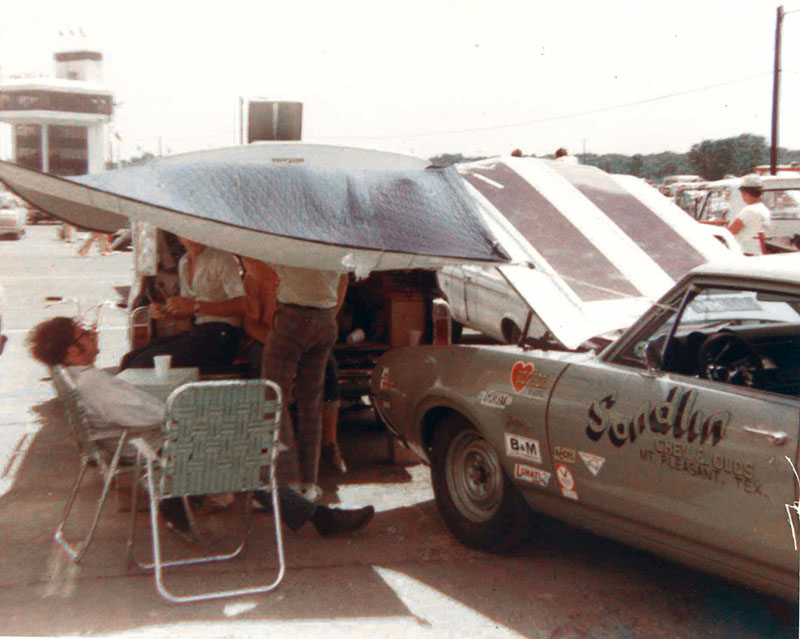
The all volunteer, shoestring budget, pit crew at the National Hot Rod Association Springnationals at Dallas International Motor Speedway in June of 1970. Yes, it was, as I’m certain Oscar declared that day, “Hotter than a road lizard.”

While hot and humid Louisiana summer nights made pickup camper accommodations miserable without any help, Gulf Coast mosquitoes added a whole ‘nother dimension. Within 15 minutes, every opening on the camper was closed except for one tiny roof vent that had a screen. I’m not saying Louisiana has the biggest mosquitoes around, but the “state bird” sized specimens buzzing that night were cause for concern about sleep. “I say we take turns sleeping while one of us stands watch,” Oscar proposed. “Just in case one of them has a can opener.”

All I could say was “amen” when I read Paul’s words, “… you loved it, you slept it and all you ever wanted to do was be at that race track. But I would never trade one moment, nor change one thing I did to race my W-31!”

Now, to my Texas friend’s final question a week or two ago as to whether I would do it again? That’s a big “definite maybe” … provided I could be that age again. We did it then, but I’m pretty sure that blissful youth had a lot to do with the fun part.

—Leon Aldridge

– – – – – – – – – – – – – – – – –

Aldridge columns are published in these Texas newspapers: The Center Light and Champion, the Mount Pleasant Tribune,  the Rosenberg Fort Bend Herald, the Taylor Press, and the Alpine Avalanche.

© Leon Aldridge and A Story Worth Telling 2020. Unauthorized use and/or duplication of this material without express and written permission from this site’s author and/or owner is strictly prohibited. Excerpts and links may be used, provided that full and clear credit is given to Leon Aldridge and A Story Worth Telling with appropriate and specific direction to the original content.