I’m not going to sleep before the dogs do

“If you want to see the sunshine, you have to weather the storm”
— Frank Lane, American baseball executive

“I slept through the whole thing,” my Abilene cousin, Fred Scott (better known to family and friends as Derf) laughed Saturday evening. After learning about the tornado that hit the West Texas town where he lives Saturday morning, I was quick to check on him.

The twister inflicted heavy damage on dwellings, businesses and a nursing home in the South 7th Street area, but there were thankfully no fatalities. Derf and his family live on South 20th, a respectable distance away geographically if you live in Abilene but way too close for comfort when the topic is tornadoes.

That same system made its way to East Texas Saturday night and was bearing down on Center by bedtime. The wind was wailing and thunderstorms raging as I waited out the 2 a.m. tornado watch expiration time. Spring weather in East Texas reminds me of West Texas tornado nights as a youngster where storm cellars were commonplace in the 1950s. When not providing shelter from storms, cellars served as a cool place for storing vegetables from the garden and for kids to play on hot summer afternoons.

When skies darkened and weather threatened, however, nights were spent in the cellar napping on cots by the warm glow of kerosene lantern light. My father often stood at the top of the stairs in the cellar doorway to watch the storm as he did the night in Seymour when I watched with him. The black funnel across town danced through the night sky illuminated by lightning and snapping power lines. Those memories of the twister gyrating through the small West Texas town leaving what the next day’s sunrise revealed to be a path of destruction have endured for 60 years. Images of weather’s wild side illuminated by the storm that spawned it plays vividly in my mind every time one of nature’s most violent forms of wrath comes to life.

Last Saturday night was no exception. I grew uneasy as did our three dogs when the storms rolled in. One, too old to jump on the bed, went under it while the other two hit the topside and burrowed under the cover amid whines and whimpers.

With the security alarm set and weather notifications on my phone turned on, I joined the two on top of the bed but kept my options open for joining the senior canine hunkered under it.

Weather alerts were frequent tracking thunderstorms, flash floods, and tornado watches into the wee hours. Both the dogs and I maintained our respective bed positions until I drifted off still holding my evening cup of tea. My dream-like memories of long-ago stormy nights and the dog’s nervous antics were quickly interrupted when a lightning flash and resounding clap of thunder made me jump sending tea across the bed and the dogs into another round of frightened frenzies.

With the same curiosity my father displayed decades ago out in West Texas, I stepped into the garage to watch Saturday night’s storm. Mere minutes had passed when another bolt flashed near enough that the ensuing thunder cracked before the flash had diminished to darkness. “That’s enough storm watching for me,” I said to the dogs, but I was talking to myself. They were long gone back in the house. Resuming our respective spots in and under the bed, I soon drifted off to dreamland as storms diminished, tornado watches expired and dogs relaxed.

I don’t think sleeping through a storm like Derf did would ever be an option for me. There’s no way I’m going to sleep before the dogs do.

—Leon Aldridge

Aldridge columns are also published in the Center, Texas Light and Champion, the Mount Pleasant, Texas, Tribune, the Taylor, Texas, Press, the Alpine, Texas, Avalanche.

© Leon Aldridge and A Story Worth Telling 2019. Unauthorized use and/or duplication of this material without express and written permission from this site’s author and/or owner is strictly prohibited. Excerpts and links may be used, provided that full and clear credit is given to Leon Aldridge and A Story Worth Telling with appropriate and specific direction to the original content.

My life story could not be told without Sears & Roebuck

“My dad’s idea of a good time is to go to Sears and look around.” —Jay Leno

I’m not sure that looking around at Sears ever scored any treasures, but rummaging around antique shops for treasures or memories and finding a 1970 Sears catalog at Nettie’s Nook in Center, Texas, a couple of weeks ago was some of both.

The treasure was expanding my catalog collection to three adding to my 1966 Winter Sale and 1955 Summer Sale catalog. The pièce de résistance will be a copy of the Sears “Christmas Wish Book.”

On the memories side, anyone who remembers spending hours with the “Wish Book” trying to decide what you wanted Santa to bring, raise your hand. Yep, just as I suspected. Those hands in the air belong to those of us who are a little more “experienced” in life while the younger hands are busy scratching heads. “Wish Book?”

The once retail and mail order giant whose obituary was finalized as 2018 ended will apparently survive to fight another day, albeit different from the business those of us with our hands in the air grew up with.

Sears cameraMy life story could not be told without mention of the chain of department stores founded by Richard Warren Sears and Alvah Curtis Roebuck in 1893. Thanks to my grandmother, I was in the first grade before I learned that I wasn’t sourced from the iconic catalog. Granny always referred to the catalog company as Sears’s which she pronounced “searz · iz.” By whatever name, even at a young age, I knew it was time to straighten up and fly right when she said, “You better mind me or I’m gonna send you back to Sears’s!”
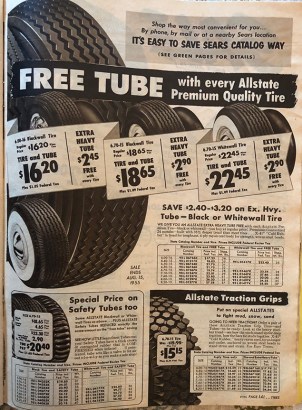
That threat spoke volumes about the retailer’s role in small-town life in the 20th Century. First, Sears was more than a store, it was a way of life. The variety of goods and services available for ordering was the ultimate marketplace, much like Amazon is today. Find it in the catalog, fill out the order blank, and mail it off to the Chicago-based company along with your check or money order. Within a couple of weeks, your anticipated package was on your doorstep or at the local store.

Also, if the Sears Easy Payment Plan didn’t close the sale, the Sears Guarantee printed in every catalog would: “If for any reason you are not satisfied with any article purchased from us, we want you to return it to us at our expense.”

Most of my grade-school shirts that Mom and Granny didn’t make came from Sears advertised for 84¢ in the Summer Sale catalog when ordered in lots of six.

In junior high when I was certain I would be scarred for life if I didn’t have a motor scooter, the Cushman Allstate advertised at $229 in the Winter Sale catalog was my dream.

Sears tires

My first car in high school ran on tires: $41 for a set of four and batteries that sold for $10.45 ordered today and picked up next Tuesday at Sears in Mount Pleasant, Texas.

My son, Lee, who is celebrating his 39th birthday the same day I am writing this, was already an ardent angler at age 10 when he fished Lake Murvaul in a small boat from Sears ordered from the Center, Texas, “catalog store” on Shelbyville Street for $184.95.

After a 97-year-history, Sears big-book catalogs disappeared in 1993. Only the Wish Book endured in smaller versions. It has randomly reappeared since, but nothing resembling the holiday tradition treasured by generations of children looking forward to Christmas morning.

I miss the Sears catalog. And while I did eventually see Chicago, fortunately, it was on my terms and not with Granny exercising the Sears return policy.

—Leon Aldridge

Aldridge columns are also published in the Center, Texas Light and Champion, the Mount Pleasant, Texas, Tribune, the Taylor, Texas, Press, the Alpine, Texas, Avalanche.

© Leon Aldridge and A Story Worth Telling 2019. Unauthorized use and/or duplication of this material without express and written permission from this site’s author and/or owner is strictly prohibited. Excerpts and links may be used, provided that full and clear credit is given to Leon Aldridge and A Story Worth Telling with appropriate and specific direction to the original content.

One little word can float your boat or sink your ship

“It’s only words, and words are all I have, to take your heart away.”
—Song lyrics by The Bee Gees 1967

Having been a lover of words and a writer of one persuasion or another all my life, I tend to get fired up over words and the power they possess. There is gratification in choosing the right words and assembling them in the right order to create precise and effective communication. Yep, I’m a word nerd and that’s why my eagerly awaited Merriam-Webster (M-W) vocabulary word builder email can very often fuel that fire into a frenzy.

The M-W topic one day last week was about correctly choosing the word “boat” or “ship” to accurately describe a specific variety of watercraft and recognizing the defining characteristics of each to make the right choice. After polling a fleet of knowledgeable sources for definitions that have been floated on the topic, the final analysis was that most of them lack the exacting language a dictionary is expected to contain.

One of the more thought-provoking examples was, “You can put a boat onto a ship, but you can’t put a ship onto a boat.” Another was, “A boat is what you get into when the ship sinks.” My personal favorite was, “a boat is a dish you put the gravy in.”

Discussion docked at the conclusion that terminology more specific than “ships are bigger than boats,” was yet to be put into words. I’m thinking this confusion could be clarified with a quick note to my seafaring friend, Jim Chionsini, who could easily chart a course to the right conclusion.

Sailing on to smoother water, M-W succinctly stated in another article that, “The English language never sleeps, and neither does the dictionary.” Noting new words added by the 191-year-old company’s vocabulary volumes as of April of 2019, M-W stated, “a dictionary is a work in progress and reflects the shifts in culture and communication.” That is something of which every wordsmith worth his or her weight in words is keenly aware. And, if there’s anything that will spark more vigorous conversation among writers than determining which word is the best choice, it might be debating the use, or sometimes the usefulness, of new additions to the dictionary.

Some changes for April included, “snowflake” declaring it something other than simply frozen precipitation. The word has been bantered about in the media so much that it has now been branded as “someone regarded or treated as unique or special” and “someone who is overly sensitive.”

The same goes for poor “purple” which is no longer seen as just one of the 64 happy Crayon colors in the big box with the built-in sharpener I coveted as a kid. It’s now officially defined as a reference to “geographical areas where voters are split between Democrats and Republicans.”

Even Goldilocks’ picky porridge sampling in the classic story about her encounter with the three bears has made her name a metaphor that astronomers use to describe as “an area of planetary orbit in which temperatures are neither too hot nor too cold to support life.”

Whether it’s the freshly-minted words or those new definitions asserted to some old familiar faces, shifts in culture and communication can keep a wordsmith busy by day searching for the right definition and awake at night evaluating connotations within society. After all, the choice of one little word for your next literary masterpiece just might be the difference in whether you float your boat or sink your ship.

I used to worry that with my luck, my ship would finally come in on a day when I was at the airport. I’ve decided there’s no need to fret about it, though. As the song goes, “It’s only words …” And, the meaning of those words will likely have changed by the time my ship comes in anyway. Or, is it my boat?

—Leon Aldridge

Aldridge columns are also published in the Center, Texas Light and Champion, the Mount Pleasant, Texas, Tribune, the Taylor, Texas, Press, the Alpine, Texas, Avalanche.

© Leon Aldridge and A Story Worth Telling 2019. Unauthorized use and/or duplication of this material without express and written permission from this site’s author and/or owner is strictly prohibited. Excerpts and links may be used, provided that full and clear credit is given to Leon Aldridge and A Story Worth Telling with appropriate and specific direction to the original content.

What’s needed most is a sense of humor

“Everything is changing. People are taking their comedians seriously and the politicians as a joke.”—Will Rogers

That humorous view by one of the country’s wittiest philosophers of the last hundred years is funnier today considering both groups are a joke that can’t be taken seriously. All at a time when what society needs most is a sense of humor.

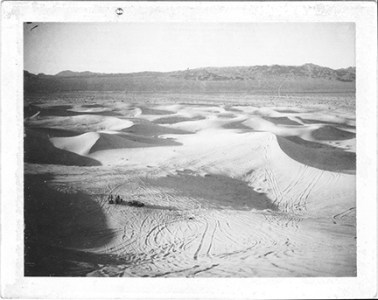
Apparently, things are not funny out in California at Oceano Dunes State Vehicular Recreation Area where dune buggies have enjoyed the sand ever since a guy named Miller is said to have invented the first sand buggy in the 1930s. Residents building homes near there in the last 15 years now claim “particulate dust” and excessive noise from the recreational vehicles is deteriorating the sand’s natural crust that permits vegetation to grow on the dunes. The dune buggy crowds disagree, they say it’s a natural occurrence.


Pismo duens 1967
Two buggies meet in the Pismo Beach sand dunes – Summer 1967

Me, I’m just enjoying memories of that same sand when it was called Pismo Beach in the summer of ’67 between college semesters. It was a summer of muscle cars, hot rods, Beach Boys on the radio, bikinis on the beach at Malibu, surfboards, and dune buggy weekends at Pismo— a summer like nothing I had experienced in my 19 years in Texas.


Mom’s younger brother, my Uncle Bill, was one of several San Fernando Valley area Volkswagen body shop managers who built and enjoyed dune buggies—a VW chassis, motor, roll bar and seats with farm implement tires on the rear to dig into the sand. Uncle Bill was also my summer host and my employer.

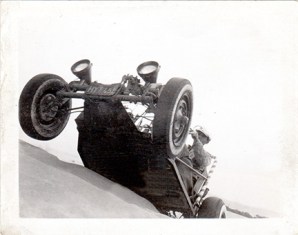
After the three-hour Saturday trek up Highway 101 north to Pismo, camp was set up on the beach before hours of challenging the sand commenced. Charging up dunes slowing just enough for the front wheels (or sometimes all four) to become airborne before coming back to earth on the other side was a test of man and machine. Not to mention a lot of fun.

Pismo buggy 1967Memories were made where fun prevailed and a sense of humor was standard fare. Perhaps the biggest jokester was Ralph, the seasoned veteran painter in Uncle Bill’s shop who taught me how to paint a car. He was a bit crusty, if anything, but a magician with a paint gun who imparted skills to me I parlayed into a job back in Texas to pay for my education.

Ralph’s finest moment had to be the flag incident. Buggies were fitted with “whip antennas” topped with brightly-colored flags designed for visibility from the other side of a dune when two buggies were coming up opposite sides.


Ralph’s new flag that weekend was noticeably … different. “Where’d you get that flag, Ralph,” someone asked. In his gruff tone, he responded with a smile, “Ladies department at the dry goods store—the biggest one they had.” The unique design of Ralph’s “double-barrel” flag combined with the emergency orange paint job he applied to the device emphasized its size so that no one missed it.

The first trip out that weekend, however, Ralph came roaring back into camp where someone pointed out that his flag was missing. Visually confirming the flag’s absence, he lamented that maybe he didn’t fasten it securely enough. Then he started chuckling before finally laughing out loud.

“What’s so funny,” Uncle Bill asked.

“I’m thinking about the poor guy who found it,” Ralph laughed. “He’s probably still out there running the dunes with a big smile, trying to find the woman who lost it.”

With politicians who are jokes, comedians who are too political to be funny, and squabbles over the use of public land, seems to me that more folks with a sense of humor like Ralph’s are sorely needed.

—Leon Aldridge

(Photo at top of the page by “Uncle Bill” Johnson at Pismo Beach, California in the summer of 1967. Dune buggy driver is yours truly and the passenger is Ronnie Lilly, my friend and MPHS classmate who made the memorable summer trip to California with me.)

Aldridge columns are also published in the Center, Texas Light and Championthe Mount Pleasant, Texas, Tribune, the Taylor, Texas, Press, the Alpine, Texas, Avalanche.

© Leon Aldridge and A Story Worth Telling 2019. Unauthorized use and/or duplication of this material without express and written permission from this site’s author and/or owner is strictly prohibited. Excerpts and links may be used, provided that full and clear credit is given to Leon Aldridge and A Story Worth Telling with appropriate and specific direction to the original content.