Talk can be cheap, but it’s not always easy

“Long distance information,
Give me Memphis, Tennessee
Help me find a party
That tried to get in touch with me.”
—“Memphis” song lyrics by Chuck Berry

Phones have come a long way since the days of talking to an operator to place a call. Now, you just talk to Siri.

Our first home phone was simple, black and utilized a rotary dial to reach out and touch others for talking, provided they had one, too. It was also the days of party lines. If you picked up while another party was using the line, you just had to hang up and wait for them to finish talking. Or, if you were mischevious, just pick up on it every couple of minutes to irritate them.

Phones were amazing then, but it sure could be frustrating when I had to wait for someone on the party line in order to talk to my friends.

When I entered the workforce a few years later, the simple, black devices for talking gained a row of buttons across the bottom allowing for more lines. That must have been the system our Dallas newsprint supplier used in the early 1980s when I was the publisher at the Center, Texas, Light and Champion. The young lady who took my call for an order just before 5:00 one afternoon said, “Please hold one second. I have someone on the other line.” A click followed and immediately she was back with me. “I have to go,” she said, “can we get together later for a drink and talk?”

Recognizing what she had done, I calmly replied, “Absolutely, but can you take my order first?” A moment of silence preceded, “Oh my goodness, I am so sorry. I hit the wrong button. I am so sorry.”

“That’s all right, I laughed. “It would take me three hours to get there anyway unless you wanted to meet me half way.”

The trip would have been more than halfway last week when Valerie Cosby at KTBS TV in Shreveport called. She wanted to show me what their marketing programs could do for Bird and Crawford Forestry Monday at 3:00 p.m.

Appointment made, the “goodbyes” had started when I said, “I think I know you.” I was the marketing director at Portacool a few years ago, and we talked about advertising. Your reporter Rick Rowe did a feature story on the company.”

“Oh yes,” she said. “I remember, and I remember you. So how did you wind up in Shreveport?”

“I’m not in Shreveport,” I replied, I’m still in Center.”

Silence followed. Then she said, “I called your number in Shreveport and was told I was being transferred to you.”

“And, you were,” I said. “We also have an office in Houston. Would you like to talk to someone there … I can transfer you?” After explaining how the phones in our offices in Center, Shreveport and Houston were all one system, she laughed and said, ” I’m glad we didn’t hang up before I learned that, otherwise I would have been at your Shreveport office Monday afternoon.”

Phones are still amazing. I don’t have to wait on party lines. Offices can be seamlessly connected between any number of cities as one. Phones have assumed the function of many everyday things like cameras, watches, calculators and more, all while connecting you to the outside world.

Yet with all of the advancements, I still ask myself when I stand in a chair on my patio trying to reach out and touch a cell phone signal: “How long will it be before the major phone company that can do these amazing things learn how to provide Center, Texas, with a decent cell phone signal past the second bush on the left side of Main Street?”

Long distance information? Operator? Siri? Anyone … hello?

The road to success is not always a straight shot

“The road of life twists and turns, and no two directions are ever the same. Yet our lessons come from the journey, not the destination.” —Don Williams, singer and songwriter

Roads to success are not always easy … or easy to explain, for that matter. But, whatever path to success each of us finds, we like to do our best and know that our work is appreciated.

Feedback is a good gauge to help writers know when their readers are engaged. I love all comments, especially from fans I’ve never met and just happen to cross paths with somewhere. I not only get support, ideas, or suggestions for improvement, but I also gain new friends … like the lady in the grocery store last week. We both had that “searching for something” look when we passed in the aisle. She smiled and asked if I knew where the Velveeta was located. “With the baking supplies,” I replied, adding, “Why they put it there, I’ve never understood.”

“You write that column in the paper,” she said. “I recognize your picture.”

“Guilty!”

“I can’t wait to read it every week,” she said. “I can tell by the way you write, you enjoy what you do.”

“Guilty again … and thank you.”

“It must be wonderful to enjoy a career having always known what your passion was and loving what you do.”

I looked around then said with a chuckle, “I’m sorry. I thought you were talking to me.” Knowing my impulsive humor needed an explanation, I continued. “My road to writing was long and winding. Went to college to be an architect but came out with a degree in psychology and art.”

“So, you started writing with a liberal arts degree. That’s fascinating,” she smiled.

“No,” I continued. “I taught special education for a couple of years but learned that just wasn’t for me. So, on the strength of high school mechanical drawing classes, I got a job drafting house plans for a construction company. When it closed, a friend offered me a job at his weekly newspaper as a photographer utilizing skills acquired at racetracks when I was a drag racing driver.

“Education, construction, photography, drag racing …” she said pausing between each word.

Hoping to dig my way out of a hole that was getting deeper by the minute, I added, “That was just until I decided what I wanted to do. I remained in the newspaper business a few years before also working as an office manager for a tire store chain, a brief stint in the office supply business and a nursing home office manager,” I concluded. “Following those diversions, I knew communication is where I belonged, so I returned to journalism.”

“But, you wound up in newspapers without a journalism education,” my newfound friend followed.

“Well not exactly, I have a master’s in communication and post-graduate work toward a Ph.D. in journalism,” I said, “earned while teaching journalism at Stephen F. Austin State University.”

“And, so you also taught journalism …” she said. “So how long have you been with the newspaper here?”

“I’m not employed by any paper,” I said. “But, I’ve worked as editor and publisher for several newspapers, plus owned a newspaper at one time. My writing is part-time freelance now. My full-time profession is marketing director for an environmental and forestry firm. I was the marketing director for an international manufacturing company for 14 years before that.”

“That is some resume you have,” she said. “It is so nice to meet you, but I better move along. Where did you say the Velveeta is located?”

“Go down about three aisles,” I pointed, “Then …”

“I really do enjoy your columns, please keep writing them,” she said walking away before I could finish the directions.

Guess she figured someone with so many twists and turns in their road of life might not be the best source for the shortest route to the Velveeta.

—Leon Aldridge

Aldridge columns are also published in the Center, Texas, Light and Champion and the Mount Pleasant, Texas, Tribune newspapers.

I always tried to obey my mother

“My mother had a great deal of trouble with me, but I think she enjoyed it.” —Mark Twain

Saw a ’55 Cushman Highlander motor scooter for sale last week at $5,500. That’s considerably more than the one I came within a heartbeat of calling mine when I was 12 years old.

Sixth grade was winding down at South Ward Elementary in Mount Pleasant, Texas, in the Spring of 1960 when my friend Gary Cornett did something that kindled one of the more serious unrequited love affairs of my life.

Just as I threw a leg over my bicycle headed home for lunch, Gary rolled up on his Cushman Highlander. “Nice looking scooter,” I said. Before I could start peddling, he hit me with, “Wanna ride it to lunch?” Some questions have only one logical answer at 12. I thanked him, jumped once on the kick-starter and was gone.

Cushman 1961 annual-smlores
Photo credit—1961 Mount Pleasant, Texas, High School annual “The Arrowhead”


The wind in my face and the single-cylinder motor thumping below me while cruising up Redbud Street turned an ordinary lunch into a life-long memory. I parked under a shade tree and went in the house. Whether mom heard me coming, or it was just a keen mother’s intuition, I’ll never know.

“How did you get home?”

“Gary’s scooter,” I said nonchalantly, thinking that would soften her reaction. It didn’t.

“What are you doing riding someone else’s motor scooter,” she asked in that “mom” tone of voice.

“He offered to let me.”

“You know better,” she continued, her voice growing louder. “I don’t like those things. You could get killed … and damage Gary’s scooter. Eat your lunch right now and get it back to school. And, I don’t ever want to hear of you getting on one again—do you understand me?”

“Yes ma’am,” I said.

Scant weeks later while spending summer days with my grandparents down the road in Pittsburg, Texas, my grandfather invited me to ride with him up to W.R. DeWoody’s Western Auto. Another question with only one logical answer because I knew the drill: a stop at the Piggly Wiggly parking lot where he would let me drive. Guiding his ’57 Ford off the parking lot, I awaited his instructions that I already knew by heart, “Shift to second, turn on the back street, park at the back door. And, don’t tell your grandmother I let you drive.”

Once inside, he headed toward the front seeking help for whatever it was he needed. I went straight to the new Cushman scooters sitting near the wall helping myself to some daydreams. I was still dreaming when he came over, took the price tag that dangled from the handlebars in his hand, and said loudly, “Two hundred and nineteen dollars?” He followed that with a loud whistle to further underscore his opinion of the price.

Several seconds of silence passed. Then he asked, “Reckon you could ride that if I bought it?”

“I rode my friend’s,” I said as my heart raced at the thought of taking the scooter home. Then as fast as it had taken off, my heart flatlined when he decided, “I better not. If I bought that for you, your mother would have my hide.”

“We can keep it at your house,” I pleaded.

“Then your mother and your grandmother would have my hide,” he chuckled.

Mom also objected years later when I bought my first motorcycle at age 20, and again every time for some 35 years that I told her about one of my many trips riding throughout much of the U.S.

I was almost 40, however, before the next time I felt the wind in my face riding on a Cushman motor scooter. It was a nicely restored red Super Eagle acquired from Dennis Leggett at Leggett Cycle in Joaquin, Texas, and riding it was just as exciting as that lunchtime ride was at 12.

However, I honored my mom’s warning from the sixth grade. “I don’t ever want to hear of you getting on one again—do you understand me?”

She didn’t. Because I never told her about the one I bought from Dennis.

—Leon Aldridge

Aldridge columns are also published in the Center, Texas, Light and Champion and the Mount Pleasant, Texas, Tribune newspapers.

Photo credit—Top of page: 1959 Cushman Motors subsidiary of Outboard Marine Corporation magazine ad

You go ahead, I’ll watch from here

“Everybody likes a roller coaster ride.” –Pete Wasserman, English record producer, songwriter, and railway enthusiast.

“That looks awesome,” responded my son, Lee. “I would go there to ride that one.”

His reply was to my message last weekend asking if he had plans to ride the world’s tallest, fastest, scariest, baddest roller coaster ever that debuts at Canada’s Wonderland park next year.

Lee’s been a coaster junkie since reaching the minimum height requirement. He’s closing in on 40 and still loves them. I’m betting he’ll ride the Yukon Striker billed as the fastest dive coaster at how fast … 80 mph? My last 80 mph “dives” were at places like a stretch of Titus County, Texas, road appropriately dubbed the “roller coaster” when I was a teenager or the old “thrill hill” in Shelby County.

The Canadian coaster is also touted as the longest dive coaster at how long … 3,625 feet? Can’t be any worse than that Delta Flight I was on landing at Chicago one morning during a thunderstorm. The freefall squeezed three inches off my waist and created enough airspace between my wallet and the seat to accommodate a Sears catalog.

The tallest dive coaster at 245 feet “including underground.” Falling that far into a hole in the earth? No, thanks. I was out on the first two.

Despite my scoffing, there was a time when challenging the best wooden coasters from Panama City Beach, Florida to Santa Monica, California was my passion. My son came by his honestly.

Unlike Lee, my passion soon turned to excitement with both feet planted on terra firma and without all the blood in my body shoved up between my ears.

I still believe every ounce of blood and a couple of organs were behind my eyeballs on The Starliner, an attraction at what was the Miracle Strip in Panama City Beach in the 60s and 70s. The wooden coaster ran the entire length of the park along the beach.

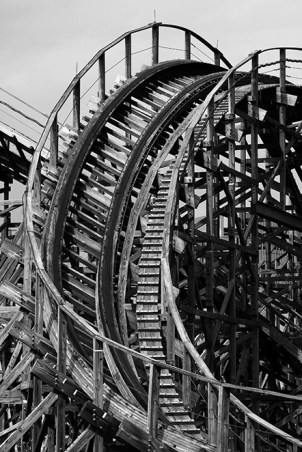
Panama City Beach is a different place now than it was in 1973 when a bunch of bike riders from Mount Pleasant rode to Florida spending a week at the “luxurious” Barney Gray Motel. Besides taming the Starliner, we basked on the beach, suffered the sunburn of a lifetime, and got our first flash from a genuine streaker. Sorry, Ethyl, we looked.Wooden roller coaster

I also looked one night a few years earlier riding the Sea Serpent on the opposite side of the continent at Pacific Ocean Park in Santa Monica, California. The 1926 wooden coaster offered a dive with an ocean view. Mine was a memorable view of a moonlit Pacific Ocean in the summer of ’67 just months before the once popular pier closed for good.

It was one night at the long closed-for-good Hamel’s Park in Shreveport that I walked away from my last ride. After a youth spent on the best coasters in the country, it was a small kid’s ride beside the Red River where I silently prayed for it to end. I was riding with daughter, Robin, who was about ten at the time. Both of us were shrieking through the night air. For her, they were expressions of joy.

Mine were more along the lines of long-time good friend Petey Gandee’s response to Lee’s message last weekend after watching the video of the Yukon Striker, “I just threw up watching it.” Doubters: Google “Yukon Striker coaster” and see for yourself.

Last week’s coaster conversation ended when Lee said, “I went to Fiesta Texas yesterday and rode The Goliath, The Batman, The Superman and The Wonder Woman (all coasters). I had a blast!”

“Cool! Ride them again and call it my turn,” I told him. “I’ll watch from the ground.“

—Leon Aldridge

Aldridge columns are also published in the Center, Texas, Light and Champion and the Mount Pleasant, Texas, Tribune newspapers.

A city dweller’s perspective of country charm

“City people make most of the fuss about the charms of country life.” — Mason Cooley, American writer and educator 1927-2002

Country life may indeed appear more charming when viewed from inside the city limits. However, viewed from the perspective of those who grew up living and working on a farm, the definition of charm may vary a little.

Response to last week’s offering on outhouses in this space was brisk. Feelings fell between humor and appreciation—humorous stories about outhouses, appreciation for their having faded into history, or some of both. The difference is again likely a matter of perspective.

I grew up from the city perspective to whatever degree living in small Texas towns could be defined as city living. Maybe dad’s wearing a white shirt and tie to work at Perry Brothers five-and-dime store qualified us.

This city dweller’s introduction to a country perspective was provided by the Hales, a family of farming folks near Crockett, Texas, in the mid-50s, and their son, Wayne, who was my friend.

A dirt driveway connected the Hale’s simple four-room house to a dirt county road and circled a huge tree. From that circular path, one gate on the left led to the house and one on the right revealed a pasture that was home to some milk cows.

Circumventing the tree and driving straight ahead led to a shed under which was parked an old gray Ford tractor and farm trailer. It was also where they parked their green, late-1940s GMC one-ton flat-bed truck although only the cab would fit under the shed. It was the only form of transportation the Hale’s owned.

Their house sat way up off the ground with nothing to stop a cold North wind blowing under it but a couple of resident hound dogs that delighted in barking at anything that moved and some things that didn’t.

At the end of that legendary path out the back door of the house, and sort of in line with the tractor shed, sat the outhouse: aka the privy.

It was a time when air conditioning was new and still scarce enough that the few businesses enjoying it enticed customers with “refrigerated air” signs in the window. It was even scarcer in homes. An oscillating fan provided the only breeze not only in the Hale’s house but also at our house in town.

Heat at the Hale’s was a wood-burning stove in the kitchen and also where the only water in the house was available. There was no television, but as with air conditioning, there was also no TV at our house in town.

My initial taste of country life at the Hale’s was where I first rode a horse, rode on a tractor, rode sitting on the back of a one-ton truck, and the only time I took a bath in a number-three washtub in the kitchen. And, yes, it was my first time to sit and ponder dirt dabbers buzzing in an outhouse.

It was also where I enjoyed home cooked meals in the most literal sense of the word. Vegetables from their garden, milk from their cows, eggs from their chickens and cured meat from their smokehouse went into any meal they put on the table.

Maybe it is true that country life viewed from this side of city dwelling is charming because of horses, tractors, home-cooked meals or riding in the back of trucks. Granted, I was never around to plow fields, harvest crops, build fences, chop wood, or milk cows.

But, it sure seemed like a lot of fun to me. Except for outhouses … those are probably best left to both humorous memories and being thankful they are no longer a way of life.

—Leon Aldridge

Aldridge columns are also published in the Center, Texas, Light and Champion and the Mount Pleasant, Texas, Tribune newspapers.