Celebrating the brief time of our mutual friend

 “There is some talk of lowering (the income tax), and they will have to. People are not making enough to pay it.”—Will Rogers

 Uncle Sam gives and he takes away.

Thank you for joining me today to celebrate the short life of our departed friend, Hard Earned Money, as we share our grief on the occasion of his departure last week on Tax Day.

Money and I were friends. We lived close to each other, sadly, not for very long at a time. I tried to spend more quality time with him, but always seemed to be watching him come and go. Perhaps I could have been a better friend to Money had I known when we met, what I know now.

We remember Money as a communicator. He was always a part of our conversations. I recall him best for all the times he was telling me, “Good bye!”

One personal memory illustrating the often impulsive nature of Money’s sojourn on earth is about the time a good investment netted me a tidy profit. Part of it bought me new a car, the rest I invested. Little did I know that in short time, I would lose the car and the investment putting together enough money to pay taxes: a reminder that we know not the day, nor the hour … or in some cases, the who, that will mark the time of our Money’s departure.

 Our friend Money was the type that never met a person in need to whom he didn’t respond for me. If we could assist someone in getting back on their feet, paying a bill, or loaning them a down payment, we never hesitated to pitch in, be they family or friend. And, we always kept them in our heart for years afterward, mostly in hopes that they would remember to pay us back.

Money’s passing last week is a reminder that while compassionate souls take risks; it’s never with the IRS. We find comfort, however, in knowing why money ventured out and was unexpectedly taken from this life on Tax Day—it was to keep me out of prison.

So, it is that we can find peace in the fact that Money left us doing something he knew had to be done. He never wanted to pay the ultimate price as a tax bill, but I can tell you his only regret about leaving was that need for old car parts, a vacation this summer and that new refrigerator was left to carry on without him.

In closing, I smile at how Money was celebrated in music. There is one song in particular that always reminds me of him, one we both liked. He asked that should he go first, would I read the lyrics at his memorial, and I’ll do that now.

I’m going back to the country,
Cause I can’t pay that rent.
I’m not completely broke,
But, brother I’m badly bent.
 
I can’t understand where my money went
I ain’t broke, but brother I’m badly bent

And now, if you will turn in the hymnal to number 1040-EZ, we’ll join in a congregational singing as a final remembrance of Income Tax Day 2018, and our dearly departed friend, Hard Earned Money. May he rest in peace, at least until next April.

Some bright morning, on tax day this year,
I’ll fly away.
To that home in Uncle Sam’s big vault.
I’ll fly away.

Time will heal our pain, because life does go on … even without Money after Tax Day.

—Leon Aldridge

Aldridge columns are also published in the Center, Texas, Light and Champion (http://www.lightandchampion.com) and the Mount Pleasant, Texas, Tribune newspapers (http://www.tribnow.com).
Spring fever can strike in many ways

“O, how this Spring of love resembleth the uncertain glory of an April day.” —William Shakespeare

Spring—one of my two favorite seasons, the other one being Fall. But, likely for reasons you might not be thinking. For me, they are best seasons for car shows and swap meets.

Sure, Spring blooms in nature’s beauty and Fall leaves add to their season. But, it’s hard to top the beauty of a classic car gathering, or acres of rusty, hibernating parts waiting for new life as part of someone’s restoration project, transporting them back to the memories of their first car.

Memories of first cars and first dates last a lifetime. It’s been a natural American phenomenon for generations, particularly among young and young-at-heart males that the aroma of gas, oil and polish emanating from that first automobile lingers longer in a man’s memory than the fragrance of the world’s finest perfume.

Memories of my first car are at least as vivid than those of my first date. Understand, that’s no reflection on the attractive young lady who caught my eye, causing me to stammer long enough to ask her out. It’s just that the set of wheels I first called mine captured my heart before she ever had the chance.

Those wheels were attached to a blue 1951 Chevrolet Styleline DeLuxe sitting quietly under the night lights at Rex Kidwell’s Fina Station on South Jefferson in Mount Pleasant the first time I saw her. Rex was a friendly fellow and customers always got a smile, gas pumped, oil checked, windshield washed and the floor mats hand swept with a small broom Rex kept in his back pocket. Everyone got that service whether they filled the tank with higher-priced ethyl gas and got change back from a five-dollar bill, or just said, “Gim’me a dollar’s worth of regular ‘til payday, please.”

The Chevy that caught my eye was not a new car. The year was 1964, but Rex was known for acquiring pristine used cars that met his standards of ‘extremely nice,’ which he would park on the lot beside his station with a ‘for sale’ sign in the window.

Between money from my after-school job sweeping out at Beall’s department store downtown and a short-term, interest-free loan from my grandmother repaid at five dollars a week, I came up with the $250 asking price. That Spring night, some 54 years ago, I drove home in my first car just a few weeks before the end of my sophomore year at MPHS.

As time and money permitted, I added my touches—a split manifold with dual exhaust glass-pack mufflers from Redfearn’s automotive on East Third Street next to the Martin theater, and dual carburetors. To this day, there is no sweeter melody to my ears than the sound of Chevy six with a split manifold and dual exhaust—beautiful music cruising through downtown Mount Pleasant late at night.

Through the streets of Mount Pleasant and beyond, the faithful Chevy transported me to school in the mornings, to work in the afternoons, to the drag races Saturday night and to church on Sunday. Oh, and also on my first date on a Friday night to the Martin theater.

I saw my first date in Mount Pleasant a couple or three years ago, and we enjoyed a short, but nice visit. As we talked, I wondered if she remembered that car. I sure do.

—Leon Aldridge

Aldridge columns are also published in the Center, Texas, Light and Champion (http://www.lightandchampion.com) and the Mount Pleasant, Texas, Tribune newspapers (http://www.tribnow.com).

Right communication, right place, right time

The way we communicate with others and with ourselves ultimately determines the quality of our lives. —Anthony Robbins

The best standard for finding a good doctor, for my money, is communication. Making a good friend is often an exercise of “the right place at the right time.” Bill Ginn was a perfect example of both axioms in my life.

What good is medical advice you don’t understand because the good doctor can’t communicate it? What better doctor or friend is there than one who is honest to a fault? Dr. Ginn never failed on either point, administering a healthy dose of his trademark wry humor with both.

Dr. William “Bill” Ginn, Jr. passed away March 8, 2018, in Center, Texas, at 87. He came to Center in 1977 to join Memorial Clinic with Doctors Mallory and Hooker. I arrived a couple of years later, and he became my physician and a good friend.

Common interests and humor lead to our friendship, but he remained my physician earning my trust as a no-nonsense communicator. Patiently explaining how my niacin “OD” before breakfast one morning had me thinking I was done for, he was also quick to discredit the list of vitamins I felt was contributing to my healthy status. He pulled no punches telling me how and why I was wasting money, adding, “Just eat healthy, it’s the better option.”

On another visit, one seeking help with my expanding waistline from eating too much healthy, his no nonsense advice was, “It’s easy. Eat anything you want.”

Before I could question this unorthodox prescription for weight loss, he added with a smile, “And, if it tastes good, spit it out.”

Office visits became routinely predictable. “How are you today,” was his standard greeting as he reviewed my file.”

“Fine,” was my usual reply.

This is when he would drop his chin, look over his glasses and reply, “Don’t lie to me. We wouldn’t be having this conversation if you were fine. Now, tell me why you’re here … but first, how’s the family? How are things at the newspaper?”

In the beginning, this seemed like friendly chat, and I’m sure to some degree it was. However, it soon dawned on me that he was following the teachings of the older physicians that many today have foregone—knowing what’s going on in the patient’s life is the beginning of diagnosing medical issues.

Those conversations were also the revelation of common interests that included things like flying. His path to medicine and our conversations included a stint in the U.S. Army as a helicopter pilot and instructor. My path was earning a fixed-wing pilot’s license in Mount Pleasant, Texas before moving to Center.

Dr. Ginn had a newfound interest in ultralight aircraft at the time, so I offered to fly him up to Mount Pleasant where a manufacturer was located. Capitalizing on the trip to my hometown, I left him at the airport to research while I enjoyed lunch with my parents.

During his tour of the facility, the owner suffered a heart attack. So it was that while in Mount Pleasant to glean knowledge about his hobby interest, the physician recognized someone having a heart attack, summoned help and stayed in constant communication with both until help arrived.

Recounting the unpredictable events of the day while flying back to Center, I noted that his decision to look at an airplane very likely saved a life. “Right place at the right time,” he smiled as he watched the East Texas country side passing below us.

I entrusted my health care to Bill Ginn for many years. The bonus was a friend and many memories of his wit and wisdom, stories I delight in communicating any place and any time.

—Leon Aldridge

Aldridge columns are also published in the Center, Texas, Light and Champion (http://www.lightandchampion.com) and the Mount Pleasant, Texas, Tribune newspapers (http://www.tribnow.com).


If he could have just seen it coming

“It ain’t over ‘til it’s over.” — Yogi Berra.

The right-handed batter from East Texas stepped to the plate, took a stance and waited for the pitch to come.

In his trademark windup, the left-handed pitcher from Oklahoma threw his right leg skyward and sent the ball scorching across the plate.

The batter would later say many times, “Heard it hit the catcher’s mitt, but never saw the ball coming.”

The year was 1944. The pitcher was Warren Spahn who spent 21 years in the National League, retiring in 1965 with 363 wins—more than any other left-handed pitcher in major league baseball history, and a record that still stands today.

Spahn started in 1942 with the Boston Braves remaining all but one year with the franchise that moved to Milwaukee in 1953 before moving to Atlanta the year after Spahn retired. He played his final year with the New York Mets and the San Francisco Giants. He ranks sixth in history for MLB wins following right handers Cy Young (511), Walter Johnson (417), Grover Cleveland Alexander (373), Christy Mathewson (373), and Pud Galvin (364).

He was named the 1957 Cy Young Award winner and elected to the Baseball Hall of Fame in 1973.

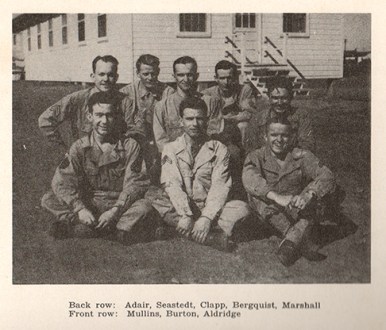
That young East Texas batter in 1944? That was my dad, Leon Aldridge, Sr., from Pittsburg, Texas. No, he never played professional baseball, but loved to tell the story of feeling the heat of a Warren Spahn pitch. They served together in the U.S. Army 276th Engineer Combat Battalion in World War II, and played baseball during training at Camp Gruber in Oklahoma.

276th at Gruber-sm
Photo at top of page: PFC Warren Spahn at Camp Gruber 1944. Above: Group photo at Camp Gruber before shipping out for Europe. PFC Leon Aldridge in the front row row, far right.

According to the history of the 276th “Rough and Ready” written and edited in 1946 by Allen L. Ryan and Clayton A. Rust, after training in Camp Gruber, the unit went to Tennessee for maneuvers. They returned to Oklahoma to await orders for shipping out to the European Theater.

The book reports, “… among the exploits of the 276th during this period was winning the 1944 Camp Gruber baseball championship … defeating all comers. Much of the credit for the fine performance of the 276th team must be given to our pitcher, S/Sgt. Lefty Spahn, formerly of the Boston Braves.”

“Very few of us got any hits off him in practice,” said dad. “But, neither did the batters on the other teams. How can you hit something you can’t see?”

Spahn volunteered for service at the end of the 1942 baseball season. Dad was drafted while a student at Texas A&M University. Before WW II was over, they saw combat duty together in the Battle of the Bulge and at the Ludendorff Bridge becoming good friends along the way.

As a kid who enjoyed school yard baseball and a couple of Little League summers in the late 1950s, I thought it was pretty cool that my father got a Christmas card every year from a major league pitching star that I watched on television.

My father was never a big sports fan, with the exception of a few high school football games. But, if the Braves were on television and Spahn was pitching, he was tuned in.

Before it was over, in Spahn’s final season while playing for the Mets, Yogi Berra came out of retirement to catch a few games, one in which Spahn was pitching. Spahn was 42 and still playing. Berra was 40 and had retired the previous year. Berra was quoted as saying, “I don’t think we’re the oldest battery, but we’re certainly the ugliest.”

Spahn died in 2004, three years before dad in 2007. Until it was indeed over, if you had asked dad what he remembered most his Army service, you would likely have heard about the time he thought he might have gotten a hit off Warren Spahn … if he could have just seen the ball coming.

—Leon Aldridge

(Photo credit, all photos: Rough and Ready Unit History 276 Engineer Combat Battalion by Allen L. Ryan, edited by Clayton A. Rust)

Aldridge columns are also published in the Center, Texas, Light and Champion (http://www.lightandchampion.com), the Mount Pleasant, Texas, Tribune (http://www.tribnow.com) and the Fort Bend Herald (http://www.fbherald.com) newspapers.