Thankful for every moment of the memories

“I’m thankful for every moment.”—Al Green, singer and songwriter.

Thanksgiving 2017 is a memory now, leaving only 28 shopping days until Christmas. But, while there may still be just one piece of pecan pie left from Thanksgiving dinner, I’m still savoring the best part of the holiday season—the memories.

My blessings are many, and long is the list enumerating things for which I am thankful. However, conversation last week with a friend in Dallas prompted memories of one thing for which I am truly thankful—Thanksgiving dinner at my grandparent’s house as a child.

While wrapping up business via email with Wachelle Williams at Sunwest Communications, preparing for the short holiday week, she said something that resonated with me for the rest of the day.

“We are scheduled for next week! Yay…” her message read. I decided this was a good time to share that we also had another two weeks of our social media programs in the works beyond Thanksgiving. Her lighthearted reply was, “My grandmomma would say…’Stop showing out!’”

“I like your grandmomma’s sayings,” I told her. “Mine was a wise woman for someone whose education went only to the 8th grade. She had a large influence on my life.”

“Don’t you miss her,” Wachelle asked, commenting on memories of her grandmother, saying, “I really miss her cooking.” I agreed. Then for the rest of the day, all I could think about was holiday and Sunday dinners at my grandparent’s house.

Truthfully, any Sunday dinner prepared by my father’s mother was the equivalent of a Thanksgiving or Christmas dinner. She stopped preparing festive dinners when my grandfather died in 1967, but I remember her cooking like it was yesterday.

It was a yesterday when families ate more meals at home. The fast food boom was yet to happen, and eating out at a “real” restaurant was a treat for rare occasions. It was also a yesterday when, like for most families then, a meal at our home in Mount Pleasant was on the table precisely coordinated with dad’s arrival from work. Not being at the table at that time was not an option unless you were so badly incapacitated that walking was out of the question. Also not an option was deciding whether mom’s menu coincided with your taste buds. You ate what was on the table without criticism or comment—unless it was a comment praising mom’s cooking.

Although it was the age of “eat what your momma put on the table,” there was no way even the pickiest eater was going to leave granny’s table hungry on any day. The big table that occupied my grandmother’s dining room, and now resides in mine, was filled to capacity with choices. Common fare was fried chicken or ham, usually both. Every imaginable vegetable, salad and a casserole was there, along with hot rolls. If that wasn’t enough, the aroma of a fresh baked pie wafted from the kitchen as a reminder to save a little room.

The cooking was a labor of love, and meals were always on the table on time. That was no small feat for a Sunday dinner considering everyone at the Pittsburg Methodist Church knew my grandmother was really under the weather if she was not in her pew for worship service. That was a feat accomplished only by many hours spent in the kitchen Saturday night and early Sunday morning, something that never dawned on me as a child. I thought the meals were just another form of “grandmother’s magic.”

It was hard to notice behind the scenes work that our parents and grandparents put into family get togethers when, as kids, we were in the yard running through fall leaves and looking for pecans under huge trees that lined my grandfather’s yard. Smell is purported to be one of the strongest sensory preceptors linked to memory, and I know that it’s true. A whiff of leaves burning even today reminds me of raking and burning leaves in that same yard more than 50 years ago.

“Don’t you miss her,” Wachelle’s words echoed in my mind last week? I do miss her and I’m thankful for the memories of many Thanksgiving pasts she gave me. I’m also thankful for the values my grandparents and parents gave me regarding family traditions that have fashioned my Thanksgivings for a lifetime, and every moment of the memories I’m still making.

I hope your Thanksgiving was the best yet, and that you added many new memories of the season.

—Leon Aldridge

Aldridge columns are also published in the Center, Texas, Light and Champion http://www.lightandchampion.com and the Mount Pleasant, Texas, Tribune newspapers https://www.tribnow.com


It’s a generational thing

“The thrill is in the chase.” — Popular old saying

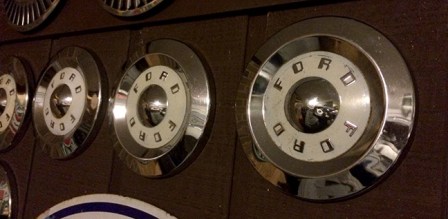
Old car hobbyists can be an easily entertained bunch. Three or four-hour drives to a swap meet with nothing in mind to buy, just to look around. Then coming home with a collection of rusty and dusty car parts unrecognizable to most people. All in a day’s fun.

“So, what did you score at the Conroe meet,” a friend asked last weekend. “Set of ’57 Ford hubcaps for myself and a ’52 Packard hood ornament for my buddy, T-Mac.” I replied.

“Hubcaps,” my befuddled friend responded with a questioning look. “And, a hood ornament? What’s a hood ornament?” Worthy of mention is that said friend was maybe half my age, and let’s just say that old car parts is not one of his conversational strong suits. I sighed and responded, “You’re kidding, right?”

57 Ford hubcaps-sm
1957 Ford “pot lid” hub caps now residing in the Aldridge garage

Maybe it’s a generational thing if you didn’t grow up when a driver’s license was a right of passage. When the memory of a guy’s first car lingered longer than that of his first girlfriend. Reading hot rod magazines in study hall is where you learned that early automobiles had radiator caps with a built-in thermometer mounted on top of the radiator where the driver could keep an eye on it and have a ball-park idea as to when the car was about to overheat. That was an era when the radiator had nothing to do with the hood that opened to either side of the radiator rather than covering it.  It was also an era when “dash boards” contained little more than a speedometer crude by today’s standards and an on-and-off ignition switch—before there was a need for the term “instrument panel” because there were between few and no instruments.

Into the 20s and 30s, radiator cap thermometers became works of art that were focal points of the car’s styling. Some were large and ornate often with wings or birds, and they were all either chrome or brass. That was also an era when cars were constructed of metal.

As cars became more modernized into the 40s and 50s, gauges moved inside the car and hoods grew to cover the radiator, but the artistic forms remained as adornments on the leading edge of the hood thus becoming “hood ornaments.” Designs grew to include elegant graceful birds, animals, even aerodynamic concepts mimicking airplanes, rocket ships and long sweeping spears with fins as reflections of the jet age.

While Cadillacs are T-Mac’s first choice in collector cars with a ’56 limo, ’67 convertible and a ’59 two-door hardtop in his garage, he’s fond of a hood ornament from any make, as long it’s “cool looking.”

Walking the swap meet in the spirit of the chase, scanning tables of junk in hopes of spotting a gem to justify the long drive, I saw the prize. Lying among rusty parts and old tools languished the graceful form of a long-necked swan, curved neck and head down with long, backward flowing wings. With dulled chrome supporting a degree of surface rust, I had no idea what make or model of automobile it once adorned. However, while lingering in condition, it was still elegant in form.

A cell phone photo dispatched to T-Mac garnered a response within minutes. “How much,” he queried? “It’s a ‘52 one-year-only Packard.”

Packard was an American luxury automobile marque produced in the United States from 1899 to 1956. They bought a failing Studebaker company in 1953 and the final Packards were actually Packard-badged 1958 Studebakers. The last Studebaker rolled off the assembly line in 1967.

I told him I didn’t know about a price, but I would find out. Rule number one at swap meets: If you find something you like, either buy it or map the exact location of the vendor. Swap meets are like huge outdoor flea markets, just all cars and parts. Returning to the scene of something like a tired, faded chrome swan hiding in a box of car parts can be a challenge.

Once I was successful in locating the vendor again, negotiations were on. The thrill is in the chase, but half the fun is bargaining over prices. Deal done, the Packard swan was acquired, and the rusty old bird was headed toward a new home.

Thrilled with the find, T-Mac renewed his standing invitation for me to see his collection. When I do make the trip to his garage in the Longview, Texas area to see it, I’m thinking I’ll invite my young friend who didn’t know what a hood ornament was. And just maybe, we’ll make the trip in a car with hub caps … before he asks, “What’s a hub cap?”

—Leon Aldridge

Aldridge columns are also published in the Center, Texas, Light and Champion (http://www.lightandchampion.com) and the Mount Pleasant, Texas, Tribune newspapers (http://www.tribnow.com).

I would hug him and thank him again

Thank a veteran every day for their service to our country.

– – – – – – – – – – – – – – – – – –

Today is Veterans Day, but truthfully, every day should be Veterans Day. We are the home of the free, only because the brave sacrifice to serve.

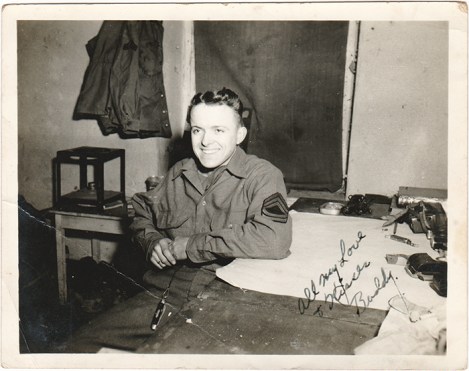
While I am grateful to all veterans, my favorite, of course, was my father. Between the day he answered the call to serve his country in the spring of 1942 and V.E. Day, Leon D. Aldridge attained the rank of Master Sargent serving with the U.S. Army 276th Engineer Combat Battalion. He returned home to Pittsburg, Texas, wearing battle ribbons for participation in three campaigns: Ardennes, Rhineland and the Central Europe Campaign.

Leon Aldridge Sr 1945-100
All photos on this page were mailed home to my mother from my father. She compiled them in an album of his Army years: Immediately above: Aldridge, Leon D. T/Sgt. — Germany 1945 — with a note scribbled to my mother. Photo at the top of the page: In my father’s handwriting on the back: “Ludendorf Bridge before its collapse. On west bank looking east. Bailey bridge in foreground built by us. Sign on bridge says, ‘This bridge built by 276th Engr. Combat Bn.’ Of course – that has reference to the Bailey!” Below: The joys of Army bivouacs.

Every veteran has stories to tell, but like most, dad talked little about his with one exception. That was in 1984 in Cologne, Germany during a trip to the Netherlands, Germany and France, the areas where he spent his service years in World War II. As we walked around the perimeter of the majestic Cologne cathedral on the banks of the Rhine River, he began to tell stories that day I had never heard. I was 36 and he was 61.

He talked in detail, often with tears in his eyes, about a night of gunfire huddled close the base of the cathedral. “See that spot,” he said pointing to a sheltered area created by two of the many huge buttresses supporting the 750-year old structure. “I spent a night there with a half dozen guys. We were engaged in gun battles with the Germans, separated from the rest of our detail while attempting to occupy the village. “

“We returned fire until it was secured at daybreak,” he said recalling obviously painful memories stirred by standing on the same ground 40 years later. “I wasn’t sure I was going to make it out that night…and I sure never expected to be here again.”

When we reached the side of the cathedral facing the Rhine, he pointed south and said, “Remagen. That’s where I was standing on the abutment when the bridge fell.”

The 276th Combat Engineers were also at the Ludendorf Bridge at Remagen, Germany, March 17, 1945 when the bomb damaged structure collapsed and fell into the Rhine River. “We returned the damaged bridge to operational status under gunfire,” he said. “We  had the Germans on the run, and they tried to blow up the bridge to stop our advancement.”

“We were still working on the bridge on the day it fell,” he continued. “Steel trusses began to groan, rivets started ‘popping like gunfire,’ and the bridge collapsed into the Rhine. Some scrambled for safety,” he said, “but many were not so fortunate. I had been on the bridge earlier that morning. Part of us fell back for materials and supplies. We were back at the abutment, waiting for the unit ahead of us to advance. Just as we started onto the bridge, it fell into the river. Five more minutes and I would have gone into the river with it and the others who were lost that day.”

Once my father began to talk, he shared many experiences. Like a story about sweeping fields near a combat zone when he stepped on a land mine. “I knew what it was when put my foot on it,” he said. “But at that moment, it was too late. I honestly thought I had taken my last breath. I fell and rolled, hoping for the best but fearing the worst. Only by the grace of God,” he said, “the land mine failed to detonate, and I lived to tell the story.”

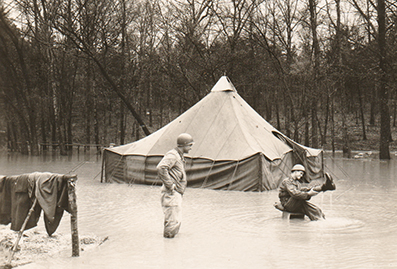
His stories included details about artillery lighting the night sky like daylight, bright enough “to read a newspaper,” as he put it. His memories of the weather were many, things like freezing weather in which they used newspaper to line boots and clothing, hoping to avoid frostbite, or sleeping on cots in tents that were flooded with water.

Flooded campMy father died in 2007, and never talked as much again about his service years as he did on that trip. He was proud of his service and I was proud of him. His stories of duty and sacrifice as part of the nation’s military are but tiny, individual examples of why America has survived for 240 years as a free and proud nation.

As I wrote a few years ago in a similar Veterans Day column, I am glad I got the opportunity to thank him. And, I will end this one the same way saying that if he were here today, I would hug him and thank him again.

—Leon Aldridge, Jr.

Aldridge columns are also published in the Center, Texas, Light and Champion (http://www.lightandchampion.com) and the Mount Pleasant, Texas, Tribune newspapers (http://www.tribnow.com).

Laugh with those who see the humor in life

 “I don’t have any out-of-body experiences. I had indeed seen a bright, beautiful light once and had followed it, but it turned out to be a Kmart tire sale. – Lewis Grizzard

Laughter is still the best medicine. It’s essential to living, or at least to living a worthwhile life. I’ve long worried about people who find fault and criticism in life quicker than finding something to laugh about.

That’s likely why the work of columnist, author, philosopher and speaker Lewis Grizzard has remained one my favorites since attending a newspaper conference in Atlanta many years ago where he was the keynote speaker.

Without any particular specialty, Grizzard was noted for commenting on just about everything in life, exposing the humor in every topic. That included politics, culture, women, men, mothers, fathers, dogs, sex, honor, racism, the past, the present, the future, and the South—there were few topics Grizzard didn’t tackle.

A true Southerner he was, born at Fort Benning, Georgia on October 20, 1946 and claiming Moreland, Georgia as his hometown. An internet article last week, noting he would have been 71, recalled the unique, easy-going humor that made his columns a favorite in the Atlanta Constitution, and led to his publishing some 20 books (18 of them New York Times bestsellers) which put him in great demand for speaking engagements.

My library includes several of his works, including a few I can recall as favorites. “If Love Were Oil, I’d be About a Quart Low,” about his three marriages and three divorces; “Elvis is Dead and I Don’t Feel So Good Myself,” about a child of the 50s coping with life in the 80s; and “Shoot Low, Boys–They’re Riding’ Shetland Ponies: In Search of True Grit,” about Americans he considered to possess genuine true grit.

Grizzard died in 1994. Shortly afterward, I wrote a column expressing my disappointment in “Life” magazine when they failed to include Grizzard’s death in their yearly review recognizing significant individuals lost that year.

Perhaps it was because Grizzard did not achieve greatness through many years of writing. He was just 47 years of age, and had really just “come into his own.”

Perhaps it was because his writing was not eloquent or culturally philosophical. He wrote about things he loved from chicken-fried steaks to his beloved Georgia Bulldog’s football. He lauded American institutions from family to a solid work ethic and the importance of education. In his own skillful manner, he often wove many subjects together successfully reminding us of the simple humor in life, and often the importance of laughing at ourselves—something he did frequently.

Writing about “That There Education,” Grizzard said, “Mother began saving for my college education with the first paycheck she ever earned. She bought bonds. She put cash in shoe boxes and hid them in the back of the closet. Having enough money to send me to college when the time came consumed my mother. Besides the bonds and the shoe-box cash, she kept a coin bank, bought day-old bread, sat in the dark to save on the electric bill, never had her hair done, quit smoking, and never put more than a dollar in the collection plate at church. She used some simple logic for not tithing the Biblical tenth: ‘If the Lord wanted me to tithe that much, he wouldn’t have made college so expensive.”’

Perhaps it was because his writing often laughed at things some hold sacred. He rallied against political correctness, and was often described as “politically incorrect and proud of it.” Grizzard fought to preserve a sense of humor, maintaining that it was impossible to be politically correct and smile.

Grizzard never won a Pulitzer Prize. In fact, he poked fun at that institution, too: “They handed out the annual Pulitzer Prizes, journalism’s highest awards, the other day, and once again, I didn’t get one. It’s becoming an all too familiar occurrence. Each year, I call my friends over, we ice down the beer and await the word from the Pulitzer committee. Word never comes, but my friends drink all the beer I bought, anyway. How two people can drink that much beer is beyond me.”

Grizzard died of complications from heart surgery, something else at which he poked fun with his book entitled, “They Tore Out My Heart and Stomped That Sucker Flat.” Prior to his fourth heart procedure to repair a valve, he was told that his chances of survival for the risky surgery were less than 50-percent to which he replied, “I just have one question: When’s the next bus to Albuquerque?”

Humor was the common factor in everything Lewis Grizzard addressed, and he didn’t waste a single day—right to the end.

Some have considered Grizzard to be a contemporary, southern version of Will Rogers who said, We are all here for a spell, get all the good laughs you can.” Lewis Grizzard made that easy to do.

—Leon Aldridge

Aldridge columns are also published in the Center, Texas, Light and Champion (http://www.lightandchampion.com) and the Mount Pleasant, Texas, Tribune newspapers (http://www.tribnow.com).